Agentic AI 2026: From Assistants to Autonomy
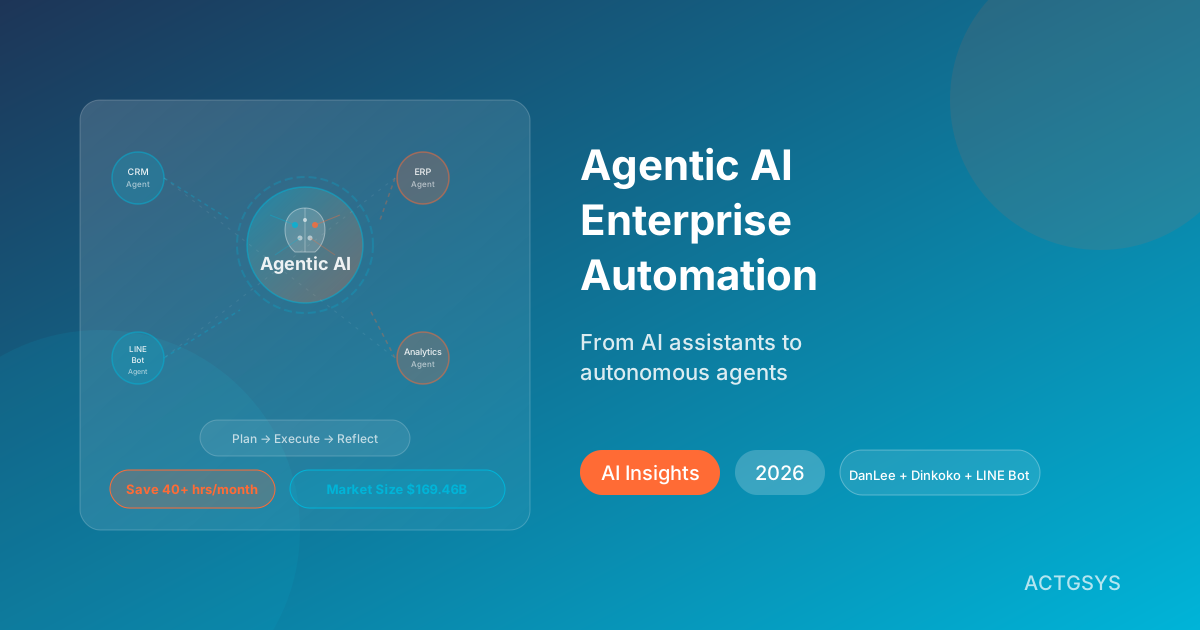
Agentic AI 2026: The Complete Guide to Enterprise Automation From Assistants to Autonomous Agents
In 2026, AI is undergoing a fundamental paradigm shift. Previous-generation AI assistants waited for your instructions before taking action. The new breed of Agentic AI can set its own goals, decompose tasks, invoke tools, and autonomously adjust strategies when obstacles arise. This is not just a technological upgrade — it is a complete rewrite of enterprise automation logic. According to MarketsandMarkets (2025), the global AI automation market is projected to reach $169.46 billion in 2026, growing at a 31.4% CAGR. For SMEs, understanding and leveraging Agentic AI is no longer a question of "whether" but "how fast."
What Is Agentic AI and How Does It Differ From Traditional AI Assistants?
Agentic AI is a class of AI systems that autonomously perceive their environment, formulate plans, execute multi-step tasks, and continuously adjust based on feedback. The fundamental difference from traditional AI assistants is that it does not require step-by-step human instructions — it receives a high-level goal and completes the entire workflow independently.
Traditional AI assistants (early chatbots, Copilot-style tools) operate in a "one question, one answer" pattern — you ask a question, it provides an answer; you specify an action, it executes that single action. Think of it as having a brilliant intern who still needs hand-holding for every task.
Agentic AI, by contrast, behaves like a seasoned employee. You say "schedule all customer follow-ups for this quarter," and it automatically pulls customer data from the CRM, analyzes last interaction dates, evaluates priority scores, drafts a follow-up schedule, and proactively flags high-churn-risk accounts for special attention. Throughout this process, it autonomously selects tools, determines execution order, and handles exceptions.
The Four Core Capabilities of Agentic AI
- Autonomous Planning: After receiving a goal, the agent decomposes it into subtasks and creates an execution plan
- Tool Use: Autonomously selects and invokes APIs, databases, and external services as needed
- Memory & Context: Retains past interactions and decisions, maintaining consistency across long-running tasks
- Reflection & Correction: Monitors outcomes during execution and self-adjusts strategy when deviations are detected
How Strong Are the 2026 Market Trends for Agentic AI?
2026 marks the inflection point where Agentic AI transitions from proof-of-concept to large-scale commercial deployment. According to multiple authoritative studies, market momentum has reached critical mass, and enterprises that fail to adopt risk structural disadvantage.
Here are the key statistics that cannot be ignored:
- Global AI automation market size: $169.46 billion, with a 31.4% CAGR (According to MarketsandMarkets, 2025)
- 40% of enterprise applications will embed AI agents by end of 2026 (According to Gartner, 2024)
- 51% of enterprises have already deployed AI agents, with another 82% planning adoption within 1-3 years (According to Capgemini, 2025)
- AI in ERP market growing from $5.8 billion in 2025 to $58 billion by 2035, a CAGR exceeding 25% (According to Precedence Research, 2025)
- Teams save an average of 40+ hours per month on repetitive work after deploying AI agents (According to McKinsey, 2025)
Microsoft Dynamics 365 2026 Wave 1: Agentic AI Goes Mainstream
One of the most significant industry signals in 2026 is Microsoft Dynamics 365 2026 Release Wave 1 fully integrating Agentic AI. Microsoft has embedded autonomous agents across sales, customer service, finance, and supply chain modules — transforming ERP/CRM systems from passive record-keeping tools into proactive intelligent partners.
The implication for SMEs is profound: when the world's largest enterprise software provider makes Agentic AI a core feature, it confirms the technology has passed market validation and is no longer experimental.
What Are the Specific Differences Between Agentic AI and Traditional AI Assistants?
To clearly understand the distinctions, here is a systematic comparison:
| Dimension | Traditional AI Assistant (Copilot) | Agentic AI (Autonomous Agent) |
|---|---|---|
| Interaction Mode | Passive response, Q&A-based | Proactive execution, goal-driven |
| Task Scope | Single-step tasks | Multi-step complex workflows |
| Tool Usage | Requires human specification | Autonomous selection and invocation |
| Decision-Making | Advisory, human decides | Autonomous within authorized bounds |
| Error Handling | Reports error, waits for instructions | Self-diagnoses, attempts alternatives |
| Memory | Single conversation | Cross-task long-term memory |
| Collaboration | One-to-one human-AI | Multi-agent orchestration, human oversight |
| Best For | Information queries, content generation | End-to-end process automation |
The critical distinction is the degree of autonomy. Traditional AI assistants are tools. Agentic AI is a teammate.
How Can SMEs Adopt Agentic AI? What Are the Real Use Cases?
Adopting Agentic AI does not require a million-dollar budget or a dedicated AI team. SMEs can start with their most painful business bottlenecks and achieve results quickly through modular SaaS tools. Here are four use cases with the highest ROI:
Use Case 1: Intelligent Customer Service Automation (LINE Bot Smart CS)
Traditional chatbots can only answer pre-configured questions. LINE Bot Smart CS powered by Agentic AI can:
- Understand complex customer inquiries and autonomously determine the handling workflow
- Automatically query order status, inventory levels, and return policies
- When encountering unresolvable issues, transfer to human agents with full conversation context
- After conversations end, automatically update CRM records and customer tags
A Taiwanese e-commerce company saw customer response time drop from an average of 4 hours to 3 minutes after deployment, with a 55% reduction in support labor costs.
Use Case 2: Intelligent Order Processing (LINE Bot Smart Order)
LINE Bot Smart Order combined with Agentic AI upgrades order processing from "manual entry line by line" to "place orders through conversation":
- Customers place orders directly via LINE using natural language
- The agent automatically matches products, verifies inventory, and calculates discounts
- Anomalous orders are auto-flagged and sales staff notified
- Order data automatically syncs to Dinkoko ERP
Use Case 3: CRM Intelligent Sales Agent (DanLee CRM)
The AI Agent within DanLee CRM proactively assists sales teams:
- Daily automatic scan of customer interaction records, generating a "today's priority follow-up" list
- Automatically adjusts lead scoring based on customer behavior
- Auto-drafts follow-up emails and LINE messages
- Detects churn risk and automatically triggers retention workflows
Use Case 4: ERP Intelligent Operations Agent (Dinkoko ERP)
Dinkoko ERP's Agentic AI module covers core processes including procurement, inventory, and finance:
- Continuously monitors inventory levels and proactively generates purchase recommendations when stock falls below safety thresholds
- Sends automatic reminders before accounts payable due dates and prioritizes payment scheduling
- During month-end closing, automatically reconciles data and flags anomalous entries for review
- Generates revenue forecasts based on historical data and market trends
What Risks Should Enterprises Watch When Adopting Agentic AI?
The powerful autonomy of Agentic AI introduces new governance challenges. Enterprises must establish a governance framework in parallel with deployment to ensure AI agents operate within safe, controllable boundaries.
Three Key Risks and Countermeasures
Risk 1: Excessive Autonomy Leading to Decision Loss-of-Control
Countermeasure: Set explicit "authorization boundaries." For example, an AI Agent may autonomously handle procurement decisions below $1,500, but amounts above this threshold require human approval. ACTGSYS solutions include built-in multi-tier permission controls, ensuring each agent's scope of autonomy can be precisely configured.
Risk 2: Data Quality Impacting Agent Judgment
Countermeasure: Conduct a data health check before deploying agents. Ensure CRM customer data and ERP inventory records are complete and accurate. Dinkoko ERP provides automated data cleansing tools to help enterprises establish a solid data foundation before go-live.
Risk 3: Employee Resistance and Role Transformation
Countermeasure: Position Agentic AI as a "digital teammate" rather than a "replacement." Emphasize that AI handles repetitive low-value work while employees focus on high-value tasks requiring creativity and judgment. In practice, teams deploying AI agents typically shift from "worried about being replaced" to "can't work without it" within 3 months.
FAQ
Q1: What is the difference between Agentic AI and RPA (Robotic Process Automation)?
RPA executes predefined processes according to fixed rules — like a precise but inflexible machine. Agentic AI possesses the ability to understand context, make autonomous judgments, and dynamically adjust. When exceptions occur in a workflow, RPA stops and waits for human intervention, while Agentic AI attempts to resolve the issue independently. The two are not mutually exclusive — the best practice is to let Agentic AI handle high-level decision-making and exception handling while RPA manages the underlying fixed processes.
Q2: What is the approximate budget for an SME to adopt Agentic AI?
Using ACTGSYS solutions as an example, SMEs can start with subscription-based SaaS plans at $250-$1,000 per month for foundational AI Agent capabilities. Given that agents help teams save 40+ hours monthly on repetitive tasks (at an average hourly cost of $8-$15, that translates to $320-$600+ in monthly labor savings), ROI typically turns positive within 2-4 months.
Q3: Is Agentic AI still effective if my business has limited data?
Agentic AI's value does not depend entirely on data volume. Even a 5-person team with basic CRM customer records and ERP transaction history can begin automating repetitive administrative tasks. As usage grows, the agent learns from interactions and continuously improves its effectiveness.
Q4: Will adopting Agentic AI lead to layoffs on my team?
According to McKinsey (2025), 85% of enterprises deploying AI agents redistribute excess capacity rather than reducing headcount. AI handles low-value repetitive work, freeing employees to focus on customer relationship building, creative planning, and strategic analysis. Most companies actually increase hiring post-deployment as capacity expands.
Q5: How do I assess whether my business is ready for Agentic AI?
Three simple criteria: (1) Does your team spend more than 30% of its time on repetitive administrative tasks? (2) Do you have digital systems (CRM or ERP) with accumulated business data? (3) Is there at least one clear operational pain point (e.g., slow customer service response, low order processing efficiency, chaotic inventory management)? If you meet two or more of these three criteria, you are ready to begin adoption.
Conclusion: From Assistant to Teammate — The Next Chapter of AI Automation
In 2026, enterprise competitiveness will be determined by whether you can make AI not just a tool, but a member of your team. Agentic AI gives SMEs, for the first time, the ability to access "intelligent workforce" capabilities that were previously affordable only by large enterprises — all within a reasonable budget.
You do not need to wait for the perfect moment. Choose the business scenario with the clearest pain point, deploy one AI Agent, and let it prove its value within 30 days — that is the best way to start.
Ready to welcome your first AI teammate? Contact us and the ACTGSYS team will help you evaluate the optimal Agentic AI adoption plan for your business.
Products & Solutions in This Article
AI-powered CRM for lead management, customer tracking, and sales pipeline optimization designed for SMEs.
AI-driven ERP focusing on procurement, inventory, and supply chain management. Each customer deployed on dedicated cloud infrastructure.
Intuitive accounting system designed for Taiwan SMEs, with automated bookkeeping and financial reporting.
Related Articles
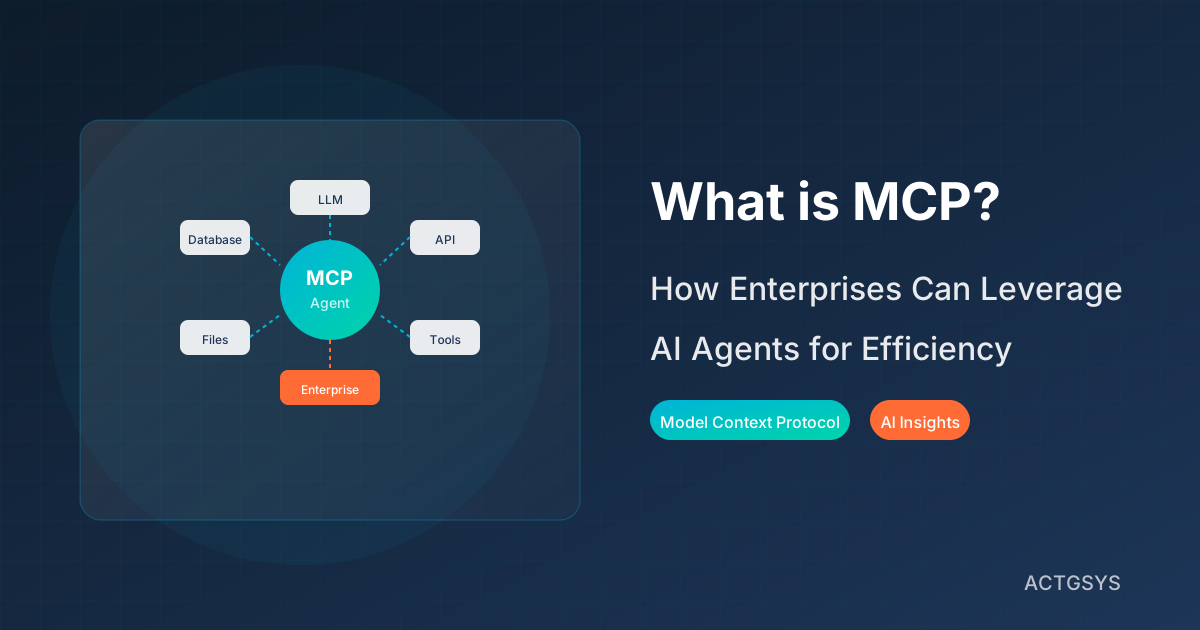
What Is MCP? Enterprise AI Agents Explained
An in-depth explanation of Model Context Protocol (MCP), and how enterprises can implement AI Agent architectures for cross-system integration, automated workflows, and intelligent decision support.
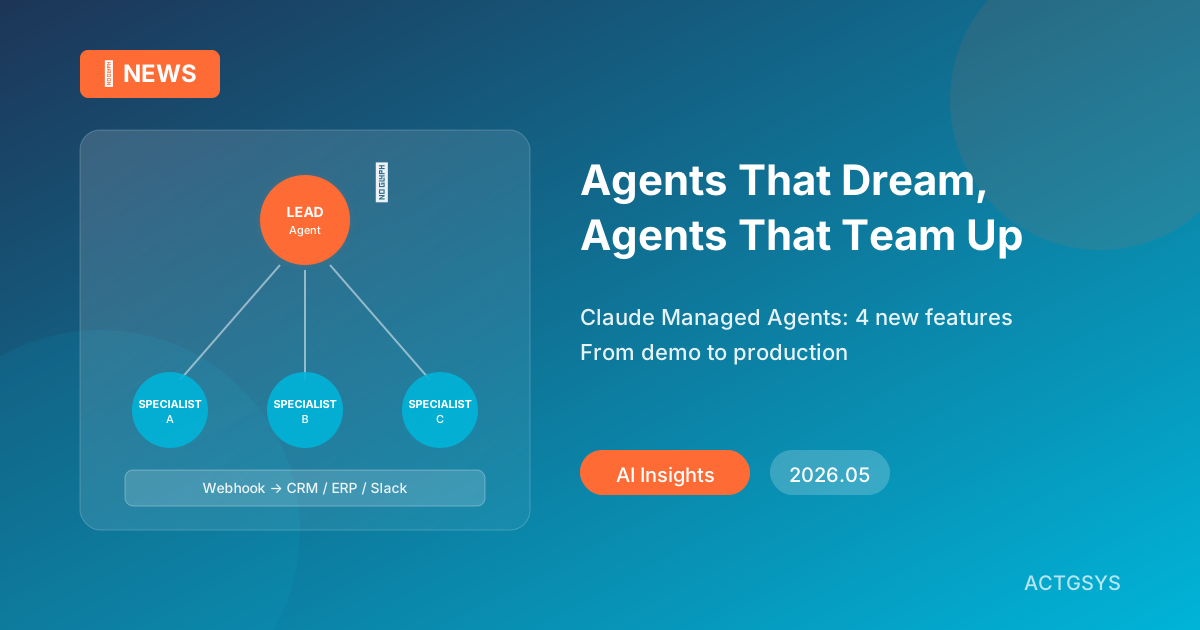
Claude Managed Agents Adds Dreaming and Multiagent Orchestration (2026): What Self-Improving AI Agents Mean for SMEs
On May 7, 2026 at Code with Claude 2026, Anthropic added four new capabilities to Claude Managed Agents — Dreaming, Outcomes, multiagent orchestration, and webhooks. We unpack how these changes shift AI agents toward production-readiness, and what Taiwan SMEs should watch.
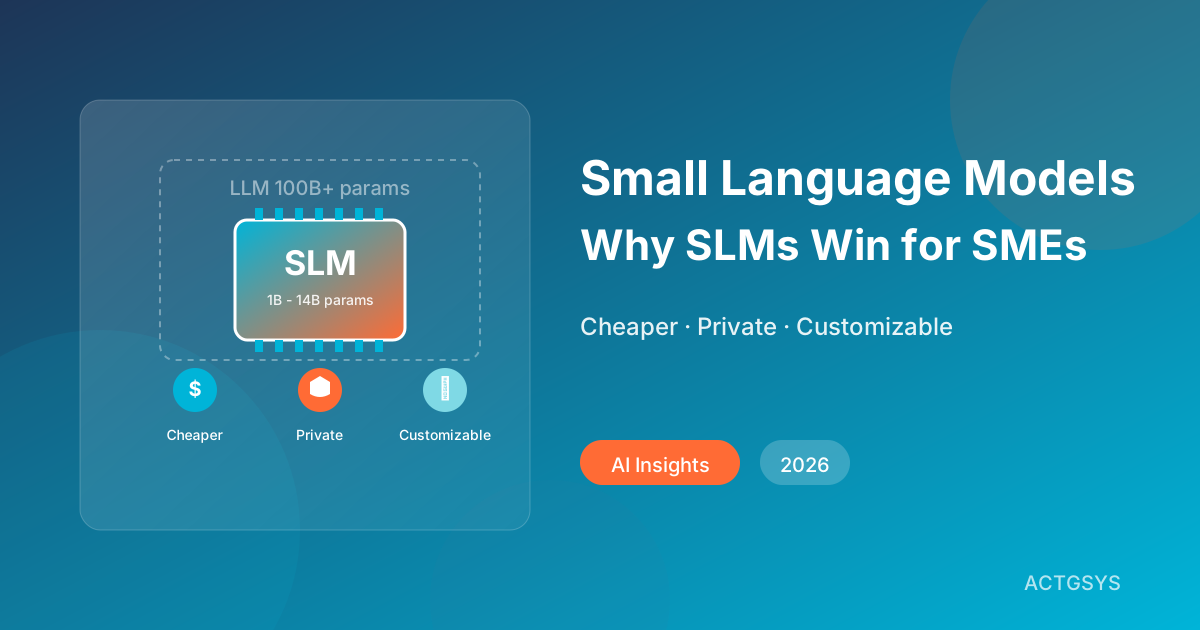
Small Language Models (SLM) for SMEs (2026)
Phi-4, Llama 3.2 and Apple Intelligence are pushing SLMs into the mainstream. This guide unpacks why small language models beat LLMs on cost, privacy and customization for SMEs.
What would this cost you?
Answer five questions. Within three working days you get a price range and what it covers. No deck, no follow-up sales calls.
Prefer to talk?LINE·02-2553-8084