The Agentic Operating Model: Scaling AI Agents 2026
Across industries, a familiar pattern played out in 2025: enterprises launched ambitious AI agent pilots, celebrated promising early results, and then watched progress stall. According to McKinsey research, roughly 77% of enterprises that began AI agent experiments remain stuck at the pilot stage, unable to move to full-scale production. The technology was never the bottleneck — the operating model was.
In 2026, the conversation has shifted from "Can AI agents work?" to "How do we organize around AI agents at scale?" UiPath's 2026 AI & Agentic Automation Trends Report introduced the concept of the Agentic Operating Model, a structural framework designed to solve the twin problems of agent sprawl and unclear ROI that plagued first-generation deployments. This article breaks down what the Agentic Operating Model is, why it matters, and how your enterprise can adopt it.
What Is the Agentic Operating Model?
The Agentic Operating Model is an organizational framework that governs how enterprises design, deploy, monitor, and scale AI agents across business functions. Unlike traditional automation governance — which treated bots as isolated scripts managed by IT — the Agentic Operating Model treats AI agents as semi-autonomous team members that require coordination, accountability structures, and performance management at the organizational level.
At its core, the model addresses three realities that emerged in 2025:
-
AI agents are proliferating faster than governance can keep up. Gartner reported a staggering 1,445% surge in enterprise inquiries about multi-agent systems from Q1 2024 to Q2 2025. With 80% of enterprise applications expected to embed agentic capabilities by the end of 2026, organizations need a systemic approach — not ad hoc project management.
-
Agents are not bots. Robotic Process Automation (RPA) bots followed deterministic scripts. AI agents make probabilistic decisions, collaborate with other agents, and adapt their behavior. Managing them with RPA-era playbooks is like managing a team of analysts with a factory floor checklist.
-
Decision velocity is the new competitive advantage. The enterprises pulling ahead are those whose agents can make and execute decisions faster — not just automate existing workflows, but compress decision cycles that previously took days into minutes. The Agentic Operating Model creates the structural conditions for this velocity.
Why Traditional Management Fails for AI Agents
Companies that attempted to scale AI agents in 2025 typically applied one of two legacy approaches: the IT project model (treating each agent as a software deployment) or the RPA Center of Excellence model (managing agents through a centralized bot governance team). Both fell short.
The IT Project Model Problem
Under this model, each AI agent is scoped, funded, and managed as an individual IT project. This creates several issues at scale:
- No cross-agent coordination. When your sales agent and your support agent both interact with the same customer record, who arbitrates conflicts? The IT project model has no answer because each agent lives in its own project silo.
- Budget fragmentation. Every department funds its own agents, leading to duplicated capabilities and inconsistent tooling. One division might deploy an agent on one platform while another uses something entirely different — both solving similar problems.
- Slow iteration. IT project cycles (requirements, approval, development, QA, deployment) can take months. Agents that need to adapt weekly to changing business conditions wither under this cadence.
The RPA CoE Model Problem
The RPA Center of Excellence worked for deterministic bots because their behavior was fully predictable. You could document every decision path in a flowchart. AI agents break this model:
- Non-deterministic behavior. An AI agent might handle the same input differently depending on context, training data updates, or multi-step reasoning. Traditional CoE documentation cannot capture this variability.
- Agent-to-agent collaboration. Multi-agent systems — where a planning agent delegates subtasks to specialized execution agents — have no equivalent in the RPA world. CoE governance was built for single bots, not agent teams.
- Continuous learning. Agents improve over time through feedback loops. A CoE model that requires re-certification for every behavioral change creates an impossible bottleneck.
The result of applying these legacy models was what analysts began calling agent sprawl: dozens of disconnected AI agents across the enterprise, each with different governance standards, monitoring gaps, and unclear ownership. The Agentic Operating Model was designed specifically to solve this.
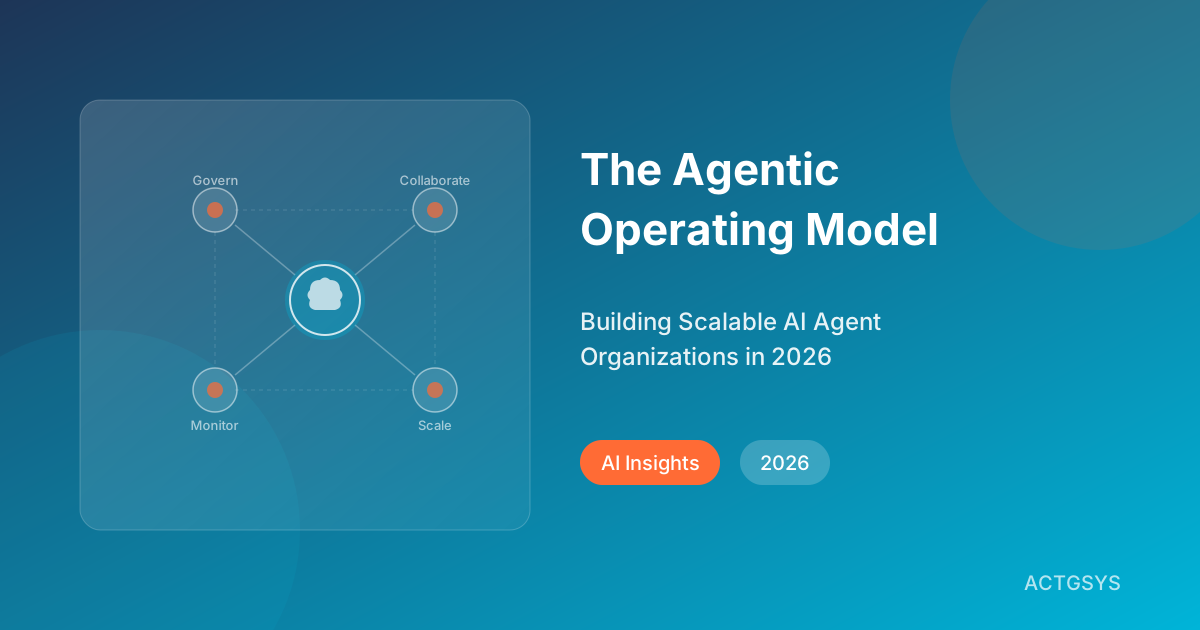
The Four Pillars: Governance, Collaboration, Monitoring, and Scaling
The Agentic Operating Model rests on four interconnected pillars. Each pillar addresses a specific failure mode observed in 2025 deployments.
| Pillar | Purpose | Key Components | Legacy Equivalent (and Why It Fails) |
|---|---|---|---|
| Governance | Establish trust and accountability for agent decisions | Agent decision authority matrix, escalation protocols, audit trails, bias monitoring | Compliance checklists (too static for probabilistic agents) |
| Collaboration | Enable agents and humans to work as integrated teams | Human-in-the-loop workflows, agent-to-agent protocols, shared context management | Ticket-based handoffs (too slow for real-time agent decisions) |
| Monitoring | Provide real-time visibility into agent performance and behavior | Decision quality scoring, drift detection, outcome tracking, cost-per-decision metrics | Uptime dashboards (miss behavioral and quality dimensions) |
| Scaling | Move agents from pilot to production systematically | Agent lifecycle management, reusable agent templates, infrastructure auto-scaling | Manual deployment pipelines (cannot handle agent volume) |
Governance: From Compliance Overhead to Trust Enabler
The most significant mindset shift in the Agentic Operating Model is how it reframes governance. In legacy models, governance was synonymous with compliance overhead — paperwork, approvals, and restrictions that slowed delivery. In the Agentic Operating Model, governance becomes the enabler of trust that actually accelerates deployment.
Here is how: when an enterprise has a clear decision authority matrix — specifying which decisions agents can make autonomously, which require human approval, and which are off-limits — teams gain confidence to deploy agents more aggressively. Paradoxically, more governance structure leads to faster scaling because it removes ambiguity and reduces the political friction that stalls rollouts.
A practical governance framework includes:
- Tier 1 decisions (fully autonomous): routine, low-risk, high-volume — e.g., categorizing support tickets, generating meeting summaries, updating CRM records.
- Tier 2 decisions (human-supervised): moderate risk, require judgment — e.g., recommending pricing changes, drafting customer proposals, flagging potential churn.
- Tier 3 decisions (human-only with agent support): high-stakes, consequential — e.g., contract approvals, strategic account decisions, regulatory filings.
Platforms like DanLee CRM are built with this tiered decision framework in mind, enabling AI agents to automate Tier 1 customer relationship tasks — such as lead scoring, follow-up scheduling, and interaction logging — while surfacing Tier 2 recommendations to human sales teams for review.
Collaboration: Designing Human-Agent Teams
The Agentic Operating Model recognizes that the highest-performing configurations are not fully autonomous agents or fully manual processes, but hybrid teams where humans and agents each contribute their strengths.
Effective collaboration design requires answering three questions:
- Where does the agent hand off to a human? Define clear escalation triggers based on confidence scores, decision complexity, or customer sensitivity.
- Where does a human hand off to an agent? Identify repetitive decision points where human judgment adds no value and creates bottlenecks.
- How do agents collaborate with each other? In multi-agent architectures, define shared context protocols so agents do not duplicate work or contradict each other.
Monitoring: Beyond Uptime to Decision Quality
Traditional monitoring asks: "Is the system running?" The Agentic Operating Model asks: "Is the agent making good decisions?" This requires a fundamentally different monitoring stack:
- Decision quality scoring: Track the accuracy and business impact of agent decisions over time, not just whether the agent responded.
- Behavioral drift detection: Alert when an agent's decision patterns shift beyond expected boundaries — critical for agents that learn continuously.
- Cost-per-decision tracking: Understand the total cost (compute, API calls, human review time) of each agent decision to optimize ROI.
TanJee integrates these monitoring principles into its analytics layer, providing enterprises with dashboards that track not just system performance but decision outcomes across integrated workflows.
Scaling: The Agent Lifecycle
The scaling pillar provides a structured path from initial experiment to enterprise-wide deployment:
- Discovery: Identify high-value use cases with clear success criteria.
- Prototype: Build a minimal agent and validate with real data in a sandboxed environment.
- Controlled production: Deploy to a limited user group with full monitoring and human oversight.
- Scaled production: Expand to full user base, automate monitoring, establish feedback loops.
- Optimization: Continuously refine agent behavior based on outcome data, retire underperforming agents.
The Roadmap from Pilot to Scale
If your organization is currently stuck at the pilot stage — and statistically, there is a 77% chance you are — here is a phased roadmap for adopting the Agentic Operating Model.
Phase 1: Assessment (Weeks 1-4)
Audit your current agent landscape. Most enterprises are surprised to discover they have more agents running than they realized — shadow AI deployed by individual teams without central visibility. Document every agent, its purpose, its data sources, its decision authority, and its owner.
Deliverables:
- Complete agent inventory
- Decision authority assessment for each agent
- Gap analysis against the four pillars
Phase 2: Foundation (Weeks 5-12)
Establish the governance and collaboration frameworks. This is the organizational design work that most enterprises skip — and the reason most pilots fail to scale.
Deliverables:
- Decision authority matrix (Tier 1/2/3)
- Human-agent collaboration protocols
- Agent naming, versioning, and ownership standards
- Monitoring KPI framework
Phase 3: Controlled Expansion (Weeks 13-24)
Take your highest-value pilot agents and migrate them to the new operating model. This is where you prove the model works before asking the rest of the organization to adopt it.
Deliverables:
- 3-5 agents migrated to full production under the Agentic Operating Model
- Decision quality baselines established
- ROI calculations validated
Phase 4: Enterprise Scale (Weeks 25-52)
Roll out the operating model across all business functions. At this stage, the focus shifts from building the framework to optimizing it — reducing cost-per-decision, improving agent collaboration, and expanding the scope of Tier 1 autonomous decisions.
Deliverables:
- Enterprise-wide agent governance in place
- Automated monitoring and alerting
- Self-service agent deployment for business teams
- Quarterly agent performance reviews
Key Metrics and ROI Calculation
One of the most common reasons AI agent initiatives lose executive sponsorship is the inability to demonstrate ROI in business terms. The Agentic Operating Model introduces a standardized metrics framework:
Primary Metrics
- Decision velocity: How much faster are decisions made with agents versus without? Measure in hours or days saved per decision cycle.
- Decision quality: What is the accuracy rate of agent decisions compared to human baselines? Track error rates, customer satisfaction impacts, and downstream corrections.
- Cost-per-decision: Total cost of an agent decision including compute, API calls, data access, and human review time. This should decrease as agents scale.
- Agent utilization rate: Percentage of time agents are actively processing versus idle. Low utilization suggests over-provisioning or poor use case selection.
ROI Formula
Agent ROI = (Value of decisions automated + Value of decision speed improvement
             - Agent operating costs - Human oversight costs) / Total investment
A practical example: if an AI agent handles 500 customer inquiries per day that previously required 3 minutes of human time each, the direct labor savings are 25 hours per day. At an average fully-loaded cost of $35/hour, that is $875/day or roughly $227,500/year. Subtract agent infrastructure and monitoring costs of $60,000/year, and the net ROI is $167,500 — a 279% return on a $60,000 investment.
But the Agentic Operating Model pushes organizations to look beyond direct labor savings. Decision velocity improvements — faster quote turnaround, faster issue resolution, faster lead qualification — often deliver 2-3x the value of labor savings through increased revenue and improved customer retention.
The Future of the Agentic Enterprise in 2026
The trajectory is clear. By the end of 2026, the gap between enterprises that have adopted the Agentic Operating Model and those still managing agents ad hoc will be enormous. Several trends will accelerate this divergence:
Multi-agent orchestration becomes standard. Enterprises will move from deploying individual agents to deploying agent teams that collaborate on complex workflows — a research agent that gathers market intelligence hands off to an analysis agent that generates recommendations, which feeds into a CRM agent in DanLee that executes personalized outreach.
Agent marketplaces emerge. Just as enterprises adopted SaaS applications, they will begin adopting pre-built agents from marketplaces, plugging them into their Agentic Operating Model rather than building everything from scratch.
Regulation catches up. The EU AI Act and similar frameworks worldwide will require the kind of governance structures the Agentic Operating Model provides. Enterprises that adopt the model now will be compliance-ready when regulations take effect.
Decision intelligence becomes a C-suite priority. Chief AI Officers and Heads of Decision Intelligence will become standard roles, responsible for the performance of the enterprise's agent portfolio — much like a CIO is responsible for IT infrastructure today.
The enterprises that thrive will not be those with the most sophisticated AI models. They will be those with the most effective operating models for putting AI agents to work at scale.
Frequently Asked Questions
What is the difference between an Agentic Operating Model and a traditional AI Center of Excellence?
A traditional AI Center of Excellence focuses on building and deploying AI models as technology projects. The Agentic Operating Model is broader — it encompasses organizational design, decision authority frameworks, human-agent collaboration protocols, and continuous performance management. Think of it as the difference between managing a fleet of vehicles (CoE) and redesigning the entire transportation network (Agentic Operating Model).
How long does it take to implement an Agentic Operating Model?
Most enterprises can establish the foundational framework in 12-16 weeks, with full enterprise-wide adoption taking 9-12 months. The timeline depends heavily on organizational complexity, existing governance maturity, and the number of agents already deployed. The phased roadmap outlined above provides a realistic schedule for mid-sized enterprises.
Does the Agentic Operating Model require replacing our existing AI tools and platforms?
No. The Agentic Operating Model is platform-agnostic. It provides the organizational structure that sits above your technology stack. Whether your agents run on proprietary platforms or open-source frameworks, the governance, collaboration, monitoring, and scaling pillars apply equally. Solutions like DanLee CRM and TanJee are designed to integrate within this model, providing agent-ready capabilities that plug into your broader operating framework.
How do we calculate ROI for AI agents when benefits are indirect?
The Agentic Operating Model introduces the concept of "decision value" — measuring not just the direct cost savings of automation, but the business value of faster and better decisions. Track metrics like shortened sales cycles, reduced customer churn from faster response times, and increased win rates from better-informed proposals. These indirect benefits often represent 60-70% of total agent ROI.
What roles need to change when adopting the Agentic Operating Model?
Key role evolutions include: IT managers becoming Agent Operations Leads responsible for agent lifecycle management; business analysts becoming Decision Designers who define agent decision authority; and QA teams expanding into Agent Performance Analysts who monitor decision quality. The model does not eliminate roles — it transforms them to focus on higher-value oversight and optimization.
Ready to Build Your Agentic Operating Model?
The transition from pilot to scaled AI agent deployment does not happen by accident. It requires deliberate organizational design, the right governance frameworks, and technology platforms built for agentic workflows.
ACTGSYS helps enterprises design and implement Agentic Operating Models tailored to their industry, scale, and maturity level. From agent governance frameworks to production-ready deployments with DanLee CRM and TanJee, we provide the structure and expertise to move from experimentation to enterprise-wide impact.
Contact us today to start building your Agentic Operating Model →
Products & Solutions in This Article
AI-powered CRM for lead management, customer tracking, and sales pipeline optimization designed for SMEs.
Intuitive accounting system designed for Taiwan SMEs, with automated bookkeeping and financial reporting.
Related Articles
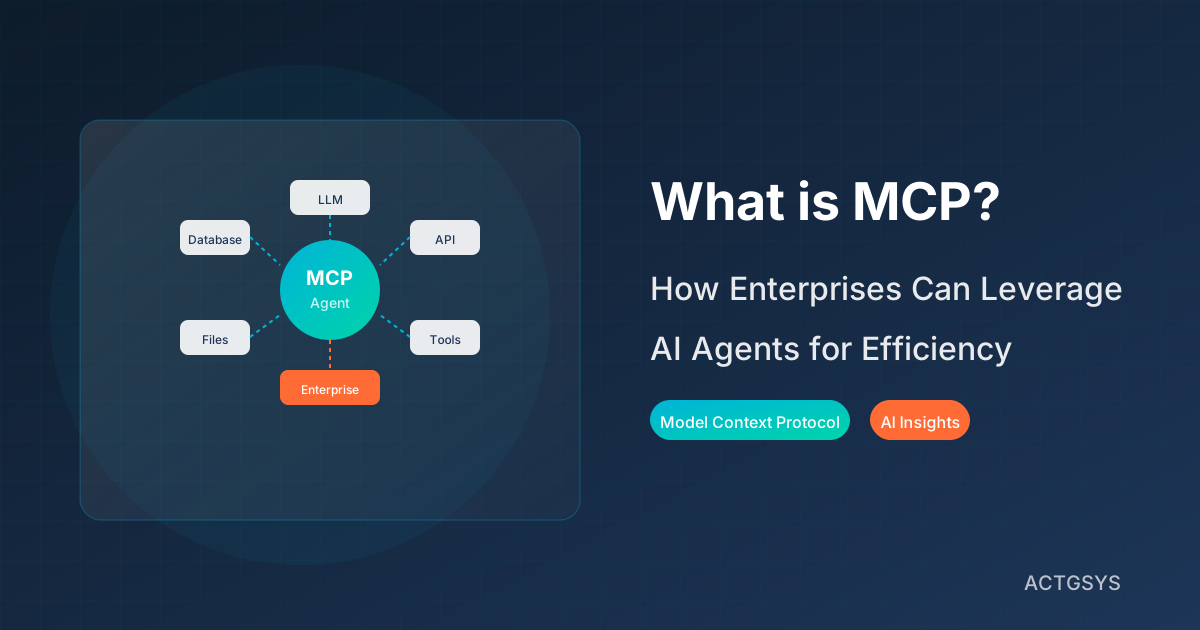
What Is MCP? Enterprise AI Agents Explained
An in-depth explanation of Model Context Protocol (MCP), and how enterprises can implement AI Agent architectures for cross-system integration, automated workflows, and intelligent decision support.
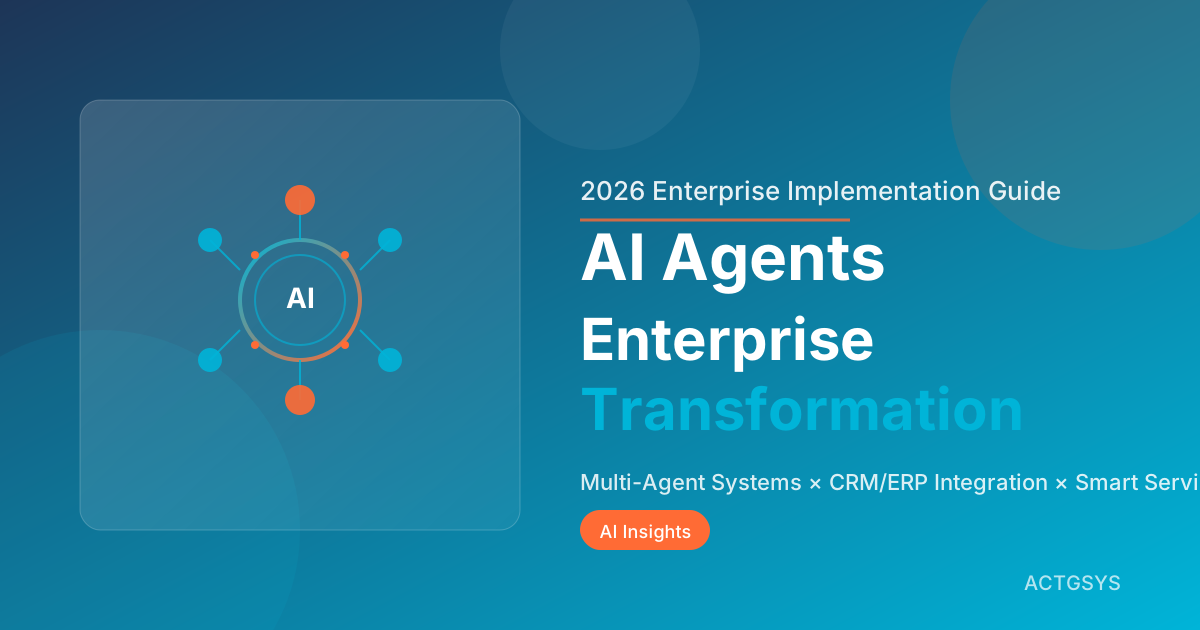
AI Agents Enterprise Transformation 2026
Deep dive into how AI Agents are reshaping enterprise operations in 2026, covering multi-agent systems, CRM/ERP integration, and customer service automation for SMEs.
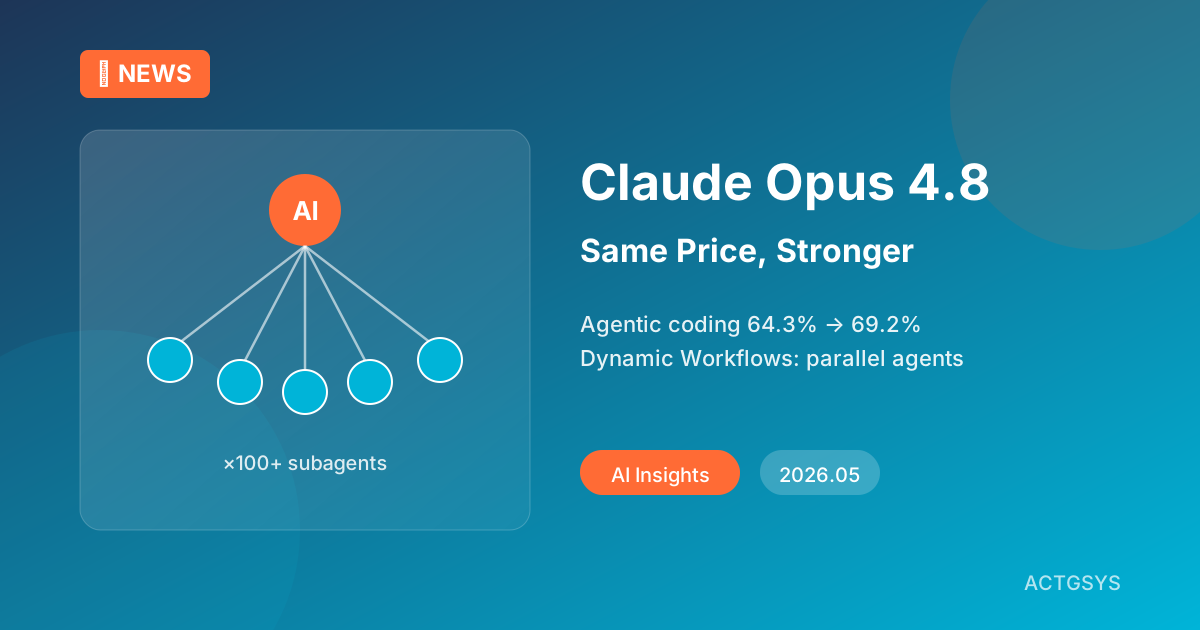
Anthropic Claude Opus 4.8 (2026): Same Price, Stronger
On May 28, 2026, Anthropic launched Claude Opus 4.8, holding the same $5 / $25 per 1M token pricing as its predecessor while lifting agentic coding from 64.3% to 69.2% and adding Dynamic Workflows — a research preview that orchestrates hundreds of parallel subagents. We unpack what this upgrade means for Taiwan SME automation.
What would this cost you?
Answer five questions. Within three working days you get a price range and what it covers. No deck, no follow-up sales calls.
Prefer to talk?LINE·02-2553-8084