AI Accounting Automation 2025: Save 80% of Time
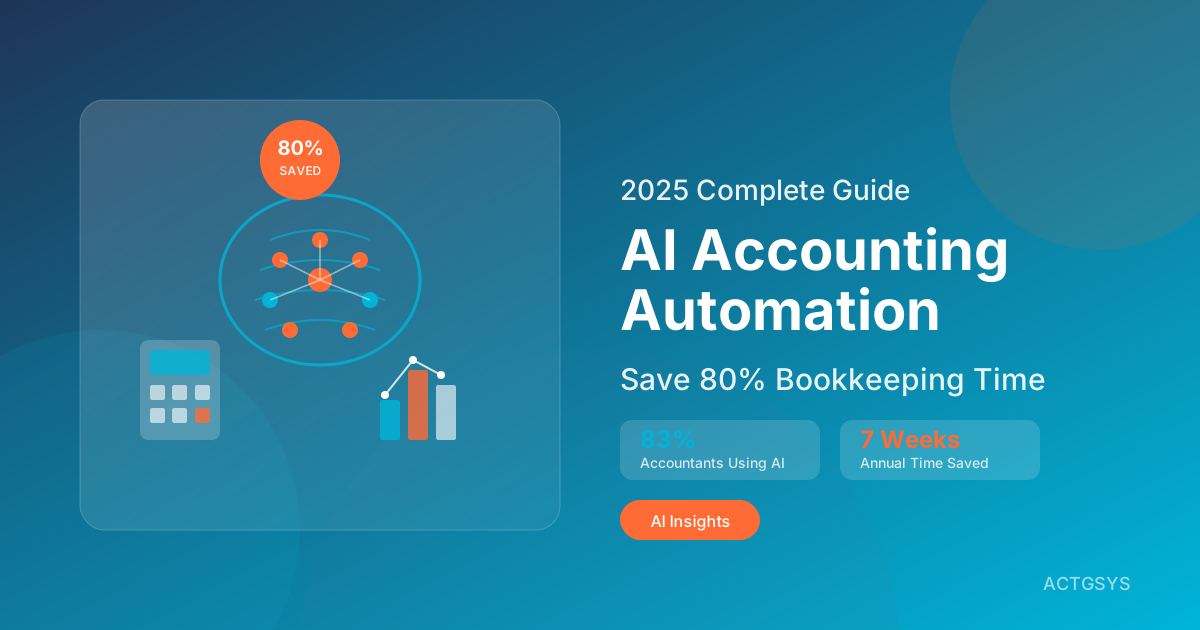
According to the 2025 AI Accounting Status Report, 83% of accounting professionals worldwide are already using AI tools, saving an average of 7 weeks per employee annually. This is no longer a future trend—it's an industry revolution happening right now. If you're still manually processing large volumes of bookkeeping work, this guide will show you how to dramatically improve financial operations efficiency through AI accounting automation.
Current State of AI Accounting Automation Market
Impressive Growth Statistics
AI applications in accounting are growing at 30% annually, expected to become standard in the accounting industry by 2027. Here are some key figures:
| Metric | Data |
|---|---|
| Percentage of accountants using AI | 83% |
| Annual time saved per person | 7 weeks |
| Reduction in manual entry errors | 30% |
| Weekly bookkeeping time saved for small businesses | 20 hours |
| Financial services efficiency improvement | 37% |
Major Investment Trends
The Big Four accounting firms are heavily investing in AI technology:
- PwC announced $1 billion investment in AI solutions
- Reuters allocated $8 billion for AI acquisitions and R&D
- Small and medium-sized accounting firms are also adopting AI tools to remain competitive
5 Major AI Accounting Automation Use Cases
1. Automated Data Entry and Classification
AI can automatically identify and extract information from invoices and receipts, including:
- Vendor name and tax ID
- Amounts and dates
- Automatic expense categorization
- Multi-currency auto-conversion
Benefits: Reduce manual data entry time by 80%, error rate down 30%
2. Smart Bank Reconciliation
Traditional reconciliation requires line-by-line comparison of bank statements with accounting records. AI can:
- Automatically match transaction records
- Identify anomalous transactions
- Predictive cash flow analysis
- Real-time alerts for outstanding items
Benefits: Month-end closing reduced from 3-5 days to within 1 day
3. Accounts Payable Automation
Complete process from invoice receipt to payment approval:
- OCR invoice scanning and data extraction
- Automatic three-way matching (PO, receiving, invoice)
- Intelligent approval workflow routing
- Payment schedule optimization
Benefits: Invoice processing cost reduced by 60-80%
4. Automated Financial Reporting
AI-driven reporting features:
- Real-time financial dashboards
- Automated monthly/quarterly/annual reports
- Anomaly data alerts
- Trend analysis and forecasting
Benefits: Report generation time reduced from days to hours
5. Tax Compliance and Filing
AI assists in ensuring tax compliance:
- Automatic calculation of various taxes
- Pre-filing data verification
- Tax optimization recommendations
- Regulatory change tracking
Benefits: Reduce tax error risks, maximize legitimate tax savings
Will AI Replace Accountants?
Short answer: No, at least not in the near term.
However, accountants must understand AI and automation technology to perform their jobs effectively. There's a saying in the industry:
"AI won't replace accountants, but accountants who use AI will replace those who don't."
How AI is Changing the Accountant's Role
| Traditional Role | AI-Era Role |
|---|---|
| Data entry | Strategic planning |
| Manual reconciliation | Anomaly analysis |
| Report creation | Business consulting |
| Compliance checking | Risk assessment |
| Repetitive calculations | Client relationship management |
AI allows accountants to focus on higher-value work: analysis, strategy, client relationships—not repetitive data processing.
How to Choose AI Accounting Tools
Evaluation Checklist
When selecting AI accounting software, consider these factors:
Functionality
- Invoice/receipt recognition accuracy
- Bank reconciliation automation level
- Report customization flexibility
- Multi-company/multi-currency support
Integration
- Integration with existing ERP/CRM systems
- Direct bank connectivity
- E-invoice integration
- API openness
Security & Compliance
- Data encryption and backup
- Compliance with local accounting regulations
- Audit trail completeness
- Access control mechanisms
Cost Considerations
- Licensing model (per user/per transaction)
- Implementation and training costs
- Maintenance and upgrade fees
- Expected ROI timeframe
Popular AI Accounting Tools Comparison
| Tool | Features | Target Users | Starting Price |
|---|---|---|---|
| Xero | AI bank reconciliation, JAX conversational assistant | Small businesses | $15/month |
| Truewind | Fully automated month-end, AI bookkeeper | Accounting firms | Contact |
| Docyt | End-to-end automation, AI assistant | SMEs | $299/month |
| Vic.ai | AP automation, machine learning | Mid-to-large enterprises | Contact |
| TanJee | Taiwan localized, Chinese interface | Taiwan SMEs | Contact |
Practical Implementation Steps for AI Accounting
Phase 1: Current State Assessment (1-2 weeks)
- Inventory existing accounting processes and pain points
- Calculate current operation time costs
- Evaluate existing system integration requirements
- Set clear benefit objectives
Phase 2: Solution Selection (2-4 weeks)
- Screen 2-3 candidate solutions based on needs
- Request trials and conduct actual testing
- Evaluate integration complexity and costs
- Confirm vendor support capabilities
Phase 3: Implementation & Go-Live (4-8 weeks)
- Data migration and system configuration
- Employee training and process adjustments
- Parallel operation to verify accuracy
- Official cutover and continuous optimization
Phase 4: Continuous Optimization (Ongoing)
- Monitor automation effectiveness metrics
- Collect user feedback
- Adjust AI rules and settings
- Expand application scope
Frequently Asked Questions (FAQ)
Q1: Is AI accounting software data secure?
Modern AI accounting software typically uses bank-level encryption and complies with international security standards (such as SOC 2, ISO 27001). When choosing, verify the vendor's security certifications and data storage location.
Q2: What budget is needed for AI accounting implementation?
Varies by business size. Small businesses can start with cloud solutions at $15-50/month; mid-sized businesses need about $300-1,000/month for full implementation; large enterprises require custom evaluation. Typically, investment can be recovered in 6-12 months.
Q3: Do existing accounting staff need retraining?
Yes, but the focus is "skill upgrading" rather than "starting from scratch." Accounting staff need to learn how to supervise AI, handle exceptions, and use AI output for analytical decision-making. Most tools provide complete online training resources.
Q4: Can AI accounting handle Taiwan-specific accounting needs?
Choosing localized solutions is important. Taiwan-specific needs include: unified invoice processing, business tax filing, labor and health insurance calculations, etc. Recommend choosing vendors with Taiwan market experience, such as ACTGSYS's TanJee accounting system.
Q5: Do small companies need AI accounting?
Precisely because resources are limited, small companies need AI even more to boost efficiency. Many cloud AI accounting tools offer free or low-cost plans, allowing small businesses to enjoy time savings from automation.
Conclusion: Now is the Best Time to Implement
AI accounting automation has shifted from "future trend" to "present reality." Early adopters are enjoying competitive advantages from efficiency improvements, while hesitant businesses face the risk of falling behind.
Regardless of your business size, now is the best time to evaluate AI accounting solutions. Start small with invoice automation, gradually expanding to complete financial automation, freeing your accounting team from tedious data processing to focus on strategic analysis work that truly creates value.
Want to learn more about AI accounting solutions designed for Taiwan SMEs?
ACTGSYS Blueprint Thinking provides the TanJee accounting system, designed specifically for the Taiwan market, combining AI automation with localized regulatory support to help your business achieve financial digital transformation.
Products & Solutions in This Article
Related Articles
How to Choose an Accounting System for SMEs
Complete analysis of accounting system selection for small and medium enterprises: from voucher management and financial statements to tax compliance, helping business owners choose the most suitable accounting software to improve financial management efficiency.
Complete SME AI Digital Transformation Guide
Learn how to implement AI solutions for your small and medium-sized enterprise. A comprehensive guide from strategic planning to practical deployment, helping business owners make smart technology investment decisions.
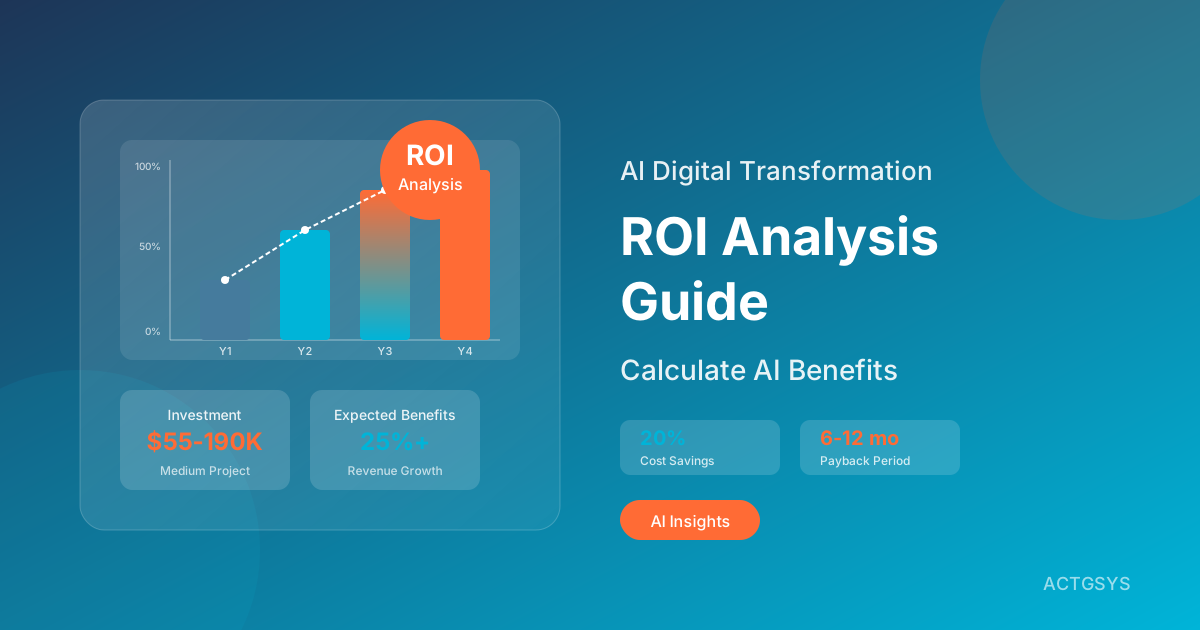
AI Digital Transformation ROI for SMEs (2025)
In-depth analysis of AI digital transformation's true costs and benefits, providing ROI calculation formulas and real cases. Learn how to avoid AI project failure, plan phased implementation strategies, ensuring maximum investment returns.
What would this cost you?
Answer five questions. Within three working days you get a price range and what it covers. No deck, no follow-up sales calls.
Prefer to talk?LINE·02-2553-8084