Scaling AI Agents: Why 77% Stall in Pilot (2026)
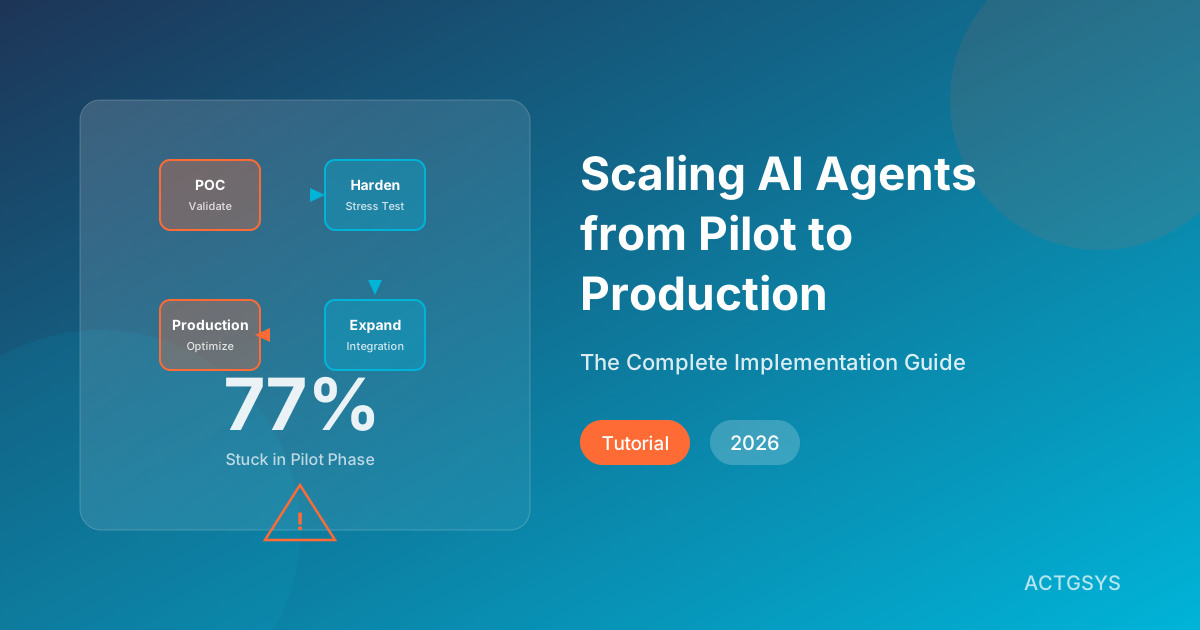
Has your company experienced this scenario: your AI Agent delivered impressive results during proof-of-concept (POC), but deployment to production became a nightmare? According to McKinsey's latest State of AI report, only 23% of enterprises have successfully scaled AI Agents to production in 2026, while 39% remain stuck in the experimentation phase. This guide breaks down the five root causes and provides a practical roadmap to overcome them.
Why Is Scaling AI Agents So Difficult? The Five Core Bottlenecks
When transitioning AI Agents from pilot to production, enterprises typically encounter these five critical bottlenecks:
1. Insufficient Data Quality and Integration
POC phases often use carefully curated datasets, but real operational environments contain messy data across CRM, ERP, and accounting systems with inconsistent formats and varying quality. When AI Agents face dirty data, accuracy can plummet from 95% to 60%.
2. Lack of Clear Governance and Accountability Framework
Pilot phases are usually driven by technical teams, but scaling requires cross-departmental collaboration. Who is responsible for AI decision quality? Who is accountable when errors occur? Without clear governance frameworks, AI Agents cannot gain organizational trust.
3. Legacy System Integration Technical Debt
Most SMEs have IT architectures built up over years, with ERP, CRM, and financial systems lacking standardized APIs. Getting AI Agents to operate seamlessly across these systems often costs more than anticipated.
4. ROI Verification Challenges
The success metrics of a POC (e.g., "response time improved by 50%") often differ from the financial metrics executives care about (e.g., "how much money saved per month"). Without a quantifiable ROI model, projects struggle to secure ongoing investment.
5. Organizational Change Resistance
Introducing AI Agents means redesigning workflows. Some employees may resist out of fear of being replaced. Companies that ignore change management often fail to scale even when the technology is ready.
The Four-Phase Path from POC to Production
Enterprises that successfully scale AI Agents typically follow these four phases:
| Phase | Objective | Timeline | Key Actions |
|---|---|---|---|
| Phase 1: Validate | Confirm AI can solve a specific problem | 1-2 months | Select a single high-value scenario, build POC |
| Phase 2: Harden | Handle edge cases and exceptions | 2-3 months | Integrate real data, establish monitoring |
| Phase 3: Expand | Scale from one department to many | 3-6 months | Build API integrations, define governance policies |
| Phase 4: Optimize | Continuous improvement and automation | Ongoing | Collect feedback, retrain models, expand scope |
Phase 1: Choosing the Right Scenario Is Half the Battle
Don't try to solve everything at once. Choose a high-frequency, high-repetition, high-impact scenario as your starting point. For example:
- Customer Service: Use AI Agents to automatically handle 80% of common inquiries (works with DanLee CRM)
- Inventory Management: Use AI Agents to generate restocking recommendations (works with Dinkoko ERP)
- Quotation Process: Use AI Agents to auto-generate customized quotes based on historical data
Phase 2: Stress Test with Real Data
After POC success, the most critical step is retesting with real-world "dirty data." This phase requires:
- Establishing data cleaning and standardization processes
- Designing fallback mechanisms for edge cases (e.g., human handoff when AI cannot handle a request)
- Building performance monitoring dashboards
Phase 3: Cross-System Integration Is the Biggest Challenge
This is where most enterprises get stuck. Recommended strategies include:
- Use middleware APIs rather than point-to-point integrations
- Prioritize integrating systems with the highest data volume
- Adopt incremental migration to avoid big-bang deployment risks
Phase 4: Build a Continuous Optimization Flywheel
Scaling is not the endpoint but the beginning of continuous optimization. Establish regular review cycles, track AI Agent performance metrics, and continuously adjust based on user feedback.
Three Accelerators for SME AI Agent Scaling
SMEs have unique advantages over large enterprises when it comes to AI scaling:
1. Shorter Decision Chains: No need for multiple layers of approval — when the owner signs off, things move fast.
2. Simpler System Architecture: Integrating two or three core systems is far less complex than managing dozens of enterprise applications.
3. Higher Team Agility: Employees adapt to new processes more easily, and organizational change resistance is relatively lower.
Leveraging these advantages with mature SaaS tools like DanLee CRM and Dinkoko ERP, SMEs can often achieve AI Agent scaling faster than large enterprises.
ROI Calculation Model for Successful Scaling
To convince decision-makers to continue investing, you need a clear ROI framework:
| Benefit Type | Formula | Example |
|---|---|---|
| Labor Savings | Monthly hours saved × hourly rate | 200 hrs × $25 = $5,000/mo |
| Error Reduction | Average error cost × error reduction rate | $5,000 × 60% = $3,000/mo |
| Revenue Increase | AI-driven conversion rate lift × average order value | 15% × $1,000 = varies by volume |
| Customer Satisfaction | Faster response → higher retention rate | Retention +10% → LTV increase |
Establish baseline measurements at the end of Phase 1 so you can clearly demonstrate progress through each subsequent phase.
FAQ
Q1: How much budget do SMEs need for AI Agent scaling?
It depends on the complexity of the use case. Using SaaS platforms with built-in AI capabilities (such as DanLee CRM's AI features), monthly costs can be kept to a few hundred dollars. Custom development typically requires an initial investment of $3,000-$15,000, but the ROI payback period is usually 3-6 months.
Q2: Is our data volume too small for effective AI Agents?
AI Agents don't always require massive datasets. Many scenarios (such as automated customer service responses and inventory alerts) rely on rule engines combined with LLM reasoning capabilities rather than large training datasets. Data quality matters more than quantity.
Q3: Our team has no AI technical background. How do we proceed?
This is precisely the advantage of No-Code/Low-Code platforms. Both DanLee CRM and Dinkoko ERP provide visual AI configuration interfaces that allow business users to set up AI Agent workflows without writing code.
Q4: What is the most common failure reason when moving from POC to full deployment?
The most common cause is "technical success but organizational lag." The AI Agent's performance meets targets, but employees refuse to change existing workflows, or cross-departmental data-sharing mechanisms haven't been established. We recommend running organizational change management in parallel with technical deployment.
Q5: How do I assess if our enterprise is ready for AI scaling?
Evaluate across three dimensions: (1) Data readiness — is your core business data digitized and accessible? (2) Organizational readiness — is there a clear AI owner and cross-departmental collaboration mechanism? (3) Technical readiness — do your core systems have API interfaces for integration?
Conclusion: Scaling Is a Marathon, Not a Sprint
Scaling AI Agents to production isn't something that happens overnight, but you don't need to wait until everything is perfect to start. The key is choosing the right starting point, establishing quantifiable success metrics, and expanding iteratively.
In 2026, AI Agent technology is mature enough. The real challenge is whether organizations can keep pace with the technology. If your enterprise is considering scaling AI Agents from pilot to production, contact our consulting team — we'll provide the most suitable scaling roadmap based on your industry characteristics and existing systems.
Products & Solutions in This Article
AI-powered CRM for lead management, customer tracking, and sales pipeline optimization designed for SMEs.
AI-driven ERP focusing on procurement, inventory, and supply chain management. Each customer deployed on dedicated cloud infrastructure.
Related Articles
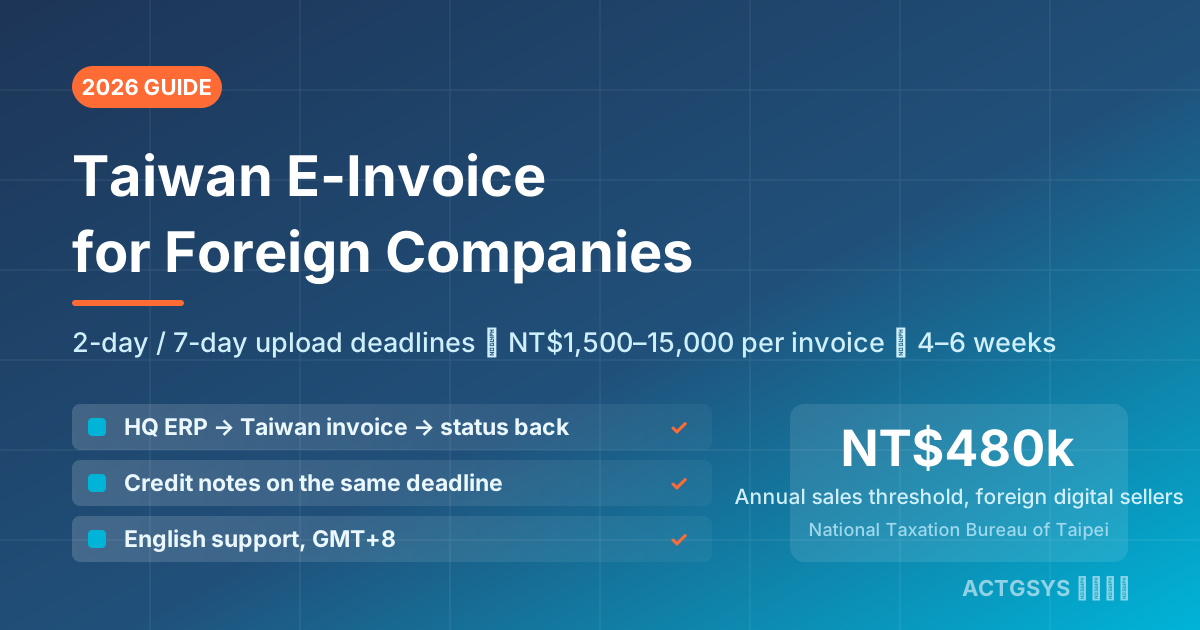
Taiwan E-Invoice for Foreign Companies 2026 - Cost
How a foreign-owned Taiwan subsidiary or branch connects its ERP to Taiwan's e-invoice platform: 2-day B2C / 7-day B2B upload deadlines, NT$1,500–15,000 per-invoice penalties, three integration paths, and a 4–6 week project from NT$50,000.
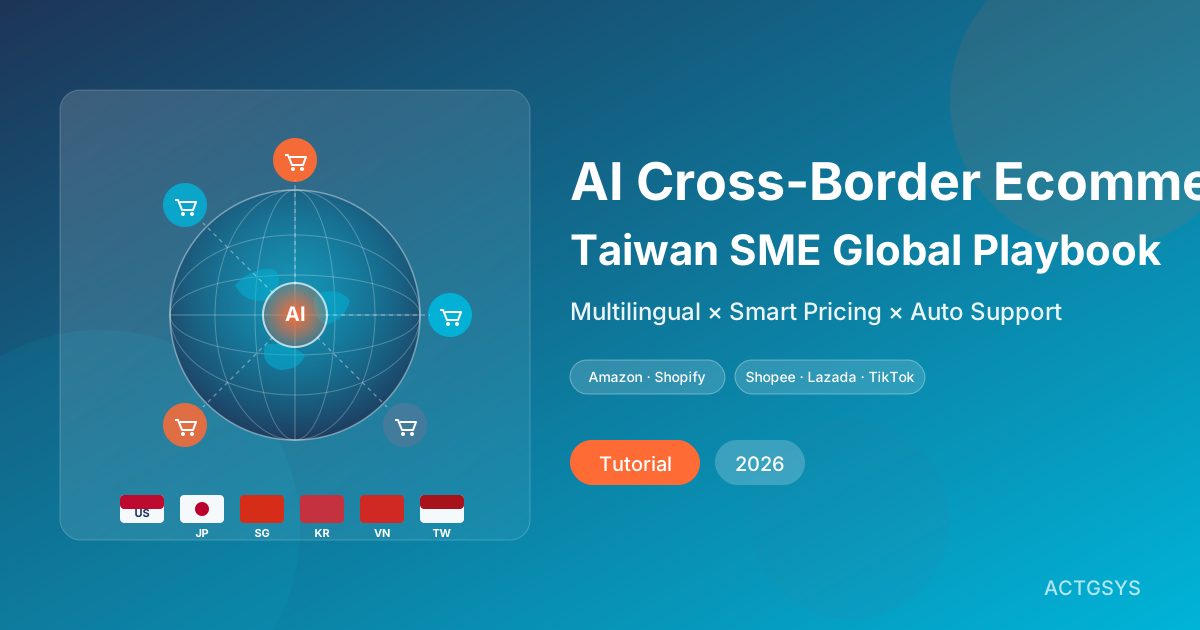
AI Cross-Border Ecommerce Playbook for SMEs (2026)
How Taiwan SMEs use AI to automate cross-border e-commerce — multilingual listings, smart customer service, dynamic pricing, ad ops, and logistics forecasting across Amazon, Shopify, Shopee, Lazada, and TikTok Shop.
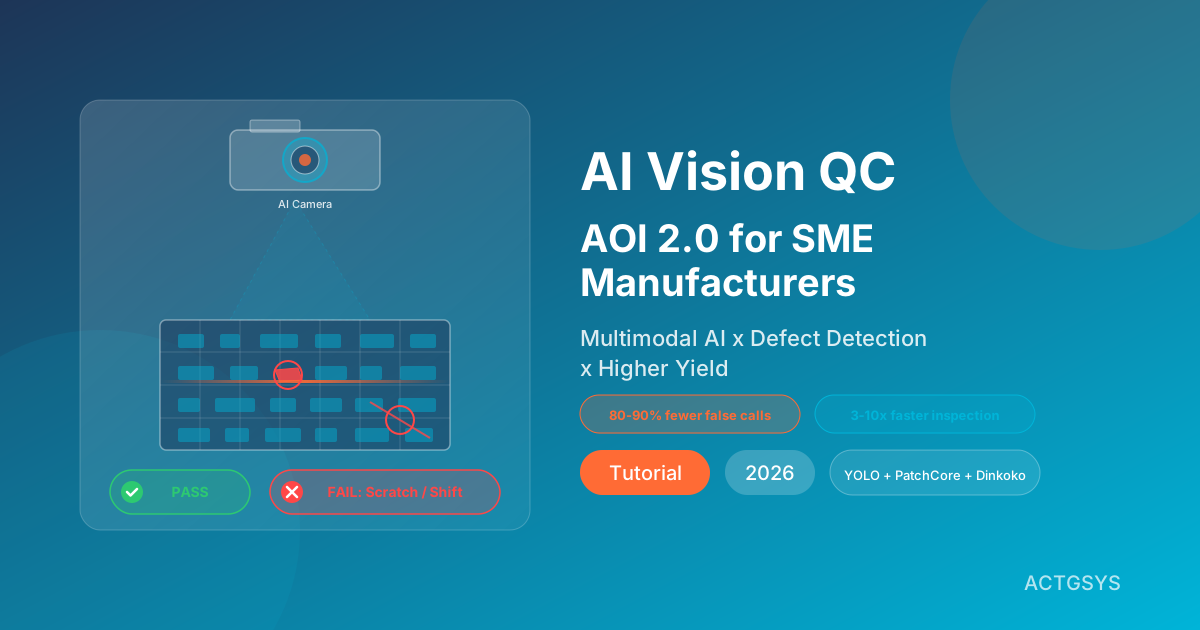
AI Vision Quality Control 2026: AOI 2.0 for SMEs
A deep dive into how AI vision QC (AOI 2.0) combines computer vision with multimodal LLMs to automate defect detection, raise yield and shrink inspection time. Includes a five-step rollout, platform comparison and FAQ.
What would this cost you?
Answer five questions. Within three working days you get a price range and what it covers. No deck, no follow-up sales calls.
Prefer to talk?LINE·02-2553-8084