AI Cash Flow Forecasting & Financial Planning Guide
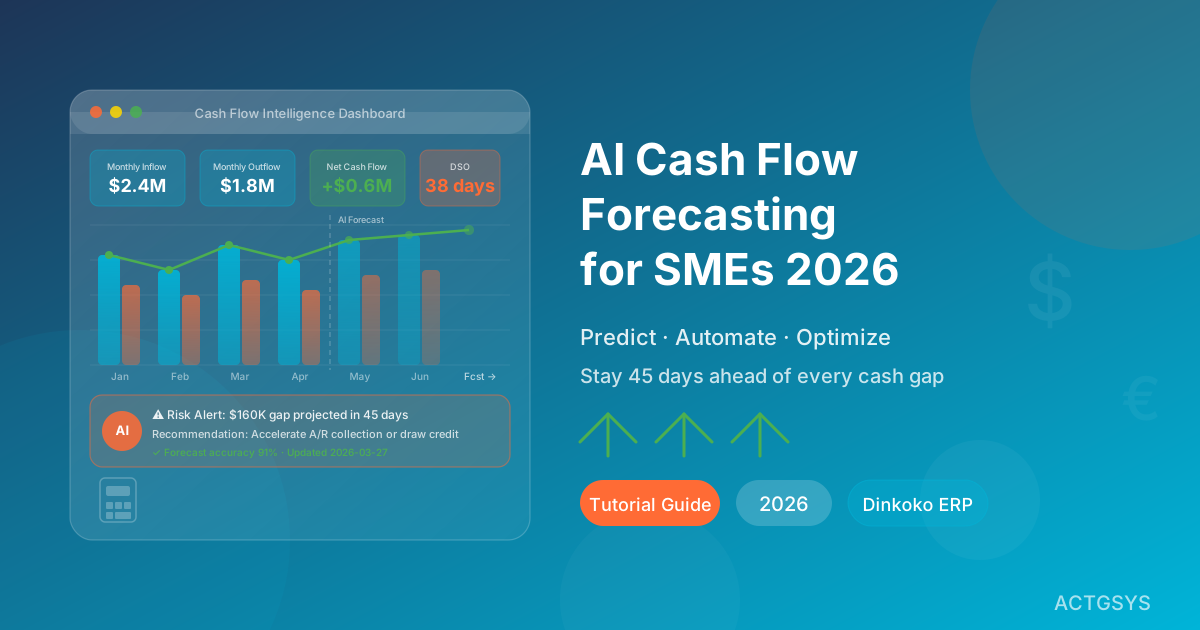
Cash flow is the lifeblood of any small or medium-sized business. A company can be profitable on paper and still collapse if its cash runs dry at the wrong moment. The data is unambiguous: 82% of SME failures are directly linked to cash flow problems — not a lack of orders or revenue, but a failure to manage the precise timing of money coming in versus money going out. Traditional cash flow forecasting relies on spreadsheets and the intuition of seasoned finance staff. Both are slow, error-prone, and fundamentally backward-looking. In 2026, AI-driven cash flow forecasting has changed the equation entirely, giving SMEs the same forward-looking financial intelligence that was once reserved for large enterprises with armies of financial analysts.
Why SMEs Need AI Cash Flow Forecasting
The central failure of traditional financial planning is that it looks in the rearview mirror. Monthly financial statements tell you what happened last period — not what is about to happen next month. Finance teams spend enormous effort consolidating historical data while remaining largely blind to the funding gaps looming 30 to 60 days ahead. When those gaps appear, companies are forced into reactive, expensive solutions: emergency credit lines at punishing rates, missed early-payment discounts, or delayed supplier payments that damage critical relationships.
AI cash flow forecasting flips this model. Instead of reacting to liquidity crises, you anticipate them weeks in advance. Key capabilities include:
- Multi-source data aggregation: Automatically pulling data from bank accounts, accounts receivable and payable ledgers, sales orders, inventory, and purchase orders into a single, unified cash position view
- 30-to-90-day forward projections: Generating rolling forecasts based on historical patterns, current order pipelines, and customer payment behavior — updated daily, not monthly
- Seasonal pattern recognition: Identifying recurring annual peaks and troughs in cash flow so you can pre-arrange financing or time investments optimally
- Scenario simulation: Modeling "what-if" situations like a major customer delaying payment by 30 days and quantifying the downstream impact on your cash position
For an SME with $1 million in monthly revenue, improving cash flow forecast accuracy from 70% to 90% can prevent costly emergency borrowing, unlock early-payment discounts from suppliers, and enable smarter capital allocation — translating to tens of thousands of dollars in annual financial benefit.
Core Technologies Behind AI Cash Flow Forecasting
Time Series Analysis
Time series analysis is the foundation of AI cash flow prediction. Models analyze historical transaction data to surface repeating patterns: the payroll spike that hits every 25th of the month, the cluster of customer payments that arrives at quarter-end, the procurement surge that precedes the holiday season.
Modern time series architectures — including Transformer-based forecasting models that have largely superseded ARIMA and LSTM approaches — can process dozens of simultaneous signals: customer payment histories, supplier payment terms, industry seasonality indices, and currency fluctuations. The result is materially better accuracy. AI models targeting a three-month forecasting window consistently achieve 85-92% accuracy, while experienced human forecasters typically land between 65-75% on the same horizon. That gap in accuracy compounds over time into significantly better capital allocation decisions.
Anomaly Detection and Early Warning
AI cash flow systems run continuous surveillance on your financial data and surface anomalies before they become crises. Common detection scenarios include:
- Late payment prediction: Flagging receivables at risk of going overdue based on customer payment history, triggering collection outreach 7-14 days before the due date
- Unusual spending detection: Identifying non-routine large disbursements and routing them for internal review before funds leave the account
- Liquidity stress alerts: Automatically notifying the CFO when the projected minimum cash balance over the next 30 days falls below a predefined safety threshold
- Concentration risk warnings: Alerting management when a single customer's receivables exceed a safe share of total outstanding balances
Scenario Simulation and Stress Testing
Beyond base-case forecasting, AI systems execute sophisticated what-if analyses across multiple scenarios simultaneously:
- Optimistic scenario: If all customers pay 10 days early, does the funding gap disappear? By how much can we accelerate the new equipment investment?
- Pessimistic scenario: If our largest customer cancels their order, how many months of runway do we have at current burn rate?
- Expansion scenario: We want to open a second production line requiring $400,000 in upfront capital — what is the optimal financing timing given our projected cash position?
These simulations give business owners and CFOs a rigorous quantitative basis for major decisions, replacing gut feel with modeled probability ranges.
Accounts Receivable AI Automation in Practice
Accounts receivable is where cash flow battles are won or lost. Every day of collection delay is a day of working capital tied up in a customer's bank account instead of yours. AI automation drives measurable improvements in receivable velocity across every stage of the collection cycle.
Manual Management vs AI Automation Comparison
| Management Dimension | Traditional Manual Approach | AI-Automated Approach | Improvement |
|---|---|---|---|
| AR aging report refresh | Weekly or monthly manual compilation | Real-time automatic updates | 7-30x faster |
| Collection notices | Finance staff drafting and tracking individually | Automatically triggered by aging tier and risk score | 80% labor reduction |
| Overdue risk prediction | Judgment-based, largely reactive | AI model accuracy of 87%+ | 20-30% accuracy improvement |
| Customer credit scoring | Static annual review | Dynamic real-time updates | 12x faster response |
| Days Sales Outstanding (DSO) | Industry average ~52 days | AI-optimized average ~38 days | 27% reduction |
| Bad debt write-off rate | Industry average ~2.5% | AI-optimized ~1.2% | 52% reduction |
Five Key AI Accounts Receivable Automation Scenarios
1. Intelligent credit assessment: Before accepting a new order, AI automatically evaluates customer creditworthiness by synthesizing payment history, publicly available financial data, and industry credit signals. Credit limits and payment terms are set dynamically, not reviewed annually.
2. Automated invoice delivery: When an order is fulfilled, the system auto-generates and sends electronic invoices without manual finance intervention. If the customer requires a specific format — EDI, customer-portal upload, or ERP-to-ERP transfer — the system handles the conversion automatically.
3. Tiered collection escalation: Rather than a one-size-fits-all dunning process, AI executes a calibrated escalation ladder — a friendly reminder 7 days before due, a formal notification on the due date, an escalated follow-up at 7 days overdue, and escalation to a human collector at 30 days overdue — with messaging tone automatically adjusted to the customer's payment tier and relationship history.
4. Payment prediction engine: By analyzing each customer's historical payment behavior, the system generates a forward-looking receivables collection schedule. Finance knows not just what is owed, but when each dollar is actually expected to arrive — dramatically improving the accuracy of the 30-day cash position forecast.
5. Dispute management tracking: When a customer raises an invoice dispute, AI automatically creates a resolution ticket, tracks it through to closure, and updates the AR balance when the dispute is settled. No disputes fall through the cracks during busy periods.
Intelligent Financial Planning Through ERP Integration
The full value of AI cash flow forecasting is unlocked when the AI engine is deeply integrated with your ERP system. A standalone forecasting tool delivers insights. An ERP-integrated AI system drives actions.
Consider how Dinkoko ERP integrates its financial module with an AI prediction engine:
Data layer integration: The ERP continuously streams financial events — sales order creation, purchase order approval, inventory movements, payroll runs, bank transactions — to the AI engine in real time. The forecasting model always works from current data, not last night's batch export.
Forecast layer output: The AI engine regenerates 30/60/90-day cash flow forecasts every morning and surfaces them on the finance dashboard in visual format. The CFO can see the projected cash curve, the contribution of each major receivable to next month's inflows, and any emerging gap risks — all before the first team meeting of the day.
Decision layer support: When the AI detects a projected $160,000 funding gap in 45 days, it doesn't just alert — it proposes three resolution options ranked by cost and feasibility: (1) accelerate collection on three specific slow-paying accounts that together would close the gap; (2) draw $100,000 from the existing credit facility now, before the gap materializes; (3) defer two non-critical procurement orders by 30 days to smooth the cash curve.
Execution layer automation: Once the CFO selects an option, the system executes — sending personalized collection escalation messages, compiling the financial documentation package for the credit facility draw request, or adjusting purchase order priorities in the procurement queue.
This sense-analyze-decide-execute loop transforms financial management from reactive firefighting to proactive capital orchestration.
AI Financial Forecasting Tool Comparison
| Tool Category | Representative Solutions | Suitable Scale | Integration Complexity | Monthly Cost | Forecast Accuracy |
|---|---|---|---|---|---|
| Standalone cash flow tools | Float, Dryrun, Pulse | Micro to small businesses | Low (cloud SaaS) | $49 - $199 | 75 - 82% |
| ERP built-in financial modules | Dinkoko ERP, SAP Business One | Small to mid-market | Medium (configuration required) | $200 - $800 | 82 - 90% |
| Custom AI financial platforms | ACTGSYS custom solutions | Mid-market to enterprise | High (bespoke integration) | $800+ | 88 - 94% |
| Enterprise FP&A platforms | Anaplan, Adaptive Insights | Large enterprises | High (professional implementation) | $2,000+ | 90 - 95% |
For most SMEs, ERP-integrated financial modules with AI extensions offer the best cost-to-value ratio. You avoid managing multiple vendor relationships and integration complexity while gaining production-grade cash flow forecasting built directly into the system your team already uses every day.
Three-Phase Strategy for Implementing AI Financial Forecasting
Phase 1: Data Readiness and Baseline Establishment (Months 1-2)
The quality of an AI forecasting model is only as good as the data it trains on. Phase 1 focuses entirely on ensuring that foundation is solid.
- Data audit: Assess the completeness of your historical financial data. At minimum, you need 24 months of transaction records covering accounts receivable, accounts payable, and bank statements
- Data cleansing: Correct miscategorized transactions, remove duplicates, and fill gaps in the historical record. This step is often underestimated and is the most common reason AI implementations underperform
- System connectivity: Establish API integrations between your bank accounts, ERP, and the AI forecasting platform so data flows in real time rather than through manual exports
- KPI baseline: Record current performance metrics — DSO, days payable outstanding, cash conversion cycle, and forecast error rate — so you have a clear before-and-after measurement framework
Phase 2: Model Training and Pilot Validation (Months 3-4)
- Model training: Train the forecasting model on your historical data, tuning parameters to reflect your industry's characteristics, your customer mix, and your business model's specific dynamics
- Parallel operation: Run AI forecasts alongside your existing manual forecasting process simultaneously. Compare outputs weekly and use the discrepancies to improve both the model and your understanding of your own business patterns
- Scenario configuration: Set up the what-if scenario templates most relevant to your business — key customer concentration risk, seasonal revenue compression, supplier payment term changes
- Alert threshold tuning: Calibrate the early warning triggers to your risk tolerance. Set minimum cash buffer thresholds that reflect your specific operating context, not generic industry defaults
Phase 3: Full Integration and Continuous Optimization (Month 5 Onward)
- Scope expansion: Graduate from cash flow forecasting to full income statement projection, capital expenditure planning, and financing need prediction
- Workflow automation: Activate automated collection escalation, credit line draw preparation, and procurement schedule adjustment workflows
- Quarterly model retraining: Retrain the model every quarter to incorporate new market conditions, changed customer behavior, and business model evolution
- Executive dashboard: Build a monthly financial health dashboard tracking DSO, cash conversion cycle, forecast error rate, and bad debt ratio — giving leadership a consistent, data-driven view of financial performance
Frequently Asked Questions
How much historical data does AI cash flow forecasting require to be effective?
In practice, 12 to 24 months of historical financial transaction data gives AI models enough signal to capture seasonal cycles and behavioral patterns. If your history is shorter, start with a 30-day forecasting horizon and extend the window as data accumulates. Data quality matters more than quantity — consistent categorization and absence of duplicate records are more important than having five years of messy data versus two years of clean data.
Can AI forecasting really reach 90%+ accuracy?
Accuracy depends on several factors: data completeness, business model stability, and how well the model is tuned to your specific context. For businesses with relatively predictable revenue streams — subscription models, long-term contract customers, or stable wholesale relationships — 30-day accuracy routinely reaches 90-95%. More volatile businesses such as retail or food service typically land in the 80-88% range. Crucially, even 85% AI accuracy is a substantial improvement over the 65-70% typical of manual forecasting, and the improvement in decision quality compounds significantly over time.
Can our existing Excel-based financial models be migrated to AI forecasting?
Yes, but with a transition period. Most AI forecasting platforms accept Excel imports as a starting point, allowing you to seed the model with existing historical data. However, to realize the full benefit, plan to progressively migrate financial data management into a structured ERP system like Dinkoko ERP. Real-time system data enables far more accurate and timely forecasts than manually refreshed spreadsheets. Most businesses complete this transition within three to six months.
Will AI financial forecasting replace our finance team?
No — it will make your finance team significantly more impactful. AI handles data collection, pattern recognition, and routine alerting. Finance professionals focus on interpreting AI insights in business context, making strategic financing and investment decisions, managing critical customer and banking relationships, and handling collection situations that require human judgment and interpersonal skill. The net effect is a finance team operating as strategic advisors rather than data administrators, handling a much larger transaction volume without growing headcount.
How does Dinkoko ERP's AI financial module work in practice?
Dinkoko ERP includes foundational cash flow analysis in its core financial module, with advanced AI forecasting available as an add-on. ACTGSYS provides full implementation support: requirements assessment, feature configuration selection, data migration planning, model training, and team onboarding. Contact us to arrange a free evaluation and product demonstration.
Accurate cash flow forecasting is the pivotal shift that separates SMEs that reactively manage financial crises from those that proactively orchestrate their capital for growth. AI makes this capability accessible to every business willing to invest in data-driven management — not just the enterprises with dedicated FP&A departments.
Ready to build a smarter financial management system for your business? Contact the ACTGSYS team for a free consultation. We will assess your current forecasting process, identify the highest-impact improvement opportunities, and design an implementation roadmap that delivers measurable results within weeks.
Products & Solutions in This Article
Related Articles
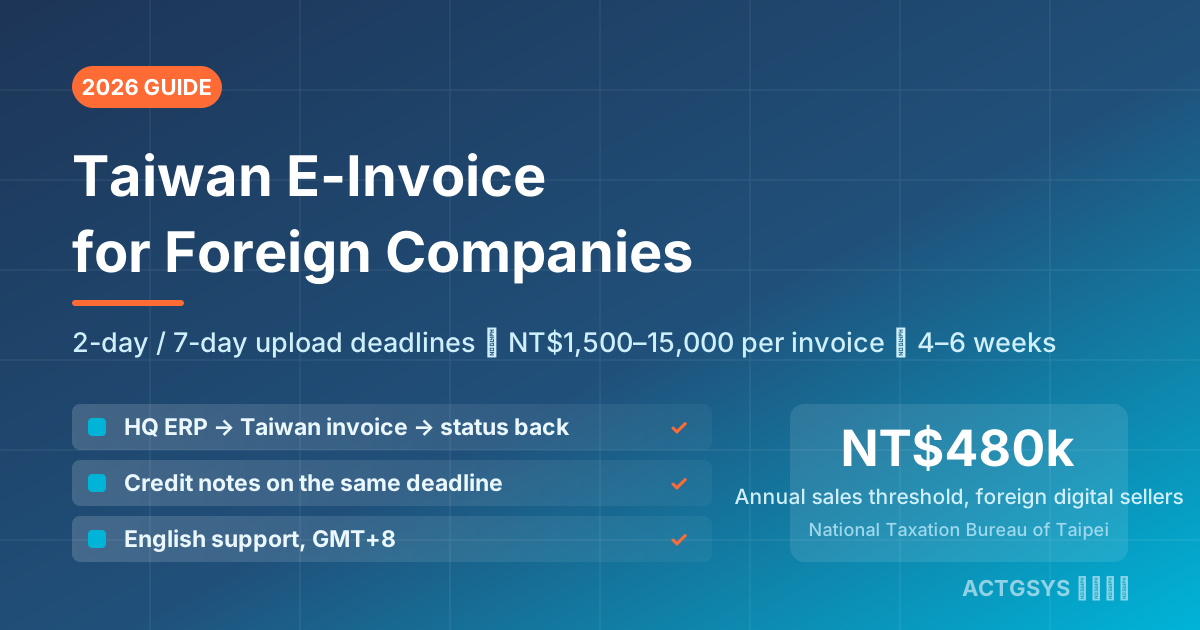
Taiwan E-Invoice for Foreign Companies 2026 - Cost
How a foreign-owned Taiwan subsidiary or branch connects its ERP to Taiwan's e-invoice platform: 2-day B2C / 7-day B2B upload deadlines, NT$1,500–15,000 per-invoice penalties, three integration paths, and a 4–6 week project from NT$50,000.
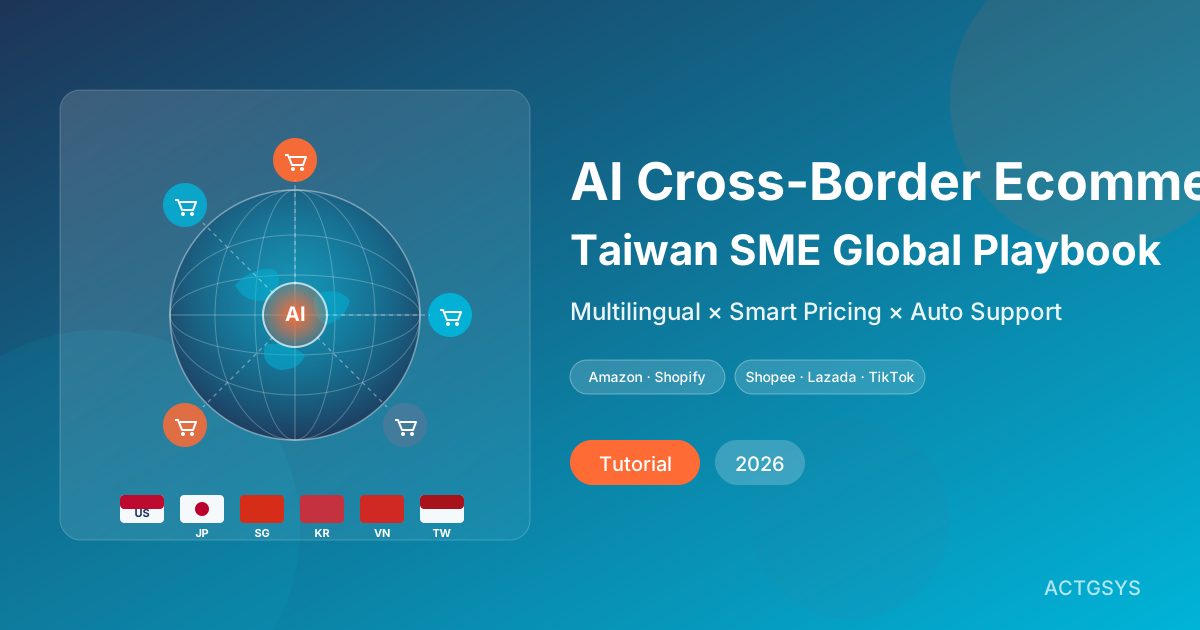
AI Cross-Border Ecommerce Playbook for SMEs (2026)
How Taiwan SMEs use AI to automate cross-border e-commerce — multilingual listings, smart customer service, dynamic pricing, ad ops, and logistics forecasting across Amazon, Shopify, Shopee, Lazada, and TikTok Shop.
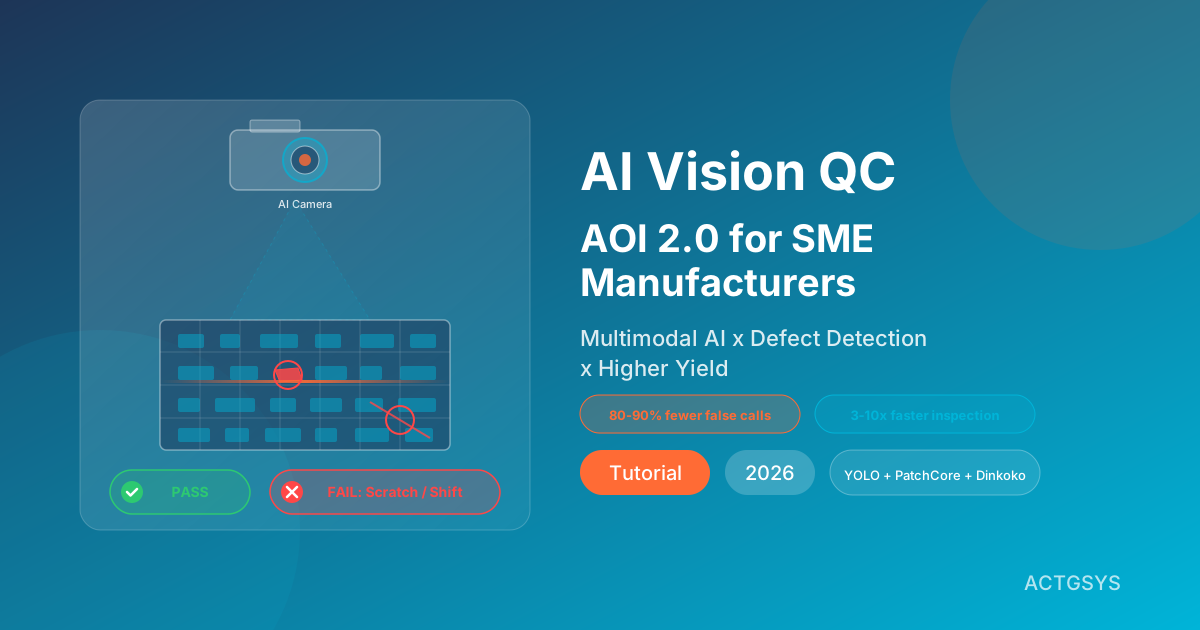
AI Vision Quality Control 2026: AOI 2.0 for SMEs
A deep dive into how AI vision QC (AOI 2.0) combines computer vision with multimodal LLMs to automate defect detection, raise yield and shrink inspection time. Includes a five-step rollout, platform comparison and FAQ.
What would this cost you?
Answer five questions. Within three working days you get a price range and what it covers. No deck, no follow-up sales calls.
Prefer to talk?LINE·02-2553-8084