AI Compliance 2026: EU AI Act and Taiwan Law
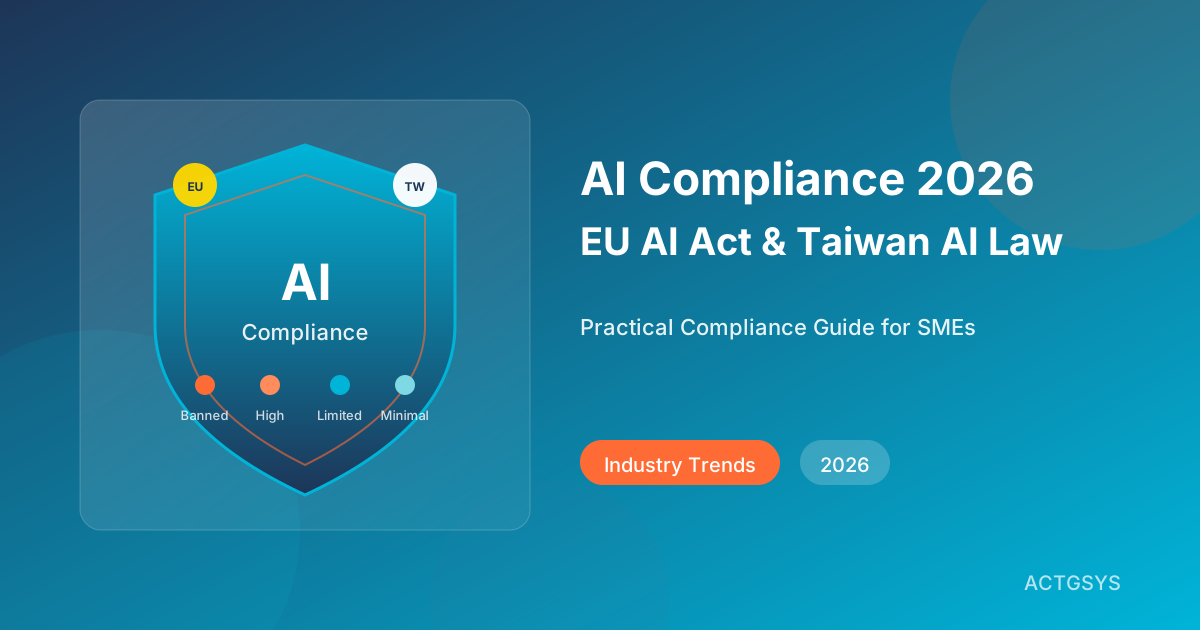
TL;DR: The EU AI Act's high-risk and transparency provisions apply in full from 2 August 2026, with fines up to 7% of global annual turnover. Taiwan's AI Basic Law follows three pillars — risk tiers, labeling duties and data governance — and is expected to pass in 2026. SMEs should focus on three actions: disclose AI usage, log AI decisions, and keep human review in the loop.
Why 2026 Is a Tipping Point for AI Compliance
2026 marks the year global AI governance shifts from "principles" to "enforcement." The EU AI Act, in force since 1 August 2024, follows a phased rollout: prohibited practices (Feb 2025), General-Purpose AI (GPAI) obligations (Aug 2025), and high-risk system rules plus most transparency duties on 2 August 2026.
For SMEs the immediate impact is threefold:
- Customers are asking: EU buyers now demand AI usage disclosures from Taiwanese suppliers
- Platforms push down: Microsoft, Google and AWS are passing compliance duties downstream to users
- Penalties bite: severe violations carry fines up to €35 million or 7% of global annual turnover, whichever is higher
In Taiwan, the Ministry of Science and Technology proposed the AI Basic Law in 2024; the Legislative Yuan continues review in 2025 with full passage expected within 2026. While details are still being shaped, three pillars are settled: risk classification, transparent labeling, and data governance.
What Are the Four Risk Tiers in the EU AI Act?
The EU AI Act takes a "risk-based" approach with four tiers. SMEs most often touch the bottom two.
| Risk Tier | Examples | SME Obligations |
|---|---|---|
| Unacceptable (Prohibited) | Social scoring, real-time biometric surveillance, manipulative systems | Banned outright |
| High Risk | Hiring screens, credit scoring, medical diagnosis, education grading | Risk assessment, technical docs, human oversight, data quality logs |
| Limited Risk (Transparency) | Chatbots, deepfakes, generative AI content | Disclose AI interaction; label AI-generated content |
| Minimal Risk | Spam filters, recommendation algorithms, AI writing assistants | Voluntary code of practice |
According to the European Commission (2025), more than 85% of enterprise AI applications fall into "minimal" or "limited" risk — but almost every business will trigger transparency duties. LINE Bot customer service, AI-written blog posts and AI-generated marketing visuals all fall under disclosure obligations.
Three Compliance Landmines SMEs Walk Into Most
Landmine 1: Undisclosed AI Customer Service
Whenever a customer might mistake an AI for a human, you must disclose clearly. A LINE Bot agent should open with "You're chatting with an AI assistant" and auto-replies should be flagged as AI-generated.
According to IDC (2026), 62% of LINE/WhatsApp customer service bots in Asia provide no clear AI disclosure — a direct violation of EU AI Act Article 50 starting August 2026.
Landmine 2: Unlabeled AI-Generated Content
The EU AI Act requires all AI-generated or modified images, videos, audio, and deepfakes to be machine-readably labeled. This affects:
- Marketing visuals from Midjourney/DALL-E
- AI voice-overs from ElevenLabs
- AI videos from Sora or Runway
- Blog articles from ChatGPT (when the topic is "matters of public interest")
Landmine 3: AI Resume Screening or Employee Evaluation
Hiring AI screens are explicitly listed as "high risk" in EU AI Act Annex III. Even SMEs using LinkedIn Recruiter or Indeed's AI features must:
- Inform applicants that AI is involved in decisions
- Keep traceable decision logs for at least 6 months
- Provide a human review channel
- Avoid relying solely on AI for final hiring decisions
Three Pillars of Taiwan's AI Basic Law
The Taiwan AI Basic Law draft centers on risk classification, labeling duties, and data governance — closely aligned with the EU AI Act but more "SME-friendly."
Pillar 1: Risk Classification
Uses the concept of "important AI systems" focused on finance, healthcare, education and public services. Pre-deployment risk assessments and traceable post-deployment logs are required. Common business AI (e.g., CRM smart recommendations, ERP forecasting) is generally classed as standard risk with lighter duties.
Pillar 2: Labeling Obligations
AI-generated content must be clearly labeled, with a "fair and reasonable human intervention mechanism" in place. This overlaps heavily with EU AI Act transparency rules.
Pillar 3: Data Governance
An extension of the Personal Data Protection Act — businesses must assess data source legality, purpose alignment, and third-party sharing risks before using AI. Particularly important for companies using overseas AI services like ChatGPT or Claude.
Seven-Step SME Compliance Action Checklist
Step 1: Inventory Current AI Usage
List every AI tool and scenario in use today:
- Customer service (LINE Bot, WhatsApp Bot, web chat)
- Marketing tools (AI image generation, copywriting, video)
- Business systems (CRM recommendations, ERP forecasts, auto-quoting)
- Daily employee tools (ChatGPT, Claude, Copilot)
- Hiring tools (resume screens, interview video analysis)
Step 2: Map to Risk Tiers
For each application, decide its risk tier. Most SME applications cluster in "minimal" or "limited" risk, but stay alert: hiring, credit scoring, and insurance pricing are high risk.
Step 3: Build a Transparency Layer
- Customer service bots: open with an AI disclosure
- AI-generated content: footer note "This article was assisted by AI"
- AI images/videos: embed C2PA metadata standards
Step 4: Keep Decision Logs
For high-risk or "semi-automated" decisions (AI-recommended discounts, AI prioritization), retain three records:
- Input data snapshot
- Model version and parameters
- Final decision plus human review record
DanLee CRM and Dinkoko ERP can ship with built-in audit logs that automatically record every AI-assisted business decision.
Step 5: Set Human Review Checkpoints
For irreversible or high-impact AI decisions (terminations, credit denials, major price changes), keep humans as the final decision-maker. Design the workflow so that humans can actually intervene, not just rubber-stamp the AI.
Step 6: Audit the Data Supply Chain
- Are training data sources legal?
- Is personal data processed in compliance with GDPR / data protection law?
- Are cross-border data transfers based on a valid legal basis?
- Do AI vendor contracts contain data protection clauses?
Step 7: Maintain a Lightweight Governance File
You don't need a thick manual — three documents are enough:
- AI tooling inventory (what's used, where)
- AI risk assessment (risk tier and mitigations per application)
- AI incident SOP (who handles incidents, how to escalate)
Real Case: A 30-Person Trader's Compliance Rollout
Background: A mid-sized export trader with EU customers and 30 employees began preparing for the EU AI Act in late 2025.
Inventory results:
- LINE Bot for auto-replying to customer inquiries (limited risk, disclosure needed)
- ChatGPT for product descriptions (limited risk, content labeling needed)
- CRM-built-in AI for recurring purchase recommendations (minimal risk, voluntary)
- No hiring AI, no credit scoring AI (high risk excluded)
Actions taken:
- Added an AI disclosure to the LINE Bot opening line: "You're chatting with an AI assistant; complex questions go to a human."
- Added a footer to product pages: "Some content was AI-assisted and human-reviewed."
- Enabled DanLee CRM's AI decision log to record the rationale for each recommendation
- Created a 4-page internal AI governance handbook
Outcomes:
- Passed an EU customer's AI compliance questionnaire — €1.2M renewal secured
- Employees became more careful with AI tools, reducing data-leak risk
- Total rollout cost: about NT$80,000 (consulting + system setup)
EU AI Act vs Taiwan AI Basic Law: Key Comparison
| Item | EU AI Act | Taiwan AI Basic Law (Draft) |
|---|---|---|
| Legal Form | Directly applicable regulation | Principle-based law + agency rules |
| Full Enforcement | 2 August 2026 | Expected to pass within 2026 |
| Risk Classification | Four tiers (banned/high/limited/minimal) | Important AI systems vs general AI |
| Maximum Fine | €35M or 7% of global turnover | Administrative fines, amount TBD |
| Transparency | Mandatory disclosure of AI interaction & content | Labeling duties (details by agencies) |
| GPAI Rules | Detailed (technical docs, copyright policy) | Not yet specified, expected via rules |
| Scope | Any business offering or using AI in the EU | Businesses operating in Taiwan or serving Taiwanese users |
Closer to home than the EU AI Act, and with per-invoice penalties already in force since January 2025, is Taiwan's electronic uniform invoice regime; our guide for foreign-owned entities covers deadlines, integration paths and cost.
FAQ
My company is in Taiwan with no EU customers. Do I still need to follow the EU AI Act?
If you have zero EU customers, do not serve the EU, and your AI outputs are not used in the EU, the EU AI Act technically doesn't apply. But the moment you have an EU customer or distributor, the AI Act applies extraterritorially. Even without current EU business, adopting the same standards is wise — Taiwan's AI Basic Law is highly similar.
Do I need to label blog posts written with ChatGPT?
The EU AI Act requires disclosure for AI text on "matters of public interest." Commercial blogs, product pages, and internal docs are not strictly mandated. In practice: label content related to politics, health, law, or news; general marketing content can stay unlabeled. Taiwan's labeling rules are still being drafted, so a conservative approach is safer.
How big are the fines? Will SMEs really get caught?
EU AI Act fines come in three tiers: prohibited practices up to €35M or 7% of global turnover; other violations up to €15M or 3%; misinformation up to €7.5M or 1%. In practice regulators prioritize major or systemic violations. SMEs that show "reasonable effort" (written policies, decision logs) are less likely to face heavy fines even if compliance isn't perfect.
We're already ISO 27001 certified — is that enough?
ISO 27001 covers information security management and doesn't directly equal AI compliance. But its risk assessment and record-keeping practices extend naturally to AI governance, saving duplicate work. The newer ISO/IEC 42001 (AI Management System Standard, 2025) is the international standard that maps directly to AI compliance — worth considering if you have EU customers.
How do DanLee CRM and Dinkoko ERP help with compliance?
Both ship with built-in features aligned with EU AI Act and data protection law: full AI decision logs, traceable data processing records, tiered customer data permissions, and one-click data subject request exports. For SMEs, using compliance-friendly systems removes the need to build audit infrastructure from scratch.
Conclusion: Compliance Is the Entry Ticket to Trust
From 2026, AI compliance is no longer "something only big companies worry about." Three forces — EU customer questionnaires, Taiwan's incoming AI Basic Law, and cloud-platform compliance pushdowns — bring obligations to every SME's door.
Good news: the core of compliance is process, not technology — inventory, disclose, log, review. SMEs are actually better placed than large firms to build a lightweight but effective governance framework, turning compliance into competitive advantage rather than burden.
Last updated: 2026-04-21
Ready to build your AI compliance framework?
The ACTGSYS team understands both EU AI Act and Taiwan AI Basic Law, and can help SMEs:
- Inventory current AI usage and classify risks
- Configure DanLee CRM and Dinkoko ERP audit logs
- Draft AI usage policies and labeling mechanisms
- Respond to EU customer AI compliance questionnaires
👉 Book a free compliance consultation and turn AI compliance into your passport to international markets.
Products & Solutions in This Article
AI-powered CRM for lead management, customer tracking, and sales pipeline optimization designed for SMEs.
AI-driven ERP focusing on procurement, inventory, and supply chain management. Each customer deployed on dedicated cloud infrastructure.
Related Articles
AI Smart Procurement & Cost Optimization Guide
Learn how AI is transforming procurement for small and mid-sized businesses — from supplier evaluation to price prediction, with ROI models, implementation steps, and Dinkoko ERP integration.
Anthropic Claude for Small Business (2026)
On May 13, 2026, Anthropic launched Claude for Small Business with 15 ready-to-run agentic workflows and native connectors to QuickBooks, HubSpot, PayPal and five other tools. We unpack what it actually does, how it compares to alternatives, and what Taiwan SMEs should consider before adopting.
Composable CRM for SMEs: Modular Beats Suites 2026
Learn how composable CRM architecture lets SMEs pick and choose feature modules, cutting implementation costs by 40%. Includes Salesforce vs HubSpot vs DanLee comparison, 5-step rollout plan, and real-world success stories.
What would this cost you?
Answer five questions. Within three working days you get a price range and what it covers. No deck, no follow-up sales calls.
Prefer to talk?LINE·02-2553-8084