AI Contract Management & Legal Automation Guide
"The contract expired — when did that happen?" Few phrases strike more dread into a business owner's day. When a sales director receives an urgent call from a long-term client only to discover that their master service agreement lapsed three months ago, the fallout is immediate: damaged relationships, halted deliveries, and potential legal liability. This is not an edge case. It is a scenario playing out weekly across thousands of small and medium enterprises (SMEs) in Asia-Pacific. According to a 2025 survey by PwC, the average SME manages between 80 and 350 active contracts simultaneously, yet over 65% still rely on spreadsheets or shared drives for tracking. Annual losses from contract management failures — including missed renewals, penalty clauses, and emergency legal fees — average USD $38,000 per company. AI contract management systems are fundamentally changing this equation.
What Is AI Contract Management? Core Capabilities Explained
AI contract management is the application of natural language processing (NLP), machine learning, and optical character recognition (OCR) to automate the full lifecycle of business contracts — from creation and review through execution, monitoring, and renewal or termination. The critical distinction from traditional contract management software is that AI does not merely store contracts: it reads, understands, and proactively acts on contract content.
Modern AI contract management platforms deliver five core capability areas:
1. Intelligent Document Extraction and Classification: The system automatically ingests PDFs, Word documents, and scanned files, identifies the contract type (purchase agreement, service contract, NDA, employment agreement, etc.), and extracts key fields — parties, financial terms, effective dates, payment conditions, and penalty clauses — without manual data entry.
2. Risk Clause Detection and Scoring: AI models trained on millions of contracts score each document for risk exposure, flagging unbalanced clauses, excessive liability waivers, ambiguous scope language, and deviations from the company's standard templates. Legal staff can prioritize high-risk contracts for focused review.
3. Expiry and Milestone Automated Tracking: The system creates a unified calendar of every contract deadline across the organization — primary agreements, amendments, auto-renewal windows, and delivery milestones — and sends tiered alerts at 90, 60, and 30 days before each date.
4. Template Management and Auto-Generation: A library of pre-approved contract templates lets the system draft new agreements in minutes by selecting the appropriate template for the transaction type and auto-populating counterparty data from the CRM. Every generated contract is guaranteed to reflect current legal policy.
5. Full-Text Search and Obligation Tracking: Any stakeholder can find any contract in seconds via keyword search. The system also maintains a running obligations register — automatically extracting commitments such as periodic reporting requirements, service level targets, or insurance obligations — so execution teams never miss a contracted duty.
Five Major Contract Management Pain Points for SMEs
Understanding why traditional approaches break down under modern commercial complexity is essential before evaluating AI solutions:
- Expiry tracking depends on individual memory: When contract tracking lives in personal calendars or team spreadsheets, employee turnover or business growth creates information gaps. Industry data shows that between 12% and 18% of contracts experience disputes or financial losses each year due to missed renewals or unmonitored auto-renewal clauses.
- Legal review is slow and prohibitively expensive: External counsel rates range from USD $300 to $800 per hour, and a moderately complex contract review takes two to five business days. Beyond cost, every external review starts from scratch — no institutional learning accumulates across engagements.
- Version control and approval workflows are chaotic: During contract negotiation, multiple document versions circulate via email attachments. Without a centralized system, parties frequently disagree on which version governs, leading to disputes that could have been avoided with basic version management.
- Cross-departmental information silos: Sales owns customer contracts, procurement owns supplier agreements, HR owns employment contracts, and finance needs data from all three to close the books accurately. These silos cause billing errors, delayed payments, and missed cost recovery.
- Compliance exposure is impossible to monitor manually: Privacy regulations, commercial law amendments, and sector-specific compliance requirements evolve continuously. Manual review cannot guarantee that all active contracts remain compliant with current law, creating latent regulatory risk.
AI Contract Management: Key Technologies and Use Cases
Intelligent Contract Review
Traditional contract review requires a lawyer or trained paralegal to read every clause manually — a standard purchase agreement takes three to four hours to assess. AI contract review engines compress this to five to fifteen minutes, with accuracy rates consistently above 90% in standardized benchmarks (compared to approximately 82% for human reviewers on clause-level deviation detection, where fatigue and volume create variability).
A practical example: when a supplier submits a 40-page procurement contract, the AI system scans the full document on upload and compares it against the company's standard template, immediately flagging three deviations — payment terms set at 90 days (company standard: 60 days), liability cap at 10% of contract value (company standard: 30%), and ambiguous IP ownership language in clause 31. Legal reviewers address only these three flagged items, reducing review time by 75% while maintaining full accountability for the final judgment.
Risk Clause Detection
AI risk detection models trained on large contract datasets reliably identify patterns that signal elevated risk:
Unbalanced power clauses: Unilateral modification rights, overly broad indemnification language, unfavorable arbitration venues, and termination-for-convenience provisions that apply only to one party.
Hidden cost clauses: Automatic price escalation mechanisms, ambiguously defined additional fee triggers, and penalty calculations that favor the counterparty.
Obligation asymmetry: Risk transfer provisions where one party bears disproportionate liability, SLA measurement methodologies designed to minimize the service provider's exposure, and force majeure clauses with exclusions that benefit the drafter.
Each contract receives a risk score from 0 to 100, with actionable remediation suggestions. Contracts scoring above 70 automatically trigger a mandatory legal review workflow, ensuring high-stakes agreements never proceed to signature without proper scrutiny.
Automated Expiry Tracking
Contract expiry management sounds simple in principle but consistently proves the highest-failure point in practice. AI contract management systems implement multi-layer tracking:
Layer 1 — Calendar integration: All contract deadlines, milestone dates, and payment due dates sync automatically to Google Calendar or Outlook, visible to all relevant stakeholders.
Layer 2 — Priority-tiered notifications: Alert timing scales with contract value and strategic importance. Enterprise agreements trigger reminders 120 days out; standard contracts at 60 days; all contracts receive a final alert 7 days before the deadline.
Layer 3 — Renewal decision support: Each reminder includes an automated performance dashboard for that contract — showing actual utilization against contracted volumes, counterparty performance scores, and benchmarked market pricing — so decision-makers have the data needed to act directly from the notification interface.
AI Contract Management System Comparison
The following table compares the platforms most commonly evaluated by SMEs in 2026:
| Criteria | Ironclad | ContractPodAi | DocuSign CLM | Agiloft | DanLee CRM (ACTGSYS) |
|---|---|---|---|---|---|
| Monthly Cost | From USD $800/mo | From USD $1,500/mo | From USD $25/user | Quote-based | Flexible plans, contact for quote |
| AI Risk Detection | Excellent | Excellent | Good | Good | Localized clause library |
| Chinese Language Support | Partial | Partial | Good | Partial | Native Traditional Chinese |
| CRM Integration | Requires setup | Requires setup | Native Salesforce | Broad API | Native DanLee CRM |
| ERP Integration | Requires setup | Requires setup | Limited | Broad | Native Dinkoko ERP |
| E-Signature | Built-in | Built-in | Built-in | Requires add-on | Integrated local platforms |
| Local Tax Compliance | Not supported | Not supported | Not supported | Not supported | Compliant with local regulations |
| Implementation Timeline | 2–4 months | 2–3 months | 1–2 months | 3–6 months | 2–6 weeks |
| Local Support | No local office | No local office | Distributor network | No local office | In-country team |
Key selection guidance: For SMEs with annual revenue below USD $2 million, the licensing costs of international enterprise platforms often consume a disproportionate share of the IT budget, while local support and localization remain inadequate. Prioritize solutions with in-country service capabilities and native integration with your existing CRM and ERP stack.
CRM and ERP Integration: Real-World Contract Management Strategies
The transformative value of AI contract management is fully realized only when the system integrates with CRM and ERP platforms, breaking down the information silos that cause most contract failures.
Three CRM Integration Use Cases
Use Case 1: Seamless opportunity-to-contract conversion When a sales rep updates a deal stage to "Closed Won" in the CRM, the system automatically triggers contract generation — selecting the appropriate template based on customer type, deal value, and product category, pre-filling counterparty data from the CRM record, and routing the draft for legal or management approval. The entire process happens within the CRM interface. Average contract generation time drops from two days to two hours.
Use Case 2: Contract expiry triggers customer success workflows When the system detects a contract expiring in 90 days, it automatically creates a "Contract Renewal" task in the CRM, assigns it to the responsible customer success manager, and attaches a 12-month account summary — utilization metrics, payment history, and satisfaction scores. The customer success manager arrives at the renewal meeting equipped with complete account intelligence rather than scrambling to assemble data from multiple systems.
Use Case 3: Contracted revenue syncs to sales forecasting All active contract values automatically write back to the CRM pipeline as committed revenue, giving sales leadership a real view of certain income (not just probability-weighted estimates) and dramatically improving the accuracy of financial forecasting and cash flow planning.
Three ERP Integration Use Cases
Use Case 1: Contract terms drive procurement and production When a customer contract with specific delivery milestones is executed, the ERP system reads the delivery dates and specifications from the contract record and automatically generates production work orders or purchase requisitions, calculates material requirements, and schedules production capacity. The contract is no longer just a legal document — it becomes the operational instruction that drives the supply chain.
Use Case 2: Payment terms automatically configure accounts receivable Payment conditions specified in the contract (e.g., "Net 30 from delivery" or "Three installments of USD $10,000") sync directly to the ERP accounts receivable module. The system generates invoicing reminders on the correct dates and automatically reconciles contract obligations against payments received, eliminating the manual cross-referencing that causes billing delays and accounting errors.
Use Case 3: Supplier contract performance tracking The ERP system cross-references supplier contracts against actual delivery records — logging on-time delivery rate, quality return rate, and price compliance for every purchase order — and generates quarterly supplier scorecards. When supplier contracts come up for renewal, objective performance data drives the negotiation, not subjective impressions.
ROI Analysis: The Business Case for AI Contract Management
The most common question from SME owners: "Is this investment actually worth it?" Here is a realistic ROI model based on a manufacturing SME with annual revenue of approximately USD $1 million and an active contract portfolio of 150 agreements:
Annual costs before implementation
- External legal counsel (average 4 contracts per month for outside review): USD $57,600/year
- Administrative staff time for contract management (15 hours/week at $25/hour): USD $19,500/year
- Losses from contract failures (missed collections, unintended auto-renewals, penalties): USD $38,000/year
- Total: approximately USD $115,100/year
Annual savings after implementation
- Legal counsel fees reduced by 60% (AI pre-screening means only high-risk contracts go to outside review): USD $34,560 saved
- Administrative time reduced by 70% (automated extraction and tracking): USD $13,650 saved
- Contract failure losses reduced by 80% (automated tracking and early warning): USD $30,400 saved
- Total annual savings: approximately USD $78,610
AI contract management system annual cost: USD $6,000 to $12,000 (depending on modules and user count)
ROI calculation: (USD $78,610 − $9,000) ÷ $9,000 = 663% at the midpoint. Payback period: approximately 1.4 months.
Even under a conservative scenario — counting only direct legal fee and administrative time savings, ignoring contract failure loss recovery — ROI exceeds 150% with a payback period under 6 months.
FAQ: Common Questions About AI Contract Management
Q1: Most of our contracts are scanned PDFs. Can AI accurately read them?
Modern AI contract management systems include high-precision OCR engines that achieve 97–99% character accuracy on clean scans (300 dpi and above). For handwritten contracts or low-quality scans, the system flags items for human confirmation. Best practice is to begin your implementation with native digital documents (Word files, electronically generated PDFs) and process historical scanned documents in a second phase once the system and workflows are validated.
Q2: How long does implementation take before the system is live?
For a typical SME with fewer than 200 existing contracts, initial system configuration, template setup, and user training complete within 2 to 6 weeks. Batch migration of historical contracts and data cleaning requires an additional 2 to 4 weeks. Full functionality is generally available within 1 to 2.5 months — dramatically faster than traditional ERP implementations that average 6 to 12 months.
Q3: Is it safe to store contracts in the cloud? Will our data be used to train AI models?
Enterprise-grade AI contract management systems offer two deployment options: SaaS cloud (data encrypted at rest and in transit in ISO 27001-certified data centers) and private cloud or on-premises (data never leaves your infrastructure). Commercial contract data is not used to train shared AI models — data isolation is a contractual obligation in reputable vendor agreements. Verify the vendor's data processing policy and compliance certifications before signing.
Q4: What are the most common reasons SME contract management implementations fail?
Industry experience points to three recurring failure patterns. First, inadequate template preparation: failing to develop and approve company-standard contract templates before implementation leaves the AI without benchmarks for deviation detection. Second, low adoption by key user groups: when legal, sales, and procurement stakeholders are not involved in workflow design, the system fails to fit actual working patterns and gets abandoned. Third, no designated system owner: without someone responsible for maintaining the template library and system configuration post-launch, the platform degrades over time. The lesson: treat process design as equally important as platform selection.
Q5: Can AI contract management replace our legal counsel?
No — and it should not try to. AI contract management automates the high-volume, rules-based aspects of review, freeing legal professionals (whether in-house or external counsel) to apply their judgment to complex, ambiguous situations that genuinely require legal expertise. The optimal model for SMEs is AI pre-screening plus escalation of high-risk contracts to legal review plus legal professionals focused on exceptions, strategy, and negotiation — not on reading standard vendor agreements from scratch every time.
Conclusion: Contract Management Is Infrastructure, Not Optional
In 2026, as commercial relationships grow more complex and regulatory requirements become more demanding, contract management capability has become foundational business infrastructure — as essential as accounting or HR systems. Companies that can rapidly generate compliant contracts, precisely track obligations, and proactively identify risks are building a compounding operational advantage in every transaction. Companies still managing contracts with spreadsheets and email threads are quietly eroding their margins and reputation with every missed deadline and every unfavorable clause they failed to catch.
AI contract management is no longer the exclusive domain of large enterprises with dedicated legal departments. It is accessible, affordable, and demonstrably high-ROI for SMEs — with implementation timelines measured in weeks, not quarters.
Ready to design an AI contract management approach tailored to your business — one that integrates with your existing CRM and ERP systems? Schedule a free consultation with our advisory team. We will assess your contract portfolio, current systems, and industry-specific requirements to provide a concrete implementation roadmap.
Products & Solutions in This Article
AI-powered CRM for lead management, customer tracking, and sales pipeline optimization designed for SMEs.
AI-driven ERP focusing on procurement, inventory, and supply chain management. Each customer deployed on dedicated cloud infrastructure.
Related Articles
2026 Taiwan SME AI Subsidy Guide: Eligibility
A comprehensive guide to all Taiwan government subsidies for SME digital transformation in 2026 — including the MOEA subsidy for companies with under 30 employees (up to NT$100,000), TCloud marketplace, and the Diversified Revitalization Program — plus how to pair subsidies with ERP, CRM, and LINE Bot deployments for maximum ROI.
Guide: AI Document Processing & Invoice Automation
Discover how AI document processing and invoice automation can reduce per-invoice costs from $15 to $2, dramatically improving accuracy and efficiency for small and medium businesses.
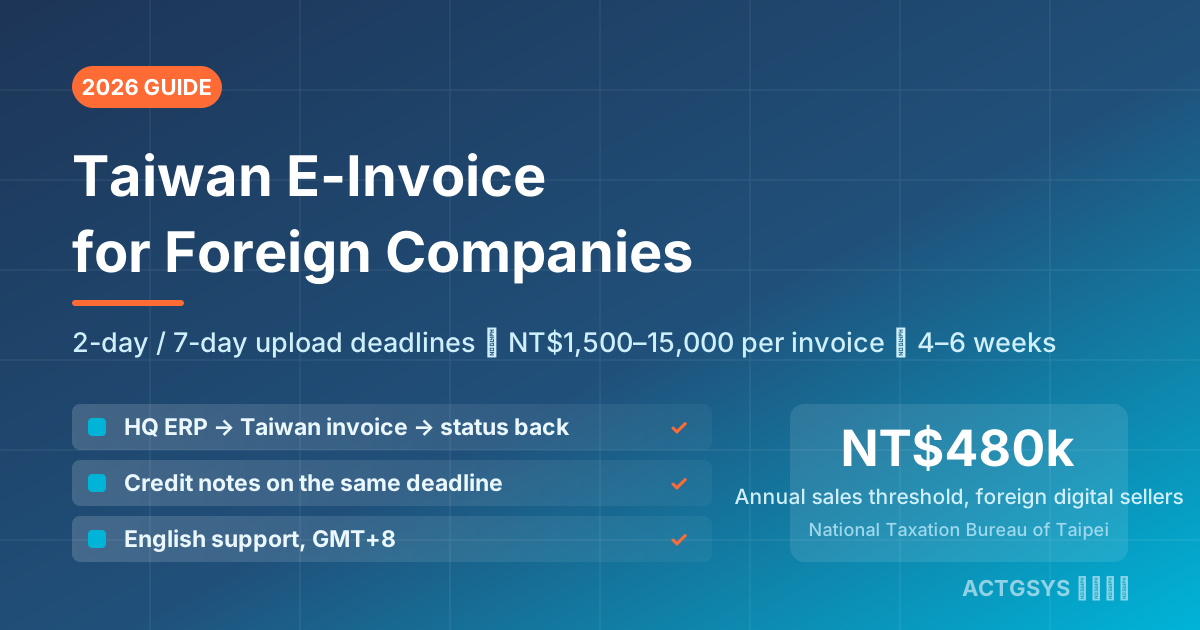
Taiwan E-Invoice for Foreign Companies 2026 - Cost
How a foreign-owned Taiwan subsidiary or branch connects its ERP to Taiwan's e-invoice platform: 2-day B2C / 7-day B2B upload deadlines, NT$1,500–15,000 per-invoice penalties, three integration paths, and a 4–6 week project from NT$50,000.
What would this cost you?
Answer five questions. Within three working days you get a price range and what it covers. No deck, no follow-up sales calls.
Prefer to talk?LINE·02-2553-8084