AI CRM Sales Automation Trends 2026
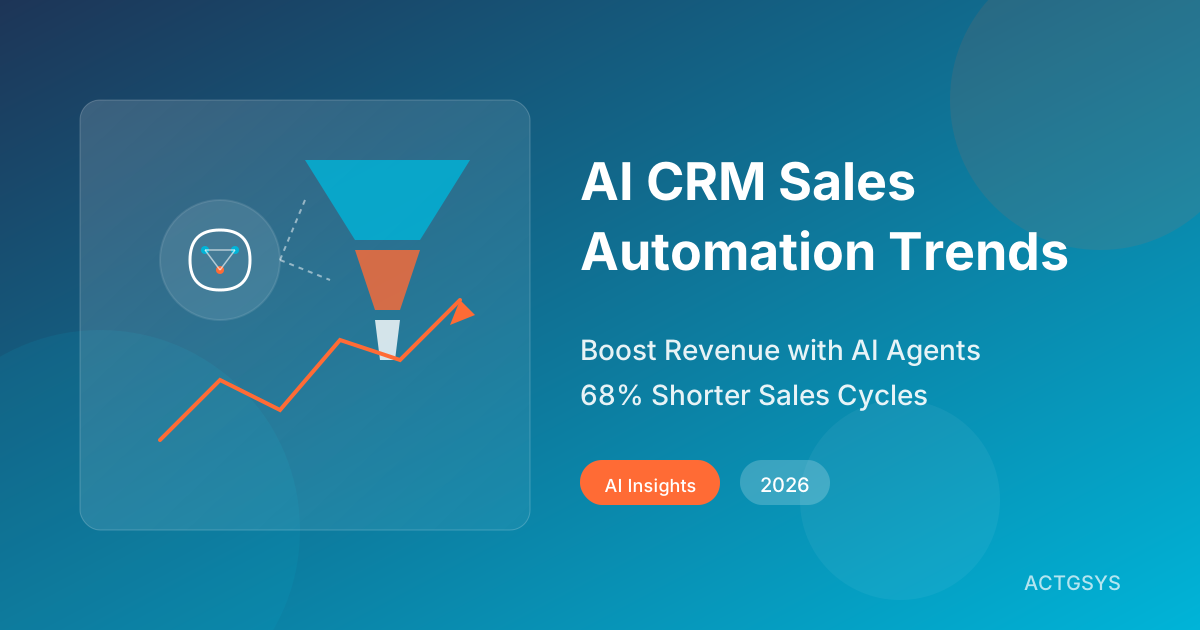
In 2026, the CRM market is undergoing unprecedented transformation. According to Gartner predictions, 40% of enterprise applications will include task-specific AI Agents by the end of 2026, and the AI-driven CRM market has reached approximately $11 billion. For SMEs, this isn't just a technology trend—it's a critical moment that will determine market advantages for the next three years.
The Shift from AI Assistants to Autonomous Execution
Traditional CRM systems require users to manually input, query, and execute tasks. The AI Agents of 2026 are completely different—they can autonomously sense signals, make judgments, and automatically execute actions when conditions are met.
The Evolution from Copilot to Agent
Past AI assistants (Copilots) only operated when users gave commands. The new generation of AI Agents can:
- Proactively sense opportunity signals: Automatically trigger follow-up actions when potential customers open emails, browse specific product pages, or reach certain interaction thresholds
- Autonomously advance sales processes: From lead distribution and quote generation to case escalation, without human intervention
- Execute cross-system coordination: Integrate CRM, email platforms, calendars, and other systems to complete tasks that previously required coordination across multiple teams
Practical Application Scenarios
For B2B sales example, when a potential customer downloads a whitepaper on the website:
- AI Agent automatically evaluates the customer's purchase intent score
- Assigns to the most suitable sales representative based on the customer's industry and scale
- Automatically sends personalized follow-up emails
- Creates tracking tasks and reminders in the CRM
- Instantly notifies sales and provides suggested response strategies when the customer replies
Seven Major AI CRM Sales Automation Trends for 2026
Based on multiple research reports, here are the most noteworthy AI CRM trends for 2026:
1. Closed-Loop Automated Execution
AI Agents no longer just provide suggestions—they can complete entire processes from start to finish. From receiving inquiries, qualification reviews, scheduling meetings to sending quotes, the entire sales cycle can operate automatically with minimal human intervention.
2. Predictive Sales Intelligence
Through machine learning analysis of historical data, AI can:
- Predict which leads are most likely to close
- Suggest optimal contact times and methods
- Identify customers at risk of churn with early warnings
- Estimate deal amounts and closing probabilities
3. Conversational AI Replaces Static Chatbots
Conversational AI Agents in 2026 can span sales, service, and marketing channels, executing actual tasks while maintaining contextual continuity, rather than just answering questions.
4. Personalization at Scale
AI enables enterprises to deliver personalized experiences at scale:
- Automatically adjust communication content based on customer behavior
- Generate customized marketing materials for different customer segments
- Dynamic pricing and offer recommendations
5. Automated Data Integration and Cleaning
AI Agents can automatically identify and correct duplicate data, outdated information, and formatting errors in CRM, ensuring sales teams always make decisions based on accurate data.
6. Voice and Multimodal Interaction
Sales personnel can interact with CRM systems through voice, quickly updating customer information, checking product inventory, or scheduling follow-up actions while visiting clients.
7. AI-Driven Sales Coaching
AI analyzes patterns of top performers and provides real-time sales advice and training for other team members, shortening new hire onboarding time.
Actual Benefits of AI Sales Tools
According to McKinsey research, companies implementing AI sales tools are seeing significant results:
| Metric | Improvement |
|---|---|
| Lead quantity | 50%+ increase |
| Operating costs | 60% reduction |
| Call time | 70% reduction |
| Sales cycle | 68% shorter |
| Productivity | 30% increase |
| Revenue growth | 13-15% increase |
These numbers explain why AI CRM is no longer optional but a competitive necessity.
Opportunities and Challenges for Enterprises
For SMEs, 2026 is a critical year for CRM + AI integration planning. Getting this right can secure competitive advantages for the next three years.
Immediate Action Recommendations
- Integrate scattered customer data: Consolidate data from Excel, ERP, and customer service systems into a unified customer view
- Choose flexible CRM SaaS platforms: Prioritize solutions that deploy quickly and support AI expansion
- Start with high-ROI scenarios: Customer service automation, order tracking, and VIP customer management are the easiest starting points
- Build data quality foundations: AI effectiveness depends on data quality—start cleaning and standardizing data now
Common Implementation Barriers
- Data quality issues: The biggest challenge for AI adoption—need to address data silos and inconsistent formats first
- Organizational resistance to change: Requires top-down promotion, helping teams understand AI assists rather than replaces
- Cost considerations: Start experimenting with free or low-cost tools, then gradually expand
Considerations When Choosing AI CRM Solutions
When evaluating AI CRM solutions, consider these factors:
Functionality
- Multi-language support (Traditional Chinese interface is important)
- Whether AI features are built-in or require additional fees
- Integration capabilities with existing systems (ERP, accounting systems, LINE, etc.)
- Flexibility and customization of automated workflows
Cost
- Per-user pricing vs. per-feature pricing
- Additional charges for data storage and API calls
- Hidden costs for implementation and training
Support
- Local technical support availability
- Completeness of community and documentation resources
- Upgrade and maintenance frequency
FAQ
Q1: Will AI CRM replace salespeople?
No. The purpose of AI CRM is to free salespeople from tedious administrative work so they can focus on building relationships and creating value. AI handles data entry, scheduling, reporting, and other repetitive tasks, while humans focus on negotiation, strategic thinking, and customer relationship management.
Q2: Can SMEs afford AI CRM?
Yes. Many cloud CRM platforms offer entry-level plans for just a few thousand dollars per month. More importantly, the efficiency gains and cost savings from AI typically pay for themselves within 6-12 months.
Q3: How long before AI CRM shows results?
According to research, customer service automation typically shows obvious returns within 4-8 months, productivity tools take about 6-12 months, and customized applications need 9-15 months.
Q4: We don't have much data—is AI still useful?
Yes. Modern AI models are pre-trained on massive datasets and can work effectively even with small datasets. The key is data quality, not quantity.
Q5: How do we evaluate AI CRM ROI?
Track these metrics: sales cycle length, lead conversion rate, customer response time, sales productivity, customer satisfaction. Establish baselines before implementation and regularly compare improvements.
Conclusion: Seize the Critical Timing for AI Transformation
2026 is the turning point for AI CRM to move from proof-of-concept to large-scale implementation. For SMEs, starting now means building first-mover advantages while competitors are still watching.
Regardless of where you are in your digital transformation journey, ACTGSYS can help you assess your current situation, plan strategy, and choose the most suitable AI CRM solution. Our DanLee CRM is designed specifically for SMEs, with built-in AI intelligent insights to help your sales team achieve more with less effort.
Ready to start your AI CRM journey? Contact us now and let our professional team create a customized plan for you.
Products & Solutions in This Article
Related Articles
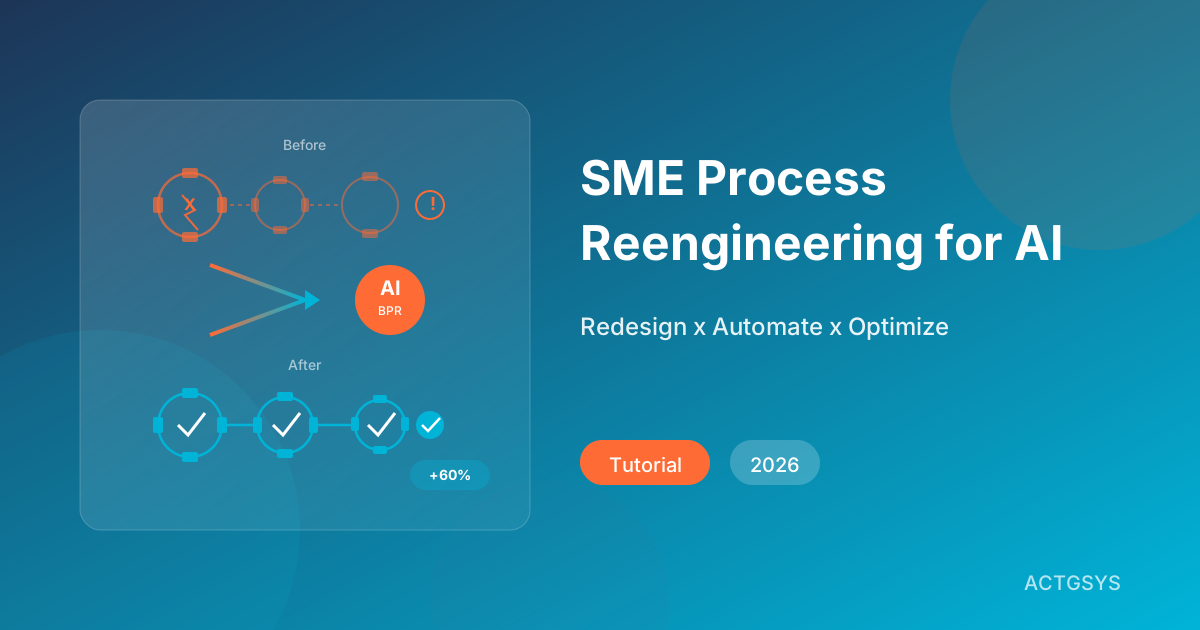
SME Process Reengineering for AI Automation (2026)
Why do most AI automation projects fail? This guide reveals that Business Process Reengineering (BPR) is the key to success, with a complete framework for SMEs.
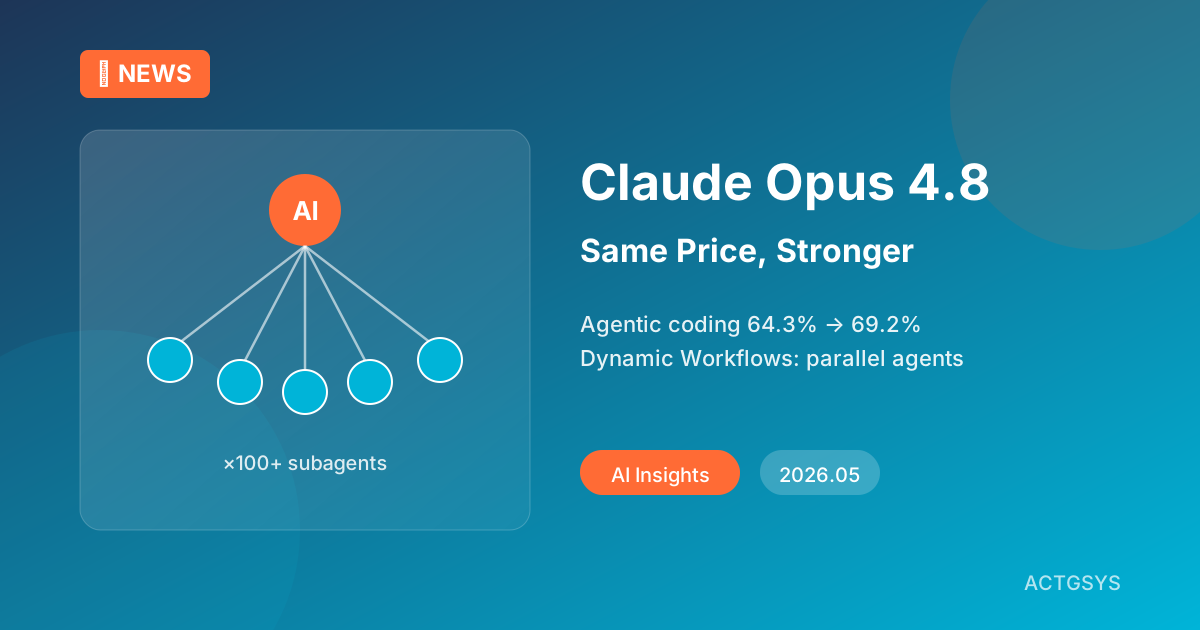
Anthropic Claude Opus 4.8 (2026): Same Price, Stronger
On May 28, 2026, Anthropic launched Claude Opus 4.8, holding the same $5 / $25 per 1M token pricing as its predecessor while lifting agentic coding from 64.3% to 69.2% and adding Dynamic Workflows — a research preview that orchestrates hundreds of parallel subagents. We unpack what this upgrade means for Taiwan SME automation.
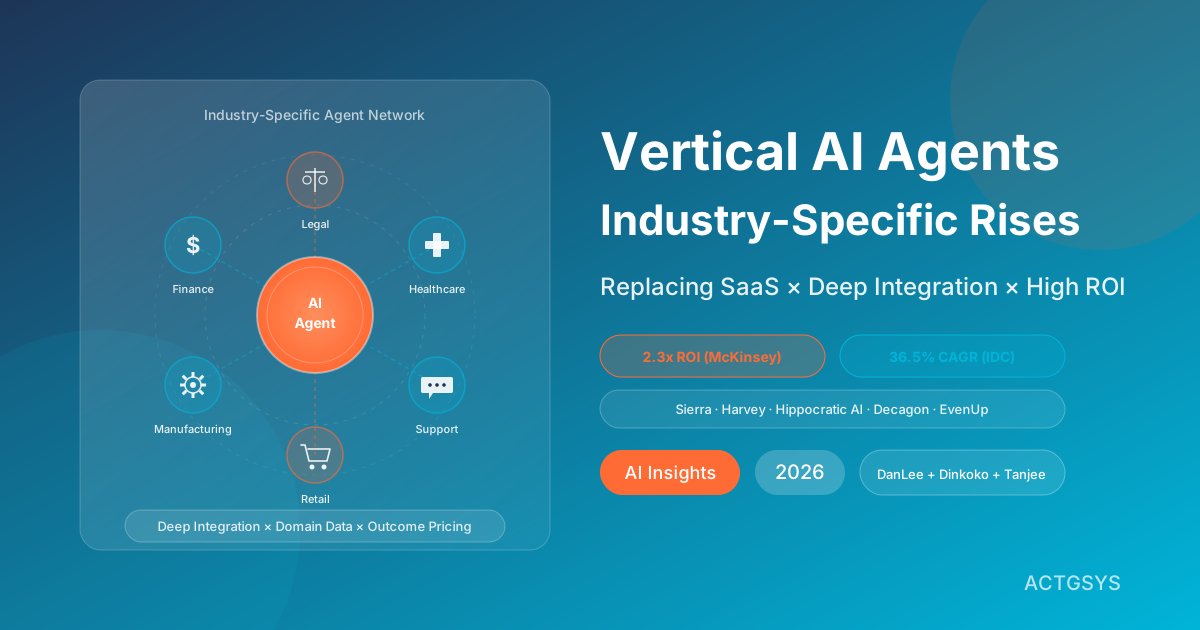
Vertical AI Agents 2026: Why Industry-Specific Agents Are Eating SaaS and How SMEs Choose or Build Their Own
An in-depth look at how Sierra, Harvey, Hippocratic AI and other vertical AI agents are replacing traditional SaaS, plus a 7-step playbook for SMEs to choose or build industry-specific agents.
What would this cost you?
Answer five questions. Within three working days you get a price range and what it covers. No deck, no follow-up sales calls.
Prefer to talk?LINE·02-2553-8084