AI Digital Transformation ROI for SMEs (2025)
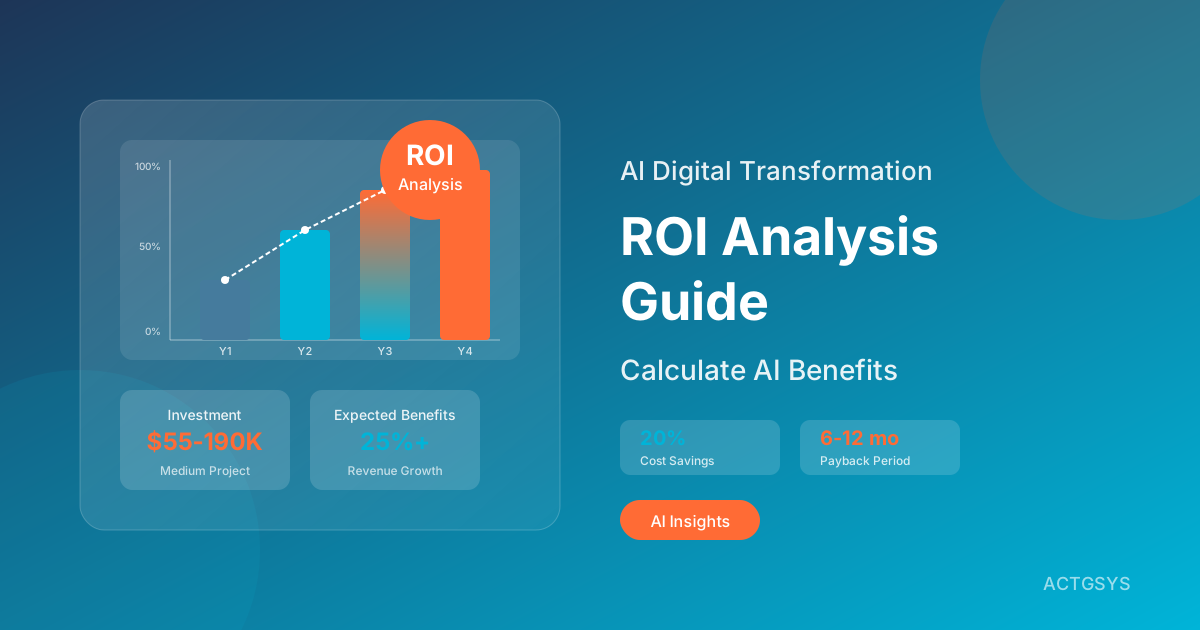
"Is AI digital transformation worth the investment?" This is the top concern for every SME owner when evaluating AI adoption. According to industry surveys, successful AI projects average 25% revenue growth and 20% cost savings, but simultaneously 70% of AI projects fail to meet expected targets. This article will help you understand how to calculate the true return on AI investment and avoid common pitfalls.
True Cost Structure of AI Digital Transformation
Direct Costs
Direct costs of implementing AI solutions include:
| Cost Item | Small Project | Medium Project | Large Project |
|---|---|---|---|
| Software License/Development | $50K-200K | $200K-800K | $800K-3M |
| Hardware/Cloud | $20K-100K/year | $100K-300K/year | $300K-1M/year |
| Consulting/Implementation | $50K-150K | $150K-500K | $500K-1.5M |
| Data Preparation | $30K-100K | $100K-300K | $300K-800K |
| Initial Total Cost | $150K-550K | $550K-1.9M | $1.9M-6.3M |
Hidden Costs (Often Underestimated)
Many businesses overlook these costs when planning:
-
Employee Training Costs
- Training time: 20-40 hours per person
- Productivity decline: Initial 2-3 months
-
Process Adjustment Costs
- Existing process redesign
- SOP documentation updates
- Cross-department coordination
-
Maintenance & Optimization Costs
- AI model continuous tuning (annual 15-25% of initial cost)
- Data quality maintenance
- System upgrades
-
Opportunity Costs
- Management time investment during project
- Opportunity cost of delayed other projects
Actual Cost Case
Case: Trading Company Implementing AI Customer Service Bot
| Item | Cost |
|---|---|
| LINE Bot Development | NT$ 180,000 |
| AI Model Training | NT$ 120,000 |
| System Integration (ERP/CRM) | NT$ 80,000 |
| Employee Training | NT$ 30,000 |
| Annual Maintenance | NT$ 60,000/year |
| First Year Total Cost | NT$ 470,000 |
AI Return on Investment (ROI) Calculation
Basic ROI Formula
ROI = (Net Benefits - Total Costs) / Total Costs × 100%

Net Benefits = Cost Savings + Revenue Increase + Intangible Benefit Value
Total Costs = Direct Costs + Indirect Costs + Maintenance Costs
Benefit Quantification Methods
1. Cost Savings Benefits
| Benefit Type | Calculation Method | Example |
|---|---|---|
| Labor Savings | Reduced hours × hourly rate | 80 hours/month saved × $300 = $24,000/month |
| Error Reduction | Error rate decrease × error cost | 50% reduction × $200,000 annual loss = $100,000 |
| Process Acceleration | Time shortened × opportunity cost | 3 day cycle reduction × $10,000/day = $30,000/case |
2. Revenue Increase Benefits
| Benefit Type | Calculation Method | Example |
|---|---|---|
| Conversion Rate Lift | Lift % × avg order value × prospects | 5% lift × $50,000 × 100 people = $250,000 |
| Customer Retention | Retention lift × customer lifetime value | 10% lift × $300,000 LTV × 50 people = $1,500,000 |
| New Opportunities | New customers × avg revenue | 20 new customers × $100,000 = $2,000,000 |
3. Intangible Benefits (Hard to Quantify but Important)
- Employee satisfaction improvement
- Customer experience enhancement
- Brand image strengthening
- Decision quality improvement
- Market response speed
Actual ROI Calculation Case
Case: Manufacturing Company Implementing AI Quality Inspection
Investment Costs:
- Initial implementation: NT$ 2,000,000
- Annual maintenance: NT$ 400,000
- 3-year total cost: NT$ 3,200,000
Benefit Analysis:
- Defect reduction: NT$ 800,000 saved annually
- Labor savings (2 QC staff reduction): NT$ 960,000 saved annually
- Customer complaints reduction: NT$ 200,000 saved annually
- 3-year total benefits: NT$ 5,880,000
ROI Calculation:
3-year ROI = (5,880,000 - 3,200,000) / 3,200,000 × 100%
           = 83.75%

Annualized ROI ≈ 28%
Payback period ≈ 20 months
5 Keys to Successful AI Projects
Key 1: Start with Clear Pain Points
Correct Approach: Choose quantifiable, high-impact business pain points
- ✅ Customer service response time too long (measurable: average 4 hours → target 30 minutes)
- ✅ Inventory forecasting inaccurate (measurable: 30% error → target 10%)
- ❌ "Want to try AI" (too vague)
- ❌ "Heard AI is hot" (not business-driven)
Key 2: Ensure Data Quality
Data Quality Checklist:
- Is data complete (missing values < 5%)
- Is data accurate (error rate < 1%)
- Is data sufficient (at least 6-12 months history)
- Is data accessible (format, permissions)
Key 3: Continuous Executive Support
AI projects need:
- Clear top management support
- Cross-department coordination authority
- Adequate budget and time
- Culture allowing experimentation
Key 4: Start with Small-Scale Validation
Recommended Implementation Path:
- POC Phase (1-2 months): Small-scale test concept feasibility
- Pilot Phase (2-3 months): Single department or complete process implementation
- Expansion Phase (ongoing): Gradually extend to other areas
Key 5: Establish Quantitative Tracking Mechanisms
Continuously track post-implementation:
- Weekly review of usage rate and adoption
- Monthly quantitative benefit reports
- Quarterly ROI evaluation and adjustment
- Annual strategy review
Common AI Project Failure Traps
Trap 1: Over-Expecting "Magic" Effects
Reality: AI isn't magic, it requires:
- High-quality data
- Clear business rules
- Continuous tuning optimization
- Human-machine collaboration design
Trap 2: Ignoring Change Management
Common Issues:
- Employee resistance to new systems
- Insufficient training
- Not adjusting performance metrics
- Ignoring user feedback
Trap 3: Technology First, Business Second
Wrong Order: Choose technology → find use cases Correct Order: Identify pain points → evaluate solutions → select technology
Trap 4: Underestimating Ongoing Investment
AI isn't a "one-time project," it requires:
- Continuous model maintenance (data drift, business changes)
- Regular performance evaluation
- Iterative new feature development
Trap 5: Lack of Clear Success Metrics
Must define before implementation:
- What are quantitative success standards?
- How to measure and track?
- How long to evaluate?
- Exit mechanism if unsuccessful?
Phased Implementation Strategy
Phase 1: Quick Wins (0-6 months)
Goal: Validate AI value with minimal cost
Recommended Applications:
- Customer service chatbot (auto-reply to common questions)
- Document auto-classification
- Basic data analysis dashboard
Budget: NT$ 150K-500K Expected ROI: 100-200%
Phase 2: Process Optimization (6-18 months)
Goal: Integrate AI into core business processes
Recommended Applications:
- Sales forecasting and inventory optimization
- Accounts receivable automation
- Quality anomaly alerts
Budget: NT$ 500K-2M Expected ROI: 50-100%
Phase 3: Strategic Transformation (18-36 months)
Goal: AI-driven business model innovation
Recommended Applications:
- Personalized product recommendations
- Dynamic pricing strategies
- Predictive maintenance services
Budget: NT$ 2M-5M Expected ROI: 30-80%
ROI Evaluation Tool: Quick Checklist
Pre-Implementation Assessment
| Assessment Item | Score (1-5) | Notes |
|---|---|---|
| Pain point clarity | __ | More specific the better |
| Data readiness | __ | Data quality & availability |
| Executive support | __ | Budget & authority support |
| Team capability | __ | Internal or external resources |
| Expected benefits | __ | Quantifiability level |
| Total | __/25 | >18 recommended to start |
Post-Implementation Tracking
| Tracking Metric | Target Value | Actual Value | Variance |
|---|---|---|---|
| Usage rate | __% | __% | __% |
| Efficiency improvement | __% | __% | __% |
| Cost savings | $__ | $__ | $__ |
| Revenue impact | $__ | $__ | $__ |
| User satisfaction | __/5 | __/5 | __ |
Frequently Asked Questions (FAQ)
Q1: Can small companies afford AI?
Yes. Many SaaS-form AI tools now available, monthly fees $500-5,000 to start. For example, AI customer service bots, smart scheduling tools, etc., no large upfront investment needed.
Q2: What's a reasonable ROI?
General recommendations:
- First year ROI > 50%: Excellent project
- First year ROI 20-50%: Reasonable range
- First year ROI < 20%: Needs review or long-term investment
But also consider intangible benefits and strategic value.
Q3: How long to see benefits?
Varies by project type:
- Quick results (1-3 months): Chatbots, document processing
- Medium-term results (3-6 months): Predictive analytics, process automation
- Long-term results (6-12 months): Complex decision support, business model innovation
Q4: What if it fails?
Recommended approach:
- Start with small POC, reduce failure risk
- Set clear stop-loss points
- Document lessons learned for next time
- Evaluate whether to adjust or terminate
Q5: Need AI experts?
Depends on situation:
- Self-handle: Use ready-made SaaS tools
- Consultation recommended: Custom needs, system integration
- Must have experts: Complex AI model development, large-scale implementation
Conclusion: Rational Evaluation, Decisive Action
AI digital transformation isn't a question of "whether to do it," but "how to do it well." Through this article's ROI analysis framework, you should be able to more clearly evaluate the true value of AI investment.
Remember these key principles:
- Start from pain points, not from technology
- Small steps, quick iterations, rapidly validate and adjust
- Quantitative tracking, let data speak
- Continuous optimization, AI is a journey not a destination
Successful AI implementation isn't about how much you spend, but how many problems you solve and how much value you create.
Want to evaluate your business's AI transformation potential?
ACTGSYS Blueprint Thinking provides free AI digital transformation consulting to help you identify optimal entry points, evaluate investment returns, and plan implementation paths suitable for your business.
Products & Solutions in This Article
Related Articles
SME Process Reengineering for AI Automation (2026)
Why do most AI automation projects fail? This guide reveals that Business Process Reengineering (BPR) is the key to success, with a complete framework for SMEs.
Complete SME AI Digital Transformation Guide
Learn how to implement AI solutions for your small and medium-sized enterprise. A comprehensive guide from strategic planning to practical deployment, helping business owners make smart technology investment decisions.
AI Accounting Automation 2025: Save 80% of Time
In-depth analysis of AI accounting automation trends. Discover how 83% of accountants leverage AI tools to boost efficiency. Complete coverage of automated bookkeeping, invoice processing, financial analysis, and more to help you choose the best AI accounting solution.
What would this cost you?
Answer five questions. Within three working days you get a price range and what it covers. No deck, no follow-up sales calls.
Prefer to talk?LINE·02-2553-8084