AI Digital Twins for Business Operations
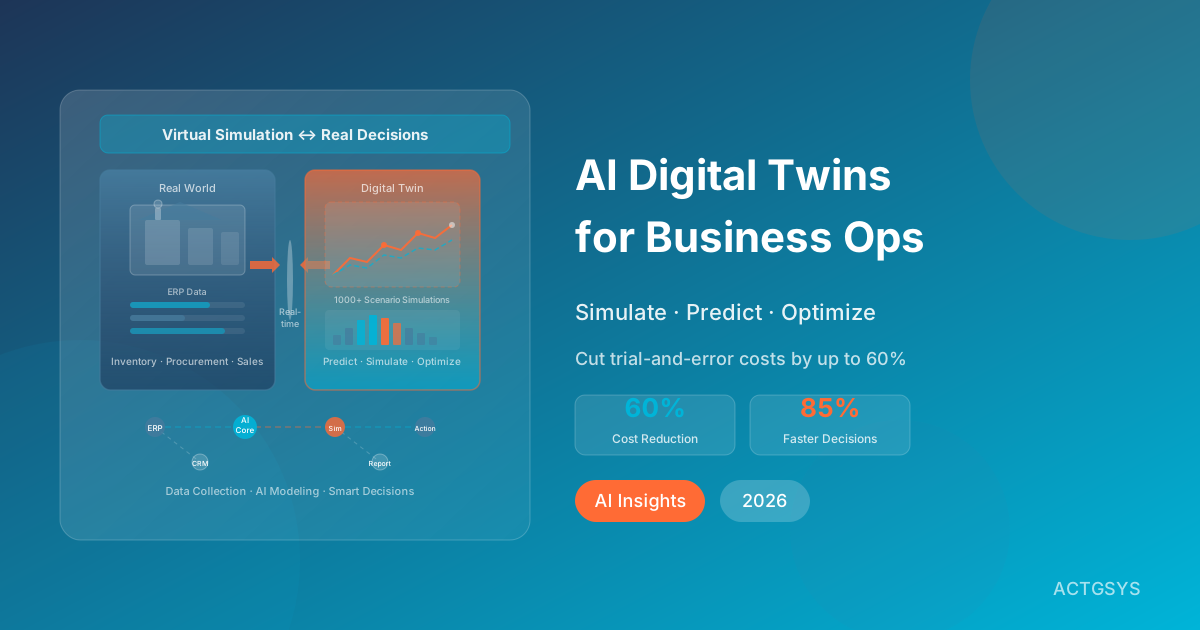
When Boeing virtually assembles and tests an entire aircraft before manufacturing a single physical part, that is digital twin technology at its most dramatic. What began as an aerospace engineering marvel has undergone a remarkable expansion. In 2026, AI Digital Twins are no longer the exclusive domain of industrial giants — small and medium-sized enterprises can now use them to simulate supply chain disruptions, model new product launches before they happen, and virtually test different team configurations before a single hire is made. According to Gartner, by the end of 2026, more than 40% of large and mid-sized companies globally will use some form of digital twin in key decision-making — and this wave is rapidly spreading into the SME market.
What Is an AI Digital Twin? From Industrial Origins to Business Applications
The core concept of a Digital Twin is building a complete virtual replica of a physical object or process, then keeping that virtual copy synchronized with reality in real time. NASA first applied this concept to remote spacecraft diagnostics. Manufacturing later adopted it for equipment health monitoring. Today, the addition of AI has transformed digital twins from "passive mirrors" into "active intelligence."
The difference between an AI Digital Twin and a traditional digital twin comes down to two key capabilities:
- Predictive simulation: It doesn't just reflect the current state — it predicts "if I do X, the result will be Y"
- Autonomous optimization: AI models continuously learn from real-world data, making the virtual model increasingly accurate over time
For SMEs, the most practical commercial application of AI digital twins isn't factory machine monitoring — it's a virtual simulator for business operations. Imagine being able to answer the following questions with zero real-world risk:
- "If I add a second production line, will profits rise or fall?"
- "During peak season, if I increase inventory by 30%, will our warehouse capacity be sufficient?"
- "If our top customer suddenly churns, how many months can our cash flow sustain operations?"
This is the core value AI digital twins deliver to SMEs: the best possible decision data at the lowest possible trial-and-error cost.
Why Do SMEs Need Digital Twins? Four Key Application Scenarios
Scenario 1: Supply Chain Stress Testing
The supply chain is one of the most vulnerable links for SMEs. The global supply chain crisis of the early 2020s caught countless businesses unprepared, while AI digital twins allow companies to rehearse risk scenarios before they materialize.
By feeding ERP data — procurement records, inventory levels, supplier profiles — into a digital twin model, businesses can simulate:
- Supplier disruption scenarios: If a key supplier halts delivery for 30 days, how long can existing inventory hold out? What's the cost differential of activating backup suppliers?
- Transit time changes: If ocean freight extends from 30 to 45 days, which SKUs will be the first to run out?
- Demand spike scenarios: If next month's orders surge by 50%, can the existing supply chain absorb the volume without stockouts?
One Taiwanese manufacturing SME deployed a supply chain digital twin and successfully simulated logistics disruptions ahead of typhoon season. They pre-positioned 20 days of buffer inventory — and when competitors scrambled, this company shipped on time and captured orders that rivals lost.
Scenario 2: Operational Process Optimization
SME operations are often governed by "habitual practice" rather than "best practice." AI digital twins can replicate an entire operational process and run through thousands of virtual iterations to identify bottlenecks and optimization opportunities.
Typical case: A 50-person e-commerce company consistently received complaints about slow order fulfillment. By building a digital twin of their warehouse operations and simulating over 500 different picking route combinations, they discovered that relocating just 3 SKUs within the warehouse would reduce average fulfillment time by 18% — with zero additional headcount required.
This "test virtually first, execute in reality second" approach reduces the cost of process improvement experimentation by more than 60%.
Scenario 3: Customer Behavior Modeling
Combined with CRM data, AI digital twins can build virtual behavioral models of customer segments — enabling companies to predict the impact of different strategies before launching any real-world marketing campaign.
- Pricing strategy simulation: If Product A is discounted by 10%, how much will the conversion rate improve? What's the net impact on gross margin?
- Promotion outcome prediction: Among different promotion structures (spend-threshold gifts, discount codes, buy-one-get-one), which generates the highest incremental orders?
- Churn prevention modeling: Which customers face the highest churn risk in the next 90 days? What is the cost-to-revenue ratio of proactive intervention?
Scenario 4: Resource Planning and Workforce Configuration
Seasonal volatility hits SMEs particularly hard. AI digital twins help businesses plan headcount, equipment, and budget allocation in advance:
- Simulate productivity and cost under different peak-season staffing configurations
- Predict the capacity impact of scheduled equipment maintenance
- Evaluate the profit impact of adding shifts versus outsourcing
The Core Technical Architecture of AI Digital Twins
Understanding the technical architecture helps SMEs make more informed decisions when evaluating solutions. An AI digital twin system typically consists of four layers:
Data Collection Layer
The quality of a digital twin depends on the quality and breadth of its data. This layer continuously collects real-time or near-real-time data from multiple systems:
- ERP systems: Purchase orders, sales orders, inventory levels, financial statements
- CRM systems: Customer interaction logs, transaction history, service tickets
- Production systems: Machine status, output data, quality inspection results
- External data: Market price indices, weather data, industry news
For SMEs, the critical insight about this layer is that you don't need perfect data to start. Even with gaps in existing data, AI models can make reasonable inferences based on historical patterns and self-correct as the system accumulates more real-world inputs.
AI Model Layer
This is the digital twin's "brain." Depending on the use case, different types of AI models may be employed:
- Time-series forecasting models: For demand forecasting and equipment lifespan prediction
- Reinforcement learning models: For automatically discovering optimal resource allocation strategies
- Causal inference models: For analyzing "if X changes, how does Y respond?"
- Generative AI: For producing decision recommendations, report summaries, and scenario narratives
Simulation Engine
The simulation engine is the digital twin's "laboratory." It receives parameter settings from AI models and rapidly executes large volumes of simulated scenarios in an isolated environment — using techniques like Monte Carlo simulation and scenario analysis — then aggregates outcome distributions across all runs.
A high-quality simulation engine can:
- Complete thousands of scenario simulations in seconds
- Account for random variation and uncertainty (rather than delivering a single deterministic prediction)
- Annotate each scenario with its estimated probability of occurrence
Decision Interface
Ultimately, the value of a digital twin must be translated into recommendations that decision-makers can understand and act on. The decision interface is responsible for:
- Presenting simulation results visually (charts, heat maps, scenario comparisons)
- Automatically generating "Option A vs. Option B" comparison reports
- Setting alert thresholds that proactively notify stakeholders when risk scenarios emerge
Digital Twin Solution Comparison
The digital twin market spans platform-grade enterprise tools to vertical-specific products. Below is a practical comparison for SME decision-makers:
| Dimension | Industrial Digital Twin Platform | Vertical SaaS Solution | ERP-Integrated Module |
|---|---|---|---|
| Suitable Scale | 100+ employees | 10–200 employees | 50–500 employees |
| Implementation Cost | High (USD 30K+) | Medium (monthly subscription) | Medium (module fee) |
| Customization | High | Low–Medium | Medium |
| Technical Barrier | High (requires specialist team) | Low (SaaS interface) | Low–Medium (requires ERP foundation) |
| Data Integration Difficulty | Complex | Simple | Simple (native integration) |
| Simulation Accuracy | Very high | Moderate | Moderate–High |
| Time to Go Live | 6–18 months | 1–4 weeks | 2–8 weeks |
| Key Advantage | High precision, high customization | Fast onboarding, low cost | Complete data, high scenario relevance |
For most SMEs, an ERP-integrated module is the optimal entry point. The ERP system has already accumulated extensive historical business data — building a digital twin on top of that foundation eliminates the need for complex data integration, and the simulated scenarios are inherently aligned with day-to-day business operations.
ERP-Data-Driven Digital Twin Strategy in Practice
Dinkoko ERP's digital twin functionality is built on exactly this principle: using a company's existing ERP data as the foundation to build a simulatable virtual operations replica. Here is a three-step practical implementation strategy:
Step 1: Establish a Data Baseline (1–2 Weeks)
Before simulation can begin, the completeness of ERP data must be verified. Key areas to audit:
- Are Bills of Materials (BOMs) complete and current?
- Is the past 12–24 months of sales history gap-free?
- Are supplier lead time records accurate?
- Is the cost structure (direct costs, overhead) properly recorded?
The more complete the data baseline, the higher the reliability of simulation results. Where gaps exist, industry benchmark data can serve as a temporary placeholder — to be replaced by real data as the system accumulates operational history.
Step 2: Define Core Simulation Scenarios (2–4 Weeks)
Don't try to simulate everything at once. Start with the 3–5 core questions that have the greatest impact on your business:
Example question checklist:
- "If our largest customer's order volume drops by 40%, how long will it take to find replacement business?"
- "Is it worth adding a production line next quarter? Where is the break-even point?"
- "If we expand warehouse space by 30%, what is the impact on inventory turnover and capital tied up in stock?"
Step 3: The Simulate-Decide-Validate Iteration Loop (Ongoing)
The value of a digital twin is not a one-time analysis report — it's a continuous decision support cycle:
- Simulate: Test different decision options in the virtual environment
- Decide: Select the best option based on simulation results and execute it in the real world
- Validate: Feed actual outcomes back into the digital twin model to continuously calibrate accuracy
Every iteration deepens the digital twin's understanding of your specific business dynamics — and makes each subsequent simulation more accurate.
Cost-Benefit Analysis of Digital Twin Implementation
The question most SME owners ask is: "Is this investment worth it?" Here is a performance comparison based on real data from companies that have already implemented:
| Performance Metric | Before Implementation | After Implementation | Improvement |
|---|---|---|---|
| Excess/obsolete inventory rate | 15–25% | 8–12% | 40–60% reduction |
| Annual trial-and-error costs | Baseline | Baseline × 0.4 | 60% reduction |
| Time to reach major decisions | 7–30 days | 1–3 days | 80–90% faster |
| Supply chain disruption response time | 7–14 days | 1–2 days | 85% faster |
| Resource utilization efficiency | Baseline | +20–35% | Significant increase |
| Budget achievement rate | 65–75% | 82–90% | 15–25% improvement |
Return on Investment Timeline:
For a manufacturing SME with annual revenue between USD 150K–3M, the typical cost of an ERP-integrated digital twin module is approximately USD 500–1,500 per month. Based on the efficiency metrics above (with inventory optimization as the primary benefit), companies typically recover the full annual investment within 6–10 months.
When the cost of avoiding major decision errors is factored in — such as preventing an over-procurement mistake or an ill-timed production line expansion — ROI can be realized in as little as 3–6 months.
Frequently Asked Questions
Q1: Our company is small with limited data. Is a digital twin still useful for us?
The barrier to entry is lower than you might think. Even with just 2–3 years of ERP history, AI models can build effective foundational simulations. More importantly, digital twins improve continuously with use — the more data accumulates, the more accurate the model becomes. A 15-person wholesaler with just 18 months of purchase and sales data built a demand forecasting model with 78% accuracy, avoiding costly over-purchasing in the very first peak season after deployment.
Q2: Do we need our own IT team to implement a digital twin?
Modern ERP-integrated digital twin solutions (such as Dinkoko ERP's simulation module) use a SaaS architecture — companies don't need to maintain their own servers or AI infrastructure. Business users simply need to learn how to set simulation parameters and interpret results in the interface. The typical learning curve is 1–2 weeks.
Q3: How accurate are digital twin simulations? Can we rely on them completely for decision-making?
Accuracy depends on data quality and scenario complexity. With complete data, demand forecasting accuracy typically falls between 70–85%, and supply chain risk assessment directional accuracy exceeds 90%. We recommend treating digital twins as a decision support tool rather than a decision replacement tool — they help you see the potential consequences of different choices more quickly, but final decisions should always integrate business experience and external judgment.
Q4: Can our existing ERP integrate with a digital twin? Do we need to switch systems?
Most mainstream ERP systems (including Dinkoko ERP) provide API interfaces that can connect to external digital twin platforms. If your ERP system has built-in digital twin functionality, integration is naturally seamless. For older legacy ERP systems, a feasibility assessment for data export would be the first step in determining the integration approach.
Q5: How is the security of digital twin data protected?
Business data security is a legitimate and critical concern. Mainstream enterprise digital twin solutions provide: encrypted data transmission and storage, private cloud deployment options, granular access control, and complete data audit logs. Dinkoko ERP offers both public cloud and private deployment options — sensitive data can remain entirely within the company's own environment.
Conclusion: From Reactive to Proactive
One of the persistent challenges for SMEs is making decisions under conditions of limited resources and high uncertainty. AI digital twins transform the expensive "trial-and-error-then-learn" model into the efficient "simulate-then-decide" model.
This capability is no longer reserved for large enterprises. Today, a 20-person manufacturer can affordably rehearse 100 different market response strategies in a virtual environment. A 50-person trading company can discover the optimal inventory configuration without making a single costly mistake in the real world.
The best time to start is now. If you'd like to explore how to build an AI digital twin for your business, or evaluate whether Dinkoko ERP's digital twin functionality fits your operations, contact us — our consulting team will help you design the right implementation path.
Products & Solutions in This Article
Related Articles
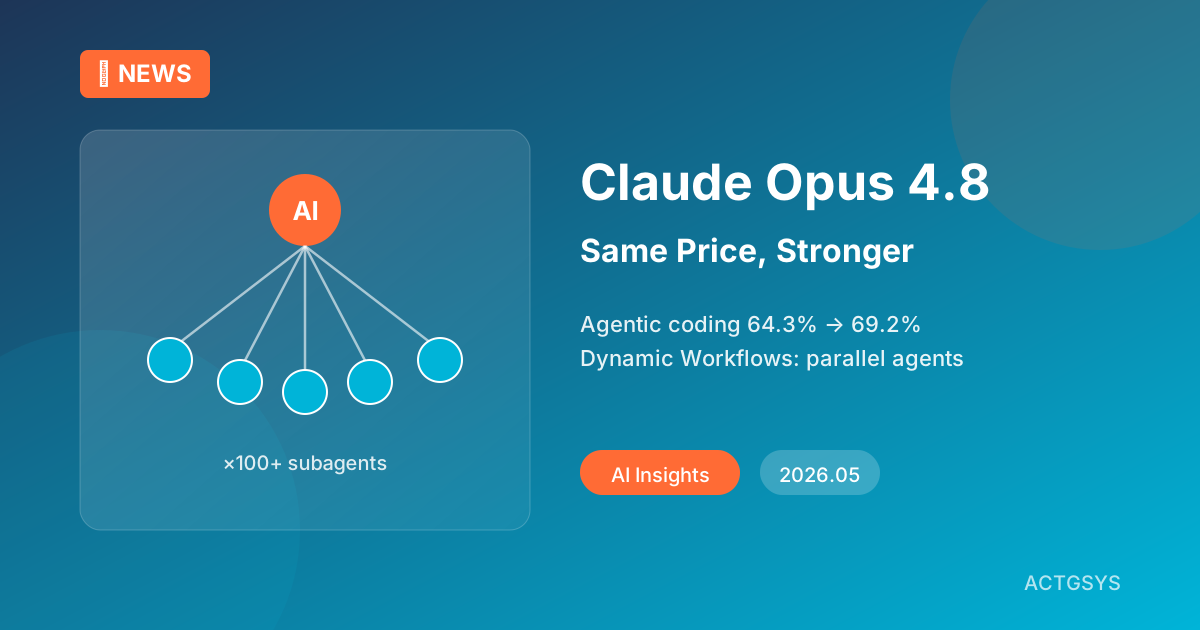
Anthropic Claude Opus 4.8 (2026): Same Price, Stronger
On May 28, 2026, Anthropic launched Claude Opus 4.8, holding the same $5 / $25 per 1M token pricing as its predecessor while lifting agentic coding from 64.3% to 69.2% and adding Dynamic Workflows — a research preview that orchestrates hundreds of parallel subagents. We unpack what this upgrade means for Taiwan SME automation.
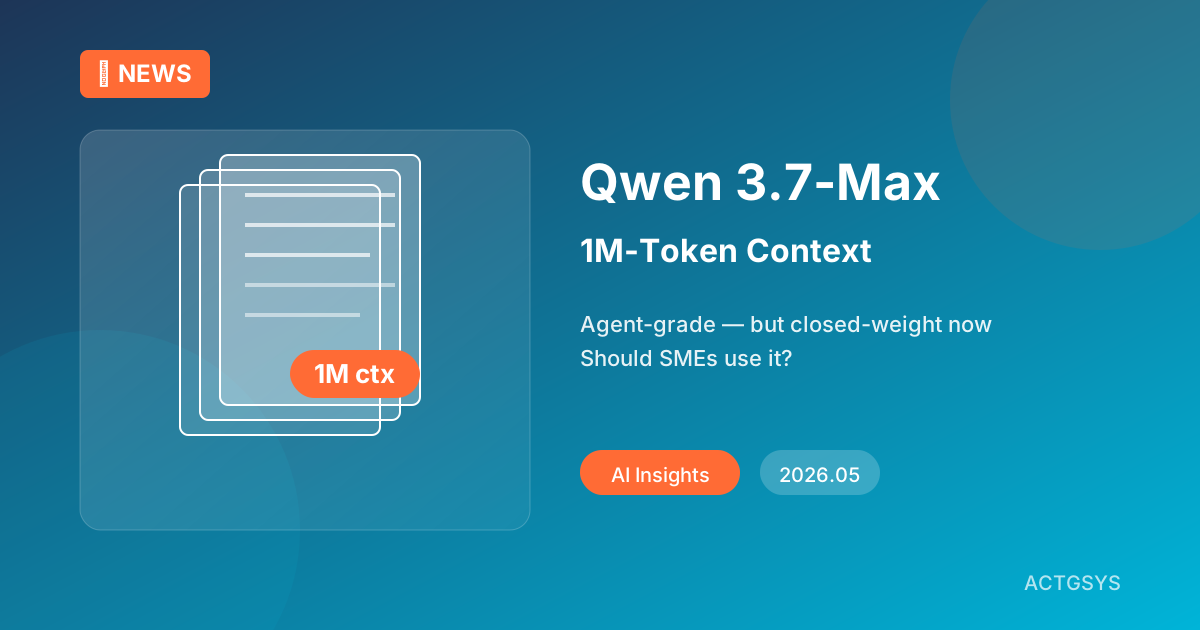
Alibaba Qwen 3.7-Max (2026): 1M-Token Context
On May 20, 2026, Alibaba launched Qwen 3.7-Max with a 1M-token context window and native extended thinking, scoring 69.7 on Terminal-Bench 2.0 and 60.6 on SWE-Bench Pro — but it's closed-weight and API-only for the first time. We unpack what this Chinese flagship means for Taiwan SME long-document processing and cost.
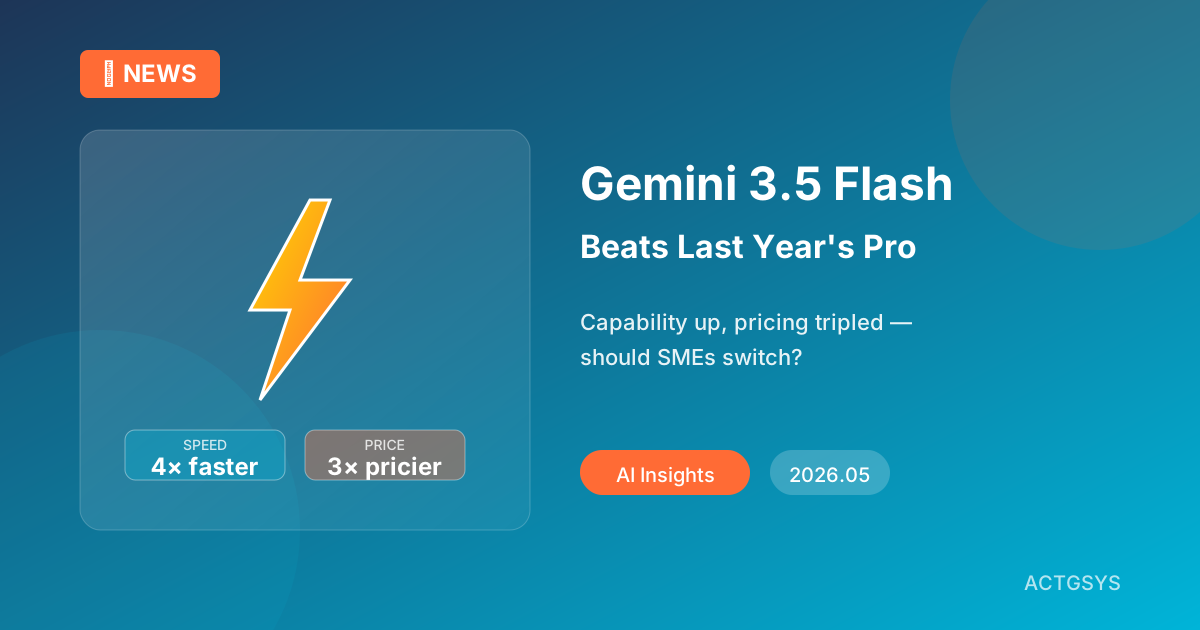
Google Gemini 3.5 Flash (2026): Flash Beats Last Year's Pro
On May 19, 2026 at I/O 2026, Google launched Gemini 3.5 Flash with coding and agentic benchmarks that beat Gemini 3.1 Pro — but API pricing tripled vs. the previous Flash. We unpack the model's strength, the pricing strategy, and what Taiwan SMEs should do.