AI ESG Sustainability Reporting Guide 2026
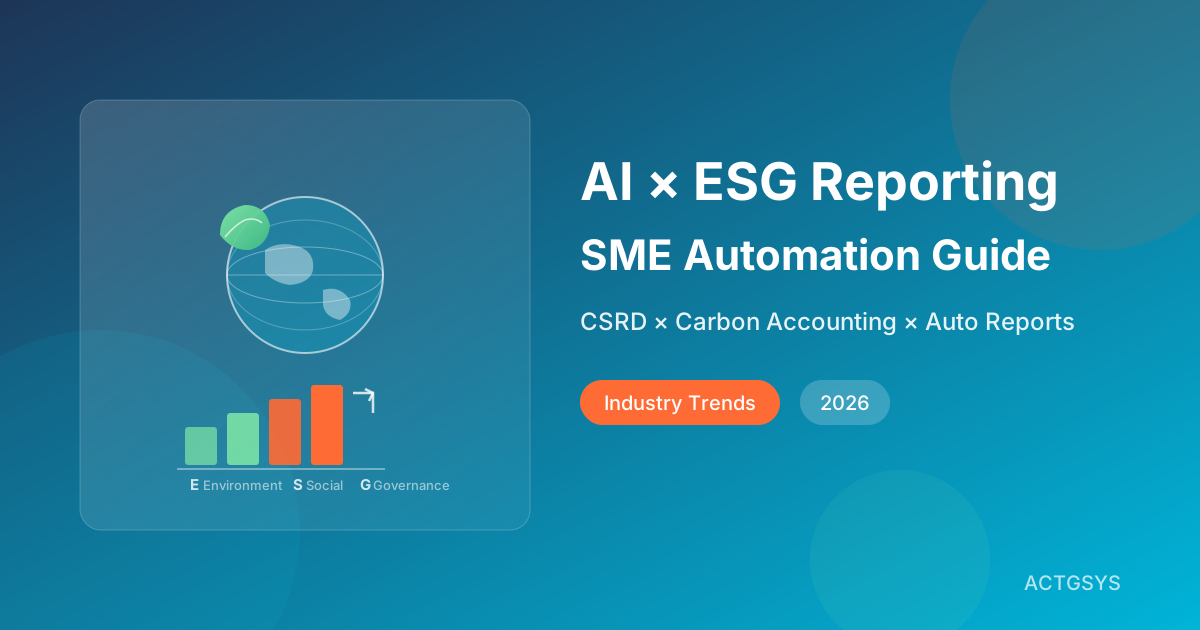
TL;DR: AI can automate ESG data collection, carbon accounting, and draft report generation, cutting an SME's sustainability reporting cycle from six months to six weeks. Under CSRD and Taiwan FSC's 2026 disclosure rules, AI has shifted from "nice to have" to a prerequisite for winning EU contracts.
McKinsey's "Sustainability through AI" research finds AI can reduce sustainability data-collection costs by 40-70% and cut reporting cycle time in half (McKinsey & Company, 2025). For Taiwan and Asia SMEs with thin sustainability teams, that's the difference between landing or losing a European purchase order.
What Is ESG Sustainability Reporting? How 2026 Regulations Affect SMEs
ESG sustainability reporting is the formal disclosure of a company's Environmental, Social, and Governance performance. From 2026, multiple regulations push this obligation, once reserved for large public companies, deep into the SME supply chain.
The EU's Corporate Sustainability Reporting Directive (CSRD) is being phased in from 2024 onward. According to the European Commission, roughly 50,000 companies fall in scope, nearly 4x the old NFRD regime, and reporting requirements cascade down to suppliers through Scope 3 data demands.
In Taiwan, the Financial Supervisory Commission (FSC)'s Sustainable Development Roadmap requires listed companies with paid-in capital over NT$2 billion to adopt IFRS Sustainability Disclosure Standards (ISSB S1 & S2) from 2026, with smaller listed companies phased in through 2027-2028 (FSC Securities and Futures Bureau, 2024).
Three pressures hit SMEs at once: listed-company customers asking for Scope 3 supply-chain carbon data, EU buyers requesting CSRD-aligned disclosures, and banks integrating sustainability scoring into credit decisions. No ESG data, no orders, no financing.
Why Manual ESG Reporting Fails for SMEs
Manual ESG reporting almost always fails at SMEs because four structural problems collide: scattered data, thin staffing, complex calculations, and a yearly redo cycle.
A joint BCG and SAP survey found that only 9% of companies can fully measure their greenhouse gas emissions, while 91% rely on estimates or partial data, undermining audit assurance (BCG x SAP Sustainability Report, 2023).
Specific pain points:
- Scattered data: electricity bills, fuel receipts, travel logs, raw material POs live in utility portals, paper forms, ERP, Excel, and email. Collecting them eats 2-3 staff for months.
- Calculation complexity: carbon accounting follows ISO 14064-1 and the GHG Protocol Scope 1, 2, 3 rules. Each fuel, material, and transport mode has different emission factors—manual math goes wrong fast.
- Standards evolve fast: GRI, SASB, TCFD, ISSB S1/S2, and ESRS update annually. SMEs without a dedicated sustainability team can't keep up.
- No reusable asset: every year the same data is re-collected and re-formatted to new templates, with nothing compounding.
Deloitte's 2024 CxO Sustainability Report surveyed 2,100 executives and found that 42% cite "data quality and availability" as the top barrier to ESG progress (Deloitte 2024 CxO Sustainability Report, 2024).
How AI Automates ESG Data Collection, Calculation, and Report Generation
AI automates ESG reporting through four core capabilities—document understanding, data integration, calculation engines, and natural-language generation—turning a multi-month consulting engagement into a continuous, auditable workflow.
Gartner forecasts that by 2027, 80% of enterprises will use AI-powered sustainability data platforms instead of spreadsheets (Gartner Sustainability Tech Hype Cycle, 2024). Tier 1 model providers including Anthropic Claude and Google Cloud Sustainability now ship dedicated APIs and evaluation frameworks for sustainability data.
Concrete use cases:
| AI Capability | ESG Pain Point Solved | Real-World Impact |
|---|---|---|
| Document OCR + LLM parsing | Auto-read utility bills, fuel receipts, raw material POs | Saves 60-80 hours/month of manual data entry |
| Cross-system data integration | Pull data from ERP, HR, and accounting into one dataset | Dinkoko ERP ships with built-in ESG module |
| Carbon calculation engine | Apply latest GHG Protocol & IPCC factors to Scope 1/2/3 | Calculation error rate drops from 15% to <1% |
| Report drafting | Generate GRI, ISSB S1/S2, and CSRD ESRS narratives | Draft time falls from 6 weeks to 3 days |
| Bilingual alignment | Produce English and Chinese reports together for EU and FSC | Translation costs down ~70% |
Microsoft Sustainability Manager and Google Cloud Sustainability have already embedded AI agents in their emission-calculation flows, but these platforms primarily target large enterprises—licensing is steep for Taiwan SMEs. In practice, pairing your existing ERP/CRM with an open-source calculation engine plus an LLM API is more cost-effective.
Six-Step Practical Guide for SME AI ESG Implementation
The following six steps are the playbook ACTGSYS uses to deploy AI ESG automation at SMEs, with total deployment time around 8-12 weeks.
- Step 1: Map the regulatory target (1 week)—identify whether you're reporting for Taiwan FSC listed disclosure, EU CSRD customers, or supply-chain questionnaires. Each maps to a different framework (GRI, ISSB, ESRS, CDP) and scopes the project very differently.
- Step 2: Build the data source inventory (1-2 weeks)—catalog every source of electricity, fuel, water, travel, waste, and raw material data. Wire up Dinkoko ERP, HR systems, and accounting books, and document access methods for each.
- Step 3: Deploy the AI document pipeline (2-3 weeks)—use LLM + OCR to auto-read utility bills, fuel invoices, and freight receipts, extracting quantity and unit. This is where labor savings are largest.
- Step 4: Build the carbon accounting engine (2 weeks)—apply GHG Protocol, ISO 14064-1, and Taiwan Ministry of Economic Affairs emission factors to compute Scope 1, 2, 3. Logic must be transparent enough for third-party assurance.
- Step 5: Auto-generate draft narrative (1-2 weeks)—use Claude or GPT-4 class LLMs to produce GRI- or ISSB-structured English and Chinese drafts, integrated through platforms like TanJee which can pull internal data securely.
- Step 6: Human review and third-party assurance (ongoing)—AI does not replace assurance providers (BSI, SGS, TÜV). The final stage requires sustainability officer or consultant review, then independent assurance for the verification statement.
PwC's 2024 Global Investor Survey reports that 73% of investors do not trust sustainability data without independent assurance (PwC Global Investor Survey, 2024), so Step 6 is non-negotiable. AI handles the first 80% efficiency lift; the final 20% still demands human and auditor judgment.
AI ESG Tool & Platform Comparison Table
SMEs typically choose between three buckets of solutions: global enterprise SaaS, local sustainability software, or self-built AI + ERP integration. The table below helps frame the decision.
| Solution Type | Representative Products | Monthly Cost (SME tier) | Strengths | Weaknesses |
|---|---|---|---|---|
| Global enterprise SaaS | Microsoft Sustainability Manager, Salesforce Net Zero Cloud, SAP Sustainability | US$1,500-6,500 | Full features, regulatory certifications | Expensive, hard to customize, heavy implementation |
| Local sustainability software | Taiwan-built disclosure platforms | US$300-1,300 | FSC-aligned, traditional Chinese UI | Shallow AI, limited cross-border acceptance |
| Self-built AI + ERP | Dinkoko ERP + DanLee CRM + LLM API | US$150-650 (mostly API usage) | Highly customizable, integrates existing data, low cost | Needs a technical partner to build |
| Consultant outsourcing | Big Four firms, local sustainability consultants | US$10,000-50,000/year | High professional bar, clear accountability | Expensive, redone yearly, no internal knowledge build-up |
For SMEs with revenue between US$30M and US$1B, the recommended pattern is "self-built AI + ERP + third-party assurance"—use AI for 80% of data work and drafts, then redirect savings into independent assurance for credibility. IDC projects that Asia-Pacific ESG software will hit US$1.4 billion by 2027 at a 22% CAGR (IDC Worldwide ESG Software Forecast, 2024), so this stack will only get more mature.
Frequently Asked Questions
How do I write an ESG report? Where should an SME start?
Start with "what does my customer require" rather than "what do the standards say." Confirm whether listed-company customers want GRI or SASB, EU buyers want CSRD/ESRS, and supply-chain questionnaires use CDP or EcoVadis. Frameworks follow customer demand, not the other way around.
What is CSRD? Will it apply to Taiwan SMEs?
CSRD is the EU's Corporate Sustainability Reporting Directive, directly regulating EU-domiciled companies. But if you supply EU enterprises, you will almost certainly be asked to provide ESRS-aligned data through Scope 3 cascades. From 2026, any EU purchase order practically requires an ESG data pack.
Can AI-calculated emissions pass SGS or BSI third-party assurance?
Yes, provided calculation logic is transparent, emission-factor versions are traceable, and source documents are preserved. AI doesn't turn calculation into a black box; it automates spreadsheets. As long as the workflow follows ISO 14064-1, assurance providers accept AI-assisted reporting.
How much does AI ESG automation cost an SME?
Based on ACTGSYS deployments, SMEs with US$30M-300M revenue using Dinkoko ERP + LLM API + third-party assurance typically spend US$10,000-25,000 in year one and US$5,000-10,000 from year two. That's a 60-70% saving over three years versus full consulting outsourcing.
Does Taiwan FSC's 2026 disclosure rule affect non-listed SMEs?
There's no direct legal obligation, but indirect pressure is significant. Listed-company customers must disclose Scope 3 supply-chain emissions, forcing them to demand carbon data from suppliers. Banks are also integrating sustainability scoring into credit reviews. From 2026, SMEs without ESG data face order loss and higher financing costs.
Last updated: 2026-05-06
Ready to let AI handle your ESG sustainability reporting?
The ACTGSYS team integrates DanLee CRM, Dinkoko ERP, and LLM APIs to help SMEs:
- Map ESG data sources and integrate existing systems
- Automate Scope 1, 2, 3 carbon accounting calculations
- Generate GRI, ISSB, and CSRD ESRS draft reports in English and Chinese
- Hand off to SGS, BSI, and TÜV for third-party assurance
Book a free ESG automation consultation and turn sustainability reporting from an annual burden into leverage for new orders and better financing.
Products & Solutions in This Article
AI-powered CRM for lead management, customer tracking, and sales pipeline optimization designed for SMEs.
AI-driven ERP focusing on procurement, inventory, and supply chain management. Each customer deployed on dedicated cloud infrastructure.
Intuitive accounting system designed for Taiwan SMEs, with automated bookkeeping and financial reporting.
Related Articles
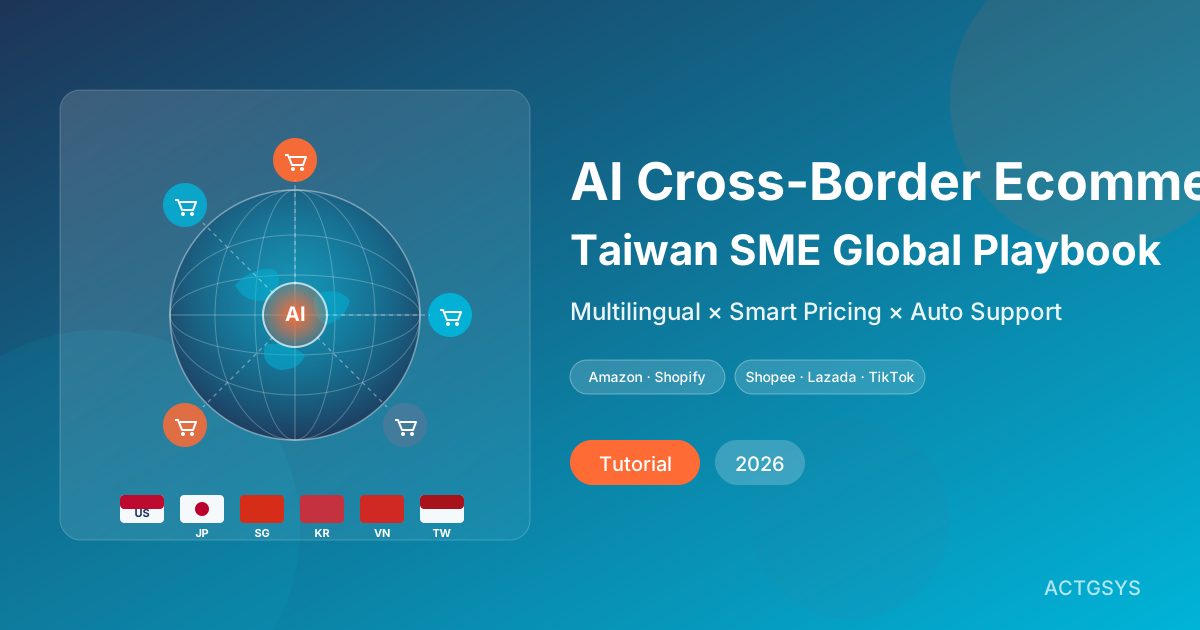
AI Cross-Border Ecommerce Playbook for SMEs (2026)
How Taiwan SMEs use AI to automate cross-border e-commerce — multilingual listings, smart customer service, dynamic pricing, ad ops, and logistics forecasting across Amazon, Shopify, Shopee, Lazada, and TikTok Shop.

2025 SME AI Automation Adoption: 68% Now Use AI Tools Daily
Latest survey shows 68% of SMEs use AI automation tools daily, a 23% quarterly increase. In-depth analysis of popular AI applications, budget allocation, success factors, and AI adoption strategies for SMEs.
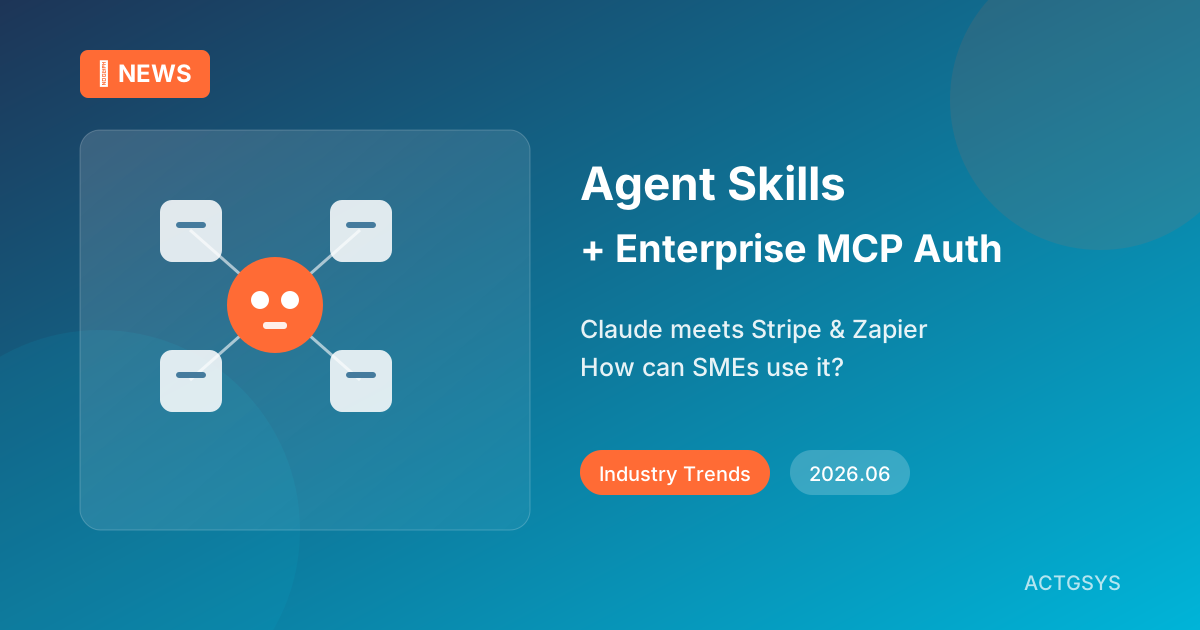
Anthropic Agent Skills as an Open Standard + Enterprise-Managed MCP Auth (2026): Wiring Claude into Stripe, Zapier, and Figma
In June 2026 Anthropic turned Agent Skills into an open standard, launching with 10 partners (including Atlassian, Figma, Canva, Stripe, Zapier), and on June 18 shipped Enterprise-Managed Authorization (EMA) for MCP connectors so IT admins can provision connectors org-wide via Okta. Here's what it means for 'wiring AI into your existing tools' and how Taiwan SMEs should adopt it.
What would this cost you?
Answer five questions. Within three working days you get a price range and what it covers. No deck, no follow-up sales calls.
Prefer to talk?LINE·02-2553-8084