AI Hyper-Personalization with CRM Marketing (2026)
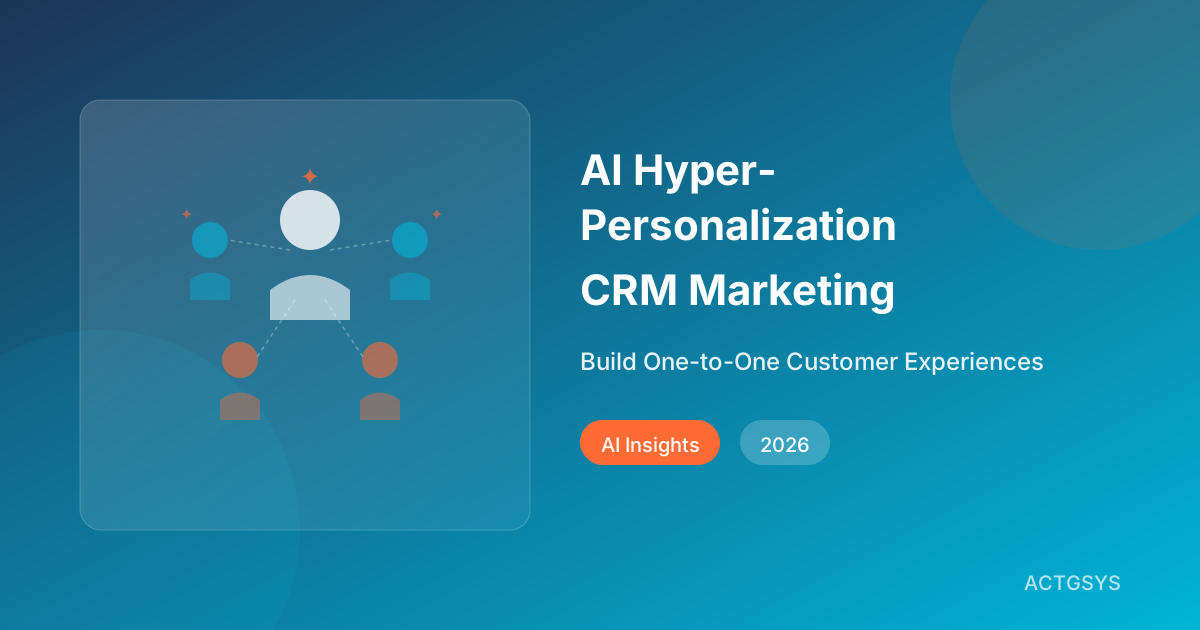
AI Hyper-Personalization Marketing: Building One-to-One Customer Experiences with CRM in 2026
"Dear Valued Customer" — if your marketing emails still open with this generic greeting, 2026 consumers have already tuned out. According to the latest research, 87% of business executives identify personalization as mission-critical to competitive advantage, and the global hyper-personalization market is projected to reach $49.6 billion by 2029. The question is: how can SMEs keep up?
The answer is already in your CRM.
What Is AI Hyper-Personalization?
Hyper-personalization isn't just inserting a customer's name into an email. It leverages AI and real-time data to deliver the right content, through the right channel, at the right time to every individual customer.
The Four Levels of Personalization
| Level | Approach | Example | Technology Required |
|---|---|---|---|
| L1 Basic | Insert name/company | "Hello, Mr. Wang" | Basic CRM |
| L2 Segmented | Demographic-based groups | Different industries receive different content | CRM + tagging system |
| L3 Behavioral | History-based recommendations | "The product you viewed is now on sale" | CRM + behavior tracking |
| L4 Hyper-Personalized | AI predicts optimal interaction | Push the most relevant content at the moment a customer is most likely to buy | CRM + AI + real-time data |
Most SMEs are stuck at L1-L2, but 2026 tools have made L3-L4 accessible to everyone.
Why Now Is the Perfect Time for Hyper-Personalization
The Data Speaks
- 87% of executives consider personalization critical to competitiveness
- Companies implementing AI CRM see average revenue growth of 20-30%
- Hyper-personalized marketing conversion rates are 4.4x higher than standard campaigns
- Global hyper-personalization market: $25.7 billion in 2025, projected $49.6 billion by 2029
Consumer Expectations Have Shifted
Modern consumers are "spoiled" by Netflix recommendations, Spotify playlists, and personalized shopping feeds. They expect every brand to communicate as if it truly understands them. Brands that can't deliver will lose customers to those that can.
Five CRM-Driven Hyper-Personalization Strategies
1. Intelligent Micro-Segmentation
Traditional segmentation ends at "industry × company size." AI hyper-personalization uses CRM data to uncover deeper behavioral patterns:
- Purchase cadence segments: Monthly orders vs. quarterly bulk vs. annual contracts
- Communication preference segments: Email vs. messaging apps vs. phone calls
- Decision style segments: Quick decision-makers vs. extensive comparison shoppers
- Value stage segments: First-time explorers vs. loyal repeat buyers vs. at-risk churners
DanLee CRM automatically analyzes these behavioral patterns and creates dynamic micro-segments, ensuring each group receives the most appropriate communication approach.
2. Dynamic Content Engine
A single marketing email, where AI automatically swaps content based on the recipient:
- Subject lines: Based on keyword combinations with the highest historical open rates
- Product recommendations: Based on browsing and purchase history
- Case studies: Matched to the recipient's industry and company size
- CTA buttons: Based on the customer's journey stage (Learn More vs. Start Free Trial vs. Renewal Offer)
3. Optimal Interaction Timing Prediction
AI analyzes each customer's interaction history to identify the best contact moments:
- Customer A always opens emails on Tuesday at 2 PM → Schedule delivery for that window
- Customer B prefers evaluating new tools at the beginning of each month → Push comparison content early in the month
- Customer C fills out an inquiry form after reading 3 blog posts → Send related content after the 2nd article
4. Cross-Channel Personalized Journeys
Example of a personalized SME customer journey:
- Customer searches "CRM recommendation" on Google → Discovers your blog article
- AI detects the customer is from manufacturing (via company IP or form data) → Dynamically displays manufacturing case studies
- Customer follows your LINE official account → Auto-sends manufacturing-specific CRM implementation guide
- Customer views the pricing page for 3 consecutive days → Sales gets notified with personalized quote suggestions
- Follow-up email is tailored to manufacturing pain points with industry-specific ROI data
5. Privacy-First Personalization
The most successful 2026 brands treat privacy as a premium feature, not a limitation:
- Explicitly ask preferences: "What matters most to you?" — let customers tell you
- Transparent data usage: "We recommended this based on your browsing history"
- Give control: Let customers customize frequency and content types
- Zero-party data first: Information customers voluntarily provide is more accurate than third-party tracking
SME Implementation Guide
Step 1: Audit Your Data Assets (1 Week)
Your CRM already contains treasure troves of data:
- Customer profiles (industry, size, job titles)
- Interaction history (email opens, clicks, replies)
- Purchase records (amount, frequency, product mix)
- Support records (issue types, satisfaction scores)
Step 2: Select 2-3 High-Impact Scenarios (1 Week)
Don't try to personalize everything at once. Recommended starting points:
- New customer welcome journey: Customized by source and industry
- Product recommendation emails: Based on purchase history and browsing behavior
- Churn prevention outreach: Triggered automatically when interaction frequency drops
Step 3: Build and Test (2-4 Weeks)
- Set up customer segmentation rules
- Create dynamic content templates
- A/B test different personalization elements
- Optimize and expand based on results
Step 4: Continuous Learning and Optimization
- Monthly review of personalized content open rates, click rates, and conversions
- Add new micro-segments based on emerging data patterns
- Test new personalization variables (timing, channel, content format)
ROI of Hyper-Personalization
| Metric | Standard Marketing | Hyper-Personalized | Improvement |
|---|---|---|---|
| Email open rate | 18% | 29% | +61% |
| Click-through rate | 2.5% | 5.8% | +132% |
| Conversion rate | 1.2% | 5.3% | +342% |
| Customer retention | 72% | 89% | +24% |
| Average order value | Baseline | +15-25% | Significant uplift |
Frequently Asked Questions
Q1: Can SMEs with limited data do hyper-personalization?
Absolutely! Hyper-personalization doesn't require millions of records. Even with just 500 customers, if data quality is strong (complete interaction records and purchase history), AI can identify meaningful behavioral patterns. It's about data quality, not quantity.
Q2: Won't hyper-personalization make customers feel surveilled?
The key is the line between "helpful and creepy." Personalizing based on actions customers know you can see (like visiting your website) feels thoughtful. But revealing information you shouldn't logically know feels invasive. Rule of thumb: only use data customers know you have, and be transparent about how you use it.
Q3: Do I need to replace my current CRM?
Not necessarily. Many hyper-personalization features can be integrated into existing CRMs via API. However, if your CRM can't even do basic behavior tracking, an upgrade may be needed. DanLee CRM natively supports AI personalization engines, making it ideal for SMEs.
Q4: Is hyper-personalization significantly more expensive than standard personalization?
Initial setup costs are moderately higher (roughly 30-50% more), but dramatically improved conversion rates and retention typically recover the extra investment within 3-6 months. Long-term ROI for hyper-personalization far exceeds standard marketing approaches.
Q5: How do I measure hyper-personalization effectiveness?
Beyond open rates and click rates, track the "personalization lift" — A/B test personalized versions against generic versions and measure the conversion rate difference. Also monitor long-term changes in Customer Lifetime Value (CLV) and Net Promoter Score (NPS).
Conclusion: From One-Size-Fits-All to One-to-One
In 2026, AI hyper-personalization is no longer a big-company exclusive. With CRM systems and AI tools, SMEs can build brand experiences that make every customer feel "you really understand me" — at a reasonable cost.
The key isn't how sophisticated the technology is — it's whether you're willing to think from your customers' perspective: when do they want to hear from you, through which channel, and about what?
Ready to upgrade your marketing from generic to genuinely personal? Contact ACTGSYS — let us help you build hyper-personalized customer experiences with AI-powered CRM.
Products & Solutions in This Article
Related Articles
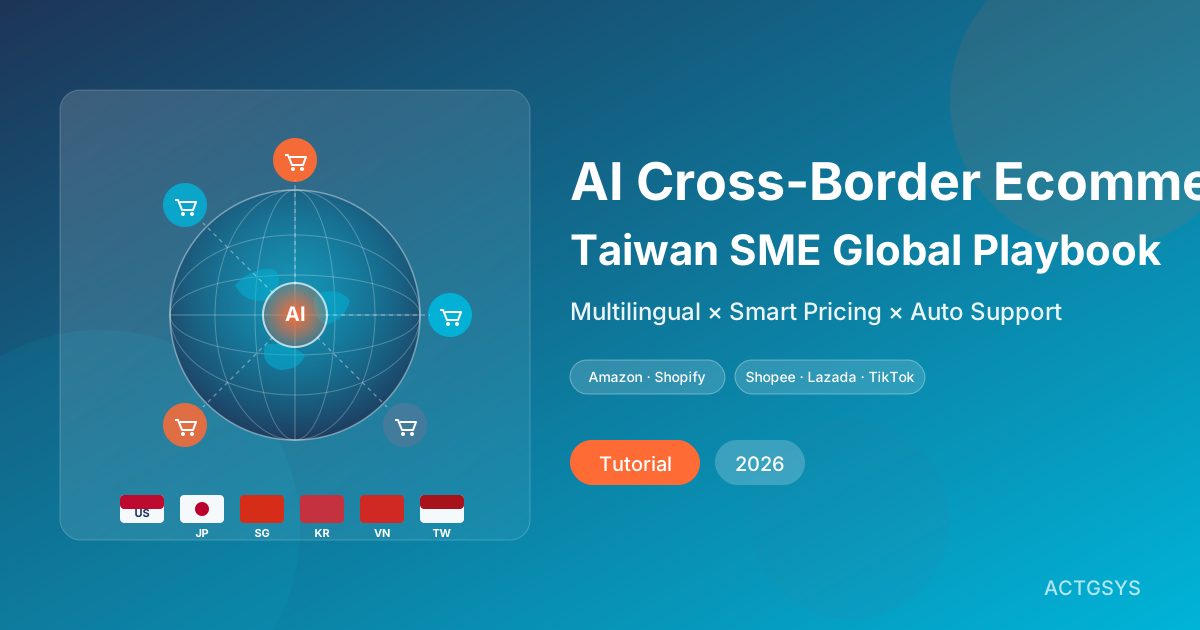
AI Cross-Border Ecommerce Playbook for SMEs (2026)
How Taiwan SMEs use AI to automate cross-border e-commerce — multilingual listings, smart customer service, dynamic pricing, ad ops, and logistics forecasting across Amazon, Shopify, Shopee, Lazada, and TikTok Shop.
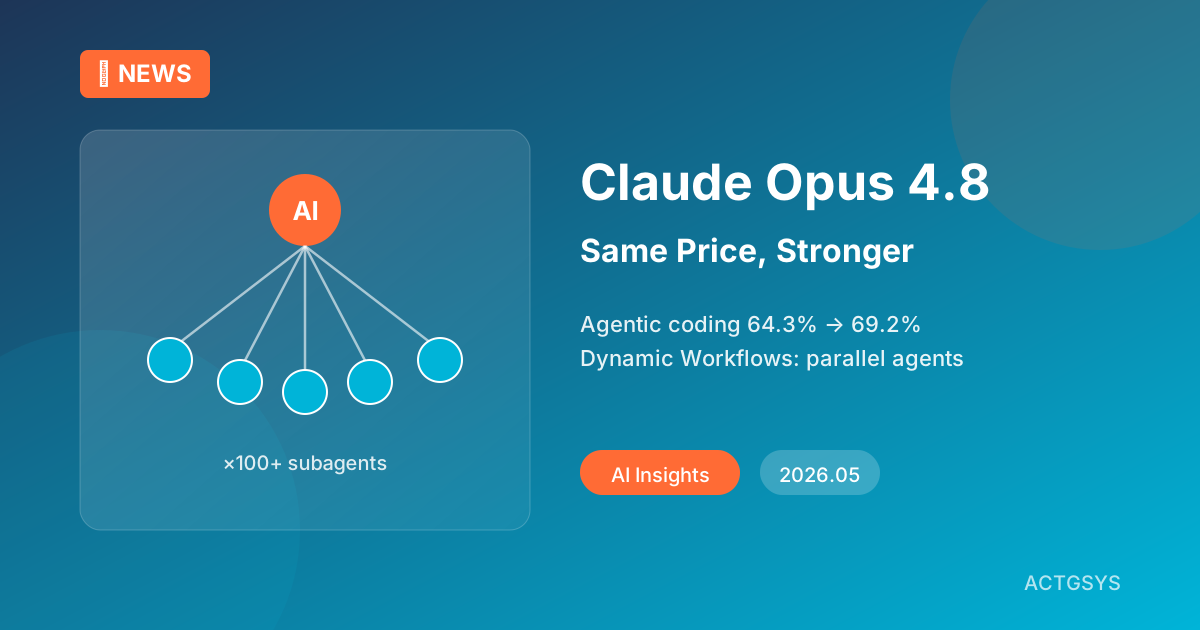
Anthropic Claude Opus 4.8 (2026): Same Price, Stronger
On May 28, 2026, Anthropic launched Claude Opus 4.8, holding the same $5 / $25 per 1M token pricing as its predecessor while lifting agentic coding from 64.3% to 69.2% and adding Dynamic Workflows — a research preview that orchestrates hundreds of parallel subagents. We unpack what this upgrade means for Taiwan SME automation.
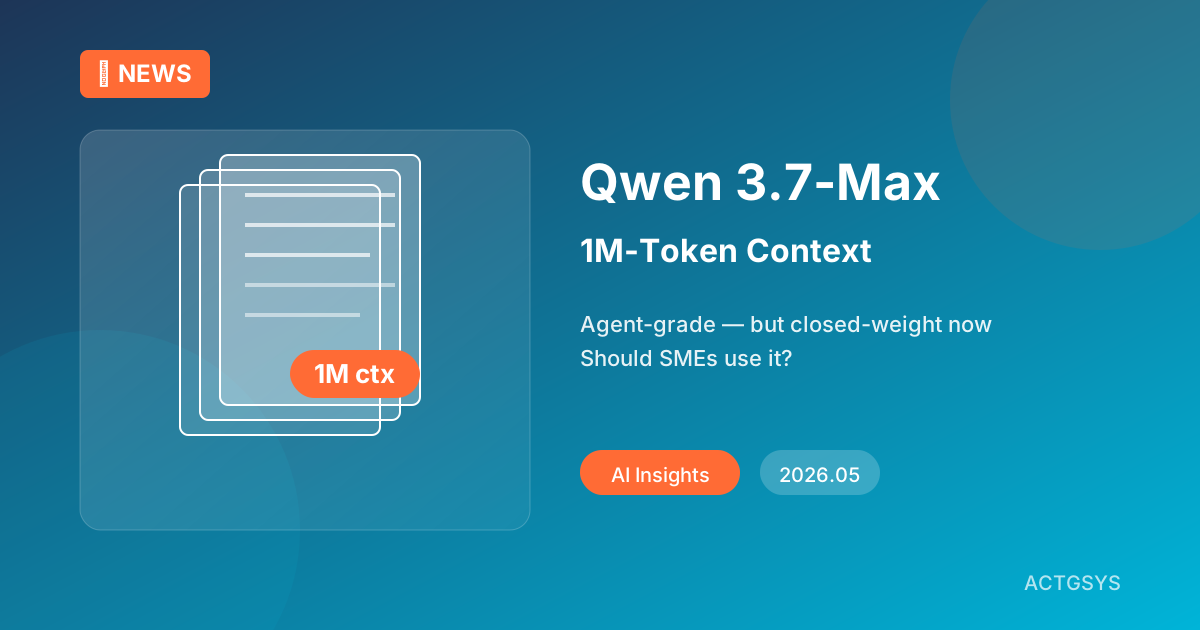
Alibaba Qwen 3.7-Max (2026): 1M-Token Context
On May 20, 2026, Alibaba launched Qwen 3.7-Max with a 1M-token context window and native extended thinking, scoring 69.7 on Terminal-Bench 2.0 and 60.6 on SWE-Bench Pro — but it's closed-weight and API-only for the first time. We unpack what this Chinese flagship means for Taiwan SME long-document processing and cost.
What would this cost you?
Answer five questions. Within three working days you get a price range and what it covers. No deck, no follow-up sales calls.
Prefer to talk?LINE·02-2553-8084