AI Inventory Management: Cut Stockouts 75% (2026)
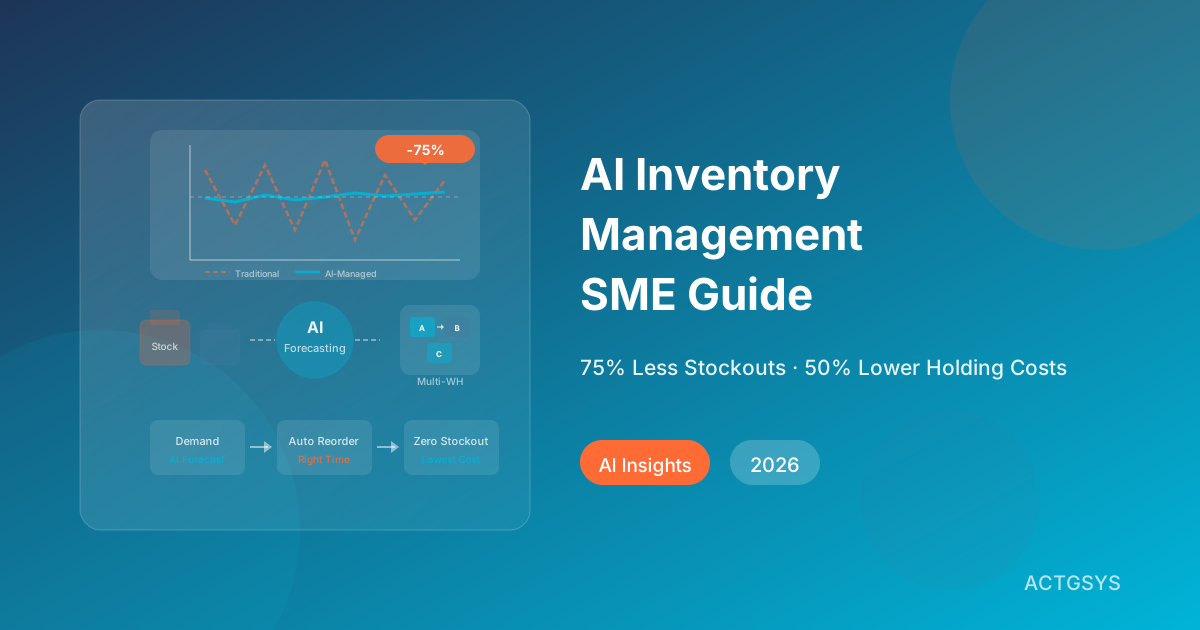
Inventory management is the lifeline of any SME, yet most businesses still rely on spreadsheets and gut feeling to manage stock levels. The consequences are predictable: warehouses full of slow-moving items while bestsellers are constantly out of stock. According to IHL Group, stockouts cost the global retail industry over $1 trillion in lost sales every year. Meanwhile, McKinsey's analysis shows that AI-powered inventory management can reduce inventory holding costs by 20% to 50%. In 2026, AI inventory management is both affordable and essential for small and mid-sized businesses.
What Is AI-Powered Inventory Management?
AI-powered inventory management uses machine learning algorithms to analyze historical sales data, seasonal trends, market signals, and external variables (weather, holidays, economic indicators) to automatically forecast future demand and dynamically adjust inventory strategies. Unlike traditional safety stock formulas, AI models learn continuously and grow more accurate as data accumulates — delivering demand forecast accuracy 30% to 50% higher than conventional methods.
The core capabilities of an AI inventory system include:
- Demand forecasting: Predicting sales volume for each SKU over the next 7 to 90 days, factoring in dozens of demand drivers.
- Automatic reorder point calculation: Dynamically setting the optimal reorder point and order quantity for each item based on predicted demand, supplier lead times, and target service levels.
- Overstock detection: AI proactively identifies items with declining sales velocity, issuing early warnings and recommending clearance or phase-out strategies before dead stock forms.
- Multi-warehouse transfer optimization: For businesses with multiple warehouses or stores, AI calculates the most cost-effective inventory allocation, reducing inter-warehouse transfer costs.
Why Traditional Inventory Management Is Costing You Money
SMEs typically have 20% to 30% of their inventory sitting as slow-moving or dead stock — meaning significant capital is locked up in warehouses generating no return. The pain points of traditional inventory management include:
- Experience-based ordering: The "order the same as last time" mentality cannot adapt to demand fluctuations, leading to chronic overstocking or understocking.
- Reactive replenishment: Waiting until a stockout occurs before reordering misses sales opportunities and erodes customer trust.
- Lack of visibility: Inventory data is scattered across spreadsheets, POS systems, and warehouse tools, making real-time oversight nearly impossible.
- High labor costs: Physical counts, safety stock calculations, and returns processing consume substantial staff time.
- Seasonal misjudgment: The human brain struggles to simultaneously track hundreds of SKUs, each with its own unique seasonal pattern.
AI Inventory Management vs. Traditional Inventory Management: A Full Comparison
| Dimension | Traditional Inventory | AI Inventory | Improvement |
|---|---|---|---|
| Demand forecast accuracy | 50-65% | 85-95% | 30-50% higher |
| Stockout rate | 8-12% | 2-3% | 75% reduction |
| Overstock ratio | 20-30% | 5-10% | 60-75% reduction |
| Inventory holding cost | Baseline | 20-50% lower | Significant savings |
| Replenishment decision speed | Days (manual calc) | Real-time (auto-triggered) | Paradigm shift |
| Multi-warehouse transfers | Manual, experience-based | AI-optimized allocation | 40% lower transfer costs |
| Count accuracy | 70-85% | 95-99% | Major improvement |
| Labor requirements | High (dedicated staff) | Low (AI automation) | 50% labor savings |
How Does AI Predict Demand and Automate Replenishment?
AI demand forecasting operates in four stages:
Stage 1: Data collection and cleansing. The system ingests historical sales data, inventory movement records, promotional calendars, and external data (weather, holiday schedules, economic indicators).
Stage 2: Model training and learning. Machine learning models analyze each SKU's sales trends, seasonal patterns, promotional effects, and cross-item correlations to build individualized demand models.
Stage 3: Prediction and recommendation. The system updates forecasts daily, automatically calculating optimal order quantities and timing while accounting for supplier lead times and minimum order quantities.
Stage 4: Automated execution and feedback loop. When inventory hits the AI-calculated reorder point, the system auto-generates a purchase recommendation or directly creates a purchase order. Each actual outcome feeds back into the model, continuously improving accuracy.
How Does AI Inventory Management Integrate with ERP?
For an AI inventory module to deliver maximum value, it must integrate deeply with the ERP system:
- Sales module: Real-time access to orders and sales data serves as the primary input for demand forecasting.
- Procurement module: AI-calculated replenishment suggestions flow directly into the purchasing workflow, enabling one-click PO generation.
- Finance module: Inventory costs are automatically calculated and reflected in financial statements, supporting FIFO, weighted average, and other valuation methods.
- Warehouse module: AI optimizes shelf layout and picking routes within the warehouse, improving fulfillment efficiency.
How Dinkoko ERP Handles Multi-Warehouse Inventory with AI
Dinkoko ERP is a cloud-based ERP system built by ACTGSYS specifically for SMEs. Its built-in AI inventory module is optimized for multi-warehouse and multi-store scenarios:
- AI smart replenishment: Based on each store's sales trends, AI independently calculates optimal stock levels and reorder timing for every warehouse, avoiding one-size-fits-all ordering.
- Cross-warehouse transfer suggestions: When product X is overstocked in Warehouse A but running low in Warehouse B, AI automatically recommends the most cost-effective transfer plan.
- Overstock early warning dashboard: Real-time monitoring of inventory turnover days for all items, proactively pushing clearance recommendations before dead stock forms.
- Demand forecast visualization: Graphical display of projected sales volume and confidence intervals for each SKU over the next 30 days, giving managers instant clarity.
- Inventory cost transparency: Real-time calculation of holding costs by warehouse and category, identifying the items tying up the most capital.
Frequently Asked Questions
Q1: How much historical data does an SME need to start AI inventory management?
Typically, at least 6 to 12 months of historical sales data is needed for AI models to build reliable predictions. However, you do not need perfect data to begin — implementing an ERP system itself continuously accumulates structured data. Dinkoko ERP supports importing historical data from Excel, allowing businesses to get started quickly.
Q2: Which industries benefit most from AI inventory management?
Virtually any industry with physical inventory can benefit, including retail, wholesale, manufacturing, e-commerce, and food service. The more SKUs you manage and the more volatile your demand, the greater the impact AI delivers.
Q3: What is the typical budget for implementing AI inventory management?
With Dinkoko ERP, cloud SaaS pricing starts from a few hundred dollars per month, eliminating server and IT maintenance costs. For a business with $1.5 million in annual revenue, reducing holding costs by just 20% could save tens of thousands of dollars, with a payback period typically within 3 to 6 months.
Q4: Will AI completely replace warehouse staff?
No. AI handles data analysis and decision recommendations, while warehouse staff evolve into inventory strategy managers — handling exceptions, managing supplier relationships, and optimizing warehouse space. AI frees the team from repetitive calculations so they can focus on higher-value work.
Q5: What if the AI predictions are inaccurate?
AI models learn and self-correct continuously. Initial accuracy may hover around 70-80%, but with data accumulation and model tuning, accuracy typically reaches 85-95% within 3 to 6 months. The system also supports manual overrides, ensuring special situations (major promotions, unexpected events) are handled appropriately.
Conclusion: Turn Your Warehouse from a Cost Drain into a Profit Engine
Inventory management should not be a guessing game driven by intuition and experience. AI inventory management ensures every replenishment decision is data-backed, every SKU stays at optimal levels, and dead stock is intercepted before it forms. In a world where stockouts alone cost over $1 trillion annually, businesses that master inventory precision hold a decisive competitive advantage.
Want to learn how AI inventory management can cut costs and improve service levels for your business? Contact the ACTGSYS consulting team today — we offer a free inventory management assessment and Dinkoko ERP multi-warehouse trial.
Products & Solutions in This Article
Related Articles
AI Smart Procurement & Cost Optimization Guide
Learn how AI is transforming procurement for small and mid-sized businesses — from supplier evaluation to price prediction, with ROI models, implementation steps, and Dinkoko ERP integration.
AI Supply Chain & Inventory Optimization
A comprehensive guide on how AI transforms supply chain management and inventory control, covering demand forecasting, smart replenishment, and supplier evaluation strategies.
AI Dynamic Pricing for SMEs: Real-Time Revenue 2026
AI dynamic pricing uses machine learning to adjust prices in real time to maximize revenue and margin — McKinsey and BCG (2026) research shows 2–5% revenue growth and 5–10% margin improvement for adopters, but fewer than 15% of retailers have deployed it.
What would this cost you?
Answer five questions. Within three working days you get a price range and what it covers. No deck, no follow-up sales calls.
Prefer to talk?LINE·02-2553-8084