AI Lead Scoring: Focus Sales on Ready Buyers
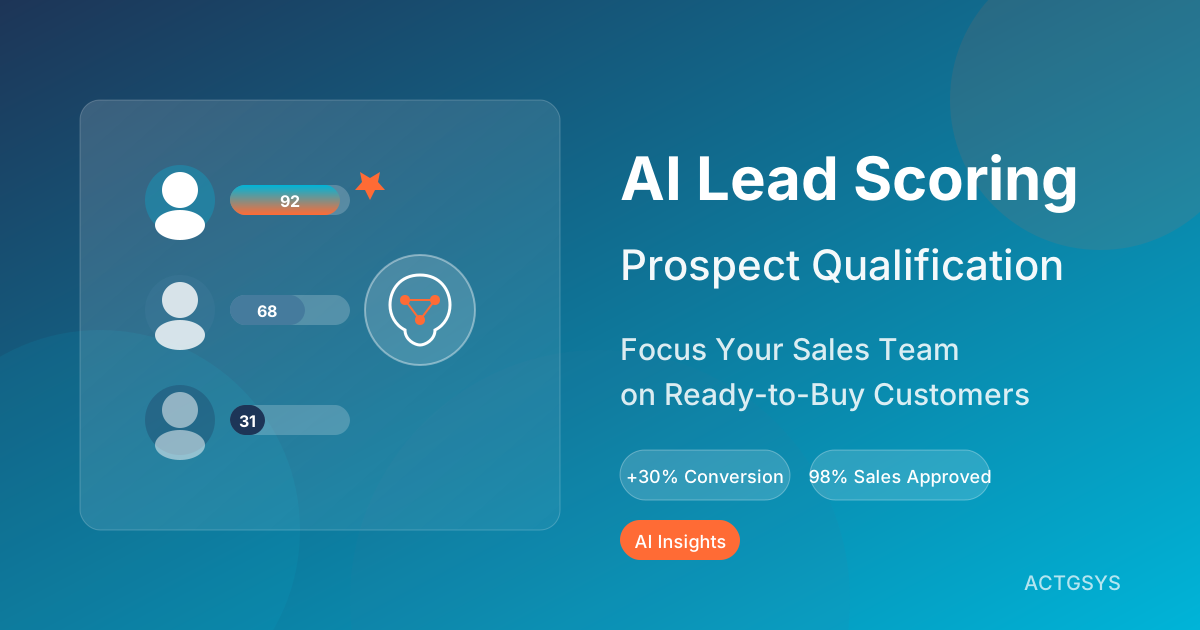
"I make 50 calls a day, but only about 5 prospects are genuinely interested." This is the daily reality for many sales professionals. Traditional "spray and pray" prospecting is not only inefficient but also demoralizing.
In 2025, AI Lead Scoring is transforming this landscape. According to surveys, 98% of sales teams using AI report significant improvement in lead prioritization, and companies implementing AI scoring see average conversion rate increases of over 30%.
What is AI Lead Scoring?
AI Lead Scoring uses machine learning to automatically analyze and evaluate how likely a prospect is to convert. Unlike traditional rule-based scoring, AI scoring can:
- Automatically discover winning patterns: Analyze thousands of historical deals to identify common traits of successful customers
- Dynamically adjust in real-time: Continuously update scores based on latest prospect interactions
- Evaluate multiple dimensions: Simultaneously consider hundreds of variables including customer attributes, behavior patterns, and engagement depth
- Eliminate subjective bias: Replace sales "gut feelings" with data-driven insights
Traditional Scoring vs AI Scoring
| Aspect | Traditional Rule-Based | AI Lead Scoring |
|---|---|---|
| Scoring Basis | Manually set rules (e.g., download whitepaper +10) | ML analysis of historical conversion patterns |
| Variable Count | Typically 5-15 | Can analyze 100+ variables |
| Update Frequency | Requires manual periodic adjustment | Real-time automatic learning |
| Accuracy | Depends on rule design quality | Continuously improves with use |
| Maintenance Cost | High (constant rule tweaking) | Low (self-learning) |
How Does AI Lead Scoring Work?
The core of AI Lead Scoring is machine learning models analyzing your historical sales data:
Step 1: Data Collection and Integration
AI collects prospect information from multiple sources:
Firmographic Data
- Company size, industry, location
- Job title, decision-making level
- Technology stack
Behavioral Data
- Website pages visited, time spent
- Newsletter open rates, content clicked
- Resources downloaded, events attended
Engagement Data
- Conversation history with sales
- Types of questions asked
- Response speed and frequency
Step 2: Pattern Recognition
AI models analyze all "won" and "lost" deals to identify key differentiators:
Common patterns in closed-won deals:
✓ Visited pricing page 3+ times within 14 days
✓ Downloaded product comparison whitepaper
✓ Job title includes "Manager" or "Director"
✓ Company size 50-200 employees
Step 3: Real-Time Scoring and Prioritization
Whenever a new prospect interaction occurs, AI instantly calculates and updates their score:
- 90-100: Hot lead, follow up immediately
- 70-89: High interest, prioritize meeting scheduling
- 50-69: Potential, continue nurturing
- Below 50: Low priority, automated nurturing
Real-World Benefits for SMEs
Benefit 1: 50%+ Increase in Sales Productivity
When sales reps stop wasting time on low-quality leads:
"I used to make 60 calls a day and close 2 deals. Now with AI filtering, I make 20 calls and close 3 deals." — B2B Software Sales Manager
Benefit 2: More Precise Marketing Spend
AI scoring reveals which marketing activities actually generate quality leads:
- Campaign A brings 100 leads, average score 35
- Campaign B brings 50 leads, average score 72
Campaign B clearly delivers higher ROI.
Benefit 3: Shorter Sales Cycles
According to Salesforce research, companies using AI Lead Scoring reduce sales cycles by an average of 20%. This happens because:
- Sales can quickly identify and contact ready-to-buy customers
- Less time wasted on "just looking" prospects
- Better timing for follow-up reminders
Benefit 4: Reduced Customer Churn Risk
AI doesn't just score new prospects—it can identify churn risk in existing customers:
- Declining product usage frequency
- Increased support requests but lower satisfaction
- Non-participation in recent activities or updates
Comparison of Popular AI Lead Scoring Tools
| Tool | Best For | AI Features | Price Range |
|---|---|---|---|
| HubSpot Breeze | SMEs | Built-in AI scoring, easy setup | Free tier available |
| Salesforce Einstein | Mid-large enterprises | Deep predictive analytics, cross-department integration | Requires advanced edition |
| Freshsales Freddy | SMEs | Intent signal detection, deal risk alerts | From ~$29/user/month |
| 6sense | B2B enterprises | Account-level scoring, buying stage prediction | Enterprise pricing |
| DanLee CRM + AI | Taiwan SMEs | Local support, Chinese interface | Custom pricing |
How to Know If You Need AI Lead Scoring
Check these scenarios—if 3 or more apply, you should strongly consider implementing AI Lead Scoring:
- Over 100 leads per month
- Sales team frequently complains about "poor lead quality"
- Unable to clearly articulate what makes a "good customer"
- Marketing and sales disagree on lead prioritization
- Want to improve sales rep productivity
- Need more accurate sales forecasting
5 Steps to Implement AI Lead Scoring
Step 1: Inventory Your Existing Data
First, confirm you have sufficient historical data:
- Recommended: 500+ complete lead records minimum
- Include clear "won" and "lost" labels
- More complete records (attributes, behaviors, interactions) = more accurate AI
Step 2: Choose the Right Tool
Based on company size and needs:
- Already have CRM: Prioritize built-in AI features (HubSpot, Salesforce)
- No CRM yet: Choose a system with AI scoring included
- Custom needs: Consider API integration or custom development
Step 3: Define What "Conversion" Means
Clarify what counts as "closed":
- Is it contract signed and paid?
- Or first purchase completed?
- Or reaching a specific deal value?
Step 4: Train and Calibrate
Initial AI models need calibration:
- Have sales reps provide feedback on scoring accuracy
- Track actual conversion rates of high-scored leads
- Adjust model parameters based on results
Step 5: Integrate with Workflows
Make AI scoring actionable:
- High-score leads automatically notify sales
- Medium-score leads enter nurture sequences
- Low-score leads receive automated content
FAQ
Q1: What if we don't have enough data?
If lead records are under 500:
- Start with rule-based scoring to accumulate data
- Choose tools with pre-trained models (like HubSpot)
- Enrich customer profiles with third-party data
Q2: Can AI scoring have bias?
AI learns patterns from historical data, so if past conversions skew toward certain industries, AI will reinforce this tendency. Recommendations:
- Regularly review scoring factors for reasonableness
- Ensure training data diversity
- Maintain human review oversight
Q3: How long does implementation take?
- Simple implementation (using existing CRM features): 1-2 weeks
- Standard implementation (data integration + process adjustment): 1-2 months
- Advanced implementation (custom models + deep integration): 3-6 months
Q4: When will we see ROI?
Most companies see benefits within 2-3 months:
- Sales productivity up 20-50%
- Lead conversion rates up 15-30%
- Sales cycles shortened 10-20%
Q5: Do we need dedicated IT staff to maintain it?
Modern AI Lead Scoring tools typically don't require it:
- Cloud SaaS automatically updates models
- User-friendly interfaces for marketing/sales teams
- Vendor-provided technical support
Conclusion: Let AI Find Your Best Customers
AI Lead Scoring doesn't replace sales judgment—it helps them invest time and energy on the most worthwhile prospects. In the competitive landscape of 2025, companies that can quickly identify and respond to high-intent prospects will gain significant market advantage.
Whether you're just considering CRM or want to enhance your existing system's intelligence, AI Lead Scoring is a worthy investment.
Want to learn how to implement AI Lead Scoring for your business? ACTGSYS provides CRM consulting and DanLee CRM implementation services. Contact us to discuss your needs.
Products & Solutions in This Article
Related Articles
What Is CRM? The 2025 SME Guide
A comprehensive guide to CRM systems: from basic concepts to implementation best practices. Learn how to select and implement the right CRM system to improve sales and customer management for your business.
AI Conversation Intelligence for B2B Sales
AI Conversation Intelligence uses AI to automatically analyze every sales call, identify winning patterns, and coach reps in real time. McKinsey (2026) research shows adopters lift call coverage from 3% to 95% and conversion rates by up to 40%.
Trigger-Based AI Automation for CRM and ERP (2026)
Discover how trigger-based AI automation transforms CRM and ERP systems from passive record-keeping to proactive pattern detection, automatic action execution, and intelligent decision-making for SMEs.
What would this cost you?
Answer five questions. Within three working days you get a price range and what it covers. No deck, no follow-up sales calls.
Prefer to talk?LINE·02-2553-8084