AI Memory Systems: Enterprise Beyond RAG (2026)
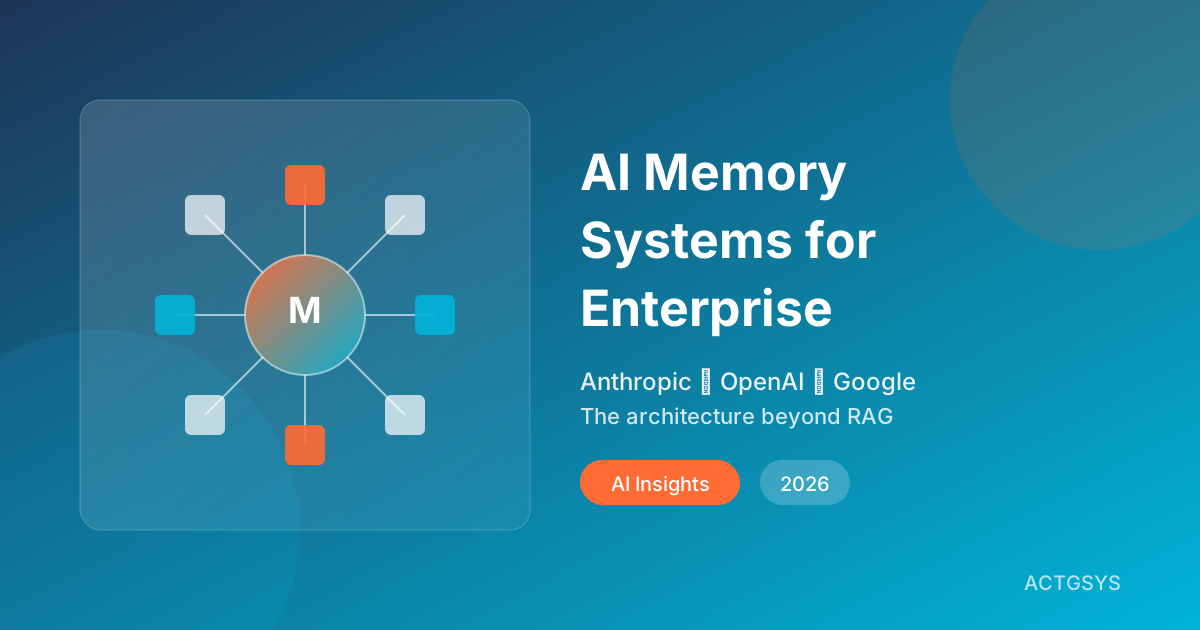
TL;DR: An AI memory system is a persistent architecture that allows AI Agents to retain user preferences, business context, and decision history across sessions and across days. Following Anthropic's launch of Memory for Claude Managed Agents in April 2026, OpenAI and Google Cloud followed within weeks — making AI memory the new production-grade baseline for enterprise AI.
For the past two years, the most painful blocker for enterprise generative AI has been "goldfish memory" — every conversation ends and the AI forgets all context, leaving customer service, sales follow-ups, and knowledge management stuck at the "toy" stage. The 2026 maturity of AI memory systems fundamentally changes this picture.
What Is an AI Memory System?
An AI memory system is a persistent architecture that allows AI Agents to retain and recall information across conversation sessions — including user preferences, business context, decision history, and human corrections. According to McKinsey & Company's "The State of AI" (2025), while 79% of organizations are experimenting with generative AI, fewer than 10% have successfully scaled AI agents — and the lack of persistent memory is a primary reason agents fail to accumulate organizational knowledge.
Traditional LLM conversations are stateless: every interaction starts from zero, relying solely on what fits in the current context window. AI memory systems add a persistent context layer, enabling Agents to:
- Accumulate knowledge across sessions — yesterday's conclusions can be referenced today
- Remember personalized preferences — employee work styles, customer-specific needs, process conventions
- Learn from corrections — content that humans have edited gets remembered, preventing repeated mistakes
Why Isn't RAG Enough? What Memory Systems Actually Solve
AI memory systems and RAG (Retrieval-Augmented Generation) solve different layers of the problem — RAG handles static knowledge retrieval, memory handles dynamic interaction accumulation. They are complementary, not competing.
| Dimension | RAG (Retrieval-Augmented Generation) | AI Memory System |
|---|---|---|
| Data source | Pre-built knowledge base documents | Dynamic data generated during interactions |
| Update method | Batch ingest or scheduled refresh | Real-time write, accumulates over time |
| Best fit | Product manuals, SOPs, regulatory docs | Personal preferences, decision history, cross-project context |
| Personalization | Shared across the company | Scoped to user, team, or agent |
| Typical question | "What's our return policy?" | "What discount did I last offer this customer?" |
Anthropic's "Building Effective Agents" research (2025) emphasizes that successful enterprise Agent adoption depends on "tool design and task decomposition" — and memory systems are the infrastructure that lets task decomposition extend across sessions.
How the Three Tier 1 Model Vendors Implement Memory
Q1–Q2 2026 became the watershed moment for AI memory systems — Anthropic, OpenAI, and Google Cloud all released enterprise-grade memory features within a single quarter, signaling industry consensus that memory is now infrastructure, not research.
Claude Memory (Anthropic)
Anthropic launched Memory for Claude Managed Agents on April 23, 2026 (public beta). The design uses a filesystem-based model — memory is stored as files that can be exported, edited, and version-controlled via API or the Claude Console.
Early adopter results have been substantial:
- Netflix uses memory to carry mid-conversation human corrections across sessions, eliminating manual prompt updates
- Rakuten achieved 27% cost reduction, 34% latency improvement, and a 97% reduction in first-pass errors
- Wisedocs sped up document verification workflows by 30%
ChatGPT Memory (OpenAI)
OpenAI brought project-scoped memory to ChatGPT Enterprise and Team, ensuring sensitive data stays inside project boundaries. All memory content is excluded from model training by default — meeting enterprise compliance requirements. Combined with GPT-5.2's enhanced long-context retrieval, enterprises can build assistants that maintain context across entire workflows.
Gemini Memory Bank (Google)
Google Cloud's Gemini Enterprise Agent Platform introduced Memory Bank, paired with Gemini 3's 1-million-token context window. This enables agents to maintain multi-day task state. In a published case study, a Financial Controller Agent reduced expense submission time by over 50% by remembering each employee's expensing habits.
What Business Value Does AI Memory Deliver?
The most direct value of AI memory systems is upgrading "one-off AI experiences" into "compounding AI assets". According to McKinsey's "Seizing the Agentic AI Advantage" (2025), effectively scaled agent deployments deliver 3–5% annual productivity gains and can lift overall growth by 10% or more.
For SMEs, the value of memory systems concentrates in three dimensions:
- Deeper customer relationships — AI sales assistants remember each customer's preferences, past conversations, and follow-up items, so relationships don't break when reps change
- Cumulative internal knowledge — employee corrections to AI outputs are retained, so organizational intelligence doesn't walk out the door with departing staff
- More reliable workflow automation — multi-step processes (from inquiry to delivery) maintain consistency across days and systems without humans needing to "re-feed" context
How Should SMEs Adopt AI Memory Systems? A 5-Step Playbook
The key for SMEs adopting AI memory isn't "which model" — it's "designing what to remember and what to forget." Five battle-tested steps:
- Audit high-memory-value scenarios — prioritize "repeated interaction" work (customer service, sales follow-ups, recurring reports), not "one-off lookups"
- Define memory scope and retention — e.g., customer memories retained 2 years, internal meeting memories 6 months, aligned with data governance
- Build a tiered memory architecture — separate personal preferences (private), team knowledge (department-shared), and organizational policies (company-wide)
- Design human correction interfaces — let employees easily "teach" the AI by correcting mistaken memories or filling gaps
- Continuously monitor memory quality — periodically audit which memories the AI cites, retiring outdated information
Taiwan's III MIC research (2025) on SME AI adoption identified the lack of "organizational knowledge accumulation mechanisms" as the leading reason pilot projects fail to scale. Memory systems fill exactly this gap.
What Risks Should Enterprises Manage?
The most common AI memory risk isn't technical failure — it's "remembering what shouldn't be remembered." Personal data, confidential business information, or private employee conversations absorbed into the memory system will leak into subsequent conversations. Reddit's r/ChatGPT and r/ClaudeAI threads are dominated by discussions of "memory contamination."
Four governance mechanisms enterprises must establish:
- Memory whitelist: explicitly define which conversations are written to memory (business context yes, salary data no)
- User revocation rights: employees and customers must be able to delete specific memories, complying with GDPR and Taiwan's Personal Data Protection Act
- Audit trails: every memory change must be logged so you can trace who taught the AI what, and when
- Incognito mode: sensitive conversations enter an isolated "no-write" mode
Anthropic and OpenAI have all four mechanisms built in, but enterprises still need to design usage workflows so employees don't accidentally write sensitive data into shared memory layers.
Frequently Asked Questions
What's the difference between an AI memory system and a RAG knowledge base?
AI memory systems handle "dynamically accumulated interaction data" — user preferences and decision history. RAG handles "static knowledge documents" — product manuals and SOPs. They're complementary: RAG provides company-wide shared knowledge, memory systems provide personalized or team-scoped context. In practice, 95% of enterprise AI systems deploy both.
How much does it cost an SME to adopt an AI memory system?
Costs split into three layers: model licensing (ChatGPT Enterprise, Claude for Work, or Gemini Enterprise — roughly USD 30–60 per seat per month), integration development (TWD 300K–1M depending on complexity), and governance design (TWD 200K–500K, ideally with an experienced consultant). Taiwan SMEs can apply for AI subsidies from the Ministry of Digital Affairs to lower the initial barrier.
Should I choose Claude Memory, ChatGPT Memory, or Gemini Memory Bank?
The choice depends on three dimensions: (1) Data governance strictness — finance/healthcare industries should prioritize Claude (filesystem-based, fully auditable), (2) Long-context task density — research/legal industries should prioritize Gemini (1M-token context), (3) Existing Microsoft/Office integration — typical office workflows should prioritize ChatGPT. Most enterprises adopt a "primary + backup" strategy to avoid vendor lock-in.
Will the AI memory system learn employees' personal data?
Yes, but the enterprise stays in control. All three vendors offer "organization admin mode" — IT departments can configure which conversations enter memory, which employees can delete memories, and whether sensitive data goes into "incognito mode" (no memory writes). The key is establishing a clear memory policy at the organizational level rather than relying on individual employee judgment.
If I already have a RAG system, do I still need a memory system?
Yes. RAG answers "what's our company policy?" — a static lookup. Memory systems answer "what did this customer last ask about?" — a dynamic follow-up. If your enterprise AI use cases include customer relationships, sales follow-ups, or multi-day projects, RAG alone is insufficient — you need a memory layer on top, so AI becomes a true "compounding asset."
Conclusion: 2026 Is the Year AI Becomes a Partner, Not a Tool
The maturity of AI memory systems marks the real inflection point where enterprise AI moves from "fragmented tool" to "compounding partner." AI without memory is like a colleague who forgets yesterday — no matter how smart, you can't entrust them with anything important. AI with memory becomes a real digital employee, accumulating organizational intelligence across CRM, ERP, and customer service workflows.
ACTGSYS helps Taiwan SMEs combine DanLee CRM with custom AI Agent solutions, integrating Anthropic Claude, OpenAI ChatGPT, and Google Gemini memory capabilities into business workflows so AI becomes a true digital asset.
Want to learn how AI memory systems apply to your business? Schedule a free consultation.
Last updated: 2026-04-29
Products & Solutions in This Article
AI-powered CRM for lead management, customer tracking, and sales pipeline optimization designed for SMEs.
Intuitive accounting system designed for Taiwan SMEs, with automated bookkeeping and financial reporting.
Related Articles
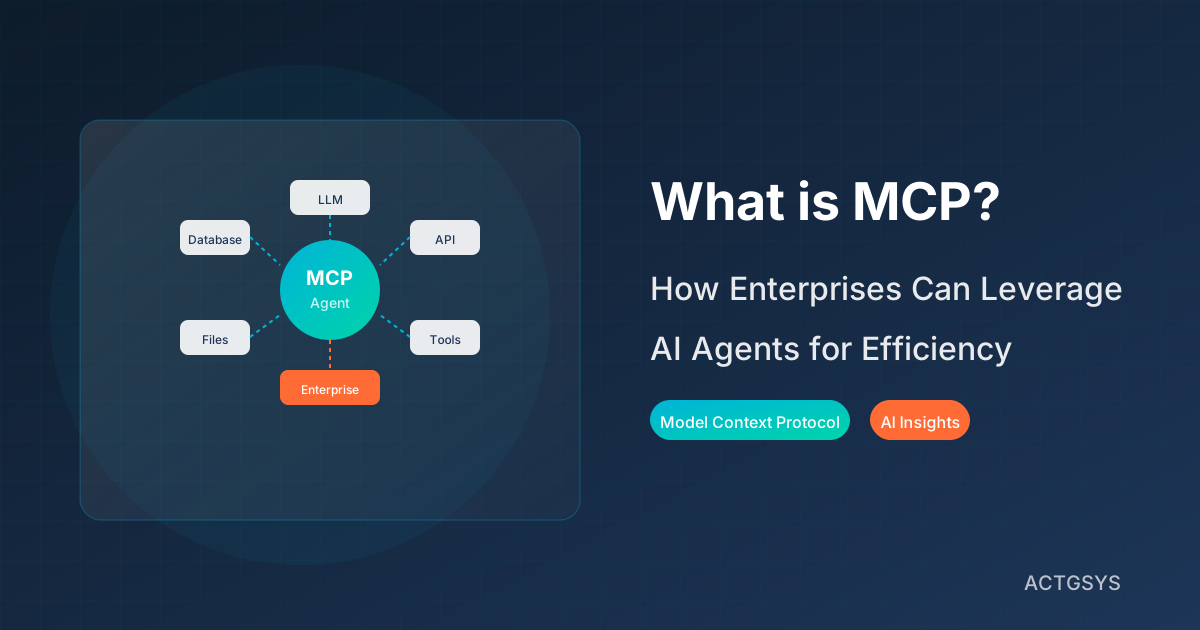
What Is MCP? Enterprise AI Agents Explained
An in-depth explanation of Model Context Protocol (MCP), and how enterprises can implement AI Agent architectures for cross-system integration, automated workflows, and intelligent decision support.
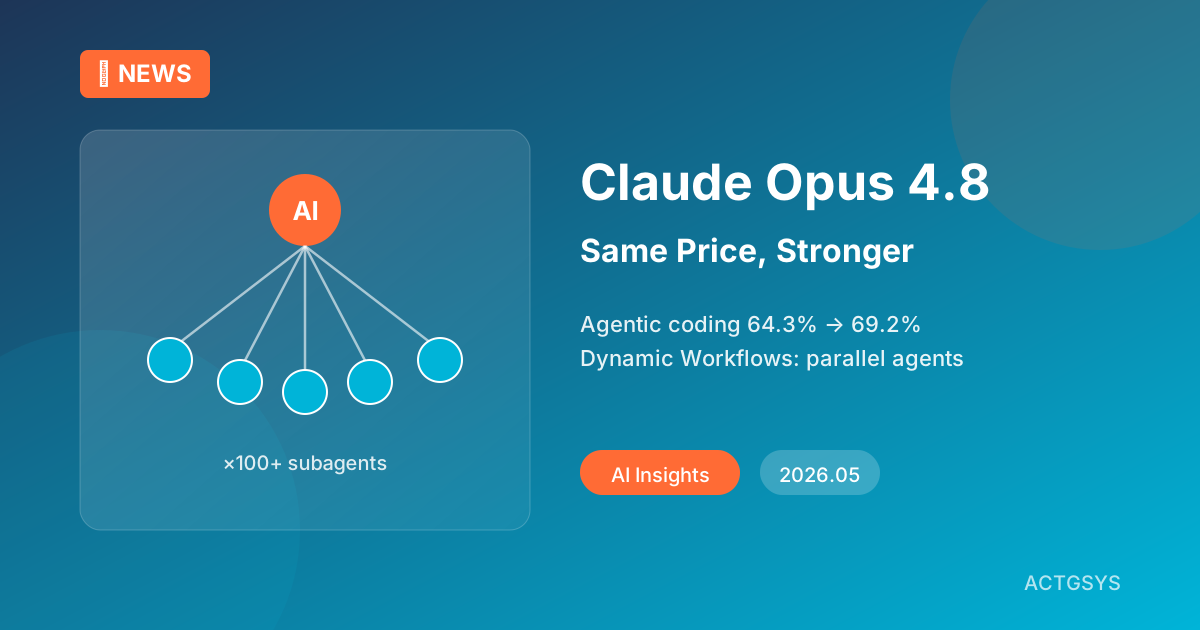
Anthropic Claude Opus 4.8 (2026): Same Price, Stronger
On May 28, 2026, Anthropic launched Claude Opus 4.8, holding the same $5 / $25 per 1M token pricing as its predecessor while lifting agentic coding from 64.3% to 69.2% and adding Dynamic Workflows — a research preview that orchestrates hundreds of parallel subagents. We unpack what this upgrade means for Taiwan SME automation.
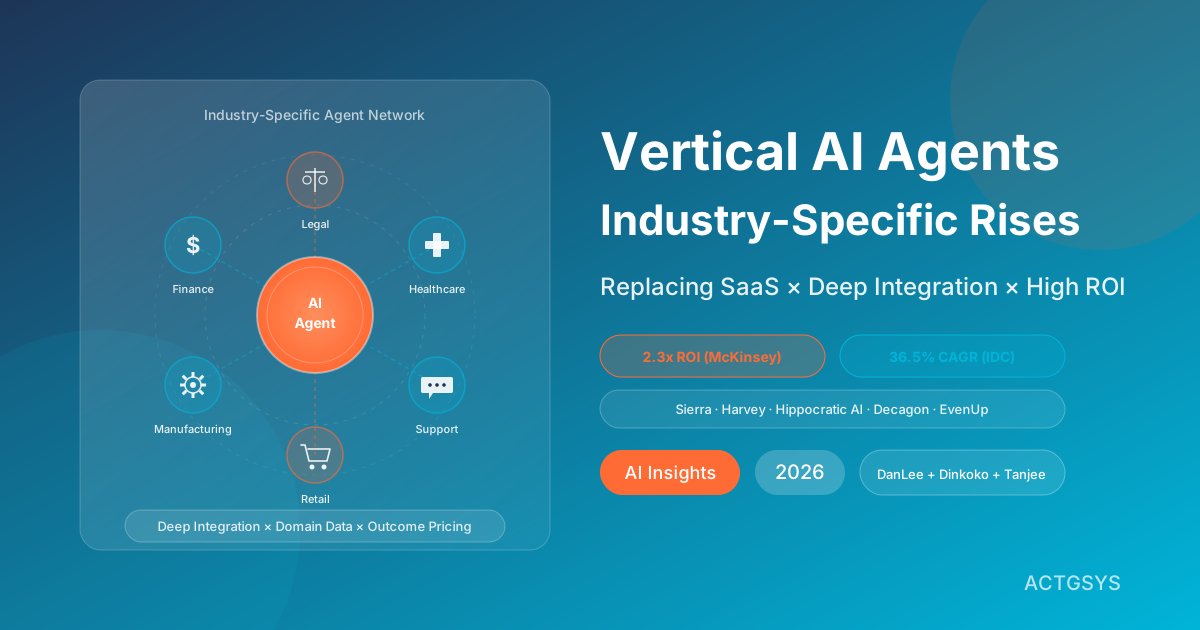
Vertical AI Agents 2026: Why Industry-Specific Agents Are Eating SaaS and How SMEs Choose or Build Their Own
An in-depth look at how Sierra, Harvey, Hippocratic AI and other vertical AI agents are replacing traditional SaaS, plus a 7-step playbook for SMEs to choose or build industry-specific agents.
What would this cost you?
Answer five questions. Within three working days you get a price range and what it covers. No deck, no follow-up sales calls.
Prefer to talk?LINE·02-2553-8084