AI Predictive Maintenance for SME Manufacturers
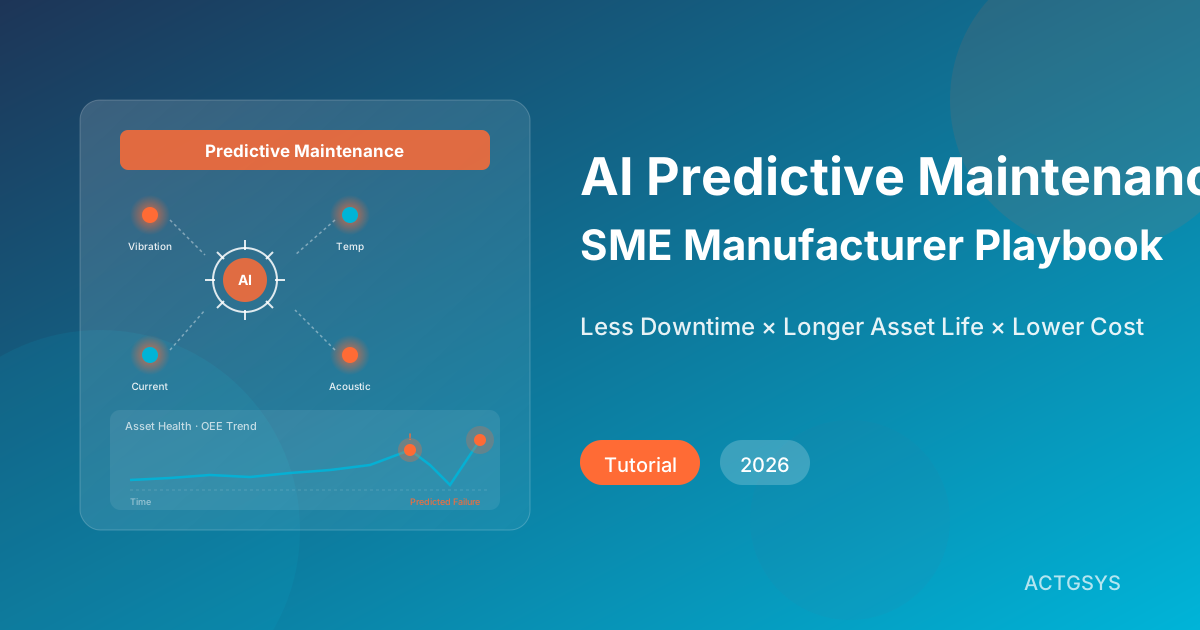
AI Predictive Maintenance for SME Manufacturers: 2026 IoT + Edge AI Playbook to Cut Downtime and Repair Costs
TL;DR: AI predictive maintenance (PdM) combines IoT sensors, time-series machine learning, and edge inference to flag failures days to weeks before they happen. According to McKinsey & Company (2024) "The Internet of Things: Catching up to an accelerating opportunity," PdM cuts unplanned downtime by 30-50%, lowers maintenance cost by 10-40%, and extends asset life by 20-40%. SME manufacturers typically deploy in 8-14 weeks at NT$60-180K per production line and reach payback inside 9-18 months.
Over the past two years, the highest-ROI AI use case in manufacturing has shifted from machine vision inspection toward predictive maintenance. McKinsey lists PdM among the top five highest-return AI investments in manufacturing, and Taiwan's Industrial Technology Research Institute (ITRI) — through the "Smart Machinery Solutions Office" — has positioned PdM as a core upgrade lever for the machine-tool and precision-machinery industry. This guide answers "what is predictive maintenance" and lays out exactly how an SME manufacturer can ship a working pilot in 8-14 weeks.
What Is AI Predictive Maintenance? How It Differs from Traditional Maintenance
AI predictive maintenance uses IoT sensors to continuously monitor equipment health signals (vibration, temperature, current, acoustic, pressure), applies machine-learning models to time-series data, predicts future failures, and triggers alerts and work orders before production is affected. It replaces the calendar-based logic of traditional preventive maintenance.
The three maintenance strategies on the shop floor differ as follows:
- Reactive maintenance: Fix it when it breaks. Highest downtime cost, expedited-parts premium, worst quality risk.
- Preventive maintenance: Service on a fixed schedule (e.g., replace bearing every 500 hours). Deloitte (2023) "Predictive maintenance and the smart factory" reports that fixed-interval replacement is on average 30% too early and 15% too late.
- Predictive maintenance: Service based on the asset's actual condition, using vibration spectra, thermal trends, motor current signature analysis (MCSA), acoustic features, and lubricant analysis.
IDC Manufacturing Insights (2024) found that 47% of global manufacturers have piloted or deployed PdM, with adoption projected to exceed 65% by year-end 2026. For SME manufacturers, the bigger shift is not "installing sensors" — it is moving maintenance from an unpredictable cost center to a planned, data-driven operational activity.
Why SME Manufacturers Must Adopt Predictive Maintenance in 2026
2026 is the inflection point for SME PdM adoption: sensor hardware prices have fallen, edge AI silicon has gone mainstream, time-series cloud databases are cheap, and the twin pressures of labor shortage and aging equipment have turned PdM from a large-enterprise privilege into an SME survival skill.
Four pressures you cannot ignore:
1. Labor shortages make tribal-knowledge maintenance unsustainable
Taiwan's Ministry of Economic Affairs Industrial Development Administration (2024) "Manufacturing Digital Transformation White Paper" reports a 150,000-person technician gap in Taiwan manufacturing, with 38% of senior technicians over age 50. The "listen to the sound, feel the vibration" knowledge held by senior technicians will retire with them unless it is digitized. PdM converts that tacit knowledge into model features.
2. Downtime cost keeps climbing
Deloitte (2023) reports that large global plants lose USD $260,000 per hour of unplanned downtime; even SME machine-tool shops and precision job shops routinely lose NT$50,000-300,000 per hour (penalties, expedited outsourcing, customer trust). McKinsey estimates PdM cuts total downtime by 30-50%.
3. Government programs are accelerating SME adoption in Taiwan
Since 2017, the Smart Machinery Promotion Program and ITRI's Smart Machinery Solutions Office have helped over 3,000 SME manufacturers deploy sensors and data platforms. Institute for Information Industry MIC (2024) reports that PdM-related projects grew 41% year-over-year — the fastest-growing subcategory inside smart manufacturing.
4. Edge AI now makes real-time, low-latency, privacy-preserving inference practical
NVIDIA Metropolis for Industries (2025) technical documentation reports that the latest edge AI modules (e.g., Jetson Orin Nano) deliver up to 40 TOPS, capable of running LSTM and Transformer time-series models directly on the equipment at sub-50 ms latency — without sending process data to the cloud. This matters for SMEs that treat process know-how as a trade secret.
Core Technology Stack: Sensors, Edge AI, Time-Series Models
AI predictive maintenance is a four-layer stack: sensing, edge, platform, and application. Each layer has open-source and commercial options, so SME manufacturers can mix-and-match around existing equipment and budget. MIT Sloan Management Review (2024) "Industrial AI: A guide for non-experts" recommends starting from a single critical asset, proving value, then horizontally replicating.
The four layers:
- Sensing layer: Vibration sensors (IEPE accelerometers), infrared thermography, current transformers, acoustic microphones, oil quality sensors, and PLC data taps. Common brands: PCB Piezotronics, IFM, Banner, Advantech.
- Edge layer: Compute nodes deployed near the asset that extract features (FFT, envelope analysis) and run lightweight models (Isolation Forest, Autoencoder, Temporal Convolutional Network). Leading options: NVIDIA Jetson, AWS Snowcone, Microsoft Azure IoT Edge, Google Distributed Cloud Edge.
- Platform layer: Time-series database (InfluxDB, TimescaleDB) plus an ML platform (AWS IoT SiteWise, Azure IoT Hub, Google Cloud AI Platform) plus a digital twin. AWS IoT SiteWise (2024) customer case studies report 25% maintenance cost reduction and 35% fewer unplanned outages.
- Application layer: Operations dashboards, work-order dispatch, ERP integration (Dinkoko ERP), customer notifications (DanLee), and LINE/Teams alerts (TanJee Agent).
Common model families: supervised learning for fault classification (XGBoost, Random Forest), unsupervised methods for anomaly detection (Autoencoder, Isolation Forest), and time-series models for Remaining Useful Life prediction (RUL — LSTM, Temporal Convolutional Network, Transformer). Stanford HAI (2024) "Industrial AI Index" notes that since 2025, Transformer architectures outperform classical LSTM by 12-18% on industrial time-series forecasting.
Six-Step Implementation Roadmap for SMEs
SME manufacturers should not try to instrument the whole plant on day one. The proven path is "single-asset pilot → line-level expansion → plant-wide replication," with the first wave completed in 8-14 weeks at one production line and 3-5 critical assets. Here is the six-step roadmap.
- Asset criticality assessment (week 1): Rank equipment by OEE, downtime cost per hour, and historical failure frequency, then target the top 20%. ITRI recommends starting with assets that have "high downtime cost, low sensing difficulty, and well-understood failure modes" — typically CNC spindles, air compressors, and conveyor motors.
- Sensor and data acquisition design (weeks 2-3): 3-6 sensor points per asset, sampling rate chosen by failure mode (bearings ≥ 10 kHz, looseness ≥ 1 kHz, temperature ≥ 1 Hz). Lock down time synchronization, consistent timestamps, and raw waveform retention.
- Edge node and data platform deployment (weeks 4-6): Pick edge hardware (Jetson Orin / Advantech EI Series / iEi) and deploy a time-series database. NVIDIA Metropolis provides validated industrial AI containers that shorten deployment. Adopt OPC UA so the stack interoperates with existing PLC and SCADA systems.
- Baseline modeling and anomaly detection go-live (weeks 7-9): Train an unsupervised anomaly detector on 4-6 weeks of healthy-state data and set confidence bands. Ship anomaly alerts before fault prediction — this builds operator trust and captures early value.
- Failure-mode labeling and supervised model training (weeks 10-12): Partner with senior technicians to label historical cases (bearing wear, imbalance, misalignment, lubrication starvation) and train classification models. Gartner (2024) "Manufacturing Top Trends" reports that technician-in-the-loop labeling raises model accuracy by 22%+.
- Work-order, ERP integration, and continuous improvement (week 13-14 onward): Pipe alerts into your existing ERP / MES / dispatch system to close the "alert → work order → parts → repair → feedback" loop. Pair with Dinkoko ERP's maintenance work-order module so spare parts, technician hours, and cost are captured for the next training cycle — your data flywheel.
Comparison Table: PdM Platforms and Tools
SME PdM options fall into three buckets: hyperscaler cloud platforms, industrial OT vendors, and Taiwan-local integrated solutions. The table below compares the five options SMEs evaluate most often in 2026.
| Dimension | AWS IoT SiteWise | Microsoft Azure IoT + Anomaly Detector | Google Cloud Manufacturing AI | NVIDIA Metropolis for Industries | ACTGSYS Custom PdM Solution |
|---|---|---|---|---|---|
| Best-fit size | Mid-to-large | SMB to large | Mid-to-large | Mid-to-large w/ vision needs | SME (10-300 assets) |
| Per-line starter cost | NT$120-250K | NT$100-220K | NT$130-260K | NT$150-300K (incl. edge HW) | NT$60-180K |
| Edge inference | Strong (Greengrass) | Strong (Azure IoT Edge) | Medium (Distributed Cloud) | Best-in-class (native Jetson) | Strong (Jetson / Advantech) |
| Prebuilt models | Templates | Anomaly Detector API | Vertex AI AutoML | NVIDIA TAO Toolkit industrial recipes | Industry-specific (CNC, compressor, conveyor) |
| OPC UA / PLC integration | Good | Good | Medium | Self-integration | Native to Taiwan PLCs (Mitsubishi, Delta, FANUC) |
| Localized service | Limited | Partial | Partial | English-dominant | Native Traditional Chinese, on-site Taiwan support |
| ERP integration effort | DIY | DIY | DIY | N/A | Native to Dinkoko ERP / TanJee |
| Best for | AWS-first plants | Microsoft ecosystem | Google Cloud users | Vision + sensing combos | SMEs needing full-stack delivery |
Key takeaway: hyperscaler platforms win on breadth, but for SME manufacturers the real bottlenecks are field deployment, PLC integration, Chinese-language work orders, and ERP linkage. Institute for Information Industry MIC (2024) "Smart Manufacturing Solutions Map" reports that 64% of stalled PdM projects in Taiwan stall on OT/IT integration complexity — not algorithm choice. Localized integration shortens time-to-value substantially.
FAQs
Q1: How is predictive maintenance different from preventive maintenance?
Preventive maintenance replaces parts on a fixed schedule (e.g., bearings every 500 hours) regardless of actual condition; predictive maintenance replaces parts when sensors and models detect degradation (e.g., vibration spectrum shifts indicating 200 hours of remaining useful life). Deloitte (2023) reports PdM cuts "too-early" replacement by 30% and "too-late" damage by 25%.
Q2: My equipment is 20+ years old and has no native sensors. Can I still do PdM?
Yes — this is the most common SME scenario. Taiwan's Precision Machinery Research Development Center (PMC) has helped machine-tool shops retrofit vibration, current, and temperature sensors without replacing the asset. NVIDIA Metropolis for Industries also publishes "non-invasive sensing" industrial recipes. Prioritize the assets with the highest downtime cost first.
Q3: How much does AI PdM cost, and how fast does it pay back?
Per production line (3-8 critical assets), SMEs typically invest NT$60-180K covering sensors, edge nodes, platform, model development, and integration. McKinsey (2024) reports average ROI of 4-10x with 9-18 month payback. For semiconductor equipment or precision machine tools where downtime is most expensive, payback often lands inside six months.
Q4: How accurate are PdM models, and how much data do I need?
Anomaly detection (unsupervised) can go live with 4-6 weeks of healthy-state data at 80-92% accuracy. Remaining Useful Life prediction needs at least 6-12 fully-instrumented failure cases to reach 85%+ accuracy. IEEE Reliability Society (2024) research shows that hybrid methods combining physics-informed ML with technician-labeled data can reach higher accuracy with less data.
Q5: Should I run AI at the edge or in the cloud?
You almost always need both. Run real-time, low-latency anomaly detection (vibration, acoustic) at the edge so the system keeps working when the network drops. Run long-horizon trend analysis, cross-line benchmarking, and model retraining in the cloud. Microsoft Azure IoT (2024) "Industrial IoT Reference Architecture" recommends this edge-cloud co-design as the default pattern.
Conclusion: Turn Downtime from a Disaster into a Plan
The real value of predictive maintenance is not "saving a few service calls" — it is converting unpredictable disasters (midnight crashes, missed shipments, lost customers) into planned operational events. For SME manufacturers that means more flexible order-taking, more stable yield, and more predictable cash flow.
In 2026 the competitive question is no longer "whose equipment is newer" but "whose equipment runs without surprises." When your competitor is still firefighting, your plant is already dispatching parts seven days before the failure happens. That is the structural advantage AI predictive maintenance delivers.
Ready to take 40%+ out of your downtime cost? Talk to the ACTGSYS team. We provide a free asset-criticality assessment and PdM pilot plan, and we integrate the full stack with Dinkoko ERP, TanJee AI Agents, and DanLee CRM — from sensor to work order, from shop floor to customer.
Last updated: 2026-05-08
Products & Solutions in This Article
AI-driven ERP focusing on procurement, inventory, and supply chain management. Each customer deployed on dedicated cloud infrastructure.
Intuitive accounting system designed for Taiwan SMEs, with automated bookkeeping and financial reporting.
AI-powered CRM for lead management, customer tracking, and sales pipeline optimization designed for SMEs.
Related Articles
AI Vision Quality Control 2026: AOI 2.0 for SMEs
A deep dive into how AI vision QC (AOI 2.0) combines computer vision with multimodal LLMs to automate defect detection, raise yield and shrink inspection time. Includes a five-step rollout, platform comparison and FAQ.
Taiwan E-Invoice for Foreign Companies 2026 - Cost
How a foreign-owned Taiwan subsidiary or branch connects its ERP to Taiwan's e-invoice platform: 2-day B2C / 7-day B2B upload deadlines, NT$1,500–15,000 per-invoice penalties, three integration paths, and a 4–6 week project from NT$50,000.
AI Cross-Border Ecommerce Playbook for SMEs (2026)
How Taiwan SMEs use AI to automate cross-border e-commerce — multilingual listings, smart customer service, dynamic pricing, ad ops, and logistics forecasting across Amazon, Shopify, Shopee, Lazada, and TikTok Shop.
What would this cost you?
Answer five questions. Within three working days you get a price range and what it covers. No deck, no follow-up sales calls.
Prefer to talk?LINE·02-2553-8084