AI Sales Forecasting and Demand Planning (2026)
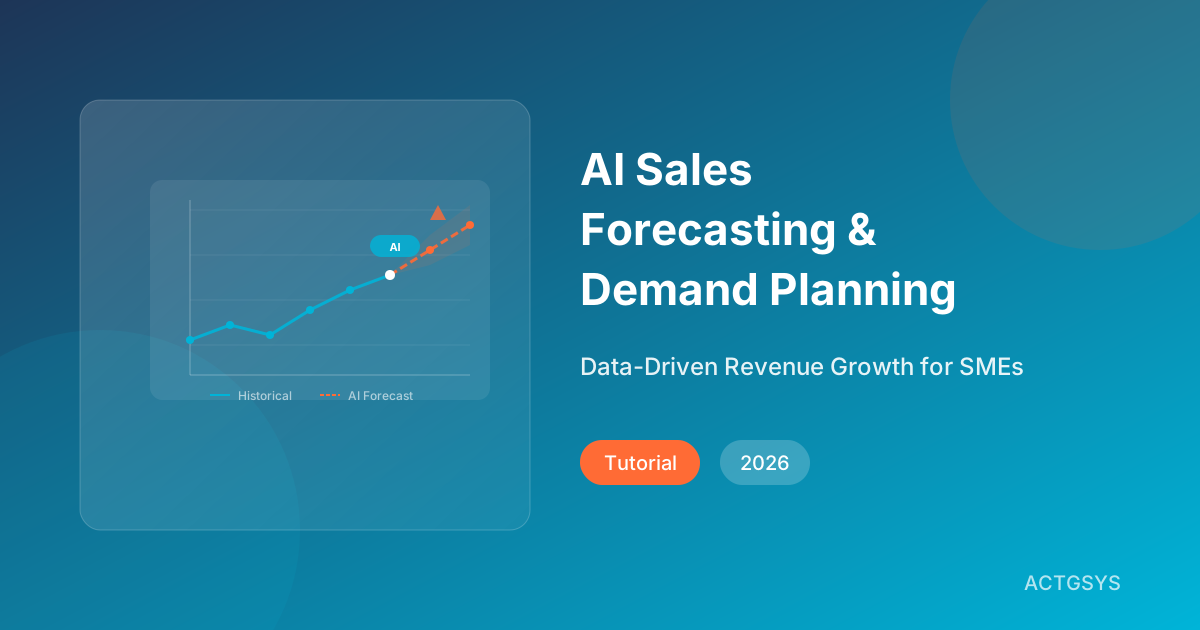
AI Sales Forecasting & Demand Planning: The 2026 SME Guide to Data-Driven Revenue Growth
If your quarterly revenue projections still come down to a sales manager eyeballing a spreadsheet and adding ten percent, you are not alone — but you are falling behind. In 2026, 75% of businesses now run AI-driven CRM systems, and the gap between companies that forecast with data and those that forecast with intuition is widening faster than ever.
The SME market is enormous. Total addressable market projections now place it at $777 billion by FY26, yet most small and mid-sized businesses still treat sales forecasting as a once-a-quarter exercise rather than an always-on intelligence layer. The result? Overstocked warehouses, missed revenue targets, and sales teams that spend 8 to 12 hours every week on manual data entry instead of closing deals.
This guide breaks down exactly how AI-powered sales forecasting and demand planning work, what ROI you can realistically expect, and how to implement these capabilities step by step — even if your team has never touched a machine-learning model.
What Is AI Sales Forecasting? How It Differs from Traditional Methods
Traditional sales forecasting relies on historical averages, pipeline snapshots, and subjective judgment. A sales director looks at last quarter's numbers, factors in a few known opportunities, and produces a target. This approach worked when markets moved slowly and product lines were simple. It does not work when customer behavior shifts weekly and economic signals arrive hourly.
AI sales forecasting replaces that linear process with a dynamic, multi-signal prediction engine. Instead of a single spreadsheet column, it ingests data from dozens of sources simultaneously:
- CRM activity logs — emails sent, calls logged, meetings booked, deal stages updated
- External market signals — commodity prices, competitor pricing changes, weather patterns, social sentiment
- Historical transaction data — not just totals, but line-item detail, seasonality curves, and customer lifetime trajectories
- Behavioral patterns — how long a prospect spends on your pricing page, which case studies they download, whether they open follow-up emails
The AI model continuously retrains itself on fresh data, meaning its accuracy improves with every sales cycle. Where a traditional forecast might achieve 55-65% accuracy at best, a well-tuned AI forecasting system routinely hits 80-85% accuracy — and it does so weeks earlier in the quarter, giving leadership more time to act.
The fundamental shift is from reactive reporting to proactive prediction. You stop asking "what happened last quarter" and start asking "what will happen next week, and what should we do about it right now."
Core Technologies Behind AI Demand Planning
Understanding the technology stack behind AI demand planning helps you evaluate vendors and set realistic expectations. Here are the key components at work.
Time-Series Models and Neural Networks
At the foundation, AI forecasting uses time-series algorithms — models specifically designed to find patterns in sequential data. Modern implementations layer neural networks (particularly LSTM and Transformer architectures) on top of classical statistical methods like ARIMA. The neural networks capture non-linear relationships that traditional statistics miss, such as how a sudden competitor price drop affects your conversion rate differently depending on the season.
Natural Language Processing for Signal Extraction
NLP engines scan unstructured data — sales call transcripts, customer support tickets, social media mentions, news articles — and extract signals that feed into the forecast. If a major client mentions "budget cuts" in an email thread, the system can flag that deal as at-risk before the sales rep updates the CRM.
Lead Scoring and Probability Engines
AI CRM platforms now offer integrated lead scoring that assigns a conversion probability to every prospect in your pipeline. These scores feed directly into the revenue forecast. When a lead's score drops from 78 to 42 because they stopped engaging, the forecast adjusts automatically — no manual intervention required.
Automated Data Capture
One of the most immediate benefits is the elimination of manual data entry. AI-driven CRM systems like DanLee CRM automatically log emails, calendar events, and call outcomes. This alone recovers 8 to 12 hours per week per sales rep — time that goes straight back into selling. More importantly, automated capture means the forecast is built on complete data rather than whatever the team remembered to log on Friday afternoon.
Workflow Automation and Trigger-Based Actions
Beyond forecasting, modern AI platforms automate the response to forecast signals. If the model predicts a 30% probability of missing the monthly target, it can automatically trigger actions: reassign leads, launch a targeted email campaign, or alert management. This closes the loop between prediction and execution.
ROI Analysis: AI vs. Traditional Forecasting
The business case for AI forecasting is no longer theoretical. Here is a side-by-side comparison based on aggregated data from SMEs that have made the transition.
| Metric | Traditional Forecasting | AI-Powered Forecasting |
|---|---|---|
| Forecast Accuracy | 55-65% | 80-85% |
| Forecast Update Frequency | Monthly or quarterly | Real-time / daily |
| Data Entry Time (per rep/week) | 8-12 hours | < 1 hour (automated) |
| Time to Detect Pipeline Risk | 2-4 weeks | 1-3 days |
| Revenue Leakage from Bad Forecasts | 10-15% of pipeline value | 3-5% of pipeline value |
| Inventory Overstock Rate | 20-30% above optimal | 5-10% above optimal |
| Implementation Cost (SME) | Spreadsheets: low; accuracy: low | SaaS subscription: moderate; accuracy: high |
| Scalability | Breaks down past 50 reps | Scales linearly with data volume |
The math is straightforward. If your business runs $5 million in annual revenue and traditional forecasting causes 12% revenue leakage through misallocated resources, bad timing, and missed deals, that is $600,000 left on the table. Cutting that leakage to 4% with AI forecasting recovers $400,000 annually — far exceeding the cost of any SaaS forecasting platform.
For inventory-dependent businesses, the impact is even larger. Reducing overstock from 25% to 8% frees up working capital that can be redirected to growth initiatives. When your CRM forecasting feeds directly into your ERP demand planning — a connection that platforms like Dinkoko ERP are designed to support — the compound benefit is significant.
5-Step Implementation Guide for SMEs
The challenge in 2026 has shifted from adoption to execution. Most business leaders understand that AI forecasting matters. The question is how to implement it without disrupting current operations or blowing through the budget. Here is a practical five-step path.
Step 1: Audit Your Data Foundation
Before you select any tool, assess what data you actually have and how clean it is.
- CRM completeness: What percentage of deals have full contact records, accurate stage assignments, and logged activities? If it is below 60%, prioritize data hygiene before anything else.
- Historical depth: AI models need at least 12-18 months of transaction history to identify seasonal patterns. If you are starting fresh, plan for a ramp-up period where accuracy will be modest.
- Data silos: Identify where revenue-relevant data lives — accounting software, e-commerce platforms, marketing automation tools, support ticketing systems. Each silo is a blind spot in your forecast.
Allocate two to three weeks for a thorough audit. Document what you find. This becomes your implementation roadmap.
Step 2: Select an AI-Native CRM Platform
Not all CRMs are created equal. Many legacy platforms have bolted on "AI features" that amount to little more than trend-line charts. Look for platforms that are AI-native — meaning machine learning is embedded in the core architecture, not added as an afterthought.
Key capabilities to evaluate:
- Automated data capture — does it log activities without rep intervention?
- Built-in lead scoring — does it assign and update conversion probabilities automatically?
- Forecast modeling — does it generate revenue projections at the deal, rep, team, and company level?
- Integration APIs — can it connect to your ERP, marketing, and accounting systems?
- Explainability — does it show you why a forecast changed, not just that it changed?
DanLee CRM is built specifically for SMEs that need enterprise-grade AI forecasting without enterprise-grade complexity. It covers all five criteria above and integrates natively with Dinkoko ERP for end-to-end demand planning.
Step 3: Connect Your Data Sources
Once your CRM is in place, connect every data source that influences revenue:
- Email and calendar — for automatic activity logging
- Marketing automation — for lead source attribution and campaign performance
- E-commerce / POS — for real-time transaction data
- ERP / inventory management — for supply-side constraints that affect what you can actually sell
- Financial systems — for margin data that lets you forecast profitability, not just revenue
Each integration adds a new signal to the model. The more signals, the more accurate the forecast. Prioritize connections based on data volume and revenue impact.
Step 4: Train Your Team on Forecast-Driven Selling
Technology alone does not change behavior. Your sales team needs to understand how to read and act on AI-generated forecasts.
- Weekly forecast reviews: Replace gut-check pipeline meetings with data-driven forecast reviews. Walk through the model's predictions, discuss where you agree or disagree, and document the reasoning.
- Deal-level coaching: Use AI risk scores to identify which deals need attention. If the model says a deal has dropped to 30% probability, the manager and rep should discuss why and decide on next steps.
- Incentive alignment: Make sure compensation structures reward forecast accuracy, not just deal volume. Reps who consistently game the pipeline to inflate numbers will degrade model performance for everyone.
Plan for a 60-90 day adoption period. Expect resistance. Measure both forecast accuracy and team engagement during this phase.
Step 5: Iterate and Expand
After one full quarter of AI-assisted forecasting, review the results:
- How did the AI forecast compare to actual revenue?
- Where were the biggest prediction errors, and why?
- Which data sources contributed the most signal?
- What operational decisions changed because of the forecast?
Use these answers to refine the model configuration, add new data sources, and expand forecasting to additional business units or product lines. AI forecasting is not a "set and forget" tool — it improves with attention and data.
CRM-ERP Integration: Connecting Forecasting to Inventory
Sales forecasting in isolation solves half the problem. If your forecast says you will sell 10,000 units next month but your warehouse only has 6,000 and your supplier lead time is six weeks, the forecast is useless without a demand planning response.
This is where CRM-ERP integration becomes critical. When your sales forecast feeds directly into your inventory and procurement systems, the entire supply chain can respond to predicted demand shifts:
- Automatic reorder triggers: When forecasted demand exceeds current inventory plus incoming shipments, the ERP generates a purchase order automatically.
- Supplier lead-time optimization: The system factors in supplier-specific lead times and recommends order dates that minimize both stockouts and carrying costs.
- Margin-aware prioritization: Not all revenue is equal. Integration lets you prioritize production and procurement for high-margin products when capacity is constrained.
- Cash flow forecasting: By combining revenue predictions with procurement commitments, you get a real-time cash flow projection — critical for SMEs where liquidity determines survival.
ACTGSYS designed DanLee CRM and Dinkoko ERP to work together as a unified intelligence layer. Sales forecasts from DanLee flow into Dinkoko's demand planning module, ensuring that what you predict on the revenue side is actionable on the operations side. This eliminates the manual handoff between sales and operations that causes delays and errors in most SMEs.
2026 Trends: Real-Time Prediction and Autonomous Decisions
The forecasting landscape is evolving rapidly. Here are the three trends defining the second half of 2026.
Decision Velocity as a Competitive Advantage
The core theme of 2026 is decision velocity — how quickly an organization can move from signal to action. AI forecasting compresses the decision cycle from weeks to hours. Companies that act on a demand spike within 24 hours capture market share from competitors still waiting for their monthly planning meeting. Speed is no longer a nice-to-have; it is the primary differentiator.
Autonomous Forecast-Triggered Actions
The next frontier beyond prediction is autonomous execution. Instead of generating a forecast and waiting for a human to act, AI systems are beginning to execute predefined playbooks automatically:
- Forecast shows a 40% probability of missing the Q2 target? The system launches a win-back campaign to dormant leads.
- Demand for Product A is projected to spike 200% due to a viral social media mention? The ERP increases the reorder quantity and alerts the fulfillment team.
- A key account's engagement score drops below threshold? The system schedules a check-in call for the assigned rep.
These autonomous actions are governed by business rules that leadership defines in advance. The AI executes within those guardrails, freeing managers to focus on strategic decisions rather than operational firefighting.
Multi-Scenario Planning
Advanced forecasting platforms now generate multiple scenarios simultaneously — best case, worst case, and most likely — each with associated probabilities and recommended actions. This lets leadership prepare contingency plans in advance rather than reacting to surprises. For SMEs with limited resources, multi-scenario planning is especially valuable because it reduces the cost of being wrong.
Frequently Asked Questions
How much historical data does AI sales forecasting need to be effective?
Most AI forecasting models require a minimum of 12 to 18 months of historical transaction data to identify seasonal patterns and build reliable baselines. However, you can start seeing value sooner if you supplement transaction history with rich activity data — emails, calls, meetings, and web engagement. The more diverse your data inputs, the less historical depth the model needs to produce useful predictions. Plan for a 2-3 month ramp-up period where accuracy will improve as the model learns your specific sales patterns.
What is a realistic accuracy improvement when switching from traditional to AI forecasting?
SMEs typically see forecast accuracy improve from the 55-65% range to 80-85% within two to three quarters of full implementation. The initial jump is usually the largest — going from spreadsheet-based forecasting to an AI-native CRM often delivers a 15-20 percentage point accuracy gain in the first quarter simply by eliminating data gaps caused by manual entry. Subsequent improvements are incremental as the model accumulates more training data and you refine its configuration.
Can AI sales forecasting work for businesses with irregular or project-based revenue?
Yes, but it requires a different modeling approach. For project-based businesses with lumpy revenue — consulting firms, agencies, custom manufacturers — the AI model focuses on pipeline velocity, win-rate patterns, and project milestone probabilities rather than recurring transaction volumes. The key is ensuring your CRM captures detailed stage-gate data for each opportunity. Platforms like DanLee CRM support configurable sales processes that map to non-standard revenue models, making AI forecasting accessible even for businesses that do not fit the typical SaaS or product-sales mold.
How does AI demand planning handle sudden market disruptions?
AI models that rely solely on historical patterns will struggle with unprecedented disruptions. Modern platforms address this by incorporating real-time external signals — news feeds, commodity indices, social sentiment, and supply chain status updates — that detect shifts before they appear in sales data. Additionally, multi-scenario planning features let you model "what if" disruptions and prepare response plans in advance. The combination of real-time signals and scenario planning makes AI demand planning significantly more resilient than traditional approaches, even in volatile markets.
What is the typical implementation timeline and cost for an SME?
A complete implementation — from data audit through full team adoption — typically takes 90 to 120 days for an SME with 10-50 employees. Costs vary depending on your existing technology stack, but most SMEs can implement AI-native CRM forecasting for a monthly SaaS subscription plus a one-time integration and training investment. The ROI breakeven point usually falls within the first two quarters, driven primarily by recovered sales rep time, reduced revenue leakage, and optimized inventory levels.
Take the Next Step
Gut-feeling forecasting had its place. That place was 2020. In 2026, with the SME market approaching $777 billion and AI-driven CRM adoption at 75%, the tools to forecast with precision are accessible, affordable, and proven.
The question is no longer whether AI sales forecasting works. It is whether you will implement it before your competitors do.
ACTGSYS helps SMEs move from intuition to intelligence with DanLee CRM for AI-powered sales forecasting and Dinkoko ERP for integrated demand planning. Whether you need a turnkey solution or a custom AI implementation tailored to your industry, our team can get you from data audit to live forecasting in 90 days.
Talk to our team about AI forecasting for your business — no obligation, no jargon, just a clear-eyed assessment of what AI can do for your revenue operations.
Products & Solutions in This Article
AI-powered CRM for lead management, customer tracking, and sales pipeline optimization designed for SMEs.
AI-driven ERP focusing on procurement, inventory, and supply chain management. Each customer deployed on dedicated cloud infrastructure.
Related Articles
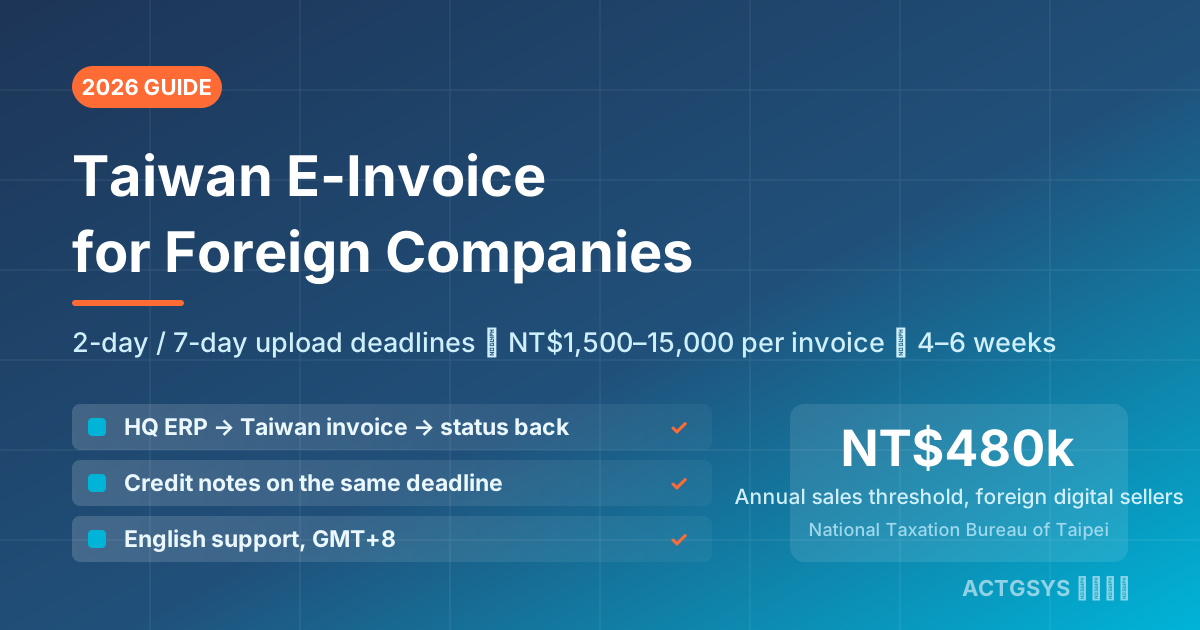
Taiwan E-Invoice for Foreign Companies 2026 - Cost
How a foreign-owned Taiwan subsidiary or branch connects its ERP to Taiwan's e-invoice platform: 2-day B2C / 7-day B2B upload deadlines, NT$1,500–15,000 per-invoice penalties, three integration paths, and a 4–6 week project from NT$50,000.
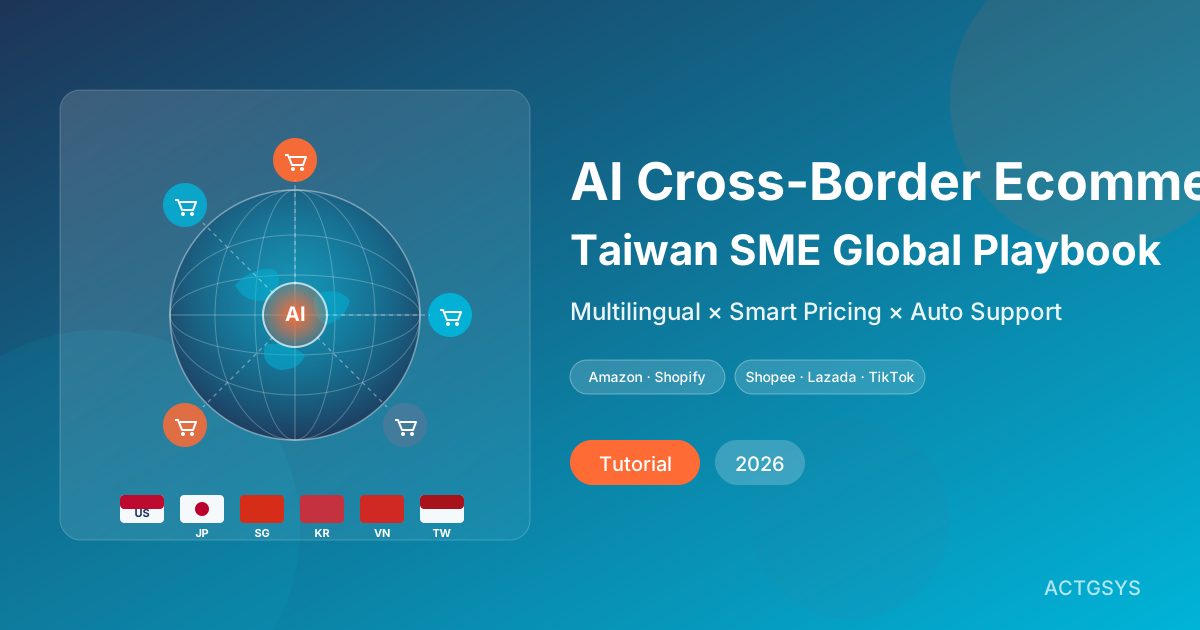
AI Cross-Border Ecommerce Playbook for SMEs (2026)
How Taiwan SMEs use AI to automate cross-border e-commerce — multilingual listings, smart customer service, dynamic pricing, ad ops, and logistics forecasting across Amazon, Shopify, Shopee, Lazada, and TikTok Shop.
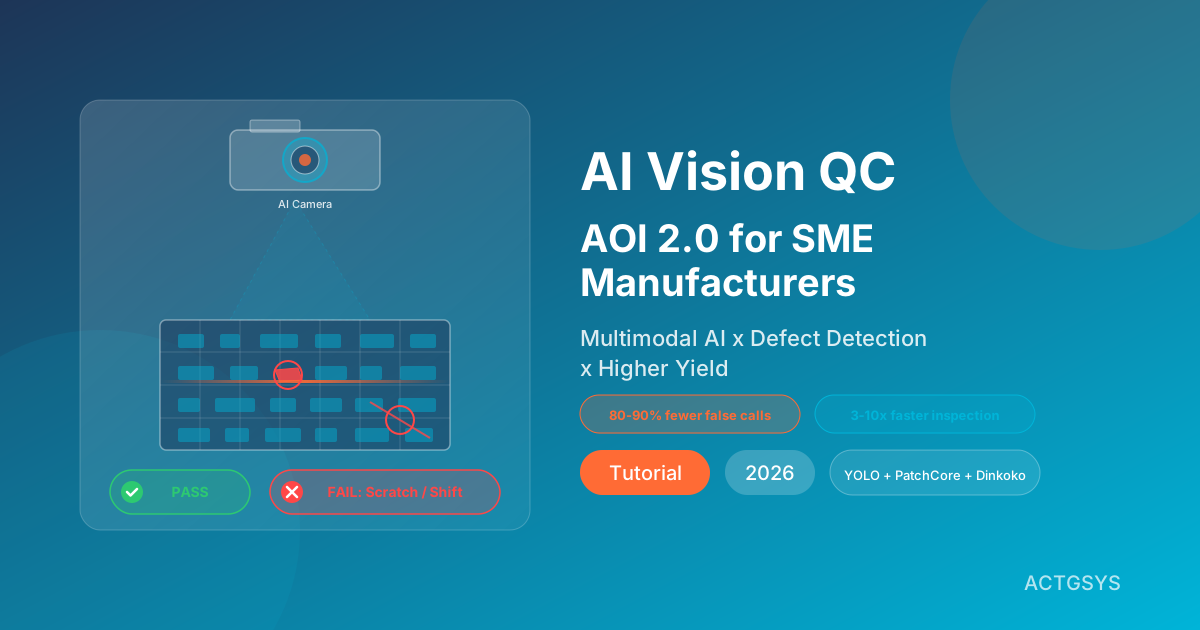
AI Vision Quality Control 2026: AOI 2.0 for SMEs
A deep dive into how AI vision QC (AOI 2.0) combines computer vision with multimodal LLMs to automate defect detection, raise yield and shrink inspection time. Includes a five-step rollout, platform comparison and FAQ.
What would this cost you?
Answer five questions. Within three working days you get a price range and what it covers. No deck, no follow-up sales calls.
Prefer to talk?LINE·02-2553-8084