AI SDR in 2026: B2B Sales Development Automation for SMEs
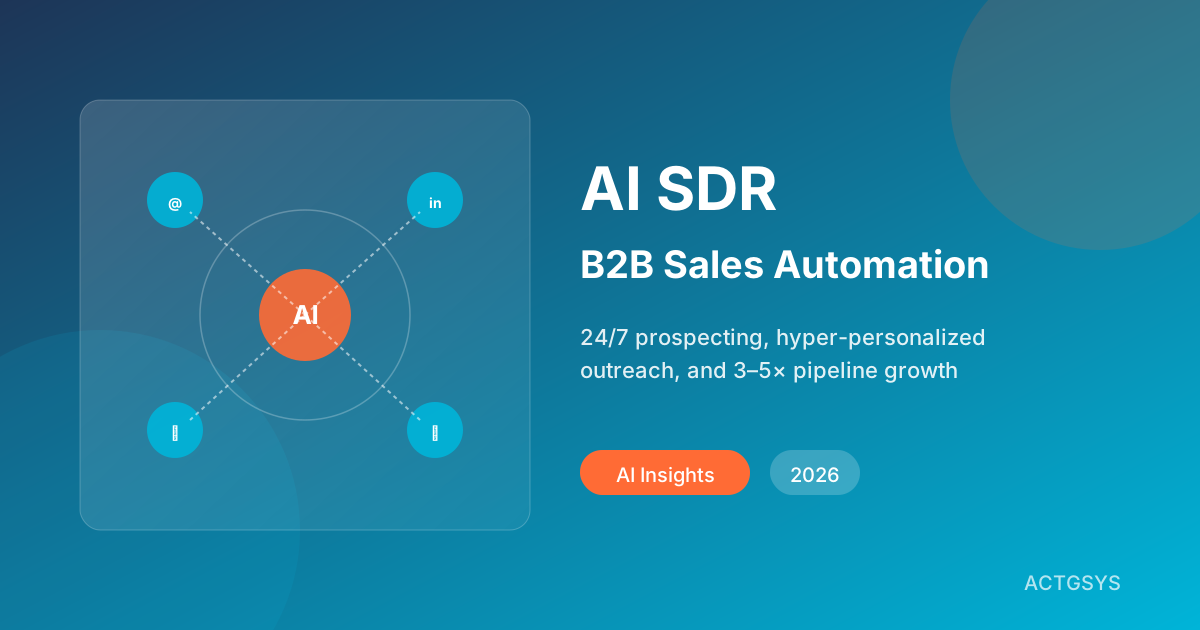
AI SDR in 2026: The Complete Guide to B2B Sales Development Automation for SMEs
Short answer: An AI SDR is an AI agent that autonomously finds prospects, writes personalized outbound messages, and follows up until a qualified meeting is booked — typically lifting SME pipeline 3–5× while cutting cost per qualified lead by 60–70%.
B2B sales development is being rewritten in 2026. According to Gartner (2025), 75% of B2B sales organizations will deploy AI-augmented sales tools by end of 2026, and the fastest-growing category is the AI SDR. The outbound motion that used to require five human development reps can now be run by one sales leader plus an AI SDR — with better coverage, higher reply quality, and perfect follow-up consistency. This guide covers what an AI SDR actually does, and how SMEs can deploy one in 6–8 weeks.
What Is an AI SDR?
An AI SDR (AI Sales Development Representative) is an AI agent that automates the B2B sales development workflow: prospecting, personalized outreach, multichannel follow-up, intelligent reply handling, and CRM sync. According to Forrester (2025), companies deploying AI SDRs grow qualified pipeline by 3–5× within 90 days on average.
A traditional SDR's day is chopped into eight fragments: list building, research, email writing, cold calls, reply chasing, CRM updates, meetings, breaks. An AI SDR compresses those eight tasks into one continuous automated loop:
- Runs 24/7 — no weekends, no time zones, no forgotten follow-ups
- Personalization at scale — every email is shaped by LinkedIn, company news, and tech stack signals
- Data-driven — every open, click, and reply feeds the next iteration
- Clean handoff — when a lead matures, a human rep takes over with full context
AI SDR vs. Traditional SDR
| Dimension | Human SDR | AI SDR |
|---|---|---|
| Daily outreach | 50–80 touches | 500–2,000+ personalized messages |
| Personalization | 5–10 template fills | Dynamic research + generation per message |
| Follow-up consistency | Prone to gaps | 100% on schedule |
| Response speed | Hours to next day | Real-time (< 60 sec) |
| Cost per qualified lead | US$40–85 | US$10–17 |
| Scaling model | Linear (more reps, more cost) | Non-linear (add workflow) |
Why 2026 Is the Inflection Point for SMEs
AI SDR maturity has crossed the line from "experimental" to "production-ready" over the past two years. According to Salesforce State of Sales (2025), 83% of high-growth sales teams have embedded AI into their outbound motion, with AI SDRs as the top-priority investment. SMEs that delay by another six months will fall behind first movers by 1–2 full sales cycles.
Three irreversible market signals:
1. Email deliverability algorithms tightened. Google and Microsoft in 2025 strengthened sender authentication (DMARC, BIMI) and content quality detection. Generic template blasts now land in spam. Only dynamically personalized messages reach the inbox.
2. Multichannel (email + LinkedIn + messaging) is table stakes. Buyers touch an average of 27 content pieces before deciding (Forrester 2025). Single-channel outbound no longer works. An AI SDR runs email, LinkedIn, and WhatsApp in sync, adjusting cadence automatically.
3. Buyers expect instant response. HubSpot (2025) reports that leads contacted within 5 minutes convert at 21× the rate of leads contacted after an hour. Humans can't do this consistently. An AI SDR can.
How an AI SDR Works, End to End
The AI SDR workflow breaks into five linked stages. Each can run standalone, or chain into a full end-to-end motion.
Stage 1: Prospecting
Starting from your ICP (Ideal Customer Profile), the AI SDR pulls from multiple data sources to build a target list:
- Public sources: LinkedIn Sales Navigator, company websites, press releases, Crunchbase
- Intent signals: Bombora, G2 buyer intent data, website visitor tracking
- Internal data: existing customers, historical opportunities, and Closed Lost lists in DanLee CRM
The model scores each prospect against your historical won customers to rank priority.
Stage 2: Deep Account Research
Human SDRs spend roughly 40% of their time on research (Gong Labs, 2025). An AI SDR completes it in 30 seconds:
- Scans the last 90 days of company news and financial signals
- Analyzes decision-maker LinkedIn posts, talks, and articles
- Detects tech stack changes, hiring signals, org shifts
- Produces a personalized "hook" for the opening line
Stage 3: Hyper-Personalized Outreach
An AI SDR isn't template substitution — it's contextual generation. Every message contains:
- Situational opener referencing recent activity (launch, award, news)
- Hypothesized pain inferred from industry + role + stage
- Value alignment linking your capability to the inferred pain
- Low-friction CTA — not "book a demo," but "15 minutes to chat?"
Stage 4: Multichannel Intelligent Follow-up
Single-email reply rates sit at 1–3%. Multichannel orchestration pushes reply rates to 8–15%:
- Day 1: LinkedIn connection request
- Day 3: Email 1 (problem angle)
- Day 7: LinkedIn engagement (react to a post)
- Day 10: Email 2 (case study)
- Day 14: WhatsApp / LINE lightweight touch
- Day 21: Email 3 (additional value)
Every step adapts in real time — opens without clicks trigger a new angle; clicks without replies trigger a case study.
Stage 5: Conversation and Handoff
When a prospect replies, the AI SDR shifts into conversation mode:
- Answers common questions from an FAQ knowledge base via RAG
- Detects buying signals (budget, timeline, decision-maker)
- Books meetings directly against Google Calendar
- Hands off to a human rep when qualification thresholds are met
The full conversation and enriched context sync back to DanLee CRM, so the human rep inherits everything.
A 6-Week Deployment Path for SMEs
Deploying an AI SDR doesn't require a 6-month enterprise project. Based on ACTGSYS deployments across 30+ SMEs over the last 18 months, here is the typical path:
Week 1: ICP and messaging
- Define the Ideal Customer Profile (industry, size, role, pain)
- Draft the value proposition and differentiators
- Build 3–5 situational message skeletons
Week 2: Data and CRM integration
- Connect existing customer data from DanLee CRM
- Set up lead scoring and qualification thresholds
- Build deduplication, suppression, and compliance checks
Weeks 3–4: Email infrastructure and model tuning
- Configure sender domains with SPF/DKIM/DMARC
- Run email warm-up sequences
- Tune the AI model to match your brand voice
Week 5: Small-scale pilot
- Run a full cycle against 100–200 targets
- Monitor open, reply, and meeting-booked rates
- Adjust messaging and cadence on real data
Week 6: Scale and continuous optimization
- Expand to 500–2,000 daily targets
- Enable automated A/B testing
- Stand up a weekly scorecard and handoff SLA
Expected KPIs After 90 Days
Typical 90-day metrics from ACTGSYS customers:
| Metric | Before | After 90 days | Lift |
|---|---|---|---|
| Monthly outreach | 1,500 | 15,000 | +900% |
| Email open rate | 18% | 42% | +133% |
| Reply rate | 2.1% | 9.8% | +367% |
| Monthly qualified opps | 12 | 48 | +300% |
| Cost per lead | US$70 | US$16 | -77% |
| SDR headcount | 3 | 1 + AI | -67% |
Will AI SDRs Replace Human Sales Reps?
No. AI SDRs replace the repetitive outreach motion, not the high-stakes conversation and closing judgment. Humans, freed from grinding, focus on what compounds: discovery, objection handling, negotiation, and relationship building. According to McKinsey (2025), hybrid AI + human sales models close at 38% higher rates than human-only teams.
Sales role evolution:
- Past: humans do 100%
- Now: AI handles 60–70%, humans own the critical 30–40%
- Next: AI handles 80%, humans become strategic advisors
Frequently Asked Questions
How is an AI SDR different from marketing automation like HubSpot Workflow?
Marketing automation is reactive — it triggers sequences after a form fill. An AI SDR is proactive — it reaches buyers who don't yet know you. The two are complementary: AI SDRs open the pipeline; marketing automation nurtures the middle.
Won't AI SDR emails get flagged as spam?
Not if you follow three rules: (1) use a dedicated sender domain with DMARC, (2) make every message genuinely personalized (not template fill), and (3) enforce suppression and unsubscribe logic strictly. ACTGSYS configures your email infrastructure during onboarding and monitors sender reputation for the first 30 days.
Does an AI SDR handle traditional Chinese and Taiwan-localized content?
Yes. The ACTGSYS AI SDR stack uses traditional-Chinese-optimized models (including Claude Opus 4.7 and fine-tuned corpora), writes with correct Taiwanese business etiquette, and understands local vocabulary (FSC, MOEA, SME Administration, etc.).
How much does an AI SDR cost for an SME?
A complete SME deployment (CRM integration, email infrastructure, model tuning, first 3 months of managed ops) typically runs US$6,000–9,500 setup plus US$1,150–2,100 monthly. Compared with hiring 2–3 human SDRs (US$80,000+ annual loaded cost), you save 70–80% in year one.
When is an AI SDR not the right investment?
Three cases to deprioritize: (1) pure e-commerce with AOV under US$1,000 that doesn't need human touch, (2) high-end bespoke services that run on referrals, (3) pre-PMF startups where messaging and ICP are still unstable. In those cases, fix positioning first.
Closing: AI SDRs Close the Gap Between SMEs and Enterprises
For years only large companies could afford 10-person SDR teams, and SMEs were structurally locked out of outbound. AI SDRs rewrite that asymmetry — a 30-person SME now runs the pipeline development capacity of a 500-person competitor. This isn't a "future trend." It's the 2026 survival threshold.
Ready to 3–5× your sales pipeline? Contact ACTGSYS for a free AI SDR readiness assessment, backed by our 90-day ROI guarantee. Learn how DanLee CRM integrates natively with our AI SDR stack.
Last updated: 2026-04-13
Products & Solutions in This Article
Related Articles
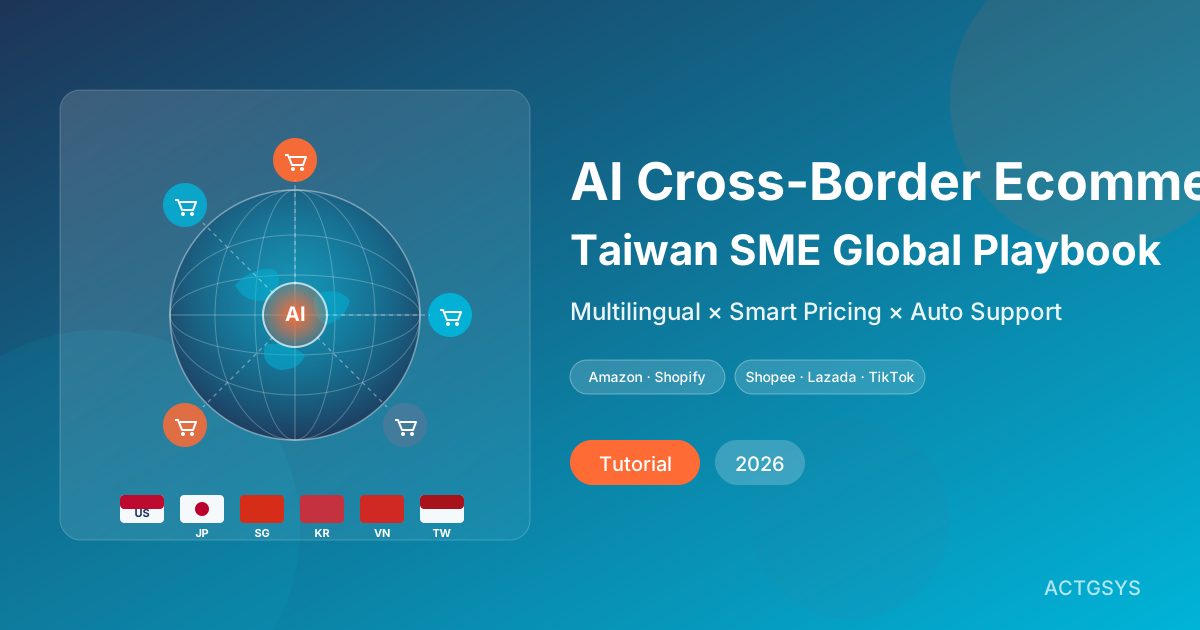
AI Cross-Border Ecommerce Playbook for SMEs (2026)
How Taiwan SMEs use AI to automate cross-border e-commerce — multilingual listings, smart customer service, dynamic pricing, ad ops, and logistics forecasting across Amazon, Shopify, Shopee, Lazada, and TikTok Shop.
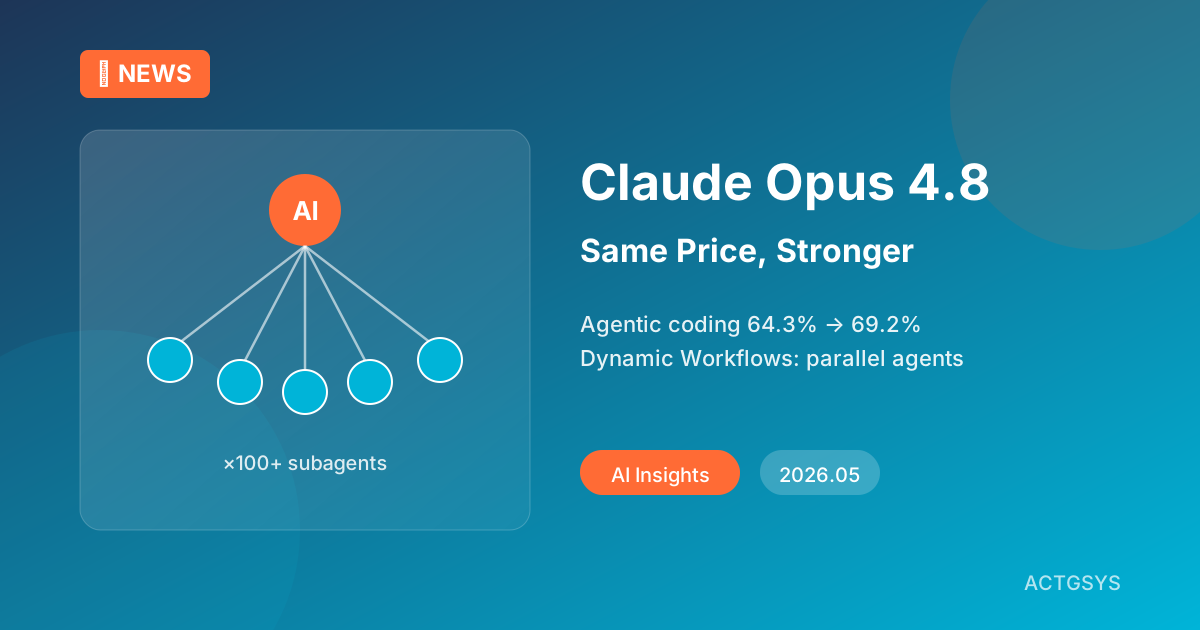
Anthropic Claude Opus 4.8 (2026): Same Price, Stronger
On May 28, 2026, Anthropic launched Claude Opus 4.8, holding the same $5 / $25 per 1M token pricing as its predecessor while lifting agentic coding from 64.3% to 69.2% and adding Dynamic Workflows — a research preview that orchestrates hundreds of parallel subagents. We unpack what this upgrade means for Taiwan SME automation.
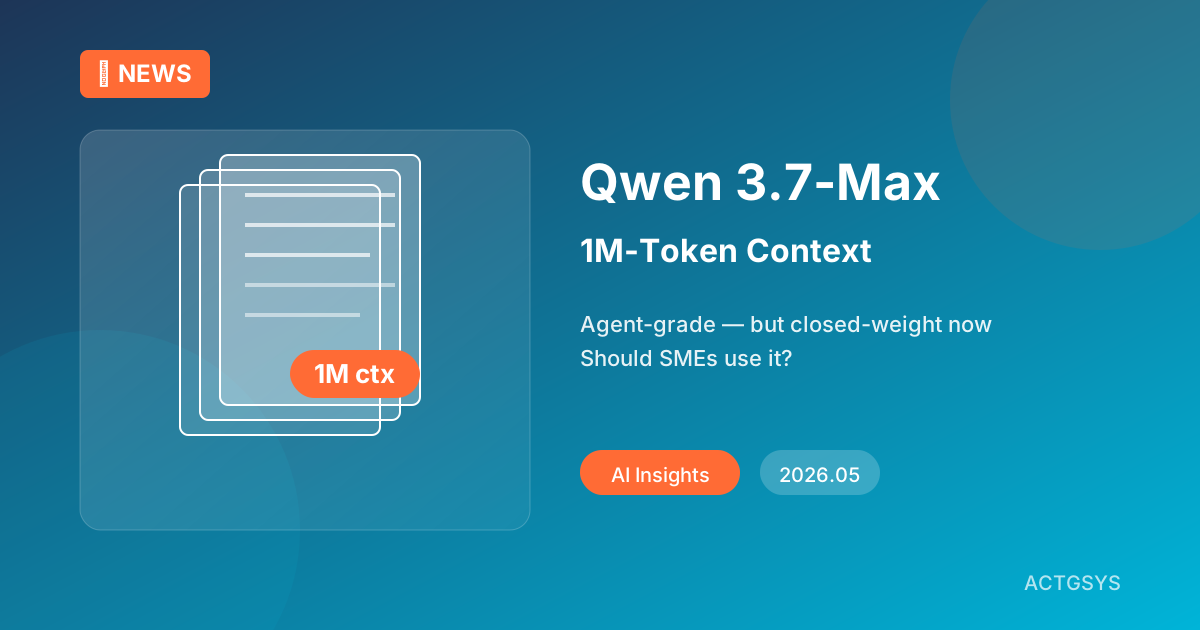
Alibaba Qwen 3.7-Max (2026): 1M-Token Context
On May 20, 2026, Alibaba launched Qwen 3.7-Max with a 1M-token context window and native extended thinking, scoring 69.7 on Terminal-Bench 2.0 and 60.6 on SWE-Bench Pro — but it's closed-weight and API-only for the first time. We unpack what this Chinese flagship means for Taiwan SME long-document processing and cost.
What would this cost you?
Answer five questions. Within three working days you get a price range and what it covers. No deck, no follow-up sales calls.
Prefer to talk?LINE·02-2553-8084