AI Vision Quality Control 2026: AOI 2.0 for SMEs
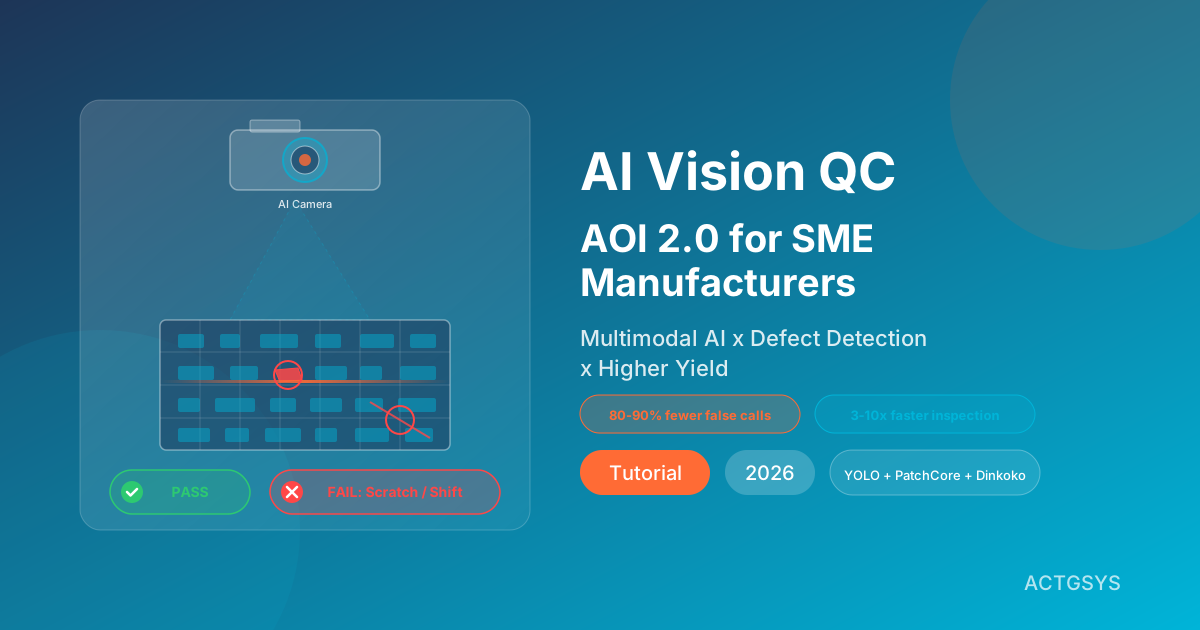
AI Vision Quality Control 2026: How SME Manufacturers Replace Manual & Traditional AOI with AOI 2.0
Taiwan's manufacturing edge is shifting from "cheap hands" to "smart eyes". For 30 years the island's PCB, semiconductor, panel and precision machinery supply chains relied on human inspectors and rule-based AOI (Automated Optical Inspection). But humans tire, rule-based AOI generates excessive false calls, and every product change-over forces engineers to retune parameters. In 2026 those pain points are being rewritten by AI vision quality control — AOI 2.0. This guide is written for SME factory owners and operations managers who want to deploy a self-learning inspection line in 8 to 12 weeks.
What Is AI Vision QC? How It Differs from Traditional AOI
AI vision QC uses deep learning models — CNNs, Transformers and multimodal LLMs — instead of fixed rules, so the inspection system can actually "understand" what a defect looks like. It recognizes previously undefined defect types, tolerates lighting and angle drift, and retrains on a new product with a few hundred images. Those three traits are precisely where rule-based AOI fails.
Traditional AOI is rule-based: engineers tune thresholds such as "brightness delta greater than X", "blob area greater than Y pixels" and "edge slope greater than Z". It works on obvious defects like PCB shorts or missing components, but on grey-zone defects — contamination, scratches, mild deformation, color shift — false-call rates often reach 30-50%, forcing manual review on nearly every board.
AI vision QC is data-driven: feed the model 500-2000 labeled images and it learns what a defect actually is. NVIDIA Metropolis and Google Cloud Visual Inspection AI public results (2024) show AI models cutting false-call rates on PCB, textile and metal-surface inspection from 30% to 3-5% — roughly 80-90% less manual rework.
Three sentences to tell them apart
- Manual inspection: depends on senior operator experience, ~5-15 parts per minute, miss rate rises with fatigue
- Traditional AOI: rule-based and fast, but high false-call rate and reparametrization on every changeover
- AI vision QC: model learns defect features, fast and accurate, retrainable as the line evolves
Why SME Manufacturers Should Upgrade to AI Vision QC in 2026
Because tier-1 customer quality demands, labor shortages and falling AI model cost are hitting an inflection point at the same time. 2026 is the year SME manufacturers must decide — skip the upgrade and you risk being squeezed out of the supply chain on every quote. McKinsey (2024) smart-manufacturing research shows AI vision QC factories typically recover the investment within 12 months.
Key data points SMEs cannot ignore:
- Global machine vision market to reach USD 22 billion in 2026, 12.8% CAGR (IDC Manufacturing, 2024)
- AI vision QC reduces defect escape rate by 40-90% depending on the use case (NVIDIA Metropolis case studies, 2024)
- 65% of manufacturing leaders rank quality management as a top AI investment priority (BCG Industry X, 2024)
- AI-driven inspection cuts inspection time by 50-70% on average (Gartner smart manufacturing survey, 2024)
- Taiwan manufacturers lose roughly 3-5% of revenue annually to quality defects (ITRI Mechanical Lab, 2023 Smart Manufacturing Yearbook)
Taiwan's AOI heritage and the upgrade window
Taiwan is the core supply base for PCB AOI machines worldwide. Utechzone, Solomon Technology, Machvision, Aeon and Test Research have all built decades of know-how in rule-based AOI. After 2020, however, global vendors Cognex and Keyence rolled out deep-learning extensions, and cloud platforms like NVIDIA Metropolis and Google Visual Inspection AI cut the entry barrier. SME manufacturers can now "skip" the expensive custom AOI machine and subscribe to AI vision QC as a service.
For mid-sized SMT, CNC, textile, food, and plastic injection plants, this means investing only in defect imagery — at roughly one-tenth the historical cost — to build AI inspection capability. Taiwan's Ministry of Economic Affairs Industrial Development Bureau (2024) Smart Machinery program also offers subsidies for SME AI QC pilots.
Core Tech: From CNN to Multimodal LLMs
The AI vision QC tech stack has four layers: image capture, model inference, decision logic and line integration. The 2026 inflection is that multimodal LLMs (OpenAI GPT-4V, Anthropic Claude vision, Google Gemini Vision) are mature enough to plug the gaps where classic CNNs need many samples or struggle to describe defects in plain language.
The base layer is still convolutional neural networks (CNNs) — ResNet, EfficientNet and especially the YOLO family for object detection. YOLOv8 and YOLOv11 from Ultralytics (2024) hit 60-120 FPS on industrial edge devices, enough to match SMT lines doing hundreds of parts per minute. For pixel-level defect segmentation, U-Net and Mask R-CNN remain mainstream.
The middle layer is anomaly detection: PatchCore and PaDiM only need "good" samples and flag everything else as anomalous — perfect for SMEs that lack large defect datasets. On the MVTec AD benchmark (IEEE CVPR 2019), PatchCore reaches 99.1% AUC for defect detection.
The newest layer is multimodal LLMs. OpenAI GPT-4V and Anthropic Claude 3.5 Sonnet vision (2024) can describe anomalies in natural language — e.g. "a 15%-contrast irregular scratch in the lower-right corner". Stanford HAI's 2024 AI Index Report shows multimodal models reaching 78% accuracy on zero-shot defect description tasks, dramatically lowering labeling cost.
NVIDIA TAO Toolkit (2024) and the Omniverse platform let SMEs train models on synthetic data when real defect samples are scarce — a virtual line generates 10,000 defect images that transfer to the real model. MIT CSAIL (2023) research shows synthetic data lifting accuracy by 8-12%.
Five-Step Implementation Guide for SMEs
To go from zero to a working AI vision QC PoC, plan for five steps over 8-12 weeks. The workflow below combines the NVIDIA Metropolis deployment framework (2024), Taiwan ITRI's 2023 Smart Manufacturing White Paper, and ACTGSYS field experience with Taiwan SME factories. The key principle: pilot one line and one defect category first, then replicate.
- Week 1 — Define defect categories and business KPI: identify the 1-3 most painful defects (solder shorts, surface scratches, print misalignment), define the visual pass/fail criteria, and set a KPI such as "drop escape rate from 5% to 1%" or "halve manual review hours".
- Weeks 2-4 — Image capture and labeling: install industrial cameras (5MP+, ring light recommended), collect 500-2000 images covering good and defective parts, and label using LabelImg, CVAT or Roboflow (2024).
- Weeks 5-7 — Model training and validation: pick the right architecture (YOLOv8 for sparse defects, PatchCore for no-defect samples, Vision Transformer for complex scenes) and train with NVIDIA TAO Toolkit or Google Vertex AI. Validation accuracy must exceed 95% before go-live.
- Weeks 8-10 — Line integration and closed loop: deploy to edge devices (NVIDIA Jetson, Intel NUC) or cloud APIs, and wire the model to PLC, MES and Dinkoko ERP so rejects are auto-diverted, defect logs flow into QC reports, and raw-material reorders or line-stop alerts fire automatically.
- Weeks 11-12 — Production monitoring and continuous learning: weekly review of false calls and escapes, feed new images back into the training set, retrain monthly or quarterly. This data flywheel is the long-run advantage over fixed-rule AOI.
Reference cases include NVIDIA's published BMW and Foxconn deployments (2024) — BMW cut automotive-part escape rate by 80%, Foxconn raised PCB inspection throughput 6x — both running on Metropolis.
AI Vision QC Platform Comparison Table
The right platform is not the "most powerful" one — it is the one with the lowest deployment friction for an SME. The table below compares the 2026 mainstream AI vision QC platforms from an SME deployment angle: feature fit, pricing, localization and ERP integration.
| Platform | Best For | Deployment | Starting Cost | Chinese Support | Dinkoko ERP Integration |
|---|---|---|---|---|---|
| NVIDIA Metropolis | High-volume lines, custom models | Edge + cloud | Priced via Jetson HW | Partial docs | Custom API required |
| Google Visual Inspection AI | Cloud-first, multi-site | Cloud SaaS | ~USD 500+/month | Good | REST API |
| Microsoft Azure Custom Vision | Azure-native stacks | Cloud + edge | ~USD 100+/month | Good | Native connector |
| AWS Lookout for Vision | Anomaly-detection focus | Cloud SaaS | ~USD 200+/month | Limited | Middleware needed |
| Cognex VisionPro Deep Learning | High-speed, low-latency lines | On-prem industrial PC | High one-time license | Good | OPC UA |
| Keyence AI Vision | Turnkey HW + SW package | On-prem industrial PC | High (incl. cameras) | Good | PLC bridge |
| ACTGSYS Custom AI Inspection | SME manufacturers needing ERP integration | Edge + cloud | Monthly subscription | Full Chinese | Native Dinkoko integration |
For Taiwan SMEs in the NT$500M-5B annual revenue band, ACTGSYS Custom AI Vision QC bundles open-source models (YOLO, PatchCore) with cloud training, full Chinese localization and native Dinkoko ERP integration — the highest-ROI entry point without locking into a single hardware vendor.
FAQs
Q1: Can AI vision QC coexist with traditional AOI?
Yes — and we recommend it. Traditional AOI is extremely fast at rule-based defects (missing parts, polarity errors). AI vision QC handles the grey zone (scratches, contamination, color shift). A common architecture has AOI doing a first-pass screen and AI re-judging the "suspect" boards, cutting false calls from 30% to under 3%.
Q2: My factory has very few defect samples — can the model still train?
Yes. The 2026 mainstream answer is anomaly-detection models like PatchCore and PaDiM: 100-500 "good" images are enough to learn what good looks like, and anything unlike that is flagged. The complement is synthetic data via NVIDIA Omniverse or Stable Diffusion. Stanford HAI (2024) research shows synthetic data improving small-sample accuracy by 8-12%.
Q3: What is the typical budget for AI vision QC deployment?
For an SME PoC, expect NT$300K-1.2M (USD 10K-40K) covering industrial cameras, edge devices (NVIDIA Jetson Orin Nano ~USD 700), model development and line integration. ACTGSYS subscription packages start at NT$25K-80K (USD 800-2,500) per month depending on lines and defect categories. McKinsey (2024) puts average payback at 9-14 months.
Q4: How many data engineers do we need? We have no AI team.
You do not need an in-house AI team. The typical SME model has IT collecting and labeling data, and an external partner handling training and deployment. ACTGSYS operates this co-build model — your side provides one QC or IT staff member for labeling and validation, and our team handles training, edge deployment, ERP integration, plus quarterly retraining.
Q5: When a new product launches, how long to retrain the model?
It depends on defect complexity. For a similar product (same PCB family, different size) incremental retraining takes 1-2 weeks. For a brand-new product category, plan the full five-step flow at 4-6 weeks. The key is the data flywheel — pipe every day's production images back into the training set so the model keeps improving over time.
Conclusion: AI Vision QC Is the Highest-ROI SME Investment for 2026
AI vision QC has evolved from "only the big plants can afford it" to "any SME can subscribe". With labor shortages, tier-1 quality demand and supply-chain price wars all converging, the factories that move first will capture more orders in 2027. Gartner (2024) projects 50% of mid-sized manufacturers will have some form of AI inspection by 2027 — laggards will trail on gross margin by 5-8 points.
If you run a Taiwan SME manufacturer in the NT$100M-5B revenue range and you are evaluating an inspection upgrade, book a free AI vision QC feasibility assessment with ACTGSYS. We will tailor an 8-12-week PoC plan, budget and integration roadmap with your existing Dinkoko ERP, MES and PLC stack — based on your product categories, line equipment and specific defect pain points.
Products & Solutions in This Article
AI-driven ERP focusing on procurement, inventory, and supply chain management. Each customer deployed on dedicated cloud infrastructure.
Intuitive accounting system designed for Taiwan SMEs, with automated bookkeeping and financial reporting.
AI-powered CRM for lead management, customer tracking, and sales pipeline optimization designed for SMEs.
Related Articles
AI Predictive Maintenance for SME Manufacturers
What is AI predictive maintenance? This 2026 guide for SME manufacturers explains the IoT + edge AI architecture, a six-step rollout, and a side-by-side platform comparison, with citations from McKinsey, Deloitte, NVIDIA, AWS, and Taiwan's ITRI.
Taiwan E-Invoice for Foreign Companies 2026 - Cost
How a foreign-owned Taiwan subsidiary or branch connects its ERP to Taiwan's e-invoice platform: 2-day B2C / 7-day B2B upload deadlines, NT$1,500–15,000 per-invoice penalties, three integration paths, and a 4–6 week project from NT$50,000.
AI Cross-Border Ecommerce Playbook for SMEs (2026)
How Taiwan SMEs use AI to automate cross-border e-commerce — multilingual listings, smart customer service, dynamic pricing, ad ops, and logistics forecasting across Amazon, Shopify, Shopee, Lazada, and TikTok Shop.
What would this cost you?
Answer five questions. Within three working days you get a price range and what it covers. No deck, no follow-up sales calls.
Prefer to talk?LINE·02-2553-8084