Anthropic Raises $30B at a $900B+ Valuation (May 2026): AI Giants Accelerate Consolidation — How Should Taiwan SMEs Pick a Vendor?
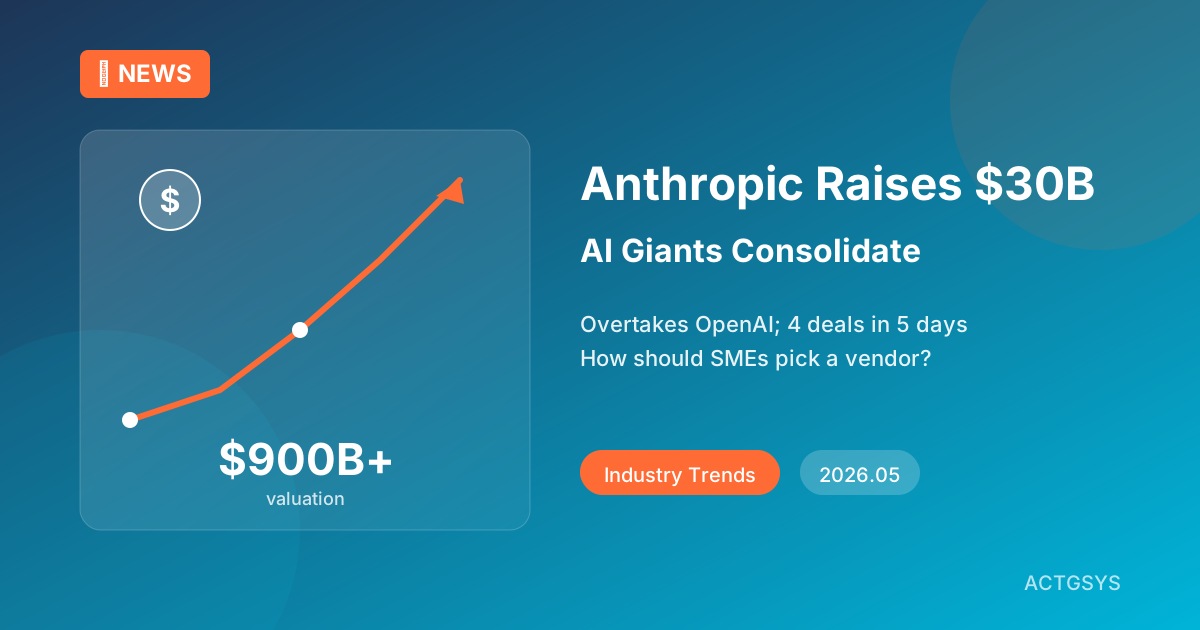
In late May 2026, Anthropic closed a round of over $30 billion at a valuation above $900 billion, overtaking OpenAI to become the world's most valuable AI startup; in nearly the same week, Anthropic, Mistral, Google DeepMind, and Meta each acquired or acqui-hired an AI startup team within five days. For Taiwan SMEs, the signal of "giants accelerating consolidation" isn't about how staggering the numbers are — it's about changing the question you ask when picking an AI vendor, from "who's cheapest" to "who will last, and will they lock me in?"
What Happened?
In late May 2026, Anthropic closed a growth round of over $30 billion at a valuation above $900 billion. According to CNBC (2026), this valuation vaulted Anthropic past OpenAI — which had raised in March at an $852 billion valuation — to become the world's most valuable AI startup.
The round was co-led by Sequoia Capital, Dragoneer, Altimeter Capital, and Greenoaks, each investing roughly $2 billion (Bloomberg, 2026). More striking is the pace: Anthropic was valued at roughly $380 billion in February, nearly 2.5×-ing in just over three months.
Almost in lockstep with the raise came a dense wave of acquisitions. Within five days, Anthropic bought Stainless, Mistral acquired Emmi AI, Google DeepMind hired the entire Contextual AI team, and Meta acqui-hired the Dreamer team (StartupHub.ai, 2026). Four major AI labs moving in the same week is widely read as a clear signal of accelerating consolidation.
What Are the Key Takeaways From This Funding and M&A Wave?
Breaking the week apart reveals three clear threads:
- Capital is concentrating in a few leaders — per VC data, the week of May 18–24, 2026 saw 61 funding rounds totaling $35.3 billion, with that astronomical figure almost entirely from Anthropic alone (Crunchbase News, 2026). Resources are tilting fast toward a handful of frontier labs.
- M&A is shifting from "buying tech" to "buying teams" — DeepMind hiring the whole Contextual AI team and Meta acqui-hiring Dreamer reflect talent (not just products) as the core target of this wave.
- The valuation race is white-hot — Anthropic and OpenAI keep trading the "world's most valuable AI startup" crown, both nearing trillion-dollar valuations, backed by a high-stakes bet on "who will dominate the enterprise AI platform."
How Is This Consolidation Different From Earlier AI Booms?
Many will ask: AI funding news is daily — what's different this time? The key is the directionality of consolidation. The table contrasts this wave with the early AI boom:
| Dimension | 2023–2024 Early Boom | May 2026 Consolidation |
|---|---|---|
| Capital flow | Spread broadly across many startups | Highly concentrated in a few leaders (Anthropic took most of one week) |
| M&A target | Buying products / tech | Buying teams / acqui-hires (grabbing talent) |
| Valuation level | Billions to tens of billions | Approaching $1T (Anthropic > $900B) |
| Signal to enterprise buyers | "Many options, experiment widely" | "Landscape converging, vendors reshuffling" |
(Sources: CNBC, Bloomberg, Crunchbase News, StartupHub.ai, 2026.)
The key takeaway: the AI industry is moving from "a hundred flowers blooming" to "consolidation around giants." For enterprise buyers that's both good news (top vendors are steadier, better resourced, faster to update) and a risk (a smaller vendor you bet on — or one that gets acquired — could suddenly pivot, raise prices, or shut down).
How Are Developers and the Industry Reacting?
Community and analyst views cluster around "stability" and "lock-in risk."
The positive view: the leaders are more trustworthy — for enterprise users, players like Anthropic, OpenAI, and Google with astronomical capital won't fold near-term, will keep pouring money into model updates, and offer stronger availability guarantees. Betting core AI apps on these leaders carries relatively low operational risk.
Reservations center on lock-in and bargaining power — as the market converges to a few players, buyers' negotiating room shrinks, and once you're deeply bound to one vendor's API, toolchain, and data formats, switching later is costly. Developers widely note that customers of the smaller AI tools just acquired (Stainless, Emmi AI, Dreamer) may face roadmap changes or absorption into the parent's ecosystem.
In the broader frame, this echoes Gartner's read on 2026: enterprises should pursue a "multi-vendor, keep switching flexibility" AI strategy rather than betting on one, to hedge against the uncertainty of market consolidation (Gartner, 2025).
What Does This Mean for Taiwan SMEs?
For Taiwan SMEs, the most practical meaning of this wave is: choosing an AI vendor can't be about today's price and features alone — factor in "longevity" and "switching cost."
Opportunities:
- Top vendors are steadier and update faster — building core AI apps on well-capitalized platforms (Anthropic/Claude, OpenAI, Google) gives better assurances on model updates, availability, and compliance.
- Price-cut dividends may continue — white-hot competition among giants tends to drive API prices down (see recent moves by DeepSeek and Gemini Flash), and SMEs can capture that.
Three cautions:
- Be careful with small tools likely to be acquired — if the AI tool you're evaluating comes from a small startup, ask first: if a major buys it and changes direction or folds it into another ecosystem, will your app be affected?
- Avoid deep single-vendor lock-in — don't bind your whole workflow to one vendor's proprietary API, toolchain, or data formats. If that vendor raises prices or pivots, switching costs can become prohibitive.
- Bargaining power is tilting to vendors — market convergence shrinks your leverage; be cautious with long contracts and usage commitments, and keep room to adjust down.
When wiring AI into DanLee CRM or Dinkoko ERP, add a "model routing / vendor abstraction" layer so the underlying AI vendor is replaceable without touching business logic. Then, however the market consolidates or whoever raises prices or gets acquired, you can switch quickly instead of being locked to any single giant.
ACTGSYS Recommendation: What Should You Do Now?
AI consolidation is a long-term trend; SMEs needn't panic, but they should formally fold "vendor risk" into AI selection.
Do now:
- Audit the "lock-in depth" of your current vendors — list which AI services you use, how many proprietary features and data formats each binds, and what switching would cost.
- Pick top, stable vendors for core apps — for critical AI apps touching customers, revenue, and long-term operations, build on well-capitalized, durable platforms first.
- Build a model / vendor abstraction layer — add routing so the AI vendor is a "replaceable part," not a "welded foundation."
Wait and watch:
- Hold off on decisions about acquired tools — if a tool you use or are evaluating was just bought, watch its roadmap and integration direction for a quarter or two before doubling down or exiting.
- Sign long contracts and large commitments conservatively — until the landscape settles, avoid hard-to-exit long-term bindings.
Frequently Asked Questions
Anthropic overtook OpenAI in valuation — does that mean Claude is better than GPT?
Not a direct equivalence. Valuation reflects investors' bet on long-term business prospects, not that the model is necessarily better for your tasks. Anthropic overtook OpenAI in late May 2026 at over $900 billion, but "which model fits you" must still be validated on your real tasks — valuation shouldn't be the sole basis for selection.
With AI consolidation, do SMEs need to worry about vendors going under?
Top vendors (Anthropic, OpenAI, Google, etc.) carry low near-term failure risk and are actually steadier. The ones to watch are small AI-tool startups, which may be acquired, pivot, or shut down. The pragmatic approach is to build core apps on top platforms while keeping switching flexibility, holding dependence on any single vendor to a controllable level.
How can SMEs avoid being locked into a single AI vendor?
Add a "model routing / vendor abstraction" layer so the underlying AI vendor is replaceable without affecting business logic; avoid deeply binding workflows to one vendor's proprietary API and data formats; and stay conservative on long contracts. Then, however the market consolidates, you can switch quickly by price and quality.
Will this AI funding and M&A wave raise API prices?
Near-term, it leans toward cheaper. White-hot competition among giants tends to push API prices down (e.g. DeepSeek's permanent cut, Gemini Flash's pricing moves), and SMEs can benefit. But if the market over-consolidates long term, bargaining power tilts to vendors — so keeping switching flexibility remains the safest strategy.
Conclusion
Anthropic absorbing tens of billions in a week and four labs making dense acquisitions within five days signals not that "AI is hot," but that "the AI vendor landscape is converging and reshuffling." For Taiwan SMEs, the right response isn't to bet on a winner but to pick top, stable vendors for core apps, avoid deep lock-in, and keep switching flexibility in the architecture — so you capture the price-cut dividends of giant competition without being bound to any single vendor in the next consolidation.
Want an AI architecture that keeps core apps stable while flexibly switching between AI vendors to hedge consolidation risk? Contact ACTGSYS — we help Taiwan SMEs build robust, flexible vendor strategies in a fast-reshuffling AI market.
Event date: May 28, 2026 (Anthropic's valuation tops $900B, overtaking OpenAI). Last updated: May 31, 2026.
Products & Solutions in This Article
AI-powered CRM for lead management, customer tracking, and sales pipeline optimization designed for SMEs.
AI-driven ERP focusing on procurement, inventory, and supply chain management. Each customer deployed on dedicated cloud infrastructure.
Related Articles
US AI Export Controls Tighten and Anthropic Briefly Pulls Fable 5 (June 2026): Taiwan SMEs Suddenly Lose Top-Tier Models — What's the Lesson?
In June 2026 the US escalated AI model export controls: a June 2 executive order, 'Promoting Advanced Artificial Intelligence Innovation and Security,' was followed mid-month by an order requiring Anthropic to block Mythos 5 and Fable 5 for non-US nationals — briefly disabling both for all customers. Taiwan SMEs are 'non-US nationals' and were directly affected. Here's the event, the risk, and a multi-model fallback strategy.
Anthropic Launches Claude Fable 5 (June 2026): Its Most Powerful Public Model Yet — But at $10/$50 per Million Tokens, Where Should SMEs Use It?
On June 9, 2026, Anthropic launched Claude Fable 5 — its first Mythos-class model available to the general public, claimed to be state-of-the-art on nearly all tested benchmarks, alongside the restricted Claude Mythos 5. From June 23, pricing is $10 per 1M input tokens and $50 per 1M output. This article explains where this flagship belongs — and where it doesn't.
Anthropic Doubles Claude Cowork Limits Free for a Month (June 2026): More Connectors, a June 15 Billing Change — How Should SMEs Use This Trial Window?
From June 5, 2026, Anthropic doubled Claude Cowork's 5-hour usage limit for free through July 5 (for Pro / Max / Team), released 20+ legal MCP connectors and 12 practice-area plugins, and previewed a June 15 billing change for Claude Code and the Agent SDK. This article explains, from an SME perspective, how to use this low-cost window to test an AI work agent.