Claude Managed Agents Adds Dreaming and Multiagent Orchestration (2026): What Self-Improving AI Agents Mean for SMEs
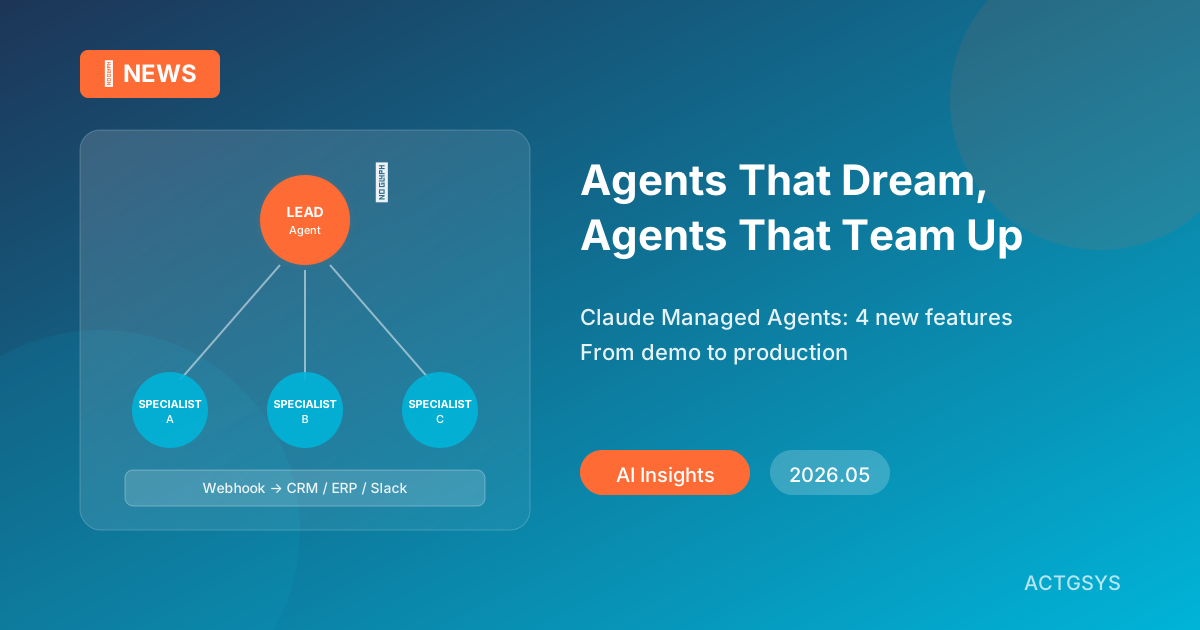
On May 7, 2026 at Code with Claude 2026, Anthropic shipped four new capabilities for Claude Managed Agents at once — Dreaming, Outcomes, multiagent orchestration, and webhooks. For Taiwan SMEs, the real news isn't the whimsical "dreaming" label — it's that AI agents now have the engineering primitives ("gets better over time," "specialists collaborate," "event-driven") needed to leave demos and enter actual operations.
What Did Anthropic Announce for Claude Managed Agents?
According to Anthropic's official blog (2026), at the Code with Claude 2026 event on May 6–7, 2026, Anthropic rolled out four capabilities for Claude Managed Agents simultaneously:
- Dreaming — research preview. Agents review past sessions and memory stores offline, extract patterns, and curate memory so they perform better next time.
- Outcomes — developers define success criteria; an independent grader evaluates agent output and prompts revisions if results fall short.
- Multiagent orchestration — a lead agent breaks the job into pieces and delegates to specialist agents with different models, prompts, and tools, all working on a shared filesystem.
- Webhooks — agents can notify external systems when work completes, shifting from "conversational" to "event-driven" AI.
Key fact: of the four, Dreaming remains a research preview; the other three are open to developers building with Managed Agents. Collectively, this update moves Anthropic's agent platform from "runs" to "runs in production."
What Does Each of the Four Capabilities Actually Do?
Each capability targets a specific pain in deploying AI agents. Walking through them:
Dreaming — per the official blog, Dreaming is a scheduled process that reviews an agent's sessions and memory stores, extracts recurring patterns, and curates reusable memories. Users can choose "auto-update memory" or "require human review before updates land." In plain terms: the agent "sleeps and organizes what it learned today," then wakes up with new insights for the next task.
Outcomes — developers write a rubric defining success, and an independent grader evaluates output against it. Failed outputs trigger a revision loop. According to Anthropic's internal testing, adding Outcomes improved success rates on harder tasks by up to 10 percentage points (Anthropic, 2026).
Multiagent orchestration — a lead agent decomposes the job and delegates pieces to specialist agents (each with its own model, prompt, tools). Specialists run in parallel on a shared filesystem and contribute back to the lead agent's overall context. For example, "customer complaint handling" can route through "classifier → policy lookup → reply drafter" specialists.
Webhooks — agents POST to external systems on task completion. This means agents can be scheduled, event-triggered, and wired into existing back-ends — they're no longer just "ask-and-answer" dialog boxes.
How Did Claude Managed Agents Change Before vs. After?
The biggest delta is "can the agent enter production." Side-by-side:
| Aspect | Before | After (May 2026) |
|---|---|---|
| Learning ability | Starts fresh every time | Dreaming: offline review and self-improvement |
| Quality control | Prompt engineering + human checks | Outcomes: auto-grading + revisions |
| Task division | Single agent does everything | Multiagent: lead delegates to specialists |
| External triggers | Conversational only | Webhooks: event-driven, schedulable |
| Hard-task success rate | Baseline | Up to +10 percentage points |
| Use cases | PoC, support assist | Cross-flow automation, long-running tasks |
For SMEs, the takeaway is direct: AI agents have historically been criticized for "starting from zero every time," "inconsistent quality," and "only handles one thing." This update directly addresses those three. AI agents now have the conditions to enter real business workflows.
How Did Developers React?
Developer community reaction split clearly by feature.
Webhooks: most welcomed, most direct praise — multiple commenters called this the critical piece that pulls agents from "demo toys" into "real systems." Without webhooks, agents only respond reactively. With webhooks, an agent can notify Slack, the CRM, the ERP, or the support system on completion — only then does end-to-end automation actually work.
Outcomes: "more useful than flashy" — compared to the more imaginative-sounding Dreaming, Outcomes has the more immediate value: rubric-driven grading is just sturdier than prompt-tuning alone. For production work, this is a faster ROI improvement.
Dreaming: real value still to be proven — "agents that dream" is the headline-grabbing phrase, but community sentiment is cautious. Most see it as "the right direction, in research preview" — whether it actually makes agents more stable in practice will take time to confirm. Some warned that with auto-update enabled, dreaming could amplify wrong patterns into memory, making the agent drift in the wrong direction.
Multiagent orchestration: applauded but cost is a concern — architecturally correct, but specialists running in parallel multiply token usage and bills. Small teams without cost controls may find multiagent quickly becomes "multi-bill."
Zooming out to industry framing, Gartner predicts enterprises will deploy more than 1,000 AI agents by 2028 (Gartner, 2025) — multiagent orchestration and webhooks are precisely the substrate that scale requires.
What Does This Mean for Taiwan SMEs?
For Taiwan SMEs, this update signals two things: AI agents are crossing from "experiments" into "operations," and the engineering bar for that crossing is higher than it might appear.
The opportunity: tasks that single LLM chat interfaces couldn't reliably do — "cross-system, long-running, verifiable" work — now have native platform support. Examples:
- Invoice chasing — a webhook watches the ERP; an overdue invoice triggers an agent that reviews chase history, drafts a notice, and writes back to the CRM.
- Customer service triage — multiagent splits "classify → product lookup → reply draft" across specialists, more stable than a single agent.
- Cross-period pattern analysis — Dreaming accumulates "common-issue patterns" and emits an insights report at month-end.
But practical adoption faces two realities:
- This is platform capability, not packaged product — Dreaming, Outcomes, and multiagent still require engineering implementation. SMEs without in-house dev teams cannot "open the box and run."
- Data and cost governance must come first — multiagent amplifies token costs; webhooks wire AI into production systems, raising the stakes if data boundaries aren't defined.
This is why ACTGSYS sees an integration layer as necessary between "Claude platform capabilities" and "what SMEs actually deploy." Using multiagent for triage in DanLee CRM, for instance, requires governance rules — which agents can read which customer fields, which action a webhook writes back to in the CRM — not just toggling a platform feature.
ACTGSYS Recommendations: What Should You Do Now?
For Taiwan SMEs, the value here is "directional confirmation," not "build immediately." Splitting:
Do now:
- Re-evaluate your AI agent roadmap — if the team is building AI automation in-house, add "can it be webhook-triggered?" and "can it run multiagent?" to your selection criteria. These two determine production-readiness.
- Pilot one event-driven scenario — pick something with a clear trigger ("overdue invoice," "support ticket unanswered for 24h"), validate the agent responds reliably via webhook, and quantify the manual hours saved.
- Set cost ceilings up front — if going multiagent, lock in a monthly token budget and alerting before launch. Don't let a PoC burn a month's budget in a week.
- Define data boundary rules — explicitly list which fields the agent can read or write, and use Outcomes rubrics to constrain output format. Don't let agents emit content they shouldn't.
Watch and wait:
- Keep Dreaming out of critical flows — while in research preview, run it only on "no revenue impact" scenarios (internal knowledge curation, for example). Promote to customer service or order processing only after it proves stable.
FAQ
Can These New Claude Managed Agents Features Be Used in Taiwan?
Yes. Claude Managed Agents is available in Taiwan via the Anthropic API, with new features rolled out platform-wide. Dreaming is a research preview; the other three are open to existing developer accounts.
Can SMEs Without an Engineering Team Use These?
Not directly. Claude Managed Agents provides platform capabilities for developers via API. SMEs without internal dev resources typically need an engineering partner to design flows and integrate with existing systems.
Will Multiagent Orchestration Cause Cost Blowouts?
It can. Specialists running in parallel multiply token usage. Set a monthly budget cap and alerts before launch, and validate the flow with a single agent first before adding the multiagent layer.
Will Dreaming Actually Make AI Agents Smarter?
The direction is right; results need validation. Dreaming reviews past sessions offline and curates memory, which should let agents improve over time. It's still in research preview, so start with low-risk scenarios before relying on it in production.
Closing Thoughts
The real significance of this Claude Managed Agents update is moving AI agents from "chat box" to "deployable business component" — event-triggerable, multiagent-collaborative, quality-graded, and self-improving offline. For Taiwan SMEs, the takeaway isn't "swap tools tomorrow" — it's to ask whether your next automation should be designed agent-ready from the start.
Looking to design an "AI agent + DanLee / Dinkoko / LINE customer service integration + cost and data governance" roadmap? Contact ACTGSYS — we help Taiwan SMEs turn new platform capabilities into deployable business automation.
Event date: May 7, 2026 (Claude Managed Agents new capabilities at Code with Claude 2026). Last updated: May 25, 2026.
Products & Solutions in This Article
AI-powered CRM for lead management, customer tracking, and sales pipeline optimization designed for SMEs.
Intuitive accounting system designed for Taiwan SMEs, with automated bookkeeping and financial reporting.
Related Articles
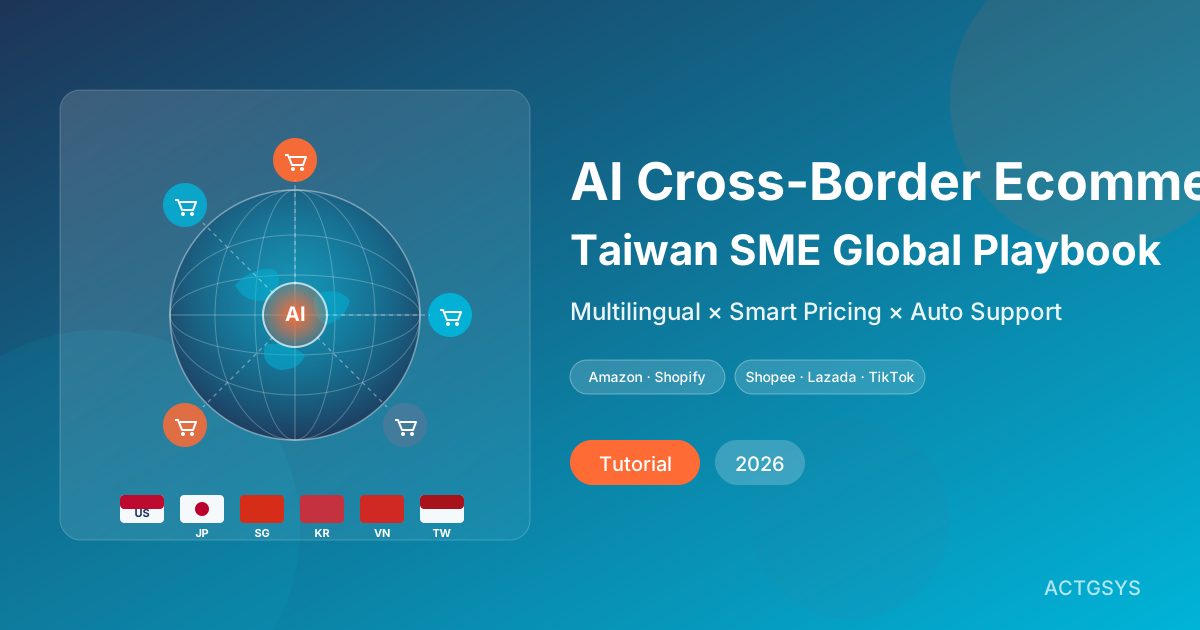
AI Cross-Border Ecommerce Playbook for SMEs (2026)
How Taiwan SMEs use AI to automate cross-border e-commerce — multilingual listings, smart customer service, dynamic pricing, ad ops, and logistics forecasting across Amazon, Shopify, Shopee, Lazada, and TikTok Shop.
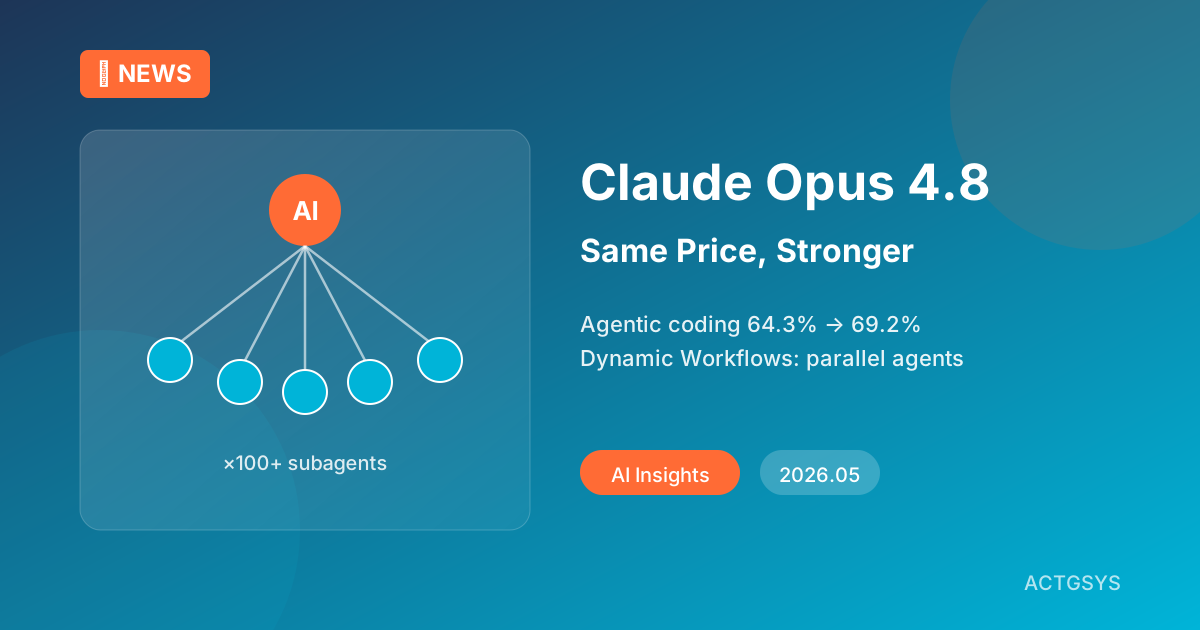
Anthropic Claude Opus 4.8 (2026): Same Price, Stronger
On May 28, 2026, Anthropic launched Claude Opus 4.8, holding the same $5 / $25 per 1M token pricing as its predecessor while lifting agentic coding from 64.3% to 69.2% and adding Dynamic Workflows — a research preview that orchestrates hundreds of parallel subagents. We unpack what this upgrade means for Taiwan SME automation.
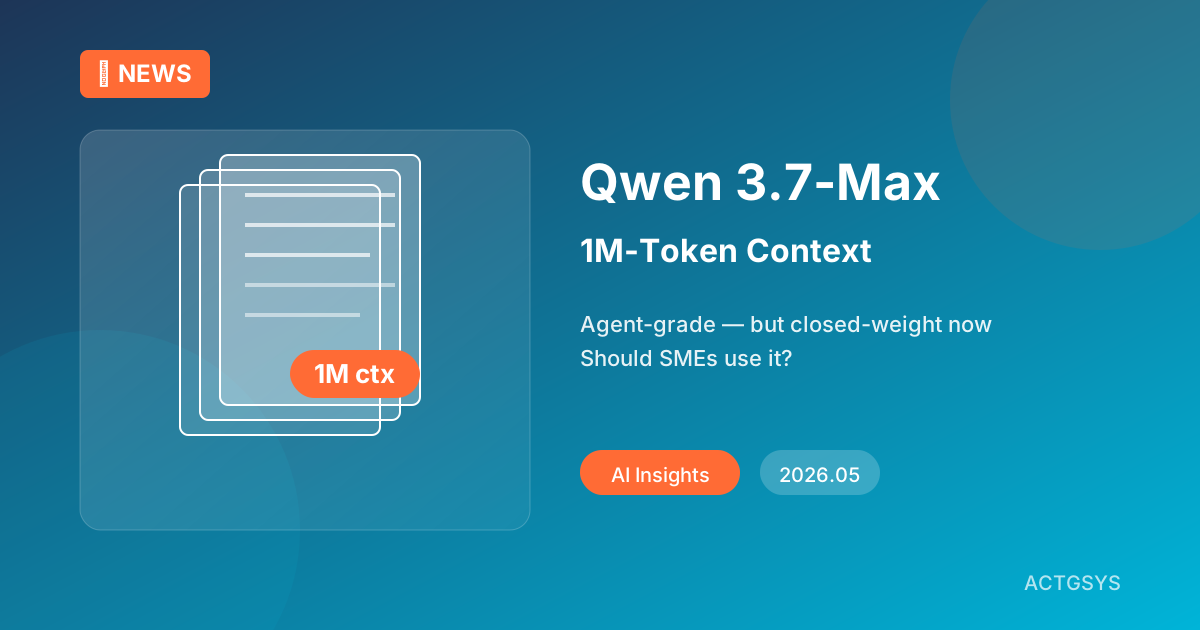
Alibaba Qwen 3.7-Max (2026): 1M-Token Context
On May 20, 2026, Alibaba launched Qwen 3.7-Max with a 1M-token context window and native extended thinking, scoring 69.7 on Terminal-Bench 2.0 and 60.6 on SWE-Bench Pro — but it's closed-weight and API-only for the first time. We unpack what this Chinese flagship means for Taiwan SME long-document processing and cost.
What would this cost you?
Answer five questions. Within three working days you get a price range and what it covers. No deck, no follow-up sales calls.
Prefer to talk?LINE·02-2553-8084