Anthropic Claude Opus 4.8 (2026): Same Price, Stronger
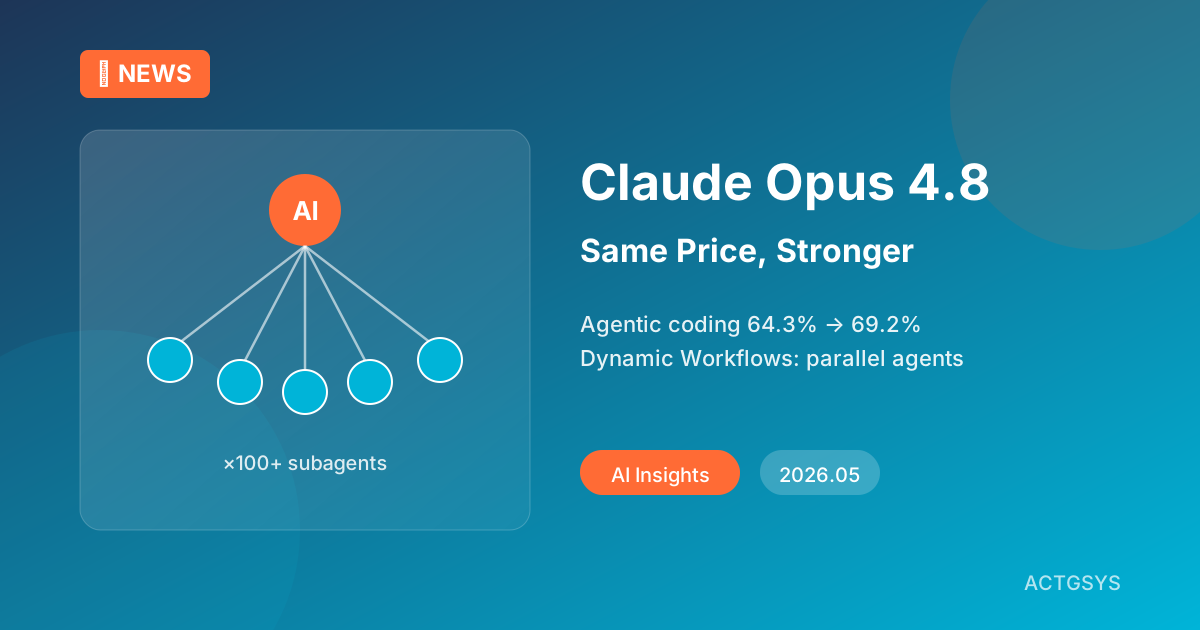
On May 28, 2026, Anthropic launched Claude Opus 4.8 — holding the same $5 input / $25 output per 1M token pricing as Opus 4.7, but lifting agentic coding from 64.3% to 69.2% and adding Dynamic Workflows, a research preview that orchestrates hundreds of parallel subagents within a single task. For Taiwan SMEs, the key isn't any single benchmark — it's that the same price now buys a meaningfully larger automation ceiling, plus a more practical trait: the model is more willing to say "I'm not sure about this data."
What Happened With Claude Opus 4.8?
Anthropic officially launched its flagship model Claude Opus 4.8 on May 28, 2026 — just 41 days after Opus 4.7 shipped. According to Anthropic's official announcement (2026), the new version is aimed at coding, agentic workflows, and complex knowledge work, emphasizing "sharper judgement, more honesty about its progress, and the ability to work independently for longer than its predecessors."
The most notable detail is the pricing strategy: Opus 4.8's standard pricing stays at $5 input / $25 output per 1M tokens — identical to Opus 4.7. In other words, you pay nothing extra for the stronger version. The API model ID is claude-opus-4-8, and it's available across the Claude API, Amazon Bedrock, Google Vertex AI, Microsoft Foundry, plus GitHub Copilot and GitLab integrations (TechCrunch, 2026).
Shipping a new version in just 41 days reflects 2026's competitive cadence — under pressure from back-to-back releases by OpenAI and Google (GPT-5.5, Gemini 3.5), frontier model iteration has compressed to a matter of weeks.
What Are the Key Improvements in Claude Opus 4.8?
Opus 4.8 is an incremental but solid upgrade, focused on three areas:
- A big jump in agentic coding — the agentic coding score rose from 64.3% (4.7) to 69.2%; multidisciplinary reasoning with tools climbed from 54.7% to 57.9% (Anthropic, 2026).
- 84% on computer-use / browser-agent tasks — on Online-Mind2Web (completing tasks by operating web pages like a human), it hit 84%, meaning it can more reliably click, fill forms, and query on your behalf inside back-office systems.
- More honest, more willing to raise its hand — Anthropic stresses the new version is "more likely to flag uncertainties about its work and less likely to make unsupported claims." After testing, Bridgewater Associates singled out this "tendency to proactively flag issues" as the biggest improvement over previous versions.
For enterprise users, that last point often matters more than benchmarks: an AI that says "I'm not sure where this report's numbers came from" is far safer than one that confidently hands you a wrong answer.
What Is "Dynamic Workflows" and How Is It Different From the Previous Version?
Opus 4.8's headline new feature is Dynamic Workflows, a research preview built into Claude Code. It lets the AI plan and execute massive tasks, orchestrating "hundreds of parallel subagents" within a single session and verifying its output before reporting back. The flagship example: codebase-scale migrations across hundreds of thousands of lines of code.
Put simply: previously you gave the AI a big task and it worked through it "as one person, slowly." Now it can "spin up a team," splitting the task across hundreds of clones working at once, then consolidate and check the results for you. The table below lays out the upgrade:
| Dimension | Claude Opus 4.7 | Claude Opus 4.8 |
|---|---|---|
| Standard pricing (input / output, per 1M tokens) | $5 / $25 | $5 / $25 (same) |
| Agentic coding score | 64.3% | 69.2% |
| Multi-agent parallelism | No native unified tool | Dynamic Workflows (hundreds of subagents) |
| Fast mode | Yes | 2.5× faster, $10 / $50 (≈3× cheaper than the previous fast mode) |
| Signature trait | Strong reasoning | More honest, longer autonomous runs |
(Source: Anthropic's official announcement (2026). Fast mode lowers the cacheable prompt minimum to 1,024 tokens.)
The key takeaway: upgrading to 4.8 costs nothing extra, but you gain stronger capability plus an entirely new scaling tool in multi-agent parallelism. For businesses doing heavy batch processing or cross-system automation, that's a real ceiling increase.
How Are Developers and the Industry Reacting?
Community reaction splits between "incremental but noticeable" and "is multi-agent just hype?"
Positive reactions center on the same-price upgrade and the honesty trait — developers broadly welcome getting nearly 5 points of agentic-coding improvement for free, plus a cheaper, faster fast mode. Institutions like Bridgewater specifically praised the "raises its hand when uncertain" behavior, which is especially valuable in finance, accounting, and legal work where one wrong number causes real damage.
Reservations center on Dynamic Workflows still being a research preview — hundreds of parallel subagents sounds impressive, but it's a preview; stability, cost control, and actual time savings remain to be seen. Orchestrating hundreds of agents also means token usage can spike, so costs need tight monitoring.
In the broader frame, this echoes Gartner's read on 2026: enterprise AI competition is shifting from "how smart is a single turn" to "can it reliably complete multi-step, long-running, real-world work autonomously" (Gartner, 2025). Opus 4.8 bets on "longer autonomous runs + multi-agent parallelism," aligned with that trend.
What Does This Mean for Taiwan SMEs?
For Taiwan SMEs, Claude Opus 4.8 pushes the feasible range of automation out another notch — and because it's same-price, the upgrade decision bar is very low.
Opportunities:
- Existing Claude apps benefit immediately — if you already integrate via Claude API, Bedrock, or Vertex, upgrading to
claude-opus-4-8is usually just a model-ID change for a stronger version at essentially zero cost. - More reliable back-office automation — 84% computer-use capability means RPA-style tasks ("log into a back-office system to look up orders, fill forms, organize data") succeed more often, ideal for ERP/CRM busywork.
- Large batch jobs become viable — Dynamic Workflows makes "clean an entire customer dataset, compare a whole batch of contracts, audit a full codebase" feasible in a single orchestrated run.
- Honesty lowers operational risk — for apps touching financial figures, quotes, or contract terms, an AI that proactively flags uncertainty greatly reduces the risk of "confidently wrong" answers.
Three cautions:
- Dynamic Workflows is still a preview — don't drop a research-preview feature straight into critical business flows; pilot on non-critical tasks first and quantify cost and stability.
- Multi-agent = watch the cost — hundreds of parallel subagents can rack up token bills fast; set usage caps and monitoring before adoption.
- Fast mode isn't free speed — fast mode is cheaper than the previous generation's, but at $10 / $50 per 1M tokens it's still double the standard rate; enable it only where real-time response genuinely matters.
When wiring Opus 4.8 into DanLee CRM for customer-data cleanup and Q&A, or into TanJee for document and contract processing, keep a model-routing layer in your architecture so you can switch flexibly between Opus 4.8, cheaper open models, and fast mode based on task difficulty and cost.
ACTGSYS Recommendation: What Should You Do Now?
Claude Opus 4.8 is a same-price upgrade — there's almost no reason for existing Claude users not to move; for SMEs not yet on board, it's a good moment to evaluate agentic automation.
Do now:
- Upgrade and test existing Claude apps — switch the model ID to
claude-opus-4-8, run an A/B on your most common real tasks, confirm the quality gain, then cut over fully (same price, very low risk). - Inventory back-office busywork suited to a "computer-use agent" — list the repetitive clicking and form-filling people currently do in ERP/CRM/reporting systems; these are where 84% computer-use shines.
- Bring the "honesty" value into finance/contract apps — in flows touching amounts and terms, deliberately leverage Opus 4.8's flag-when-uncertain behavior to design an "AI flags + human reviews" double check.
Wait and watch:
- Pilot Dynamic Workflows small — multi-agent parallelism is promising, but during the research preview use it on non-critical batch jobs, quantify time and cost savings, then scale.
- No rush to pay for fast mode — unless you have a clear real-time need (e.g. live chat support), the standard rate is fine.
Frequently Asked Questions
Can Claude Opus 4.8 be used in Taiwan?
Yes. Opus 4.8 has been globally available since its May 28, 2026 launch. In Taiwan you can use it via the Claude API (model ID claude-opus-4-8), Amazon Bedrock, Google Vertex AI, Microsoft Foundry, and GitHub Copilot / GitLab integrations. If data residency and access control matter, deploy via Bedrock or Vertex AI in a designated region.
Is Claude Opus 4.8 more expensive than 4.7? Is it worth upgrading?
No — standard pricing is identical to Opus 4.7, at $5 input / $25 output per 1M tokens. Agentic coding rose from 64.3% to 69.2% and computer-use hit 84%, so you get a stronger version at the same price. For existing users, upgrading is essentially zero-risk; A/B test on real tasks, then switch.
What is Dynamic Workflows, and should SMEs use it now?
Dynamic Workflows is an Opus 4.8 research-preview feature in Claude Code that orchestrates hundreds of parallel subagents within a single task and verifies the results — ideal for whole-codebase migrations and large batch processing. But it's still a preview and multi-agent runs raise token costs, so SMEs should pilot small on non-critical tasks with usage caps before scaling.
How do I choose between Claude Opus 4.8, GPT-5.5, and Gemini 3.5?
It depends on the use case. Opus 4.8 stands out in agentic coding, long autonomous runs, and flagging uncertainty — good for coding and high-precision knowledge work; GPT-5.5 is broad in general chat and ecosystem reach; Gemini 3.5 leads on speed and Google-ecosystem integration. Test all three on the same set of real tasks before deciding, and keep switching flexibility in your system.
Conclusion
Claude Opus 4.8 isn't a "revolution" — it's a focused, solid upgrade: same price, stronger agentic capability, a more honest posture, and multi-agent parallelism turned into a usable tool. For Taiwan SMEs, the right response is to upgrade and validate existing apps, hand back-office busywork to a more reliable computer-use agent, bring the honesty value into finance and contract flows, and pilot the still-preview Dynamic Workflows pragmatically and small.
Want to build an agentic automation architecture that switches flexibly between Opus 4.8, fast mode, and open models by task difficulty and cost? Contact ACTGSYS — we help Taiwan SMEs turn the latest AI models into automation that's deployable, governable, and cost-controlled.
Event date: May 28, 2026 (Anthropic launches Claude Opus 4.8). Last updated: May 31, 2026.
Products & Solutions in This Article
AI-powered CRM for lead management, customer tracking, and sales pipeline optimization designed for SMEs.
Intuitive accounting system designed for Taiwan SMEs, with automated bookkeeping and financial reporting.
Related Articles
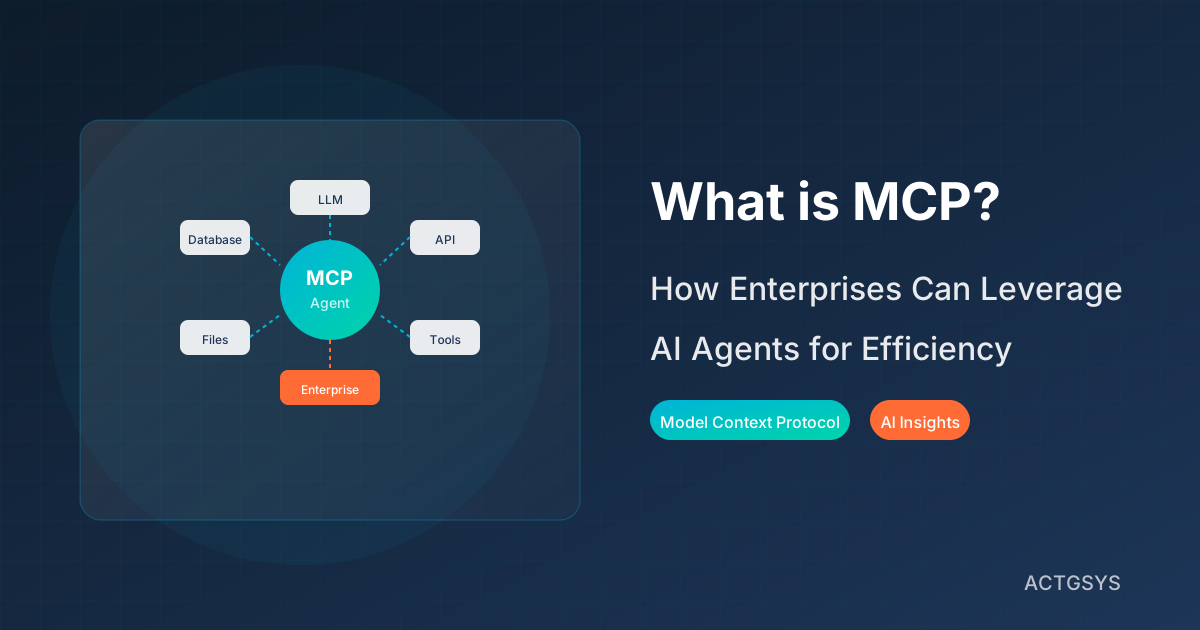
What Is MCP? Enterprise AI Agents Explained
An in-depth explanation of Model Context Protocol (MCP), and how enterprises can implement AI Agent architectures for cross-system integration, automated workflows, and intelligent decision support.
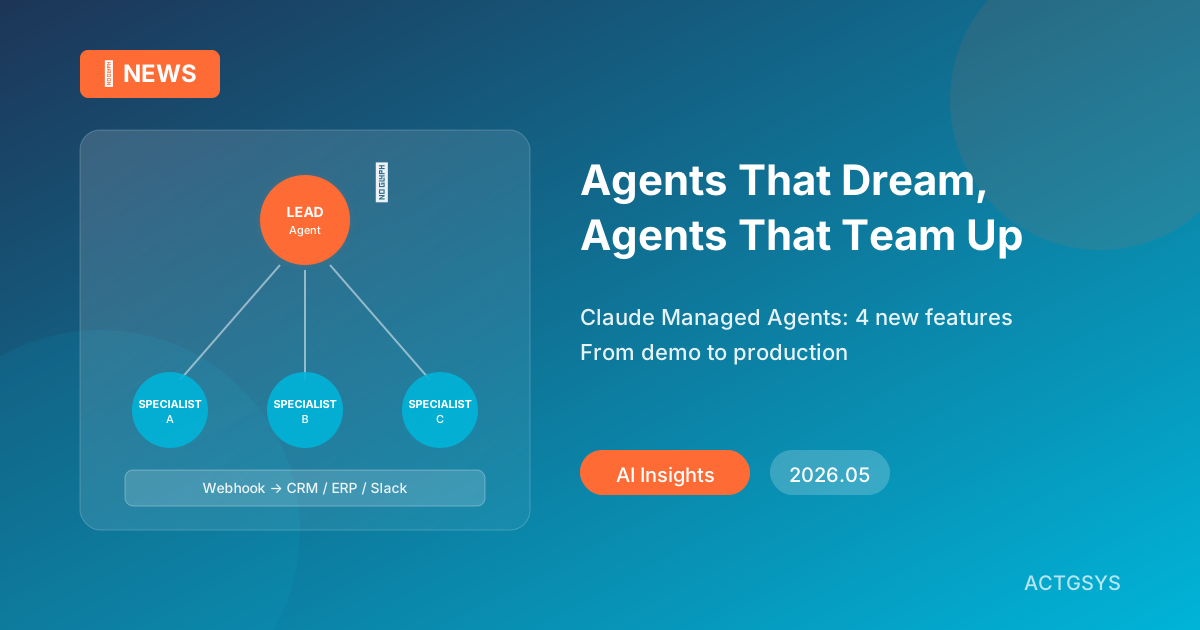
Claude Managed Agents Adds Dreaming and Multiagent Orchestration (2026): What Self-Improving AI Agents Mean for SMEs
On May 7, 2026 at Code with Claude 2026, Anthropic added four new capabilities to Claude Managed Agents — Dreaming, Outcomes, multiagent orchestration, and webhooks. We unpack how these changes shift AI agents toward production-readiness, and what Taiwan SMEs should watch.
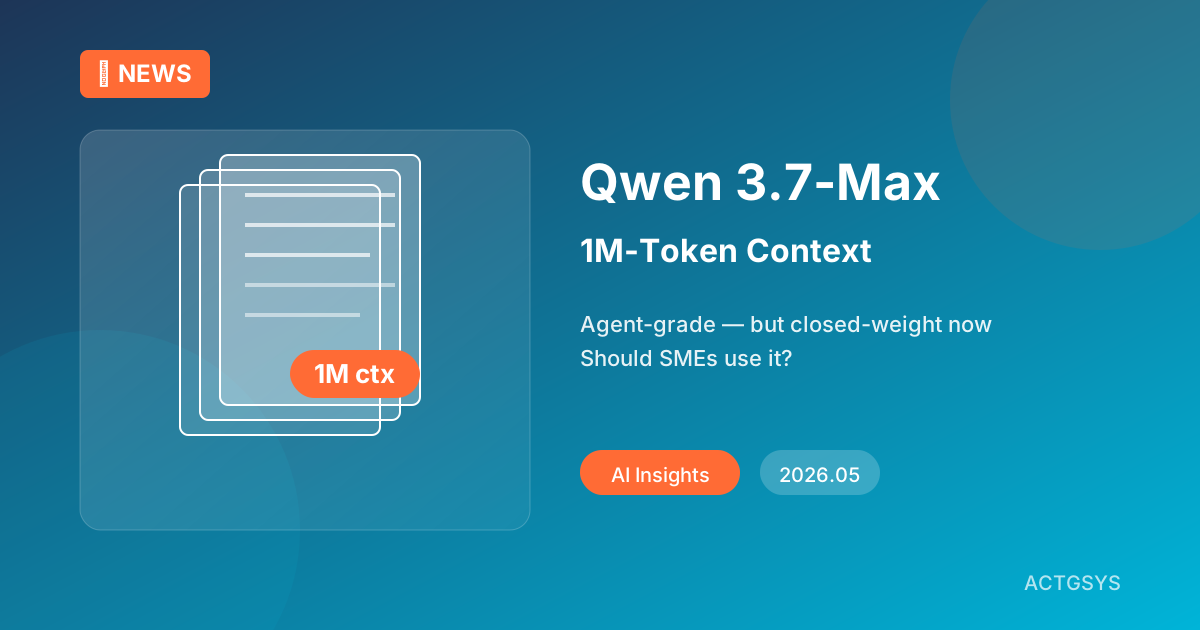
Alibaba Qwen 3.7-Max (2026): 1M-Token Context
On May 20, 2026, Alibaba launched Qwen 3.7-Max with a 1M-token context window and native extended thinking, scoring 69.7 on Terminal-Bench 2.0 and 60.6 on SWE-Bench Pro — but it's closed-weight and API-only for the first time. We unpack what this Chinese flagship means for Taiwan SME long-document processing and cost.
What would this cost you?
Answer five questions. Within three working days you get a price range and what it covers. No deck, no follow-up sales calls.
Prefer to talk?LINE·02-2553-8084