Composable CRM for SMEs: Modular Beats Suites 2026
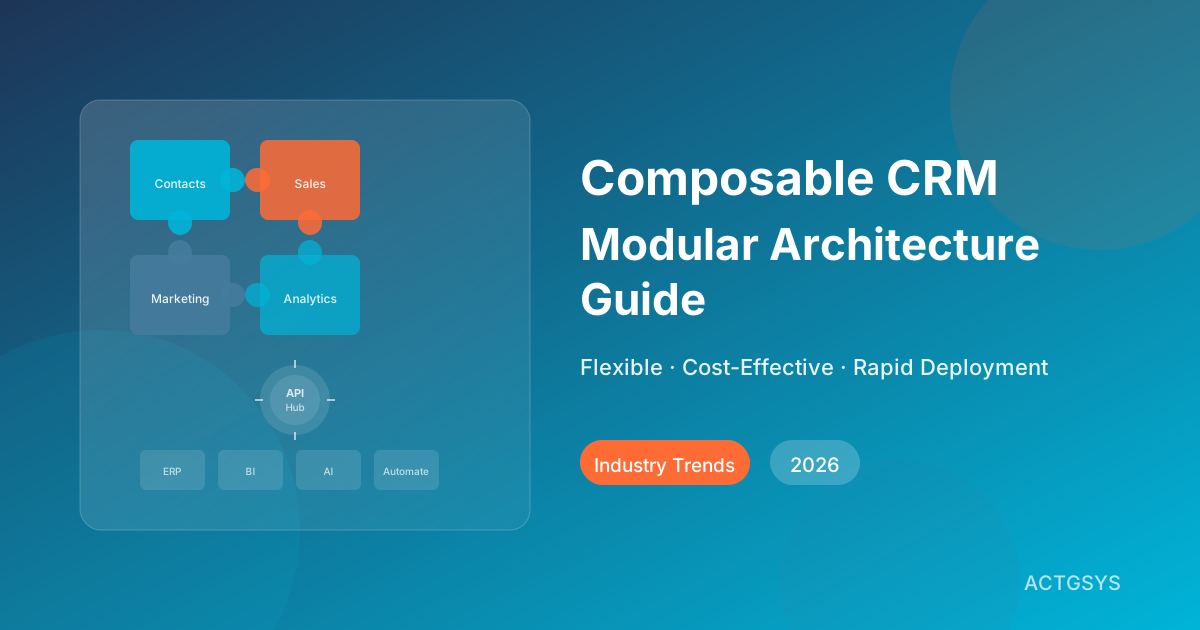
Is your company paying a premium for a bloated CRM suite but only using a fraction of its features? You are not alone. According to a 2025 Gartner survey, over 65% of SMEs report that large portions of their all-in-one CRM licenses go completely unused, wasting an average of 40% of annual subscription costs. In 2026, a fundamentally different approach is reshaping the market: Composable CRM.
What Is Composable CRM? The Core Difference from Monolithic Suites
A traditional monolithic CRM is like buying a fully furnished apartment — you cannot choose to keep the kitchen but skip the bathroom. Everything is bundled together whether you need it or not. Platforms like Salesforce, HubSpot, and Dynamics 365 offer comprehensive feature sets, but most SMEs only need contact management, sales tracking, and basic marketing automation. Yet they are forced to pay for the entire package.
Composable CRM takes a radically different design approach. It breaks CRM functionality into independent Packaged Business Capabilities (PBCs) — self-contained modules that operate independently while connecting seamlessly with other modules through standardized APIs.
The three core principles of composable architecture:
- Modularity: Each capability is developed and deployed independently; businesses select only what they need
- Discoverability: Modules are listed in API marketplaces or catalogs, making it easy to find and integrate new capabilities
- Orchestration: Visual workflow tools chain different modules into complete business processes
For example, an e-commerce company might only need "Contact Management," "Order Tracking," and "LINE Messaging" modules — without purchasing an entire suite that includes helpdesk ticketing, project management, knowledge bases, and a dozen other features they will never touch.
Three Forces Driving the Rise of Composable CRM in 2026
Force 1: Surging Demand for Embedded AI Agents
Gartner predicts that by the end of 2026, 40% of enterprise applications will embed task-oriented AI agents. Composable architecture is inherently AI-friendly — businesses can plug AI capabilities into any module without waiting for their monolithic vendor's update cycle. Need AI-powered lead scoring in your sales module? Add it. Want conversational AI in your support module? Plug it in. You upgrade on your own timeline.
Force 2: SMEs Need Flexibility, Not One-Size-Fits-All
Small and medium businesses operate with wildly different models. A B2B manufacturer and a D2C e-commerce brand have entirely different CRM requirements. Monolithic suites force both into the same functional framework, while composable architecture lets each company assemble a CRM tailored to its actual business scenarios. According to Forrester, companies adopting composable architecture ship new features 80% faster than those on traditional platforms.
Force 3: The API-First Ecosystem Has Matured
In 2026, the API economy is the backbone of enterprise software. The widespread adoption of OpenAPI specifications, GraphQL standards, and Event-Driven Architecture (EDA) means modules from different vendors snap together like LEGO bricks. Businesses are no longer locked into a single vendor and can freely choose the best solution for each functional area.
Composable CRM vs Monolithic CRM: Complete Comparison
| Dimension | Monolithic CRM | Composable CRM |
|---|---|---|
| Upfront Cost | High (full license required, often $15K+ per year) | Low (pay per module, start with core modules only) |
| Feature Flexibility | Low (fixed features, customization requires extra development) | High (freely select, add, or remove modules) |
| Deployment Time | 3–12 months (full planning and implementation) | 2–6 weeks (individual modules go live quickly) |
| AI Integration | Dependent on vendor update schedule | Freely embed any AI service |
| Customization | Moderate (within the platform's framework) | High (modules can be freely orchestrated and connected) |
| Vendor Lock-in Risk | High (data and processes deeply tied to a single platform) | Low (standard API interfaces, individual modules replaceable) |
| Scalability | Requires plan upgrades or additional module purchases | Add modules on demand, scales linearly |
| Maintenance Complexity | Low (single platform, unified management) | Moderate (integration between modules requires oversight) |
| Best Fit | Mid-to-large enterprises (200+ employees) | All sizes (especially 10–200 employee SMEs) |
5-Step Implementation Playbook for SMEs
Step 1: Audit Your Current Processes and Pain Points
Before evaluating any system, map out your core business workflows. Identify the most time-consuming tasks in customer management, sales tracking, and marketing operations. Common pain points include: manually updating customer records, lack of sales pipeline visibility, and information silos between departments.
Step 2: Define Core Module Requirements
Based on your audit, create two lists — "must-have modules" and "future expansion modules." For most SMEs, the essential modules include:
- Contact Management: Centralized customer profiles, interaction history, and segmentation tags
- Sales Pipeline Management: Track the entire journey from lead to closed deal
- Communication Integration: Connect Email, LINE, WhatsApp, and other messaging channels
Step 3: Evaluate Vendors and Technical Architecture
When selecting a composable CRM vendor, focus on these criteria:
- Is the API documentation comprehensive and openly available?
- Does it support webhooks and event-driven notifications?
- What is the data synchronization mechanism between modules?
- Does it offer a visual workflow builder?
- What level of localization is available (local language support, regional payment integrations, etc.)?
Step 4: Implement in Phases
Never roll out all modules at once. Follow a "core first, expand later" strategy:
- Weeks 1–2: Deploy contact management and sales tracking modules
- Weeks 3–4: Integrate communication channels (Email/LINE connectivity)
- Weeks 5–6: Activate marketing automation and analytics modules
- Ongoing: Continuously optimize based on usage data and add AI-powered modules
Step 5: Establish a Data-Driven Continuous Improvement Loop
After go-live, regularly review KPIs including customer response time, sales conversion rates, and marketing campaign ROI. The beauty of composable architecture is that when a module underperforms, you can swap it out for a better alternative without overhauling the entire system.
How DanLee CRM Delivers Modular Flexibility
DanLee CRM is a composable CRM system purpose-built for SMEs, embodying the full advantages of modular architecture. DanLee's design philosophy is simple: businesses should only pay for the features they actually use, with the freedom to scale as they grow.
Key modular features of DanLee CRM:
- Pick-and-Choose Modules: From contact management, sales tracking, and marketing automation to AI-powered analytics — each module can be activated independently
- API-First Architecture: Open RESTful APIs make it straightforward to integrate with existing ERP systems, e-commerce platforms, and communication tools
- Built-in AI Agent Integration: Native support for AI-driven lead scoring, churn prediction, and automated follow-up recommendations
- Native LINE / WhatsApp Integration: Deep integration with the messaging channels most commonly used in the APAC market
- Visual Workflow Orchestration: Design automated workflows through a drag-and-drop interface — no coding required
One e-commerce brand activated only three modules — contact management, LINE integration, and AI-powered recommendations. Their implementation timeline shrank from an estimated 3 months to just 3 weeks, and annual system costs dropped by over 45%.
Frequently Asked Questions
Q1: Is composable CRM suitable for SMEs with limited technical resources?
Absolutely. Modern composable CRMs like DanLee provide visual configuration interfaces and pre-built module connectors. You do not need an engineering team to complete basic system setup and workflow automation. Advanced customization through APIs is only necessary for more complex integration scenarios.
Q2: How difficult is it to migrate from a monolithic CRM to a composable architecture?
Migration complexity depends on your existing data volume and process complexity. We recommend a "parallel operation" approach: build new workflows on the composable CRM first, then gradually migrate data and users — rather than doing a hard cutover. Most businesses complete core functionality migration within 4–8 weeks.
Q3: How is data consistency maintained across multiple modules?
Composable CRMs use Event-Driven Architecture (EDA) and real-time API synchronization to ensure data consistency. When customer data is updated in any module, the change propagates instantly to all related modules. Most platforms also provide conflict resolution mechanisms and sync status monitoring dashboards.
Q4: Is the long-term Total Cost of Ownership (TCO) of composable CRM truly lower?
According to Forrester's Total Economic Impact research, SMEs adopting composable architecture see an average TCO reduction of 35–45% over three years. Savings come from eliminating unused feature licenses, shorter implementation and customization timelines, and lower vendor switching costs. However, businesses do need to invest some effort in managing inter-module integrations — this overhead can be minimized by choosing platforms with strong built-in integration capabilities.
Conclusion: 2026 Is the Best Time for SMEs to Rethink Their CRM Architecture
Composable CRM is more than a technical upgrade — it represents a fundamental shift in mindset. Instead of accepting whatever feature bundle a vendor dictates, businesses can now assemble the exact solution that fits their needs. With AI agents, the API economy, and modular design reaching maturity, SMEs finally have access to the kind of flexibility that was once reserved for enterprises with massive IT budgets.
If your business is evaluating CRM systems — or if you are frustrated with low utilization rates and high costs from your current platform — now is the ideal time to rethink your architecture.
Want to learn how composable CRM can be tailored for your business? Contact the ACTGSYS team today for a free CRM architecture assessment and modular implementation plan.
Products & Solutions in This Article
Related Articles
What Is CRM? The 2025 SME Guide
A comprehensive guide to CRM systems: from basic concepts to implementation best practices. Learn how to select and implement the right CRM system to improve sales and customer management for your business.
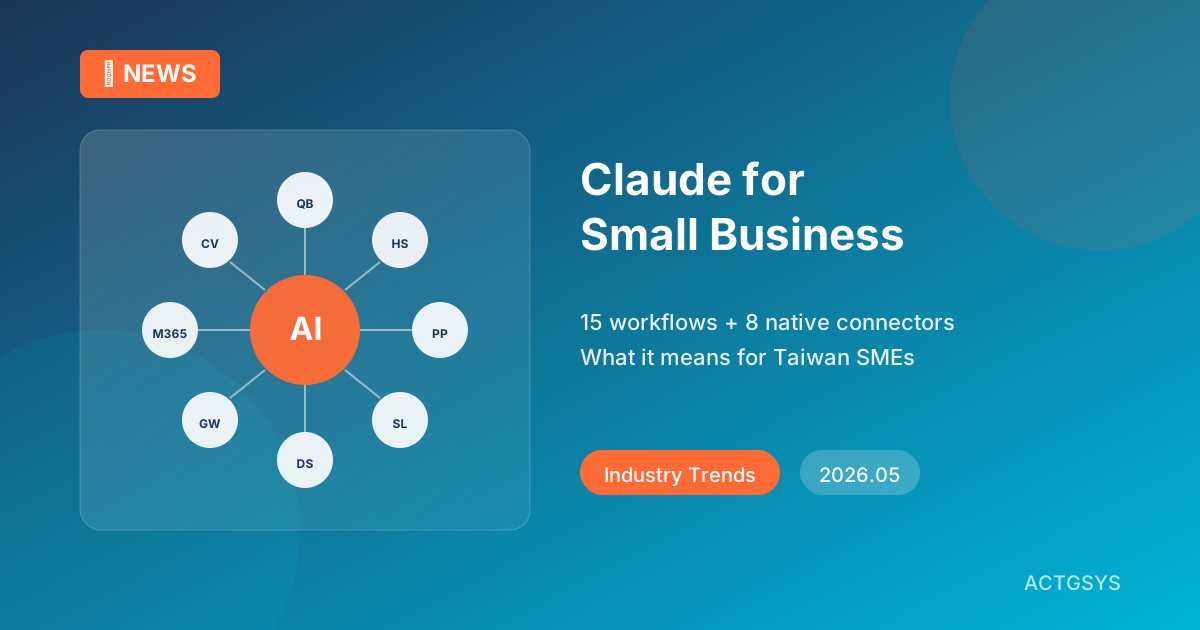
Anthropic Claude for Small Business (2026)
On May 13, 2026, Anthropic launched Claude for Small Business with 15 ready-to-run agentic workflows and native connectors to QuickBooks, HubSpot, PayPal and five other tools. We unpack what it actually does, how it compares to alternatives, and what Taiwan SMEs should consider before adopting.

AI Compliance 2026: EU AI Act and Taiwan Law
EU AI Act high-risk rules take full force on 2 August 2026, and Taiwan's AI Basic Law is on the legislative fast track. This guide unpacks the practical compliance must-dos for SMEs.
What would this cost you?
Answer five questions. Within three working days you get a price range and what it covers. No deck, no follow-up sales calls.
Prefer to talk?LINE·02-2553-8084