Conversational Commerce & Social Selling AI Guide
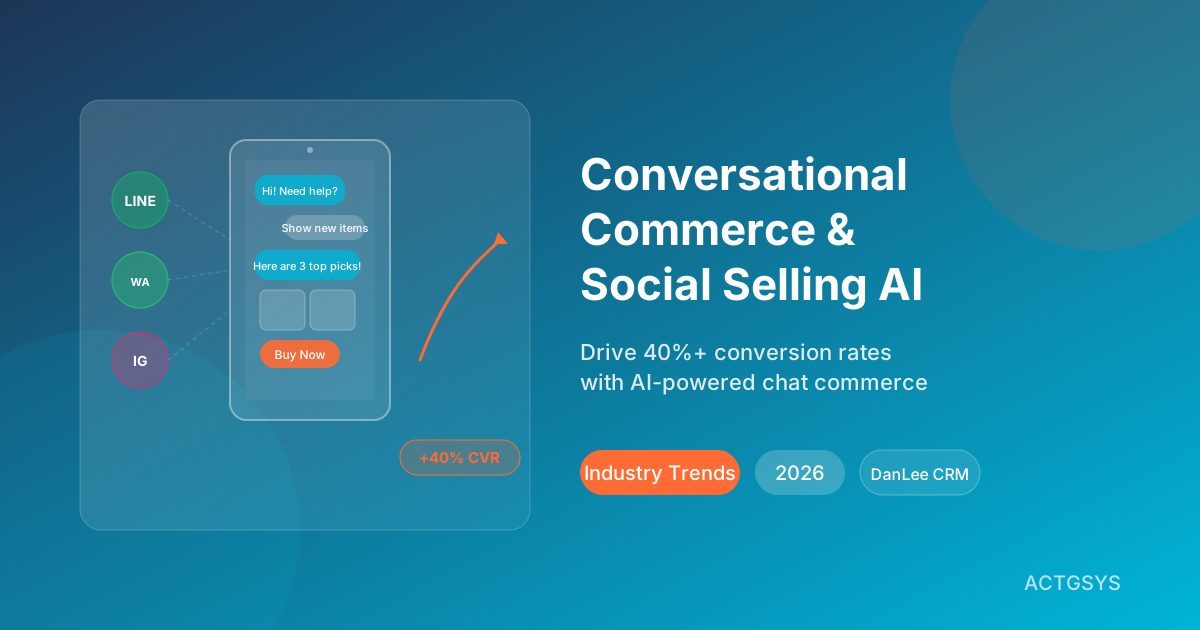
Consumer shopping behavior is undergoing a fundamental transformation. In 2026, over 67% of consumers across Asia report preferring to complete purchases through chat interfaces rather than browsing traditional e-commerce websites. This shift isn't merely a change in user habit—it represents a complete inversion of commerce logic, evolving from "search then buy" to "close deals through conversation." Conversational commerce is reshaping retail and service industries at an unprecedented pace, with AI chatbots as the core engine of this revolution. For SMEs, understanding and leveraging conversational commerce isn't just about keeping up with trends—it's the key to building differentiated competitive advantage in an increasingly crowded market.
What Is Conversational Commerce? A New Shopping Experience from Browse to Buy
Conversational commerce was first coined by Chris Messina, a former Uber executive, in 2015. The core concept is using instant messaging, chatbots, and voice assistants to let consumers discover, inquire, compare, purchase, and receive after-sales support through a natural conversational flow—all within a single interface.
Traditional e-commerce follows a one-directional path: consumers actively search → browse product pages → add to cart → check out. This process carries clear pain points: information overload, decision fatigue, lack of real-time answers, and a sense of distance from the brand. Conversational commerce fundamentally changes this logic—consumers describe their needs in natural language, AI systems instantly understand intent, provide personalized recommendations, answer questions, and guide users through to purchase completion.
The Four Core Characteristics of Conversational Commerce
Immediacy: Consumer questions receive responses within seconds, eliminating the wait for email replies or phone queues. AI chatbots operate 24/7, ensuring no potential order is lost to slow response times.
Personalization: Systems gather consumer preferences, budget constraints, and use cases through dialogue, delivering precise personalized recommendations rather than generic product lists.
Context Awareness: AI remembers past conversation history, purchase records, and browsing behavior, building each new interaction on an established relationship rather than starting from scratch every time.
Seamless Integration: Conversations happen on platforms consumers already use daily (LINE, WhatsApp, Instagram)—no new apps to download or interfaces to learn, dramatically lowering the barrier to engagement.
According to Juniper Research, the global conversational commerce market is projected to reach $290 billion in 2026, growing more than 4x from 2022. Growth in Asian markets has been even faster, with LINE's business application monthly active users surpassing 21 million in Taiwan alone—covering virtually the entire internet-connected population.
Three Major Social Commerce Trends in 2026
Trend 1: AI Personal Shopping Assistants—From Passive Recommendation to Active Guidance
AI shopping assistants in 2026 have moved far beyond simple "if you liked A, you might like B" recommendation logic. Next-generation AI shopping systems can proactively initiate conversations, identify latent consumer needs, and even predict likely purchasing behavior before consumers explicitly express intent.
Take fashion retail as an example: when a consumer asks through a LINE Official Account "do you have anything suitable for a wedding?", the AI doesn't just search for products tagged "wedding." It asks follow-up questions—is the venue indoor or outdoor, what's the preferred style (conservative or fashionable), budget range, and any color restrictions—then integrates these inputs to provide 3-5 precisely tailored recommendations with styling advice and buyer reviews. This depth of conversation has driven conversion rates up 53%, with average order values increasing 28% due to outfit pairing suggestions.
Trend 2: The AI Interaction Layer for Live Commerce
Live commerce (livestream shopping) is already a mature sales channel across Asia, but the defining upgrade of 2026 is the addition of an AI interaction layer. While hosts present products on livestream, AI systems simultaneously answer viewer questions in the comment section, process orders, and automatically record purchase information—freeing hosts to focus on content presentation rather than manual order management.
More advanced applications deliver personalized live shopping experiences: the system identifies each viewer's purchase history and preferences, displaying products most relevant to that individual in a sidebar next to the livestream, and proactively pushing purchase links when the host mentions relevant items. This technology has pushed average live commerce conversion rates from 3-5% to 12-18%.
Trend 3: AI-Powered Social Group Buying Platforms
Group buying has always had a solid market foundation across Asia, and AI tools are now enabling individual group buy organizers (Key Opinion Consumers, KOCs) to manage large-scale orders with far greater efficiency. AI automates order collection, payment confirmation, shipping notifications, and after-sales tracking—allowing one person to manage the order volume that previously required a team of 3-5.
Some platforms go further by integrating AI product selection tools that help organizers analyze community consumption preferences and trends, recommending product combinations most likely to succeed and reducing unsold inventory risk.
How AI Chatbots Drive Sales Conversions
Different social platforms have distinct user behavior patterns—effective conversational commerce strategy must be tailored to each platform, leveraging its unique characteristics.
LINE: Taiwan's Most Critical Conversational Commerce Battleground
LINE's penetration rate in Taiwan exceeds 90%, making it the most important conversational commerce channel that cannot be ignored. LINE Official Accounts offer rich business features, and LINE Bot integration enables automated conversations at scale.
Effective LINE conversational commerce strategy centers on these key elements:
Menu-Based Interaction Design: Rich Menus allow users to quickly initiate conversations through button taps rather than typing, dramatically lowering engagement barriers. A well-designed Rich Menu can increase Bot interaction rates by 60% or more.
Precision Segmented Push Messaging: Target users based on tags (purchase history, preferred product categories, geographic region) for personalized push messages rather than broadcasting the same message to all followers. Personalized pushes generate 3-5x higher click-through rates than mass messages.
Shopping Cart Integration: LINE Pay integration lets users complete the entire shopping journey without leaving the LINE interface—from inquiry to payment in a seamless flow that significantly boosts conversion rates.
A Taiwanese mid-sized fashion brand that deployed an AI LINE Bot saw customer service response time drop from an average of 4 hours to 30 seconds within three months, shopping inquiry conversion rates climb from 12% to 31%, and monthly revenue grow by 44%.
WhatsApp: The Essential Channel for Southeast Asian Expansion
For Taiwan-based companies targeting Southeast Asian markets, the WhatsApp Business API is indispensable. WhatsApp penetration exceeds 80% in Malaysia, Indonesia, Vietnam, and other markets—making it the primary communication tool for consumers in those regions.
WhatsApp Business's Catalog feature allows companies to showcase products directly within the chat interface. Combined with AI Bot recommendations, consumers can browse products, ask questions, and place orders—all within a single conversation window. Critically, WhatsApp's open rates reach 98% (compared to email's average of 20%), meaning marketing messages achieve far superior reach compared to traditional channels.
Key WhatsApp Business Features: Message Templates enable standardized order confirmations, shipping notifications, and promotional messages; Interactive Messages provide button and list options for quick consumer responses; and Business Verification badges increase brand credibility and reduce consumer hesitation.
Instagram: Optimized for Visual-Driven Impulse Purchases
Instagram's user base skews toward 18-35 year olds, where visual content drives the strongest impulse purchase behavior. Instagram Shopping integrated with DM (Direct Message) conversational commerce creates a seamless purchase flow—guiding consumers from the moment they're captivated by a post or Story directly into the buying process.
AI makes Instagram conversational commerce even more precise: when users comment "where can I buy this?" or "is this in stock?", AI automatically detects purchase intent and proactively responds in DM, providing product links, stock information, and discount codes—converting spontaneous interest into actual purchases.
This "comment triggers DM" automation workflow has boosted brands' Instagram conversion rates by 35-45% while significantly reducing manual customer service workload.
Facebook Messenger: Cross-Generational Omnichannel Touchpoint
Facebook Messenger maintains broader age distribution in Taiwan, with particularly strong penetration among the 35+ demographic. For businesses serving diverse age groups—insurance, real estate, healthcare—Messenger Bots are an important service channel.
Messenger's Sponsored Messages feature allows businesses to send personalized messages directly to users who have previously interacted with the page, and paired with AI analysis of optimal send timing, dramatically improves message open and engagement rates. Messenger's Webview feature also enables businesses to embed complete product pages or order forms within the chat interface, eliminating the need to redirect to external websites.
Conversational Commerce Platform Comparison
| Feature | LINE Bot | WhatsApp Business | Instagram DM Bot | Facebook Messenger Bot |
|---|---|---|---|---|
| Taiwan Market Penetration | ★★★★★ (90%+) | ★★★ (~55%) | ★★★★ (~75%) | ★★★★ (~70%) |
| Southeast Asia Coverage | ★★★ (Thailand primarily) | ★★★★★ | ★★★★ | ★★★★ |
| Automation Capability | ★★★★★ | ★★★★ | ★★★★ | ★★★★★ |
| Product Catalog Integration | ★★★★ | ★★★★★ | ★★★★★ | ★★★★ |
| Payment Integration | ★★★★★ (LINE Pay) | ★★★ | ★★★ | ★★★ |
| Push Messaging | ★★★★★ | ★★★★ | ★★★ | ★★★★ |
| Audience Segmentation | ★★★★★ | ★★★ | ★★★ | ★★★★ |
| Human Escalation | ★★★★ | ★★★★ | ★★★ | ★★★★ |
| Development Complexity | Medium | Medium-High | Medium | Medium |
| Base Monthly Cost | NT$888-4,888 | Per-message billing | Free (limited) | Free (limited) |
Recommended Strategy: For SMEs focused primarily on the Taiwan market, prioritize building a LINE Bot first. If Southeast Asian expansion is planned, simultaneously deploy WhatsApp Business API. If the target demographic is predominantly younger consumers, Instagram DM Bots offer the highest ROI.
CRM Integration: The Real-World Strategy for Conversational Commerce
The true value of conversational commerce isn't in individual transactions—it's in transforming every conversation into an accumulating customer asset through CRM integration. A chatbot without CRM integration is simply an automated customer service tool. With CRM integration, it becomes a sales engine that drives long-term revenue growth.
Automatic Customer Data Synchronization
Every time a consumer interacts with a chatbot, the system should automatically sync the following to your CRM:
- Identity Information: Name, contact details, social account IDs
- Behavioral Data: Product categories inquired about, interaction frequency, active time windows
- Transaction Records: Items purchased, spending amounts, repurchase intervals
- Preference Tags: Interest preferences, price sensitivity, and brand loyalty indicators extracted from conversations
This data forms a comprehensive Customer Profile in the CRM, enabling every subsequent marketing push to make personalized decisions based on real behavioral data.
Automatic Sales Funnel Tracking
With CRM integration, each potential consumer's position in the sales funnel is tracked precisely:
- Awareness Stage: Inquired about products but didn't purchase → Automatically set a 3-day follow-up reminder
- Consideration Stage: Multiple inquiries about similar products with hesitation → Trigger a special offer or time-limited discount
- Decision Stage: Added to cart but didn't complete payment → Send cart abandonment reminder message
- Post-Purchase Stage: Purchase completed → Automatically initiate after-sales service flow and cross-sell recommendations
This automated funnel management lets sales teams focus on the highest-value customer interactions rather than spending time on repetitive follow-up tasks.
Unified Cross-Channel View
Modern consumers move fluidly across platforms—discovering products on Instagram today, inquiring on LINE tomorrow, purchasing through the website the day after. This multi-channel journey is increasingly common. The critical value of CRM-integrated conversational commerce is unifying these cross-channel interactions into a single customer file, giving businesses a complete view of the customer journey rather than fragmented channel interactions.
DanLee CRM's cross-channel integration module automatically identifies the same consumer across different platforms, consolidating dispersed interaction data into a unified customer view—helping businesses design more precise retargeting strategies.
AI-Driven Customer Lifecycle Management
Combined with AI predictive analytics, CRM proactively identifies key moments:
- Repurchase Prediction: Based on historical purchase intervals, predicts the next likely purchase window and sends personalized reminders or offers 3-5 days in advance
- Churn Warning: Identifies customers whose interaction frequency is declining and triggers retention strategies before they actually leave
- Upgrade Timing: Analyzes consumption behavior patterns to identify customers with high spending potential and delivers premium product recommendations at the right moment
Success Stories: Real ROI Data from SME Conversational Commerce
Case 1: Taiwan Beauty & Skincare E-Commerce Deploys LINE AI Bot
Company Profile: A Taichung-based e-commerce brand specializing in natural organic skincare, with annual revenue of approximately NT$12 million and a team of 8, including 2 customer service staff.
Pain Points Before Implementation:
- Over 150 LINE inquiries daily—2 customer service staff overwhelmed
- Average response time exceeded 3 hours; evenings and weekends went completely unattended
- No systematic customer data, making precise retargeting impossible
Solution: Deployed an AI LINE Bot integrated with the product database and CRM system. Designed three core conversation flows: skin type assessment, ingredient lookup, and product pairing recommendations. Connected LINE Pay to close the shopping loop entirely within LINE.
Results (6 months post-implementation):
- Customer service response time: from 3 hours to real-time (within 30 seconds)
- Inquiry conversion rate: from 18% to 42% (133% improvement)
- After-hours orders: from 0% to 23% of total (Bot operates 24/7)
- Staff capacity freed: 2 customer service staff now focus exclusively on complex cases and VIP service
- Monthly revenue growth: NT$3.8 million increase in monthly average revenue after 6 months (+31.7%)
Case 2: Restaurant Chain's WhatsApp Reservation System
Company Profile: A Japanese restaurant chain in Kaohsiung with 3 locations, handling approximately 2,400 reservations per month.
Pain Points Before Implementation:
- Phone reservations consumed significant staff time; peak hours frequently overwhelmed lines
- Reservation data scattered across paper records and Excel, impossible to manage centrally
- Unable to collect guest preferences for personalized service
Solution: Built a WhatsApp Business reservation chatbot integrated with the table management system. Designed automatic confirmation, reminder, and modification workflows. Sent automatic thank-you messages and next-visit discount codes after dining.
Results (4 months post-implementation):
- WhatsApp reservation share: from 0% to 58% of total bookings (phone reservations significantly reduced)
- No-show rate: from 15% down to 6% (automated reminder function)
- Customer satisfaction (NPS): from 62 to 78
- Return visit rate: discount code mechanism increased 30-day return rate by 25%
Case 3: B2B Industrial Materials Distributor's Facebook Messenger Inquiry System
Company Profile: A mid-sized industrial materials wholesaler in New Taipei City primarily serving manufacturing factories, with annual revenue of NT$80 million.
Pain Points Before Implementation:
- Sales staff spent 40% of daily time responding to basic product inquiries
- Inconsistent pricing across different sales representatives undermined customer trust
- No systematic mechanism for tracking potential customers
Solution: Deployed a Messenger inquiry chatbot integrated with the product specification database and pricing system. The bot automatically responds to standard inquiries and generates preliminary quotes; complex needs are automatically escalated to human sales representatives. CRM integration records every inquiry interaction.
Results (5 months post-implementation):
- Repetitive inquiry time for sales staff: reduced by 60%
- Inquiry-to-formal-quote cycle: from an average of 2 days to 4 hours
- Potential customer tracking rate: from 45% to 92% (CRM automatic recording)
- Closing rate: improved by 22% (timely responses increase customer confidence)
FAQ
Q1: What types of SMEs benefit most from conversational commerce?
Conversational commerce is applicable to nearly all B2C and many B2B business scenarios, but companies in these categories see the strongest results: retail (fashion, beauty, food), food service (reservations, takeout, customer service), service businesses (beauty, fitness, aesthetic medicine consultations), and B2B businesses requiring frequent customer interaction (regular procurement, technical support). The key evaluation criterion is whether your business handles large volumes of repetitive customer inquiries—if yes, the ROI on conversational commerce is typically very high.
Q2: What does it cost to deploy an AI chatbot?
Cost varies widely depending on platform choice and feature requirements. Basic LINE Bot solutions using established platforms (such as MAAC or Crescendo Lab) run approximately NT$3,000-15,000 per month; mid-range solutions integrating CRM and custom conversation flows cost approximately NT$15,000-50,000 per month; fully custom enterprise-grade development typically requires NT$300,000-1,000,000 in one-time development costs plus monthly maintenance fees. For most SMEs, starting with a SaaS platform that offers integrated solutions provides the best cost-effectiveness.
Q3: Can AI chatbots completely replace human customer service?
Complete replacement is not recommended—collaboration is the optimal model. AI bots are best suited for: standard inquiries (product specifications, pricing, inventory), order status checks, basic after-sales service, and segmented push messaging. Complex complaint handling, personalized service for high-value customers, and situations requiring emotional communication still warrant human involvement. Best practice is establishing an "AI-first, human escalation" hybrid service model.
Q4: How do you measure conversational commerce effectiveness?
Core KPIs include: Conversation Completion Rate, Inquiry-to-Purchase Rate, Bot Self-Service Rate, Customer Satisfaction (CSAT/NPS), and customer service labor cost savings. Set a 3-month pilot period, establish baseline values for these metrics before launch, then measure improvement against those baselines to determine whether to expand investment.
Q5: What's the difference between a LINE Bot and a custom-built chatbot?
A LINE Bot operates within the LINE platform, with the advantage of directly reaching Taiwan's massive LINE user base—but functionality is constrained by LINE's API specifications. Custom-built chatbots (typically deployed on company websites or apps) offer complete functional freedom and data ownership, but require actively attracting users to visit, resulting in higher customer acquisition costs. For most Taiwan SMEs, building a LINE Bot first and then considering multi-channel expansion based on evolving needs is the most practical approach.
Conclusion: Now Is the Optimal Time to Invest in Conversational Commerce
Conversational commerce isn't a future trend—it's reshaping consumer purchasing behavior right now. In 2026, the gap between businesses that have deployed AI chatbots and those that haven't is widening rapidly across response speed, conversion rates, and customer satisfaction. For SMEs, the cost of entering this space today is lower than it will be two years from now, and competitive advantages are easier to establish before the market becomes saturated.
ACTGSYS provides end-to-end conversational commerce solutions spanning strategic planning, platform selection, bot development, and CRM integration. Our TanJee social commerce module and DanLee CRM have already helped dozens of SMEs successfully transform their sales operations, delivering average conversion rate improvements of over 40%.
Ready to start your conversational commerce journey? Contact us today to have an ACTGSYS consultant design a tailored solution for your business. From the very first conversation, start converting every potential customer into a loyal advocate.
Products & Solutions in This Article
AI-powered CRM for lead management, customer tracking, and sales pipeline optimization designed for SMEs.
Intuitive accounting system designed for Taiwan SMEs, with automated bookkeeping and financial reporting.
Related Articles
WhatsApp AI Chatbot Guide for SMEs (2026)
WhatsApp has 3.3 billion users and 98% open rates. Meta's 2026 AI policy changes the rules. Learn how SMEs can use WhatsApp AI chatbots to boost customer communication and achieve 28% lead conversion.
Anthropic Agent Skills as an Open Standard + Enterprise-Managed MCP Auth (2026): Wiring Claude into Stripe, Zapier, and Figma
In June 2026 Anthropic turned Agent Skills into an open standard, launching with 10 partners (including Atlassian, Figma, Canva, Stripe, Zapier), and on June 18 shipped Enterprise-Managed Authorization (EMA) for MCP connectors so IT admins can provision connectors org-wide via Okta. Here's what it means for 'wiring AI into your existing tools' and how Taiwan SMEs should adopt it.
US AI Export Controls Tighten and Anthropic Briefly Pulls Fable 5 (2026): Taiwan SMEs Suddenly Lose Top-Tier Models
In June 2026 the US escalated AI model export controls: a June 2 executive order, 'Promoting Advanced Artificial Intelligence Innovation and Security,' was followed mid-month by an order requiring Anthropic to block Mythos 5 and Fable 5 for non-US nationals — briefly disabling both for all customers. Taiwan SMEs are 'non-US nationals' and were directly affected. Here's the event, the risk, and a multi-model fallback strategy.
What would this cost you?
Answer five questions. Within three working days you get a price range and what it covers. No deck, no follow-up sales calls.
Prefer to talk?LINE·02-2553-8084