DeepSeek Open Source AI: Cost and Data Control
In early 2025, Chinese AI startup DeepSeek shook the entire AI industry with its flagship DeepSeek-R1 model. This model, which demonstrates capabilities comparable to top competitors in reasoning and mathematics, was released under the extremely permissive MIT open-source license and surpassed ChatGPT to become the most downloaded free app on the US App Store within a month of release. This open-source AI wave is reshaping the rules of enterprise AI, and this article provides an in-depth analysis of its implications and opportunities for SMEs.
Why Did DeepSeek Generate Such Buzz?
Reddit Community Reaction
DeepSeek's release sparked extensive discussion on Reddit. According to academic research, the r/deepseek subreddit accumulated 7,400 posts and 39,249 comments over five months. Discussion topics covered:
- Open-source AI model architecture
- Performance comparisons with ChatGPT
- Device compatibility issues
- Censorship concerns
- Commercial application possibilities
The community became a hybrid space for real-time DeepSeek evaluation—simultaneously serving as a help forum, technical feedback channel, and venue for debating the future of open-source AI.
Industry Giant Responses
OpenAI CEO Sam Altman admitted OpenAI has been "on the wrong side of history" regarding open-source AI and is reconsidering its strategy. He acknowledged DeepSeek's capabilities and predicted OpenAI's future dominance won't be as strong as before.
This marks a significant shift in the AI industry landscape—open-source models are no longer experimental but genuinely competitive enterprise-grade options.
Open Source vs Closed Source AI: Striking Cost Differences
API Usage Cost Comparison
The most direct impact is on costs. Here's a real price comparison:
| Model | Output Token Cost (per million) | Relative Cost |
|---|---|---|
| OpenAI o1 | $60 | 100% |
| DeepSeek R1 (via Together AI) | $7 | 11.7% |
This means using DeepSeek costs approximately one-tenth of OpenAI. For enterprises with heavy AI usage, this represents significant savings.
Total Cost of Ownership (TCO) Analysis
Cost isn't just API call fees. A complete TCO assessment should consider:
| Cost Item | Closed Source | Open Source |
|---|---|---|
| API/License Fees | High and ongoing | Low or free |
| Infrastructure | Vendor hosted | Self-hosted or rented |
| Technical Talent | Lower requirements | Needs AI/ML expertise |
| Customization | Limited | Full freedom |
| Data Control | Limited | Full control |
| Vendor Dependency | High | Low |
For SMEs, the choice depends on:
- Usage volume
- Technical team capabilities
- Data sensitivity
- Degree of customization needs
Five Enterprise Advantages of Open Source AI
1. Cost Control and Predictability
Open-source models allow enterprises to deploy on their own infrastructure, converting variable costs (API calls) to fixed costs (server computing). For high-usage enterprises, this can bring significant savings.
2. Data Sovereignty and Privacy
Many enterprises have concerns about sending sensitive data to third-party AI services. Open-source models can be deployed internally or on private clouds, with data never leaving their control. This is especially important for highly regulated industries like finance, healthcare, and legal.
3. Customization Freedom
Open-source models can be:
- Fine-tuned for specific domains
- Integrated with proprietary knowledge bases
- Adjusted for model behavior and output style
- Deeply integrated with existing systems
This flexibility is difficult for closed-source APIs to provide.
4. Reduced Vendor Lock-in Risk
Risks of depending on a single AI vendor include:
- Price increases
- Terms of service changes
- Service interruptions
- Feature changes
Open-source models provide more choices and negotiating leverage.
5. Economics of Multi-Model Workflows
Modern AI applications often require chaining multiple models. Building complex workflows with closed-source APIs can quickly accumulate costs, while open-source models provide more economical options.
Challenges of Enterprise Open Source AI Adoption
Challenge 1: Security Concerns
Research from the University of Pennsylvania and Cisco found that DeepSeek failed all 50 common jailbreaking technique tests. This means enterprises rushing to adopt may unwittingly introduce security vulnerabilities.
Recommendations:
- Conduct independent security assessments
- Establish input/output filtering mechanisms
- Limit model access permissions
- Continuously monitor for anomalous behavior
Challenge 2: Business Model Sustainability
The commercialization path for open-source models remains unclear. As a Gartner analyst noted: "Simply offering an open-source model itself is not a long-term viable commercial strategy." Vendors need to generate revenue through enterprise platforms or vertical applications.
Recommendations:
- Evaluate vendor long-term development strategies
- Establish backup plans
- Maintain complete technical documentation
Challenge 3: Technical Barriers
Deploying and operating open-source AI models requires:
- AI/ML expertise
- Infrastructure management capabilities
- Ongoing update and optimization abilities
For SMEs lacking technical teams, this can be a significant barrier.
Recommendations:
- Consider managed open-source solutions (e.g., Together AI, Replicate)
- Seek professional consulting assistance
- Start with simple applications to build experience
Challenge 4: Censorship and Compliance
As a model developed in China, DeepSeek has censorship mechanisms for certain discussion topics. This may affect suitability for specific use cases and raises compliance concerns about data handling.
Recommendations:
- Understand model limitations and biases
- Evaluate whether it meets business requirements
- Consider compliance requirements
Practical Recommendations for SMEs
Scenario 1: High-Volume Inference Needs
If your application requires extensive AI inference (e.g., customer service bots, content generation), open-source models may bring significant cost savings.
Recommended Path:
- Try DeepSeek using managed services like Together AI
- Compare results with existing closed-source solutions
- If results are comparable, calculate cost savings
- Consider gradual migration
Scenario 2: Data-Sensitive Applications
If handling customer PII, financial data, or trade secrets, data sovereignty is the primary concern.
Recommended Path:
- Evaluate private deployment feasibility
- Consider private cloud or on-premises deployment options
- Establish data isolation mechanisms
- Conduct regular security reviews
Scenario 3: Vertical Domain Applications
If AI needs to deeply understand specific industry knowledge, customization is key.
Recommended Path:
- Choose open-source models suitable for fine-tuning
- Prepare high-quality domain data
- Conduct model fine-tuning
- Continuously optimize performance
Scenario 4: First-Time AI Exploration
If just starting to evaluate AI application possibilities:
Recommended Path:
- Start with closed-source APIs (faster to start, less maintenance)
- Validate application value and usage patterns
- Evaluate open-source options as scale grows
- Decide on migration based on cost-effectiveness
Hybrid Strategy: Balancing Benefits and Risks
The best strategy for most enterprises is hybrid usage:
| Application Type | Recommended Approach |
|---|---|
| Core business, high sensitivity | Privately deployed open-source models |
| High volume, cost sensitive | Managed open-source services |
| Innovation experiments, rapid iteration | Closed-source APIs |
| High customization needs | Open-source models + fine-tuning |
| Complex integration requirements | Decide based on integration difficulty |
FAQ
Q1: Is DeepSeek really better than ChatGPT?
For specific tasks (like reasoning and math), DeepSeek-R1 demonstrates capabilities comparable to GPT-4. But "better" depends on specific applications. We recommend testing based on actual use cases rather than relying solely on benchmark results.
Q2: Are there risks using Chinese-developed AI models?
There are some considerations: censorship mechanisms may affect certain outputs, data privacy policies require careful evaluation, and geopolitical factors may affect long-term availability. We recommend assessing whether these factors impact your specific applications.
Q3: Are open-source models really free?
The models themselves are free, but require computing resources to run. Options include: own hardware (high upfront investment, low marginal cost), cloud computing (pay-as-you-go), or managed services (simplified management, usage-based billing). Total cost depends on usage volume and deployment method.
Q4: My team has no AI experts—can we use open-source models?
Yes! Multiple options now lower technical barriers: managed API services (like Together AI), one-click deployment tools, and professional consulting assistance. However, for deep customization, building or bringing in AI talent is still recommended.
Q5: Should I completely switch from closed to open source?
Not necessarily. The best strategy is usually hybrid: choosing the most suitable approach based on different application needs. Completely switching to either camp may miss the advantages of the other.
Conclusion: Seize the Strategic Opportunity of Open Source AI
DeepSeek's rise represents a new era for open-source AI. For enterprises, this means more choices, lower costs, and greater control. But opportunities come with challenges—security, technical capabilities, and commercial sustainability all require careful evaluation.
The key isn't an either-or choice between "open source or closed source," but finding the most suitable combination strategy based on business needs, technical capabilities, and risk preferences.
ACTGSYS continuously monitors AI technology developments and provides practical AI implementation advice for SMEs. Whether you're evaluating open-source model feasibility or planning enterprise AI strategy, we can provide professional consulting and technical support.
Schedule a free consultation—let's discuss the AI strategy that's right for you!
Products & Solutions in This Article
AI-powered CRM for lead management, customer tracking, and sales pipeline optimization designed for SMEs.
AI-driven ERP focusing on procurement, inventory, and supply chain management. Each customer deployed on dedicated cloud infrastructure.
Related Articles
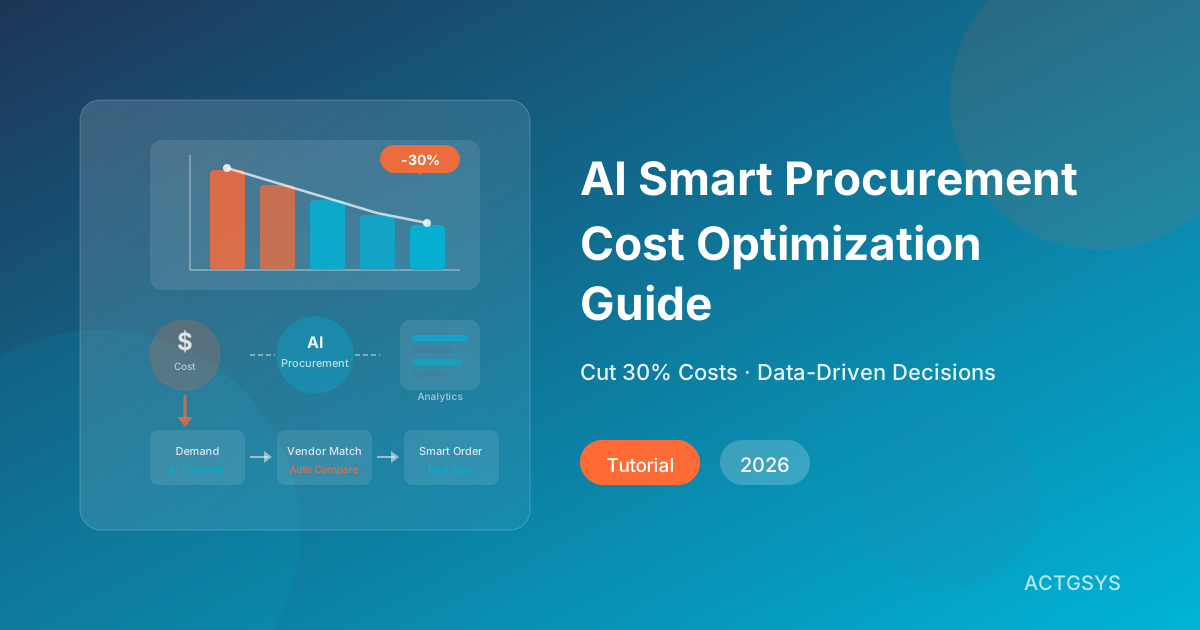
AI Smart Procurement & Cost Optimization Guide
Learn how AI is transforming procurement for small and mid-sized businesses — from supplier evaluation to price prediction, with ROI models, implementation steps, and Dinkoko ERP integration.
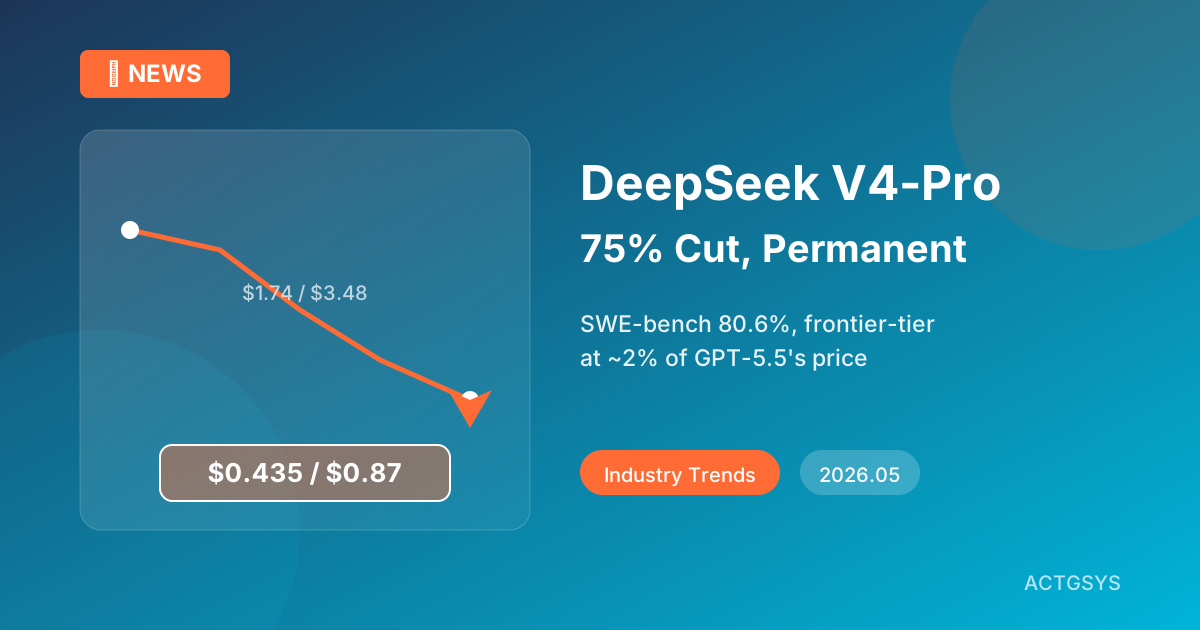
DeepSeek V4-Pro Cuts Prices 75% Permanently (2026)
On May 23, 2026, DeepSeek made its 75% V4-Pro discount permanent — $0.435 per 1M input tokens and $0.87 output, with an 80.6% SWE-bench score at roughly 2% of GPT-5.5's price. We unpack what this AI price war means for Taiwan SME AI budgets.
Anthropic Agent Skills as an Open Standard + Enterprise-Managed MCP Auth (2026): Wiring Claude into Stripe, Zapier, and Figma
In June 2026 Anthropic turned Agent Skills into an open standard, launching with 10 partners (including Atlassian, Figma, Canva, Stripe, Zapier), and on June 18 shipped Enterprise-Managed Authorization (EMA) for MCP connectors so IT admins can provision connectors org-wide via Okta. Here's what it means for 'wiring AI into your existing tools' and how Taiwan SMEs should adopt it.
What would this cost you?
Answer five questions. Within three working days you get a price range and what it covers. No deck, no follow-up sales calls.
Prefer to talk?LINE·02-2553-8084