Edge AI for SMEs: On-Device AI Cuts Cost (2026)
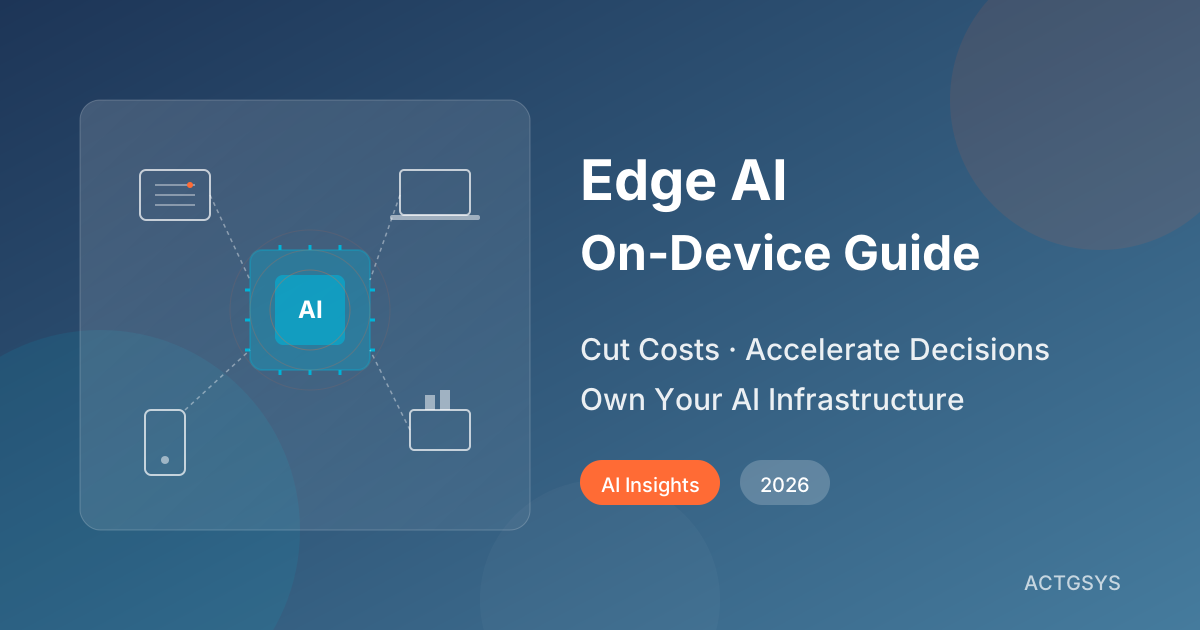
How much does your company spend on cloud AI API fees every month? What if you learned that 2026 Edge AI technology can now let an ordinary office computer handle AI tasks that previously required cloud computing power? For SMEs, Edge AI isn't just a technical buzzword — it's a practical weapon for lowering AI adoption barriers, protecting data privacy, and accelerating real-time decisions.
What Is Edge AI? Why 2026 Is the Tipping Point
Edge AI refers to deploying AI models on devices close to where data is generated, running inference locally rather than sending all data to the cloud. These devices can be office servers, industrial equipment, POS terminals, or even phones and tablets.
Three Major Technical Breakthroughs in 2026
According to industry research, Edge AI has reached critical breakthroughs:
- Small model capability leap: Small and medium AI models now rival large models on specific tasks while requiring only one-tenth of the compute
- Edge AI chip performance breakthrough: Dedicated inference chips enable efficient AI execution on standard hardware
- Model compression maturity: Quantization, distillation, and pruning techniques allow dramatic model size reduction
Cloud AI vs Edge AI Comparison
| Aspect | Cloud AI | Edge AI |
|---|---|---|
| Latency | 50-500ms (network dependent) | 1-10ms (local execution) |
| Data Privacy | Data sent to third-party servers | Data stays on-premises |
| Monthly Cost | Pay-per-API-call, scales with volume | One-time hardware investment |
| Offline Capability | Requires internet | Fully offline operation |
| Scalability | Elastic scaling | Requires additional hardware |
| Best For | Complex reasoning, large-scale training | Real-time inference, privacy-sensitive scenarios |
Five Edge AI Use Cases Perfect for SMEs
1. Smart Customer Service & Auto-Reply
Deploy a small language model in-house to handle common customer questions. No need to send customer conversation data to external servers — protecting privacy while reducing latency.
Real Impact: Customer service response time drops from 3 seconds to under 0.5 seconds, with 60-80% monthly savings on API costs.
2. Intelligent Document Analysis
Use local AI models to automatically classify, extract key information, and generate summaries from contracts, invoices, and quotes. Especially suitable for documents containing confidential information.
3. Manufacturing Quality Inspection
Deploy image recognition AI models at the production line for real-time defect detection. Edge deployment ensures millisecond response times without production line interruptions from network latency.
4. Retail Inventory Forecasting
Run demand prediction models on store POS systems, adjusting restocking suggestions in real-time based on historical sales data and local factors (weather, holidays, events).
5. Office Automation & Data Processing
Execute AI models on internal servers to automatically handle daily report generation, data cleaning, email classification, and other repetitive tasks without worrying about confidential data leaks.
How to Choose the Right Edge AI Hardware
Solutions by Company Size
| Company Size | Recommended Solution | Estimated Budget | Model Size Supported |
|---|---|---|---|
| Micro (1-10 people) | High-performance desktop + GPU | $1,000-2,000 | 1B-3B parameters |
| Small (10-50 people) | Workstation + Professional GPU | $2,500-6,500 | 3B-13B parameters |
| Medium (50-200 people) | Edge server | $6,500-16,000 | 13B-70B parameters |
Popular Edge AI Hardware Options
- NVIDIA Jetson Series: Best for image recognition and industrial IoT scenarios
- Intel NUC + NPU: Ideal for office automation and document processing
- Apple Silicon Mac: Great for development, testing, and small-scale deployment
- Dedicated AI Inference Servers: Built for high-throughput enterprise needs
Four Steps to Deploy Edge AI
Step 1: Assess Needs and Feasibility
Inventory your current cloud AI usage and filter tasks that meet these criteria:
- Latency-sensitive (requires real-time response)
- Privacy-sensitive (data shouldn't be uploaded)
- High frequency (significant API cost share)
- Moderate complexity (doesn't need the largest models)
Step 2: Select Models and Frameworks
Current mainstream Edge AI deployment frameworks include:
- Ollama: The simplest local LLM deployment tool
- llama.cpp: High-performance C++ inference engine
- ONNX Runtime: Cross-platform model inference framework
- TensorRT: NVIDIA GPU-optimized inference
Step 3: Small-Scale Pilot
Start with one specific scenario — we recommend beginning with "intelligent document analysis" or "internal customer service," as these deliver the most easily quantifiable benefits.
Step 4: Scale and Optimize
Based on pilot results, gradually expand to more scenarios. Continuously monitor model performance and regularly update model versions for better results.
Cost-Benefit Analysis of Edge AI
Using a 50-person SME as an example, assuming $1,000/month in cloud AI API fees:
| Item | Cloud (Annual) | Edge (Year 1) | Edge (Year 2+) |
|---|---|---|---|
| API / Service Fees | $12,000 | $0 | $0 |
| Hardware Cost | $0 | $5,000 | $0 |
| Additional Electricity | $0 | $400 | $400 |
| Maintenance | $0 | $1,000 | $1,000 |
| Annual Total | $12,000 | $6,400 | $1,400 |
Save approximately 47% in the first year, with savings reaching 88% from the second year onward. Three-year ROI exceeds 500%.
Frequently Asked Questions
Q1: Is Edge AI less effective than cloud AI?
For specific tasks (document classification, simple conversations, image recognition), fine-tuned small models can achieve 90-95% of large model accuracy. However, for complex tasks requiring broad knowledge reasoning, cloud-based large models still have advantages. We recommend a hybrid architecture: Edge AI for daily tasks, cloud AI for complex ones.
Q2: Do I need dedicated IT staff to deploy Edge AI?
2026's Edge AI tools have been dramatically simplified. Tools like Ollama can be deployed with just a few commands. However, enterprise-grade stable operations and model fine-tuning still benefit from professional partner support.
Q3: Is Edge AI suitable for all SMEs?
If your AI usage is minimal (monthly API costs below $150), cloud solutions may be more economical. Edge AI is most suitable for businesses with continuous, high-frequency AI inference needs.
Q4: How is data security ensured?
One of Edge AI's greatest advantages is that data never leaves your premises. Combined with enterprise-grade access controls and encryption, data security is actually higher than cloud solutions.
Q5: How do I know if my business is ready for Edge AI?
If your business already has stable AI use cases, monthly AI spending exceeds $300, and basic IT infrastructure is in place, you're ready to adopt Edge AI.
Conclusion: Edge AI Is the Next Competitive Advantage for SMEs
In 2026, the maturity of Edge AI technology gives SMEs the first real opportunity to "own their own AI." No more being locked into cloud API fees, no more worrying about data privacy breaches, no more being limited by network quality.
ACTGSYS has extensive experience in AI system integration and can help your business evaluate Edge AI adoption feasibility, providing end-to-end services from hardware selection to model deployment.
Want to know if Edge AI is right for your business? Schedule a free consultation now and let us design the optimal plan for you.
Products & Solutions in This Article
Related Articles
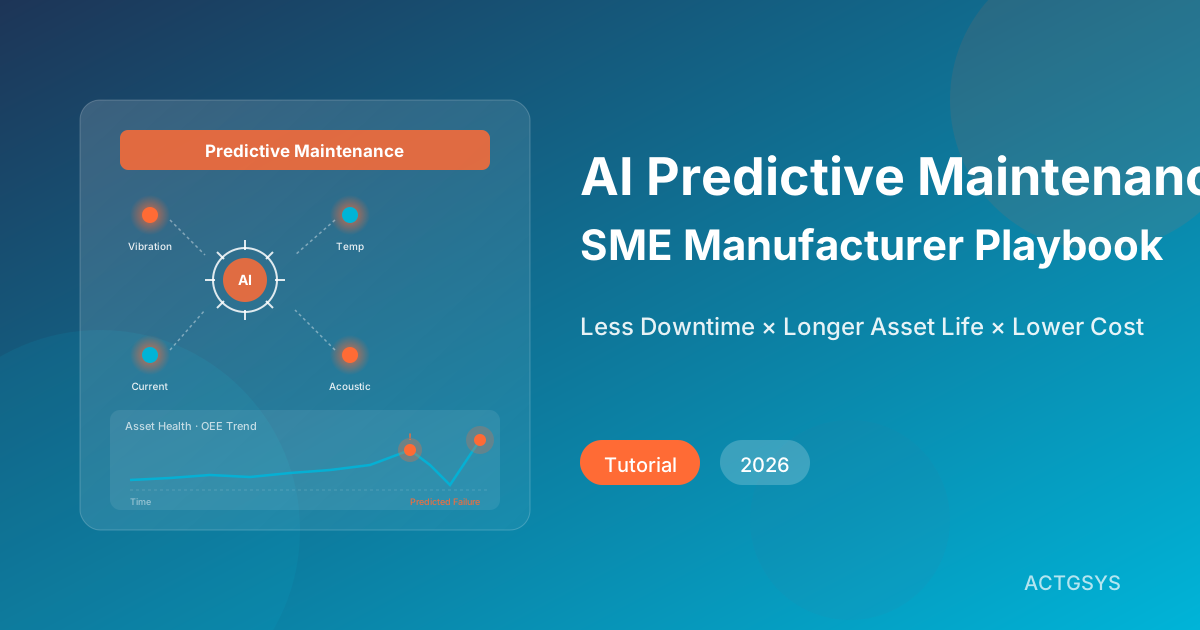
AI Predictive Maintenance for SME Manufacturers
What is AI predictive maintenance? This 2026 guide for SME manufacturers explains the IoT + edge AI architecture, a six-step rollout, and a side-by-side platform comparison, with citations from McKinsey, Deloitte, NVIDIA, AWS, and Taiwan's ITRI.
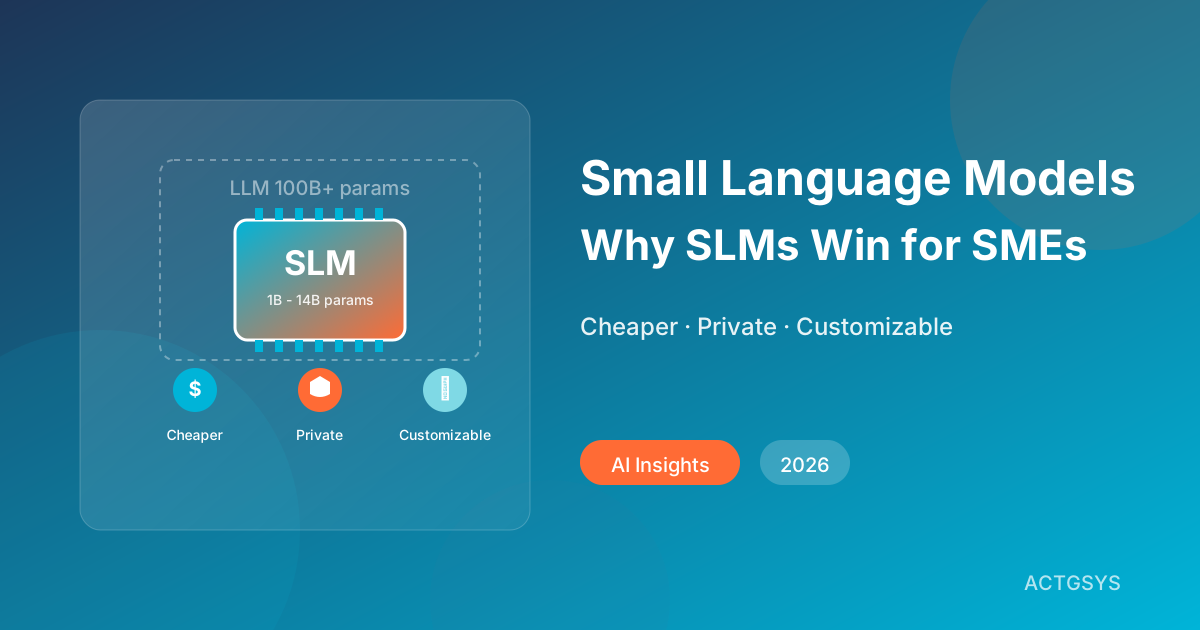
Small Language Models (SLM) for SMEs (2026)
Phi-4, Llama 3.2 and Apple Intelligence are pushing SLMs into the mainstream. This guide unpacks why small language models beat LLMs on cost, privacy and customization for SMEs.
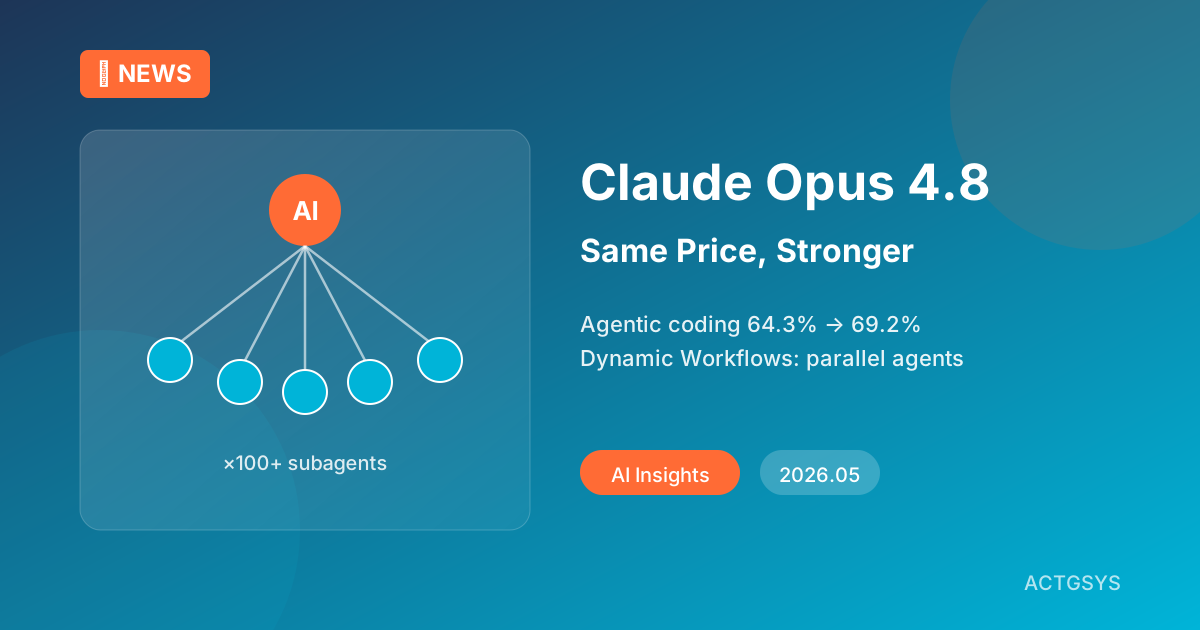
Anthropic Claude Opus 4.8 (2026): Same Price, Stronger
On May 28, 2026, Anthropic launched Claude Opus 4.8, holding the same $5 / $25 per 1M token pricing as its predecessor while lifting agentic coding from 64.3% to 69.2% and adding Dynamic Workflows — a research preview that orchestrates hundreds of parallel subagents. We unpack what this upgrade means for Taiwan SME automation.
What would this cost you?
Answer five questions. Within three working days you get a price range and what it covers. No deck, no follow-up sales calls.
Prefer to talk?LINE·02-2553-8084