GEO: Generative Engine Optimization in 2026
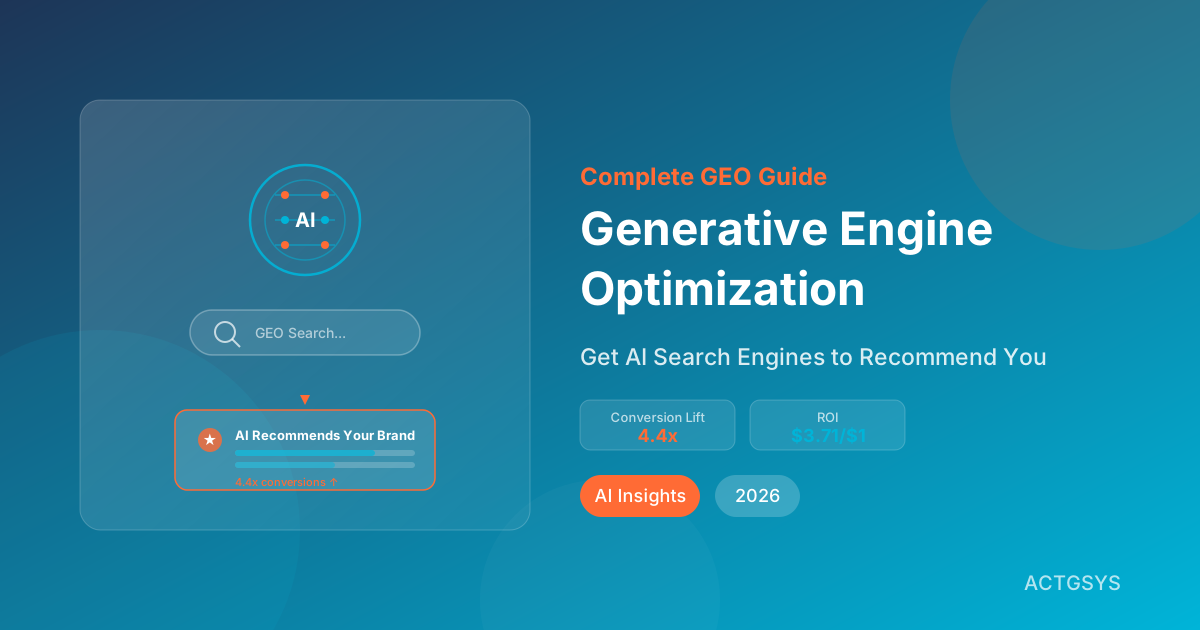
Have you noticed that when you ask a question on ChatGPT or Google, AI gives you a direct answer — and you never click through to any website? This is the massive search behavior shift of 2026. Gartner predicts traditional search engine volume will drop 25%, while AI-powered search is growing at an astounding rate. If your brand content isn't being cited by AI search engines, you're essentially invisible in this new traffic war. This guide covers the complete GEO (Generative Engine Optimization) strategy your business needs.
What Is GEO and Why Is It More Important Than Traditional SEO?
GEO (Generative Engine Optimization) is a content optimization strategy designed to get your brand actively cited, recommended, and mentioned by AI search engines like ChatGPT, Google AI Overviews, Perplexity, and Claude.
If traditional SEO aims to "rank on page one of Google," GEO aims to "become part of the AI-generated answer itself."
Key Differences Between GEO and Traditional SEO
| Factor | Traditional SEO | GEO |
|---|---|---|
| Goal | Higher search rankings | Get cited by AI |
| Optimization Target | Google algorithm | ChatGPT, Perplexity, AI Overviews |
| Success Metric | Click-through rate (CTR) | AI citation rate, brand mentions |
| Content Focus | Keyword density, backlinks | Structured data, authority, E-E-A-T |
| Conversion Impact | Baseline | 4.4x higher conversions |
| ROI | Varies by competition | $3.71 return per $1 invested |
The Scale of AI Search in 2026
AI search engine user numbers are staggering:
- ChatGPT: 800 million weekly active users
- Google Gemini + AI Overviews: Over 2 billion monthly users
- Perplexity: Over 45 million users
- Claude: Over 30 million users
More critically, in searches with AI Overviews, the top organic result sees a 34.5% drop in click-through rate, with overall organic CTR plummeting from 1.76% to just 0.61%.
Why SMEs Must Start GEO Now
Many SME owners might think "GEO is only for big corporations," but the opposite is true. AI search engines are fundamentally changing how customers find you:
1. Consumer Behavior Has Already Shifted
More people are searching directly in ChatGPT or Perplexity for queries like "best IT consulting firm in Taipei" or "CRM system for small businesses." If your brand isn't cited by AI, these potential customers will never find you.
2. SMEs Have a GEO Advantage
Large enterprise websites are structurally complex and slow to adapt. SMEs can optimize content structure faster, securing an early position in the GEO race.
3. Higher ROI
Industry research shows GEO-optimized content converts at 4.4x the rate of traditional SEO, delivering $3.71 in returns for every $1 invested.
Six Core GEO Optimization Strategies
Strategy 1: Ensure AI Crawlers Can Access Your Content
The first and most basic — yet most overlooked — step is checking your robots.txt file. Many websites unknowingly block AI crawlers.
AI crawlers you should allow:
GPTBot(ChatGPT / OpenAI)Google-Extended(Gemini / AI Overviews)PerplexityBot(Perplexity AI)ClaudeBot(Claude / Anthropic)Bytespider(ByteDance AI)
Strategy 2: Implement Structured Data (Schema Markup)
Structured data helps AI systems understand your content contextually, significantly increasing citation chances.
Priority Schema types:
Organization: Company informationArticle/TechArticle: Content structureFAQPage: Frequently asked questionsProduct: Product detailsHowTo: Step-by-step guidesBreadcrumbList: Site navigation
Strategy 3: Build E-E-A-T Authority
Google's E-E-A-T (Experience, Expertise, Authoritativeness, Trustworthiness) framework now extends to AI search tools. AI systems evaluate whether your content demonstrates:
- Experience: Real case studies and firsthand knowledge
- Expertise: Deep technical knowledge and detail
- Authoritativeness: Industry recognition and external citations
- Trustworthiness: Transparent sources and accurate information
Strategy 4: Include Statistics and Expert Quotes
According to Princeton University's GEO research, adding citations, statistics, and expert quotes to content can improve AI search visibility by 30-40%.
Practical steps:
- Cite data from authoritative research reports
- Include expert opinion quotes
- Use specific numbers instead of vague descriptions
- Attribute sources and dates
Strategy 5: Adopt Hub & Spoke Content Architecture
Build a "hub page + spoke pages" content structure to establish deep topical authority in the eyes of AI systems:
- Hub: Topic overview page (e.g., "Complete Guide to AI Transformation for SMEs")
- Spokes: Deep-dive articles on specific subtopics (e.g., "CRM AI Integration," "ERP Automation")
- Tightly interlinked pages throughout
Strategy 6: Maintain Content Freshness and Multimodal Optimization
AI search engines (especially Perplexity, which indexes content daily) favor up-to-date content.
Key actions:
- Refresh evergreen content at least annually
- Include charts, videos, and other multimodal content
- Use clear Q&A formats (FAQ)
- Ensure fast page loading speed
GEO Audit: Three Steps to Assess Your AI Search Visibility
Step 1: AI Search Test
Search 10-20 business-relevant keywords across these three platforms:
- ChatGPT
- Perplexity
- Google (check AI Overviews section)
Record whether your brand is mentioned, cited, or recommended.
Step 2: Competitive Analysis
Analyze competitors that AI recommends. Study what makes their content stand out:
- Level of structure
- Data and sources cited
- Content depth and update frequency
Step 3: Create an Optimization Plan
Based on test results, prioritize:
| Priority | Optimization Item | Expected Impact |
|---|---|---|
| High | Check robots.txt for AI crawlers | Baseline visibility |
| High | Add Schema Markup structured data | 30% citation increase |
| Medium | Build Hub & Spoke content architecture | Topical authority |
| Medium | Add statistics and expert citations | 30-40% visibility boost |
| Low | Multimodal content optimization | Long-term AI visibility |
FAQ
Q1: Will GEO replace traditional SEO?
No. GEO builds upon traditional SEO foundations. AI search engines still pull from indexed web content, so crawlability, content quality, and authority signals remain the foundation that GEO extends.
Q2: How much budget do SMEs need to start GEO?
GEO doesn't require significant additional budget. Start with basics like checking robots.txt and adding structured data — these are zero-cost. The real investment is consistently producing high-quality, in-depth content.
Q3: How long before seeing GEO results?
Typically within 4-8 weeks of optimization, you'll see increased AI citations of your brand. Building sustainable AI search visibility requires 3-6 months of consistent content strategy execution.
Q4: Which industries benefit most from GEO?
All knowledge-intensive industries excel at GEO: B2B services, technology, professional services (consulting, legal, accounting), and healthcare. AI search engines need to cite credible, expert sources when answering queries in these fields.
Q5: How do you track GEO performance?
Beyond traditional SEO metrics, track: AI brand mention frequency, number of pages cited by AI, traffic changes from AI search sources, and structured data coverage rates.
Conclusion: In 2026, Ignoring GEO Means Choosing Invisibility
AI search isn't a future trend — it's happening right now. Billions of searches are completed through AI every day, and that number keeps growing. For SMEs, GEO isn't an "optional nice-to-have" — it's an essential strategy for maintaining brand visibility.
The good news is that GEO's core principles — providing high-quality, structured, authoritative content — are simply good content strategy. Start optimizing now and you'll be ahead of the curve in the AI search era.
Want to learn how to develop an AI search optimization strategy for your business? ACTGSYS provides comprehensive AI digital transformation consulting services, from technical website optimization to content strategy planning, helping your brand stand out in the AI search era.
Products & Solutions in This Article
AI-powered CRM for lead management, customer tracking, and sales pipeline optimization designed for SMEs.
AI-driven ERP focusing on procurement, inventory, and supply chain management. Each customer deployed on dedicated cloud infrastructure.
Related Articles
Taiwan E-Invoice for Foreign Companies 2026 - Cost
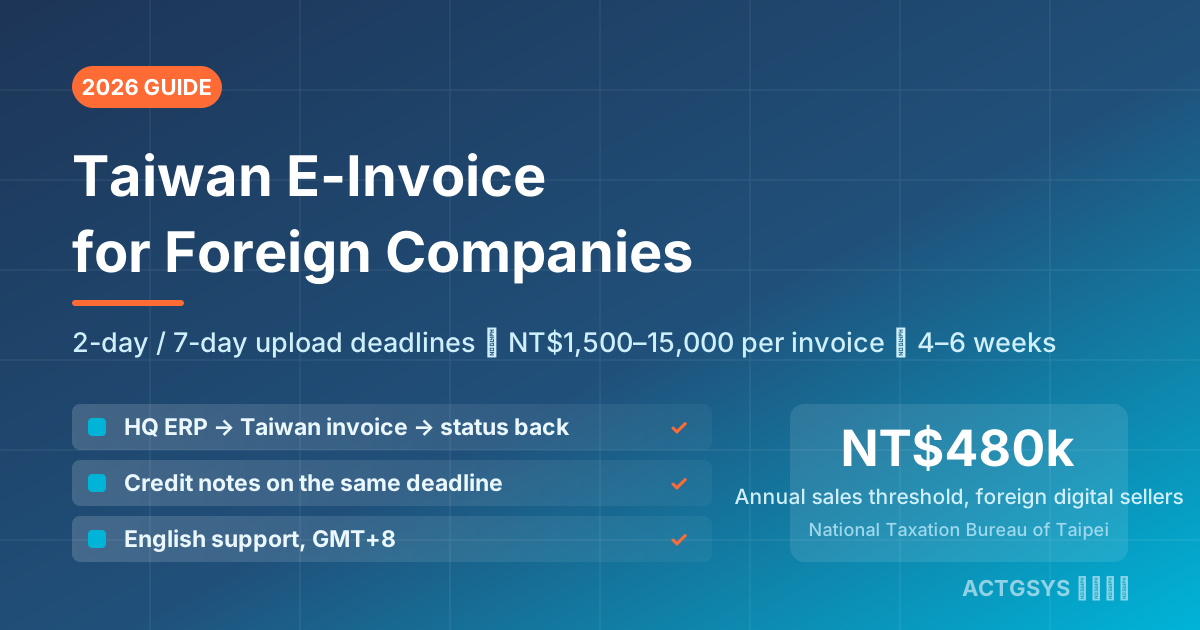
How a foreign-owned Taiwan subsidiary or branch connects its ERP to Taiwan's e-invoice platform: 2-day B2C / 7-day B2B upload deadlines, NT$1,500–15,000 per-invoice penalties, three integration paths, and a 4–6 week project from NT$50,000.
Anthropic Claude Opus 4.8 (2026): Same Price, Stronger
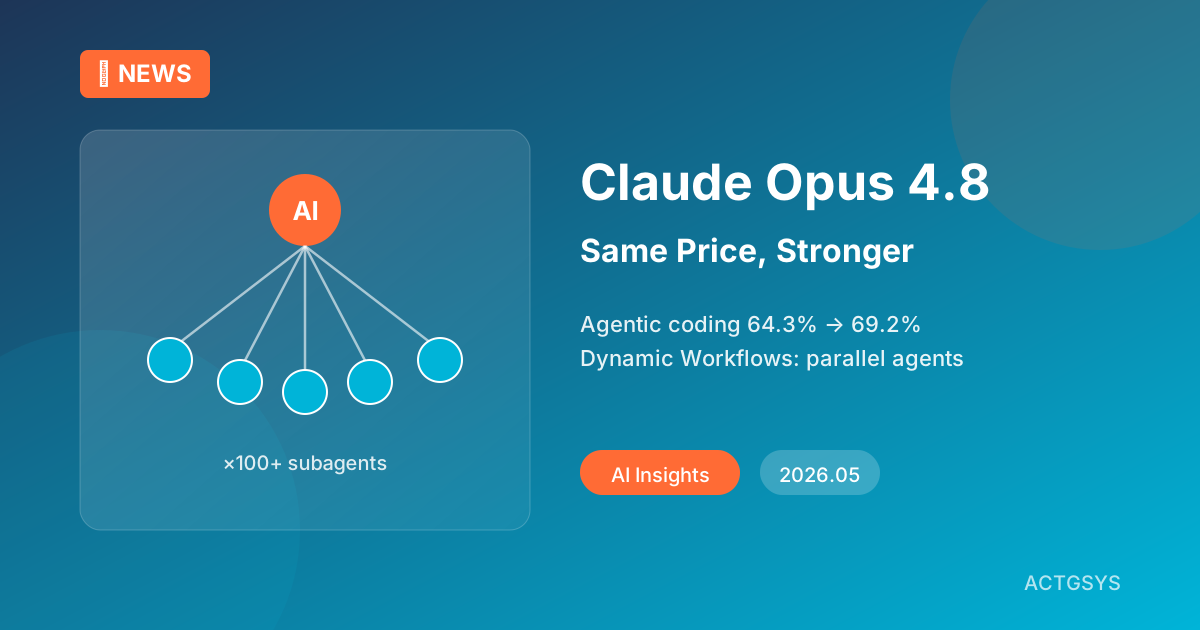
On May 28, 2026, Anthropic launched Claude Opus 4.8, holding the same $5 / $25 per 1M token pricing as its predecessor while lifting agentic coding from 64.3% to 69.2% and adding Dynamic Workflows — a research preview that orchestrates hundreds of parallel subagents. We unpack what this upgrade means for Taiwan SME automation.
Alibaba Qwen 3.7-Max (2026): 1M-Token Context
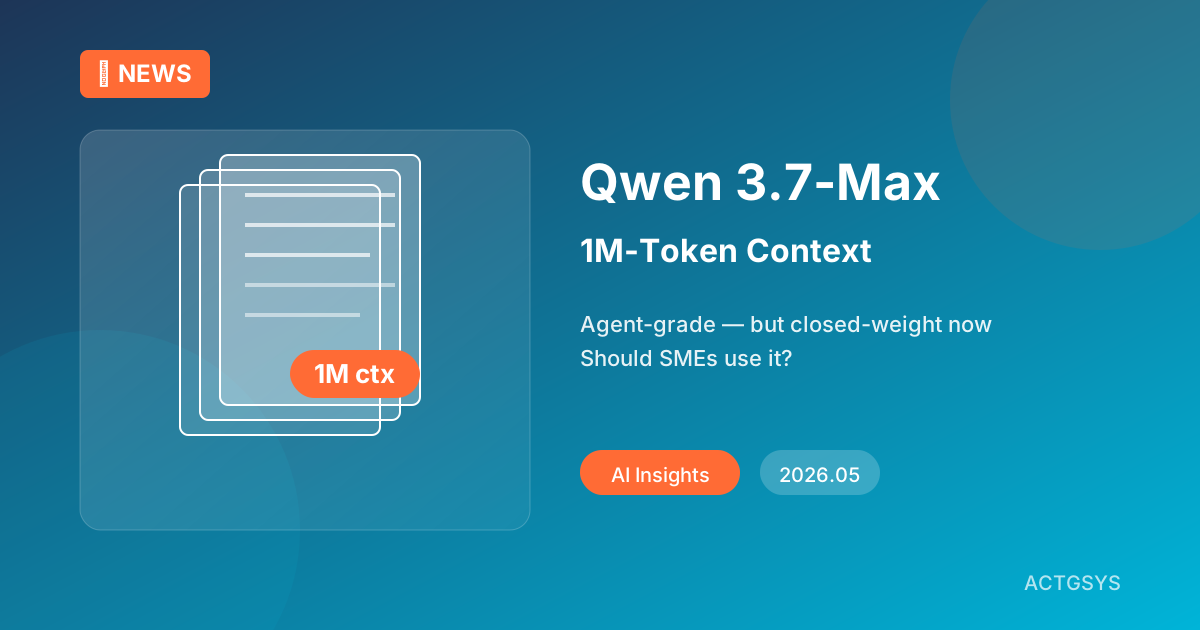
On May 20, 2026, Alibaba launched Qwen 3.7-Max with a 1M-token context window and native extended thinking, scoring 69.7 on Terminal-Bench 2.0 and 60.6 on SWE-Bench Pro — but it's closed-weight and API-only for the first time. We unpack what this Chinese flagship means for Taiwan SME long-document processing and cost.
What would this cost you?
Answer five questions. Within three working days you get a price range and what it covers. No deck, no follow-up sales calls.
Prefer to talk?LINE·02-2553-8084