Google Predicts 5 Major AI Agent Trends for 2026
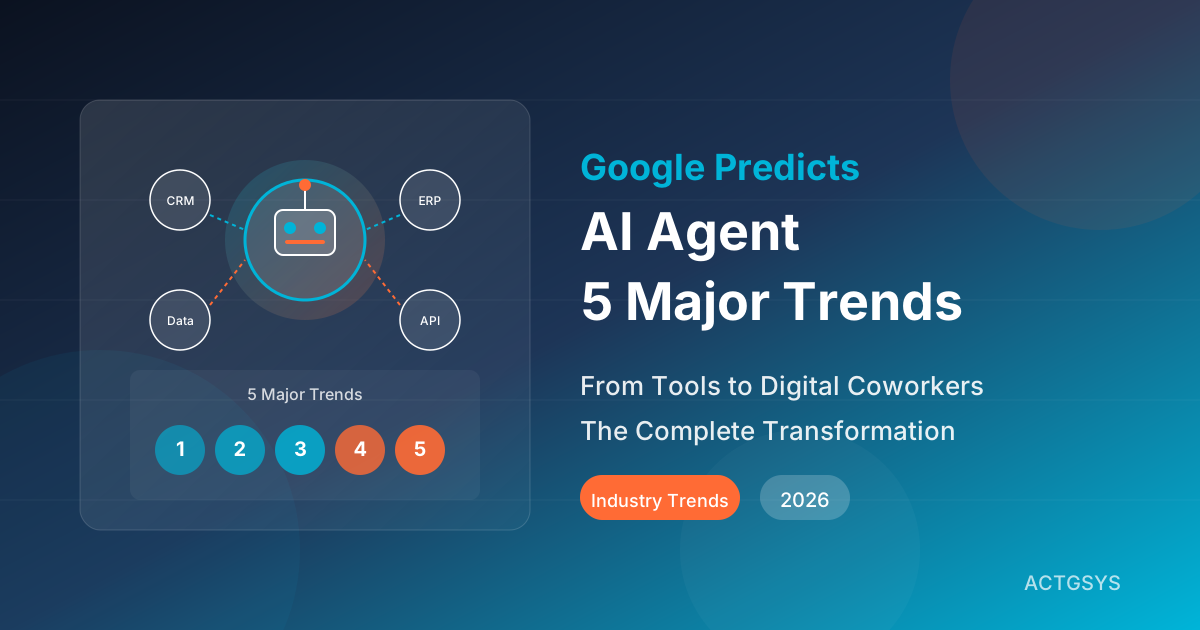
In January 2026, Google released its highly anticipated AI Agent trends report, making significant predictions about AI evolution in enterprise applications. The report states that AI Agents are transforming from "assistive tools" to "autonomous digital coworkers," which will fundamentally change how businesses operate. For SMEs, understanding these trends and planning ahead will be key to maintaining competitiveness over the next three years.
What is an AI Agent?
According to Google's definition, an AI Agent is "a system that combines advanced AI model intelligence with tool access permissions, capable of proactively taking action on behalf of humans under user control."
Unlike traditional AI assistants (like ChatGPT, Copilot), AI Agents are characterized by:
| Characteristic | Traditional AI Assistant | AI Agent |
|---|---|---|
| Interaction Mode | Waits for commands | Proactively senses and acts |
| Execution Scope | Single tasks | Cross-system workflows |
| Decision Capability | Provides suggestions | Autonomous decision-making |
| Learning Ability | Static model | Continuous learning and optimization |
| Tool Integration | Limited | Deep multi-system integration |
Simply put, an AI Agent is like a tireless digital coworker that can understand goals, plan steps, use tools, execute tasks, and autonomously adjust strategies throughout the process.
Google's Five Major AI Agent Predictions for 2026
Trend 1: Complete Upgrade from Copilot to Agent
In 2025, most enterprises used Copilot-type AI—requiring humans to issue commands before AI would act. In 2026, AI Agents will begin executing tasks autonomously:
- Signal sensing: Monitoring emails, CRM updates, system alerts, etc.
- Context assessment: Deciding whether to act based on preset rules and learned experience
- Autonomous execution: Completing tasks rather than just providing suggestions
Practical example: When a business system detects a customer's order volume declining consecutively, the AI Agent will automatically:
- Analyze the customer's purchase history
- Identify possible churn reasons
- Generate personalized retention strategies
- Schedule follow-up meetings with sales representatives
- Prepare customer reports needed for the meeting
Trend 2: 85% of Executives Will Rely on AI Agents for Real-Time Decisions
The report predicts that by 2026, 85% of enterprise executives will rely on AI Agent recommendations for real-time, data-driven decisions.
This represents a fundamental shift in enterprise decision-making:
Past decision process: Collect data → Manual analysis → Write report → Executive review → Make decision (takes days to weeks)
2026 decision process: AI Agent continuous monitoring → Real-time analysis → Auto-generate insights → Executive quick decision (takes minutes to hours)
Trend 3: Employee Roles Transform to "AI Agent Supervisors"
Google predicts that employee roles will transform at scale in 2026. Primary responsibilities will no longer be executing tedious tasks, but rather:
- Setting strategy and goals: Telling AI Agents what to achieve
- Defining boundaries and rules: Setting the scope of AI Agent actions
- Quality verification: Reviewing AI Agent outputs
- Exception handling: Addressing special cases AI Agents cannot resolve
This means enterprises need to rethink talent development:
| Traditional Skills | New Skills Needed in 2026 |
|---|---|
| Data entry | AI system operation |
| Report creation | AI output review |
| Process execution | Process design and optimization |
| Problem reporting | Root cause analysis |
| Single tool expertise | Cross-system integration thinking |
Trend 4: 80% of Enterprise Applications Will Embed AI Agents
IDC predicts that by 2026, 80% of enterprise workplace applications will have built-in AI Agent (or AI Copilot) functionality. This means:
- CRM systems: Automatically track customers, predict opportunities, generate personalized communications
- ERP systems: Automatic replenishment, inventory optimization, demand forecasting
- HR systems: Automatic resume screening, interview scheduling, onboarding tracking
- Financial systems: Automatic reconciliation, anomaly detection, report generation
Enterprises won't need to purchase separate AI solutions—the business systems they use will inherently have AI capabilities.
Trend 5: Agentic AI Ecosystem Takes Shape
In 2026, AI Agents are no longer isolated tools but form a complete ecosystem:
Vertical integration:
- Industry-specific AI Agents (manufacturing, retail, finance)
- Specialized Agents optimized for specific processes
Horizontal integration:
- Agents can communicate and collaborate with each other
- End-to-end automation across departments and systems
Developer ecosystem:
- Low-code/no-code Agent development tools
- Agent marketplaces and templates
How Enterprises Can Respond to These Trends
Short-term Actions (3-6 months)
-
Assess AI capabilities of existing systems
- Do your current CRM, ERP, and other systems have AI features?
- What is the supplier's AI development roadmap?
- Do you need to switch to more AI-capable systems?
-
Identify automatable workflows
- List repetitive tasks your team performs daily
- Evaluate which tasks are suitable for AI Agent handling
- Estimate benefits after automation
-
Start data preparation
- AI Agents need clean, structured data
- Start cleaning and standardizing data now
- Establish SOPs for data quality maintenance
Medium-term Planning (6-12 months)
-
Choose suitable AI Agent platforms
- Evaluate AI Agent solutions from different vendors
- Consider integration capabilities with existing systems
- Confirm multi-language support
-
Pilot projects
- Select a clear use case for piloting
- Establish benefit measurement metrics
- Collect user feedback
-
Talent development
- Train employees to use AI Agents
- Cultivate "AI supervisor" mindset
- Build internal AI knowledge base
Long-term Strategy (1-2 years)
-
Build AI-First workflows
- Redesign processes with AI Agents at the core
- Humans handle supervision, exception handling, and creative work
- Continuously optimize human-machine collaboration
-
Develop AI governance framework
- Define AI Agent permissions and boundaries
- Establish quality review mechanisms
- Ensure information security and privacy compliance
-
Create digital competitive advantages
- Use AI Agents to create unique customer experiences
- Develop data-driven decision capabilities
- Build a culture of continuous learning and improvement
Security Considerations for AI Agents
Google's report specifically warns that as AI Agents gain more permissions, security risks also increase:
Key Risks
- Over-authorization: AI Agents gaining system access beyond what's necessary
- Insufficient monitoring: Lack of tracking and auditing AI Agent behavior
- Data leakage: AI Agents potentially mishandling sensitive data
Protection Recommendations
- Principle of least privilege: Only give AI Agents the minimum permissions needed to complete tasks
- Behavior monitoring: Log and audit all AI Agent actions
- Human review checkpoints: Important decisions must go through human confirmation
- Regular evaluation: Periodically review whether AI Agent behavior meets expectations
AI Agent Applications Across Industries
Manufacturing
- Automatic production line anomaly detection and scheduling adjustments
- Supplier management and automatic procurement
- Quality inspection and traceability
Retail
- Personalized product recommendations and dynamic pricing
- Inventory forecasting and automatic replenishment
- Customer service and returns processing
Services
- Appointment scheduling and resource optimization
- Automatic customer issue classification and response
- Employee scheduling and task assignment
Finance
- Risk assessment and credit review
- Fraud detection and early warning
- Compliance checking and report generation
FAQ
Q1: Will AI Agents replace human jobs?
AI Agents will replace certain tasks but not humans. Repetitive, rule-based work will be largely automated, while work requiring creativity, empathy, and strategic thinking will become more valued. Employee roles will shift from "executors" to "supervisors" and "decision-makers."
Q2: Can SMEs afford to implement AI Agents?
Yes. The 2026 trend is AI Agent functionality being built into commonly used business software, so enterprises don't need to purchase or develop separately. By choosing SaaS platforms with AI capabilities, businesses can enjoy AI Agent benefits at reasonable costs.
Q3: Can AI Agent decisions be trusted?
The approach should be "trust but verify." For low-risk, high-frequency decisions, AI Agents can execute autonomously; for high-risk, high-impact decisions, human review checkpoints should be set. Also continuously monitor AI Agent performance to ensure decision quality.
Q4: How do we evaluate AI Agent benefits?
Track these metrics:
- Efficiency metrics: Task completion time, human intervention frequency
- Quality metrics: Error rate, customer satisfaction
- Cost metrics: Labor cost savings, operational cost changes
- Business metrics: Revenue growth, customer retention rate
Q5: Are there suitable AI Agent solutions available?
Yes. Local vendors like ACTGSYS have integrated AI Agent functionality into their CRM (DanLee) and ERP (Dinkoko) products, providing localized interfaces and services. International vendors like Salesforce and Microsoft also offer solutions with multi-language support.
Conclusion: Embrace the AI Agent Era
Google's predictions tell us that 2026 will be the pivotal year for AI Agents to move from concept to large-scale application. For SMEs, this presents both challenges and opportunities:
- Challenges: Need to rethink workflows, develop new skills, invest in new systems
- Opportunities: AI Agents can enable small teams to achieve enterprise-level efficiency, creating competitive advantages previously unimaginable
The key to success isn't pursuing the most advanced technology, but finding the application scenarios most suitable for your business, starting small, and continuously learning and adjusting.
ACTGSYS is committed to helping SMEs embrace the AI Agent era. Our DanLee CRM and Dinkoko ERP already have built-in AI Agent functionality, allowing your team to focus on high-value work rather than tedious administrative tasks.
Want to learn how AI Agents can help your business? Book a consultation now and let us plan your AI transformation roadmap together.
Products & Solutions in This Article
AI-powered CRM for lead management, customer tracking, and sales pipeline optimization designed for SMEs.
AI-driven ERP focusing on procurement, inventory, and supply chain management. Each customer deployed on dedicated cloud infrastructure.
Related Articles
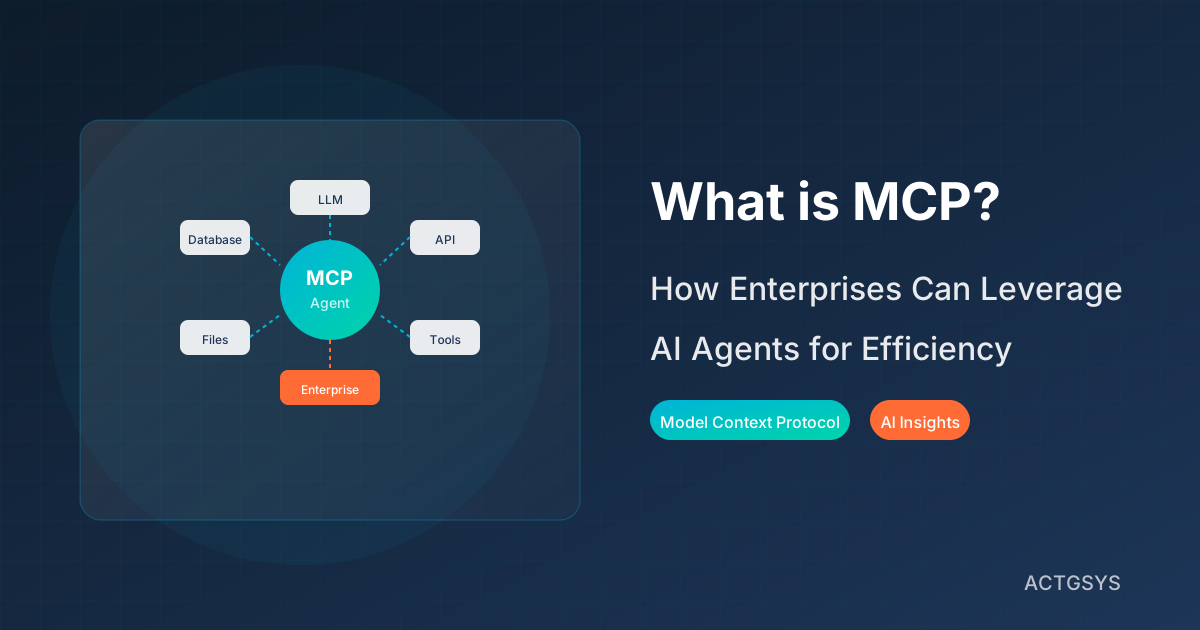
What Is MCP? Enterprise AI Agents Explained
An in-depth explanation of Model Context Protocol (MCP), and how enterprises can implement AI Agent architectures for cross-system integration, automated workflows, and intelligent decision support.
Snowflake CoCo and CoWork (2026): The Data Platform Grows Its Own AI Agents
At its June 2026 Summit, Snowflake made its data platform fully agentic: CoCo (formerly Cortex Code) became an autonomous development platform, CoWork is a personal agent for knowledge workers, and Snowflake claimed CoCo beats Claude Code on its own benchmark. This article unpacks the 'data-native agent' trend and how to read 'vendor self-run benchmarks' — and what it means for SMEs.
OpenAI Brings Codex to 'Every Role' (2026)
On June 2, 2026, OpenAI announced a major Codex update: role-specific plugins for six jobs (data analytics, sales, product design and more — bundling 62 apps and 110 automated skills) plus Codex Sites, which turns data and documents into shareable internal apps. This article breaks down what 'non-engineers building tools with AI' means for SMEs.
What would this cost you?
Answer five questions. Within three working days you get a price range and what it covers. No deck, no follow-up sales calls.
Prefer to talk?LINE·02-2553-8084