Google Launches Antigravity 2.0 at I/O 2026 (May 2026): Multi-Agent Orchestration as a Desktop App — What Can Taiwan SMEs Learn?
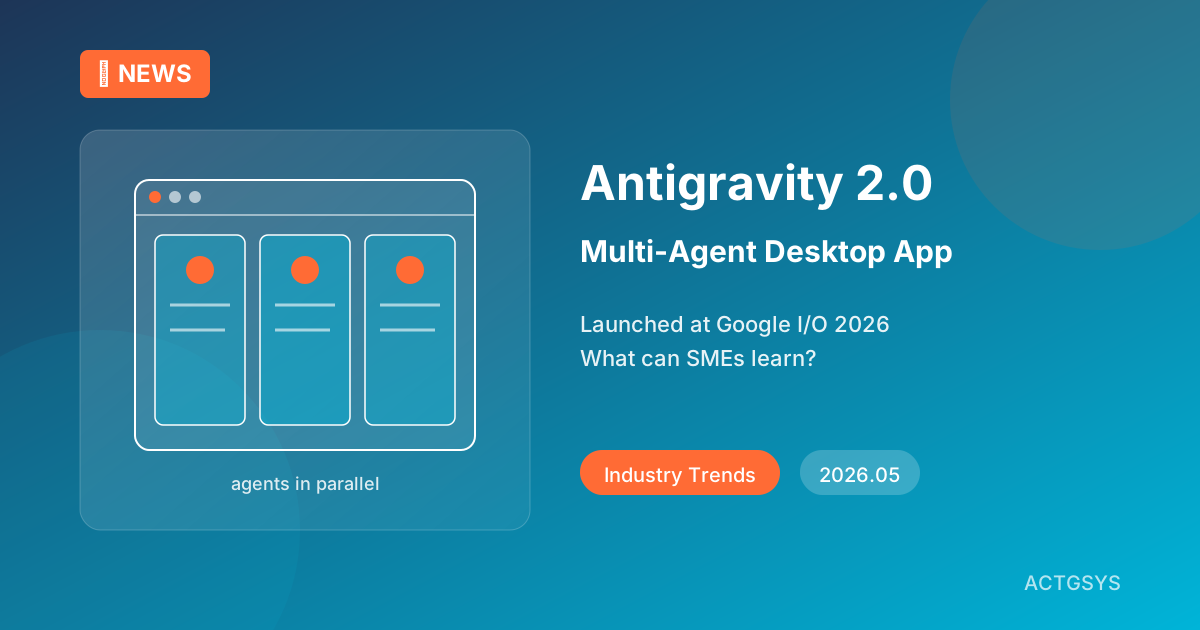
On May 19, 2026, at the I/O 2026 developer conference, Google launched Antigravity 2.0 — turning "multi-AI-agent orchestration" into a standalone desktop application that lets you run multiple agents in parallel, design custom subagent workflows, and schedule background automation — alongside the Antigravity CLI, Antigravity SDK, and a $100/month AI Ultra plan. For Taiwan SMEs, the real signal isn't any single feature — it's that "AI agent collaboration" has officially moved from concept to a product form you can buy and use.
What Happened With Google Antigravity 2.0?
Google officially launched Antigravity 2.0 at I/O 2026 on May 19, 2026. According to Google's official developer blog (2026), the new version is a standalone desktop app built around "agent-first" design, positioned as "a central home for agent interaction, allowing you to orchestrate multiple agents to execute tasks in parallel."
It wasn't just one app — a whole toolset shipped together:
- Antigravity 2.0 desktop app — multi-agent parallelism, custom subagent workflows, scheduled background automation, plus new native voice commands (direct your agents by speaking instead of typing).
- Antigravity CLI — a lightweight terminal version to create agents instantly without a GUI; Google explicitly encourages former Gemini CLI users to migrate.
- Antigravity SDK — a programmatic interface to build custom agents on the same agent harness powering Google's own products, deployable on your infrastructure of choice.
On pricing, Google introduced a new AI Ultra plan at $100/month, offering 5× higher usage limits in Antigravity than AI Pro; the existing top-tier AI Ultra subscription dropped from $250 to $200/month (TechCrunch, 2026). All three tools center on Gemini 3.5 Flash, emphasizing speed and multi-agent orchestration over single-turn prompting.
What Are the Key Improvements in Antigravity 2.0?
Antigravity 2.0 consolidates agent capabilities once scattered across IDE plugins, CLI, and API into a single "agent collaboration workstation":
- Multi-agent parallel collaboration — orchestrate multiple agents in one interface, splitting big tasks across agents — the core upgrade.
- Scheduling and background automation — set agents to run tasks automatically on a schedule, turning "AI agents" into schedulable digital workers.
- Native voice commands — direct agents by speaking, lowering the barrier to use.
- SDK + self-hosting — customize agent behavior via the SDK and deploy on your own infrastructure for more enterprise control.
How Is Antigravity 2.0 Different From Claude Code and the Previous Version?
The most-searched query is "Antigravity vs Claude Code." The table lays out where each agent dev tool sits:
| Dimension | Antigravity 1.x (prev) | Antigravity 2.0 | Claude Code |
|---|---|---|---|
| Form factor | IDE-style tool | Standalone desktop app + CLI + SDK | CLI / terminal agent |
| Multi-agent parallelism | Limited | Native multi-agent collaboration | Dynamic Workflows (hundreds of subagents) |
| Underlying model | Gemini | Gemini 3.5 Flash | Claude Opus 4.8 |
| Scheduling / background | Weak | Scheduled background automation | Via integrations |
| Pricing | Within existing plans | AI Ultra $100/mo (5× Pro usage) | API usage-based |
(Sources: Google's official developer blog (2026), TechCrunch, 2026.)
The key takeaway: 2026's AI competition has shifted from "whose model is smarter" to "who can turn multi-agent collaboration into a usable product." Google (Antigravity) and Anthropic (Claude Code's Dynamic Workflows) both shipped "multi-agent parallelism" in nearly the same week — a highly aligned direction. For SMEs, the signal is that agent collaboration is rapidly being productized and democratized.
How Are Developers and the Industry Reacting?
Community reaction splits between "promising direction" and "rocky first release."
Positive reactions center on productizing agent collaboration — developers broadly welcome Antigravity 2.0 packaging once-DIY multi-agent workflows into a ready-to-use desktop app, with scheduling and voice lowering the barrier to "getting multiple AI agents to work together." Centering on the fast Gemini 3.5 Flash also makes parallel tasks more friendly on speed and cost.
Reservations center on first-release stability and ecosystem lock-in — some reviews call 2.0 a "rocky launch," with early stability and experience still needing polish. More crucially, ecosystem lock-in: Antigravity is deeply tied to Gemini and Google Cloud, so a full bet makes switching later costly.
In the broader frame, this echoes Gartner's read on 2026: agent collaboration platforms are becoming a key battleground for the majors, but enterprises should assess "platform lock-in risk" and avoid binding all automation to one ecosystem (Gartner, 2025).
What Does This Mean for Taiwan SMEs?
For Taiwan SMEs, Antigravity 2.0 lowers the bar for multi-agent automation another notch — but weigh "usability" against "lock-in."
Opportunities:
- Multi-agent automation becomes a buyable product — agent collaboration that once required engineers to assemble now ships as a ready desktop app, letting SMEs without large tech teams experiment.
- Scheduled background automation = digital workers — set agents to run "daily report aggregation, data tidying, routine queries" in the background, like extra assistants who never clock out.
- SDK gives build flexibility — with dev capability, use the SDK to build custom agents fitting your workflow, deployed on your chosen infrastructure.
Three cautions:
- Don't put critical flows on the first release — given the "rocky launch" reviews, pilot on non-critical internal tasks first and expand after stability is proven.
- Beware deep Google-ecosystem lock-in — Antigravity ties to Gemini and Google Cloud; betting all automation on it makes switching costly. Decouple core logic from the underlying platform.
- Do the math on $100/month — before adopting AI Ultra at $100/month, confirm your agent usage and labor savings can cover this fixed cost.
When grounding agent collaboration into TanJee document processing, DanLee CRM customer-data tidying, or LINE Bot automation, keep a "platform-neutral" design so you can choose flexibly between Antigravity (Gemini), Claude Code (Claude), and others by task and cost, rather than being locked to one ecosystem.
ACTGSYS Recommendation: What Should You Do Now?
Antigravity 2.0 is a good window into "productized agent collaboration" — worth trying for SMEs, but manage lock-in and cost pragmatically.
Do now:
- Inventory internal tasks suited to "multi-agent parallelism" — list routine work spanning several steps and systems (report aggregation, data cleanup, batch queries); these suit multi-agent automation pilots best.
- Pilot small on non-critical tasks — pick a low-risk internal flow, test Antigravity 2.0's stability, speed, and time savings, then decide whether to expand.
- Evaluate competitors in parallel — put Antigravity alongside Claude Code and others, comparing on the same real tasks; don't look at one ecosystem alone.
Wait and watch:
- Hold critical flows until stability is proven — before the "rocky launch" reviews settle, don't bet core customer-facing flows.
- Try before buying large subscriptions — validate AI Ultra's $100/month value with a trial or smaller plan before upgrading.
Frequently Asked Questions
Can Google Antigravity 2.0 be used in Taiwan?
Yes. Available since its May 19, 2026 I/O launch, the desktop app supports macOS / Linux / Windows and is downloadable in Taiwan, with higher usage via AI Pro / AI Ultra subscriptions. Enterprises needing more control can use the Antigravity SDK to build custom agents deployed on their chosen infrastructure.
Does Antigravity 2.0 cost money? Is the $100/month AI Ultra worth it?
Antigravity 2.0 works under existing AI plans, but higher usage requires a subscription. Google's new AI Ultra is $100/month, offering 5× higher usage limits than AI Pro. Whether it's worth it depends on your agent usage and labor savings — pilot on a lower-tier plan, quantify the benefit, then upgrade rather than committing to a large fixed cost upfront.
How do I choose between Antigravity 2.0 and Claude Code?
Both center on multi-agent collaboration but differ by ecosystem. Antigravity ties to Gemini and Google Cloud as a desktop app + CLI + SDK, suiting teams already in Google's ecosystem; Claude Code is a terminal agent on Claude Opus 4.8 with strong coding. Test both on the same real tasks and keep switching flexibility — don't lock into one ecosystem.
Can SMEs without an engineering team use Antigravity 2.0?
You can start with the desktop app. Antigravity 2.0's desktop version adds voice commands and scheduling, lowering the barrier so non-technical staff can set up basic agent tasks. But for deep automation tailored to your workflow, dev capability or an implementation partner using the SDK is still recommended.
Conclusion
Google Antigravity 2.0's real signal isn't another dev tool — it's that "multi-AI-agent collaboration" has been turned into a buyable, usable product form, with Google and Anthropic both betting on this direction in nearly the same week. For Taiwan SMEs, the right response is to inventory internal tasks suited to multi-agent work, pilot small on non-critical flows, compare competitors in parallel, and keep platform-neutral switching flexibility — capturing the democratization of agent collaboration without being locked to one ecosystem.
Want an architecture that automates routine work with multi-agent collaboration without being locked to one AI ecosystem? Contact ACTGSYS — we help Taiwan SMEs turn the latest agent collaboration capabilities into automation that's deployable, governable, and switchable.
Event date: May 19, 2026 (Google launches Antigravity 2.0 at I/O 2026). Last updated: May 31, 2026.
Products & Solutions in This Article
Intuitive accounting system designed for Taiwan SMEs, with automated bookkeeping and financial reporting.
AI-powered CRM for lead management, customer tracking, and sales pipeline optimization designed for SMEs.
Related Articles
Snowflake Launches CoCo and CoWork (June 2026): The Data Platform Grows Its Own AI Agents — and 'Beats Claude Code on Its Own Benchmark.' What Should SMEs Watch?
At its June 2026 Summit, Snowflake made its data platform fully agentic: CoCo (formerly Cortex Code) became an autonomous development platform, CoWork is a personal agent for knowledge workers, and Snowflake claimed CoCo beats Claude Code on its own benchmark. This article unpacks the 'data-native agent' trend and how to read 'vendor self-run benchmarks' — and what it means for SMEs.
OpenAI Brings Codex to 'Every Role' (June 2026): Six Role Plugins + Sites Let Non-Engineers Build Internal Tools — How Should SMEs Use It?
On June 2, 2026, OpenAI announced a major Codex update: role-specific plugins for six jobs (data analytics, sales, product design and more — bundling 62 apps and 110 automated skills) plus Codex Sites, which turns data and documents into shareable internal apps. This article breaks down what 'non-engineers building tools with AI' means for SMEs.
Mistral Rebrands Le Chat as Vibe, a Full 'Work Agent' (May 2026): European AI Goes Straight for Your Inbox and Calendar — Should SMEs Care?
Mistral renamed its chatbot Le Chat to Vibe on May 28, 2026, unifying Work Mode and Code Mode so a single account connects to Google Workspace, Outlook, Slack, and GitHub to autonomously handle email, calendar, documents, and recurring processes. Here's what this European work agent means for SME automation.