How to Choose an AI Vendor: SME Guide (2026)
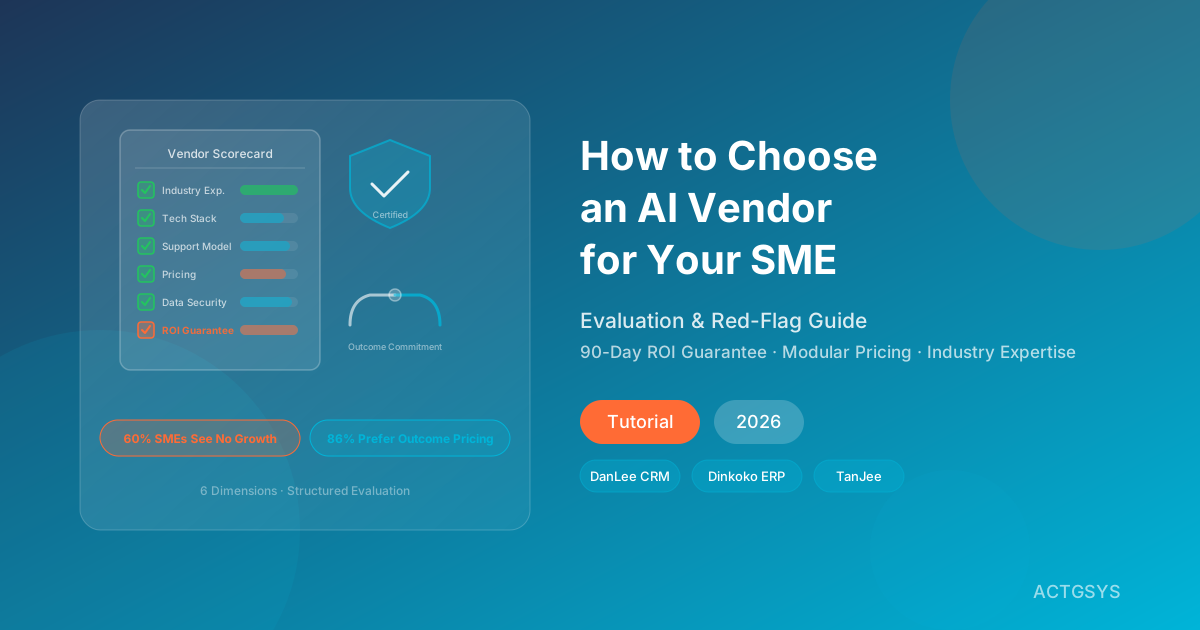
How to Choose an AI Vendor for Your SME: 2026 Evaluation & Red-Flag Guide
Choosing the wrong implementation vendor is the single most common reason SME digital transformation projects fail. According to a PwC Taiwan survey, over 60% of SMEs see no significant revenue improvement after deploying a new system — and "vendor mismatch" consistently ranks among the top three root causes. The software itself works fine, but the vendor doesn't understand your industry, post-launch support is nonexistent, and the pricing model hides costs that double your total investment. These are the factors that turn a promising initiative into a write-off.
The 2026 AI/ERP/CRM market is more crowded than ever, making vendor selection simultaneously more important and more complex. This guide provides a structured evaluation framework to help you avoid landmines and make the decision that delivers real results.
Why Do Over 60% of SMEs Feel "Nothing Changed" After Implementation?
When a new system fails to deliver visible benefits, the root cause is almost never the software itself — it's the fit between the vendor and the business. The three most common failure patterns:
1. The vendor has no real experience in your industry. Generalist vendors sell the same system to manufacturing, retail, and service companies, but the operational processes in each industry differ enormously. Without industry-specific know-how, implementations require extensive customization that blows up timelines and budgets.
2. The "sell and disappear" transactional model. Many vendors operate on a "sign the contract, deliver the software, move on" model. Post-launch user training, system fine-tuning, and operational optimization are minimal or absent, leaving the system as an expensive shelf ornament.
3. Opaque pricing with hidden cost layers. The initial quote looks affordable, but customization fees, integration fees, upgrade fees, and consulting fees pile up — ultimately pushing total cost of ownership to 2-3x the original quote.
Six Dimensions for Evaluating an AI System Vendor
A strong implementation partner should satisfy all six criteria below. A gap in any dimension can create a time bomb for your project.
Dimension 1: Industry Experience and Verified Case Studies
This is the single most important factor. Has the vendor served businesses in your industry or a closely adjacent one? Do they have verifiable success stories — not just logos on a slide, but reference customers you can actually call? A vendor with ten proven manufacturing implementations will almost certainly outperform a "we do everything" generalist on your manufacturing project.
Dimension 2: Open and Extensible Technology Architecture
Is the system a closed ecosystem or does it offer open APIs? Can it integrate with your existing tools (LINE, accounting software, e-commerce platforms)? Will it scale smoothly as your business grows? Closed-architecture systems may cost less upfront, but they lock you into a single vendor long-term.
Dimension 3: Post-Launch Support Model
Go-live is the starting line, not the finish line. A quality vendor should provide: at least 3 months of intensive post-launch hand-holding, a dedicated Customer Success Manager, regular system health checks and optimization recommendations, and user training for new features. If the vendor's support model is limited to "submit a ticket and wait," treat that as a red flag.
Dimension 4: Pricing Transparency
Does the proposal clearly itemize every cost? Are customization, integration, training, and upgrade fees disclosed upfront? According to Simon-Kucher's global pricing study, 86% of B2B buyers prefer outcome-based or usage-based pricing over traditional fixed licensing fees. Selecting a vendor that offers transparent, flexible pricing is the first step in protecting your investment.
Dimension 5: Data Security and Compliance
Your customer data, financial records, and trade secrets will all live inside this system. Are the vendor's security measures up to standard? Do they support on-premises deployment? Are they compliant with data protection laws and industry-specific regulations? Never compromise on data security — the risk is irreversible.
Dimension 6: ROI Guarantee and Outcome Commitment
This is the most differentiating vendor selection criterion in 2026. A vendor willing to guarantee ROI demonstrates genuine confidence in their product and service. Gartner predicts that 40% of enterprise software will include outcome-based pricing by the end of 2026. McKinsey research shows that companies adopting value-based pricing achieve 5-10% higher return on sales. If a vendor offers no outcome commitment at all, you should ask yourself: why aren't they willing to stand behind their work?
Vendor Type Comparison: Which Is Best for SMEs?
| Dimension | International Brands (SAP, Salesforce, etc.) | Local System Vendors | Boutique Consultancies (e.g., ACTGSYS) |
|---|---|---|---|
| Industry experience | Broad but mostly large enterprise cases | Strong local market knowledge | Deep specialization, SME-focused |
| Tech architecture | Feature-rich but high complexity | Varies by vendor; verify scalability case by case | Modular design, flexible composition |
| Implementation timeline | 6-18 months | 3-6 months | 4-8 weeks to go-live |
| Post-launch support | Standardized support processes | Varies by vendor | Dedicated CSM + intensive hand-holding |
| Pricing model | High license fees + consulting fees | One-time purchase or annual subscription | Modular pricing + outcome-based fees |
| SME suitability | Best for budgets above USD $150K | Good for simple requirements | Best fit for 10-200 person companies |
| ROI guarantee | Typically not offered | Rarely offered | ACTGSYS: 90-day ROI guarantee |
Key takeaway: International brands are powerful but often "overkill" for SMEs — companies end up paying 100% of the cost for 20% of the features they actually use. Local vendors are budget-friendly but hit a technology ceiling as the business grows. Boutique consultancies combine agility with deep expertise, making them the optimal choice for SMEs seeking fast deployment and verifiable ROI.
Five Red Flags During Vendor Evaluation
If you encounter any of the following during vendor assessment, proceed with caution:
- Refuses to provide customer references. Good vendors are proud to let prospects speak with their clients. Reluctance usually means there are no success stories worth sharing.
- Vague quotes with frequent cost additions. If the initial proposal isn't transparent, everything that follows will be less so.
- No concrete implementation timeline. A vendor that cannot provide specific milestones typically lacks implementation experience.
- Over-promises features without a demo. Verbal assurances that "we can do anything" without a working demo or proof of concept (POC) is classic sales theater.
- Evasive answers on data security. Where is your data stored? Who has access? Is it encrypted at rest and in transit? If the vendor can't answer these questions clearly, that's a deal-breaker.
Why Outcome-Based Pricing Is the Defining Trend of 2026
The traditional software pricing model is "you pay first; whether it works is your problem." But the market is shifting decisively:
- 86% of B2B buyers prefer outcome-based or usage-based pricing (Simon-Kucher 2025 Global Pricing Study)
- Gartner forecasts 40% of enterprise software will incorporate outcome-based pricing by end of 2026
- McKinsey: companies with value-based pricing achieve 5-10% higher return on sales
Outcome-based pricing aligns the vendor's interests with yours — the vendor only succeeds when you succeed. This fundamentally changes the "sell and disappear" dynamic, giving vendors a strong incentive to invest in your ongoing success.
ACTGSYS's 90-day ROI guarantee embodies this philosophy: we commit to demonstrating quantifiable return on your investment within 90 days of go-live. If the promised outcomes aren't achieved, we keep working until they are. This isn't marketing language — it's a contractual commitment.
Vendor Evaluation Checklist
Before making your final decision, verify each item:
- Does the vendor have 3+ successful case studies in your industry?
- Can they provide a contactable reference customer list?
- Does the system offer open APIs and third-party integration capabilities?
- Does the proposal itemize all costs (customization, integration, training)?
- Is there a concrete implementation timeline with milestones?
- Does post-launch support include a dedicated Customer Success Manager?
- Do they offer an ROI guarantee or outcome-based pricing?
- Do their data security measures meet industry regulatory requirements?
- Can the system scale with your future business growth?
- Do they offer a POC (proof of concept) or free trial?
Frequently Asked Questions
Q1: How much budget should an SME plan for AI system implementation?
It depends on system complexity and company size. For a 20-50 person SME, CRM systems typically cost USD $500-1,300/month and ERP systems USD $650-2,000/month. By choosing a vendor with modular pricing (like ACTGSYS), you can start with the modules you need most, validate ROI, and expand incrementally — keeping initial investment under USD $700/month.
Q2: How long does implementation typically take?
International brands usually require 6-18 months, local vendors 3-6 months. ACTGSYS uses an agile implementation methodology with core modules going live in as fast as 4 weeks and full systems completed in 6-8 weeks. Speed doesn't mean cutting corners — our modular architecture lets us deploy the highest-value features first, then progressively activate advanced modules.
Q3: We already use a system. How risky is switching?
Switching systems carries real risk, but the risk of staying on an underperforming system may be greater. The key is choosing a vendor with proven data migration experience and using a "parallel run" strategy — operating both old and new systems simultaneously for 2-4 weeks to confirm stability before full cutover. ACTGSYS provides complete data migration and parallel cutover services with 100% historical data integrity.
Q4: How can we tell if a vendor's ROI guarantee is real or just marketing?
Ask to see the contract terms. A genuine ROI guarantee should explicitly state: specific measurable KPIs, the measurement methodology, the deadline for achievement, and the remediation mechanism if targets are missed. If a vendor says "we guarantee results" verbally but won't put it in the contract, it's not a real guarantee. ACTGSYS's 90-day ROI guarantee includes clearly defined KPI metrics and contractual terms.
Q5: What data security assurances should we require from vendors?
At minimum, confirm: data storage location (domestic or overseas), encryption standards (in-transit and at-rest), access control mechanisms, backup and disaster recovery plans, relevant security certifications (ISO 27001 or equivalent), and whether on-premises deployment is supported. For any system handling customer personal data, ensure the vendor complies with applicable data protection regulations.
Conclusion: Choosing the Right Vendor Matters More Than Choosing the Right System
System features are increasingly commoditized, but vendor service quality, industry understanding, pricing integrity, and outcome commitment — these are what determine whether your investment succeeds or fails. In 2026, SMEs have no shortage of options; what they need is a structured evaluation method.
Ready to evaluate your next system vendor? Contact ACTGSYS today — we offer a free implementation needs assessment and back every engagement with our 90-day ROI guarantee so you can start your digital transformation with confidence. Check out our transparent pricing plans to see exactly what you'll pay, with no hidden costs.
Products & Solutions in This Article
AI-powered CRM for lead management, customer tracking, and sales pipeline optimization designed for SMEs.
AI-driven ERP focusing on procurement, inventory, and supply chain management. Each customer deployed on dedicated cloud infrastructure.
Intuitive accounting system designed for Taiwan SMEs, with automated bookkeeping and financial reporting.
Related Articles
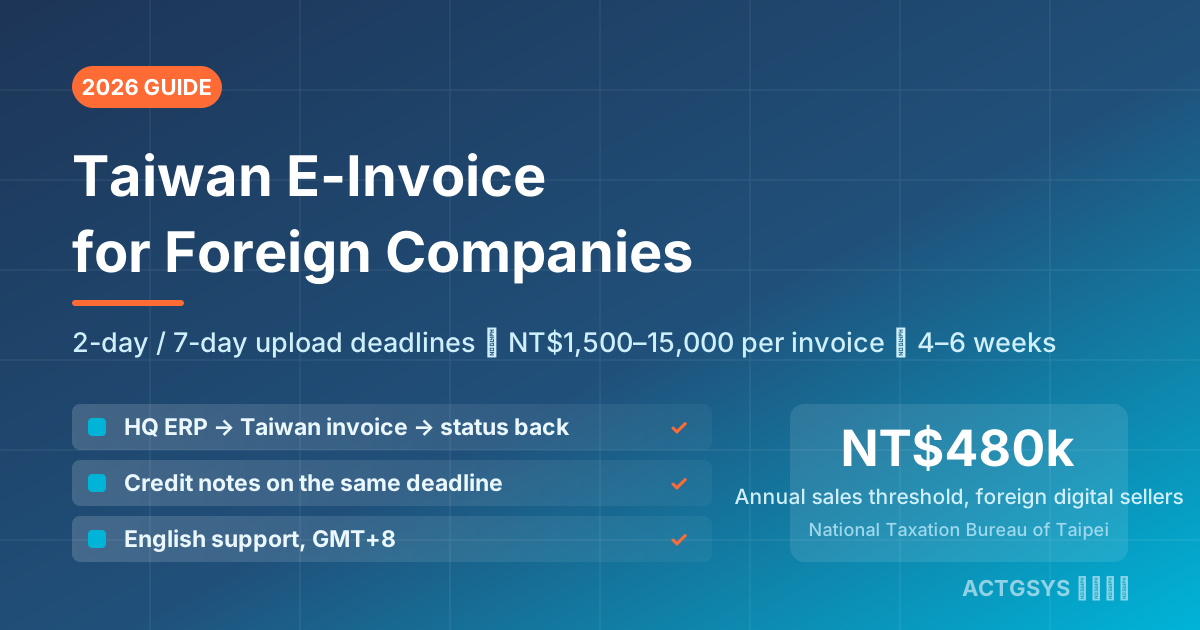
Taiwan E-Invoice for Foreign Companies 2026 - Cost
How a foreign-owned Taiwan subsidiary or branch connects its ERP to Taiwan's e-invoice platform: 2-day B2C / 7-day B2B upload deadlines, NT$1,500–15,000 per-invoice penalties, three integration paths, and a 4–6 week project from NT$50,000.
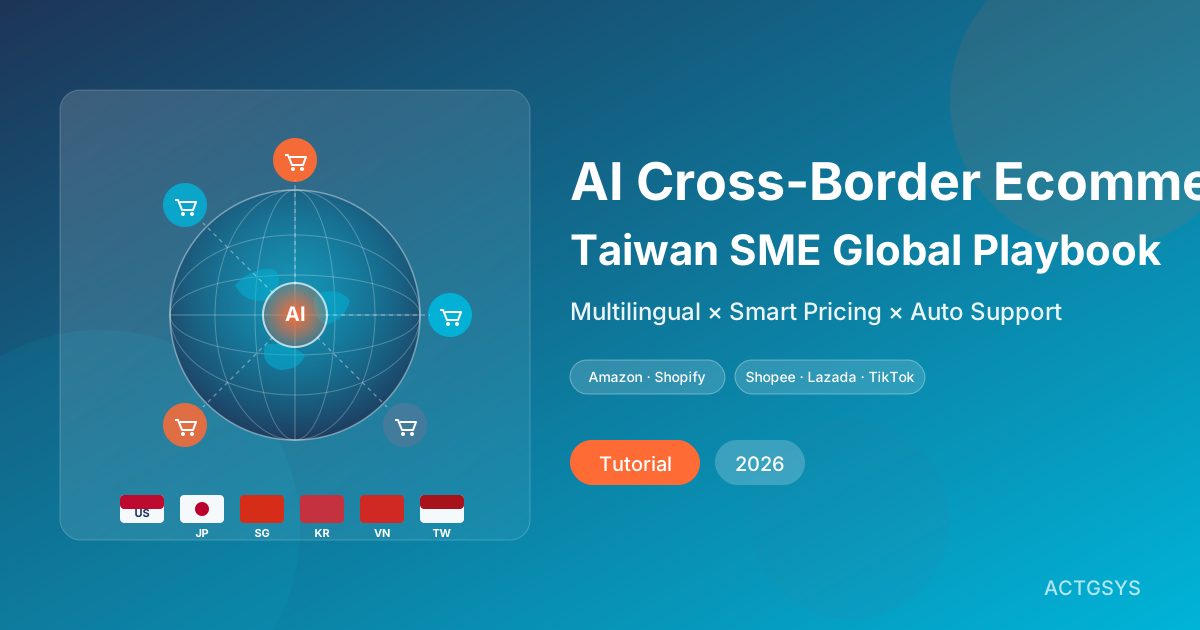
AI Cross-Border Ecommerce Playbook for SMEs (2026)
How Taiwan SMEs use AI to automate cross-border e-commerce — multilingual listings, smart customer service, dynamic pricing, ad ops, and logistics forecasting across Amazon, Shopify, Shopee, Lazada, and TikTok Shop.
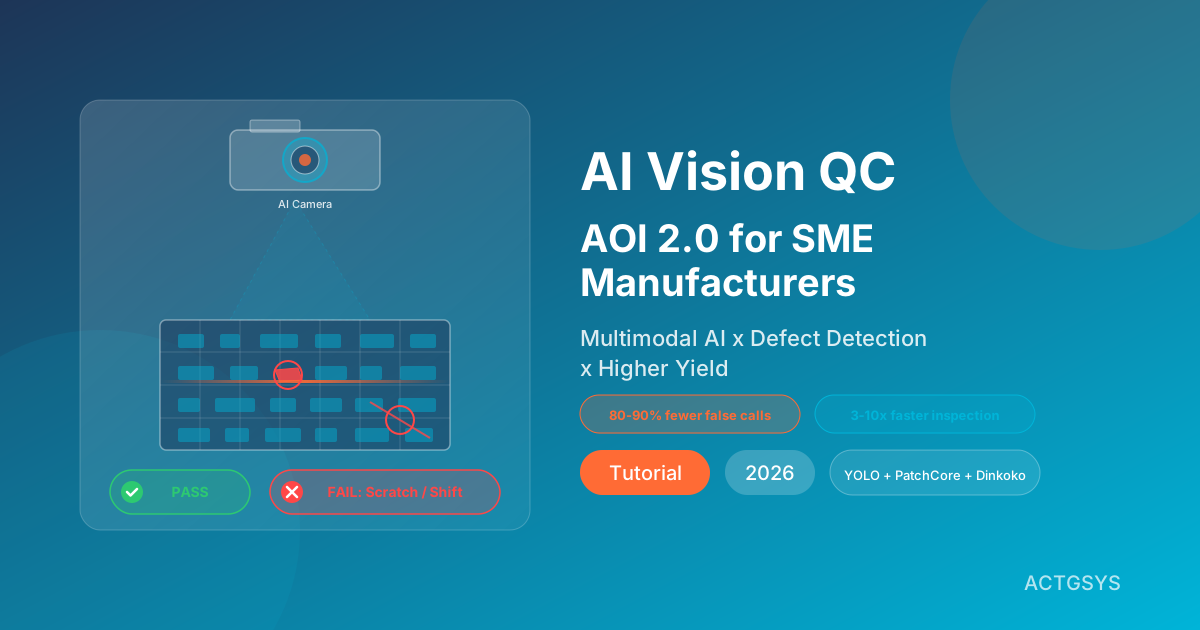
AI Vision Quality Control 2026: AOI 2.0 for SMEs
A deep dive into how AI vision QC (AOI 2.0) combines computer vision with multimodal LLMs to automate defect detection, raise yield and shrink inspection time. Includes a five-step rollout, platform comparison and FAQ.
What would this cost you?
Answer five questions. Within three working days you get a price range and what it covers. No deck, no follow-up sales calls.
Prefer to talk?LINE·02-2553-8084