Manufacturing ERP Digital Transformation
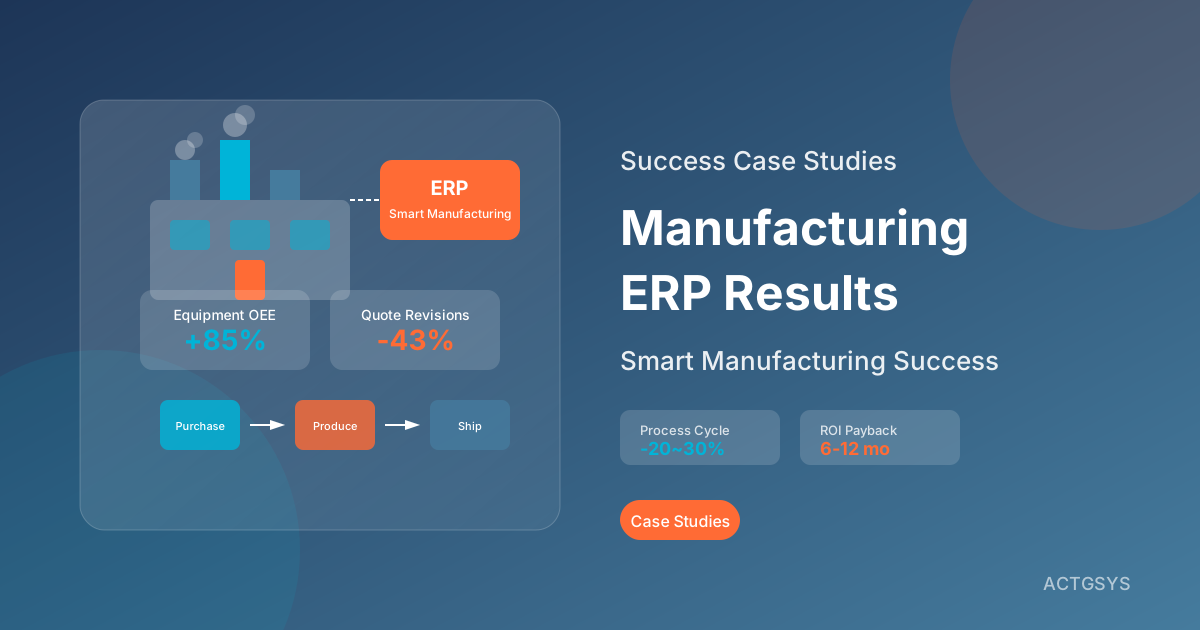
Manufacturing ERP implementation is often viewed as a "major project," with many business owners worried about large investments, high risks, and long payback periods. But real cases tell us: Choose the right solution and strategy, and manufacturing ERP transformation can show significant benefits within 6-12 months. This article compiles the most representative manufacturing ERP success cases from 2024-2025.
Case 1: STIHL German Power Tools — Global OneCRM Integration
Company Background
STIHL is a globally renowned power tool manufacturer (chainsaws, trimmers, etc.), headquartered in Germany, with products sold in over 160 countries worldwide.
Challenges Faced:
- No unified CRM system
- Dealer and customer data scattered
- Local sales subsidiaries operating independently
- Slow customer service response
- Lack of 360-degree customer view
Solution Deployed
STIHL chose Microsoft Dynamics 365 Sales + Customer Service, establishing global unified "OneCRM" platform:
Integration Scope:
- Global dealer database
- Customer purchase and service records
- Local sales subsidiary systems
- Customer service ticket management
Actual Results
| Metric | Before | After | Improvement |
|---|---|---|---|
| Customer view | Scattered | 360-degree unified | New feature |
| Service response speed | Slow | Greatly improved | Significant improvement |
| Sales subsidiary transparency | Low | Completely transparent | Quantum leap |
| Dealer management | Independent | Globally unified | Standardized |
Key Success Factors
- Executive commitment: Global unified strategic direction
- Phased rollout: Start from core markets first
- Standardized processes: Unified global sales and service processes
- Continuous training: Ensure local teams can use system
Case 2: STIHL Quote-to-Cash Integration — 43% Fewer Quote Revisions
Company Background
Building on OneCRM, STIHL's next step was the quoting process. Before the project it faced:
- Complex product portfolio (thousands of configurations)
- Tedious quotation process, frequent revisions
- CRM and CPQ (quote configuration) systems not integrated
- Overly long sales cycles
Solution Deployed
Integrated Dynamics 365 CRM + Experlogix CPQ (Quote Configuration System):
Core Features:
- Product configurator (auto-validates compatibility)
- Dynamic pricing engine
- Auto-generate quotations
- Complete CRM integration
Actual Results
| Metric | Improvement |
|---|---|
| Quote revision count | -43% |
| Quote generation time | Significantly shortened |
| Configuration errors | Near 0 |
| Sales cycle | Noticeably shortened |
Source: Microsoft Dynamics 365 Blog (2024)
Key Success Factors
- Deep CRM+CPQ integration: Eliminates information gaps
- Product rule automation: Avoids human configuration errors
- Dynamic pricing: Auto-adjusts based on customer and quantity
- Mobility: Sales can quickly quote while on the go
Case 3: P&G — AI-Driven Smart Manufacturing
Company Background
Procter & Gamble (P&G) is one of the world's largest consumer goods companies (Tide, Pampers, Gillette brands) and continues to invest heavily in smart manufacturing and IT.
Innovation: Smart Manufacturing
P&G's digital transformation strategy includes:
1. IoT Touchless Production Control
- Sensors monitor production lines in real-time
- Auto-adjust process parameters
- Automatic anomaly alerts
2. Agile Supply Chain Management
- AI-driven demand forecasting
- Real-time inventory visibility
- Dynamic supplier management
3. Company-wide Digital Skill Enhancement
- Manufacturing floor personnel AI training
- Data analytics capability building
- Continuous learning culture
Actual Results
Industry-leading Metrics:
- Became global "Smart Manufacturing" benchmark
- Production line real-time monitoring and adjustment
- Supply chain resilience greatly improved
- Employee digital capabilities comprehensively upgraded
Implications for Local Manufacturing
While P&G is large-scale, its strategies can be applied smaller:
- Start with IoT sensors: Monitor critical equipment
- Cloud ERP integration: Real-time production and inventory visibility
- Employee training: Enhance digital literacy
Case 4: Unilever — 85% Equipment Efficiency Boost
Company Background
Unilever is a global consumer goods giant achieving breakthrough results in AI and ERP integration.
Innovation
Implemented AI-Driven Operational Optimization System:
Core Features:
- Predictive Maintenance
- Equipment efficiency auto-optimization
- Smart production scheduling
- Quality anomaly prediction
Actual Results
| Metric | Data |
|---|---|
| Overall Equipment Effectiveness (OEE) | +85% improvement (Indaiatuba plant, Brazil, 2024; Unilever news) |
| Unplanned downtime | Significantly reduced |
| Maintenance costs | Noticeably decreased |
| Capacity utilization | Nearing optimization |
Key Technologies
- Sensor data collection: Real-time equipment status monitoring
- AI prediction models: Predict failure precursors
- Auto work dispatch: Maintenance tasks auto-scheduled
- Continuous learning: Models become more accurate with data accumulation
Case 5: SME Manufacturing — 6-12 Month Investment Recovery
Industry Statistics
According to 2024-2025 industry surveys, manufacturing SMEs successfully implementing ERP commonly achieve:
| Benefit Item | Average Improvement |
|---|---|
| Weekly manual data entry reduction | 15-20 hours |
| Inventory backlog reduction | 20-30% |
| Order processing time reduction | 50% |
| Investment payback period | 6-12 months |
Typical Investment and Benefits
For a 20-person manufacturing plant:
Investment Costs:
| Item | Cost |
|---|---|
| ERP software (annual subscription) | $6,000 |
| Implementation consulting | $8,000 |
| Employee training | $1,500 |
| First-year total investment | $15,500 |
Annual Benefits:
| Item | Savings |
|---|---|
| Reduced manual data entry (15 hours weekly) | $7,800 |
| Reduced inventory backlog cost (20%) | $10,000 |
| Reduced order errors (50 × $150/year) | $7,500 |
| Annual total benefit | $25,300 |
ROI:
ROI = (25,300 - 15,500) / 15,500 × 100% = 63%
Payback period = ~7.4 months
Common Success Patterns in Manufacturing ERP
Pattern 1: Real-time Inventory Visibility
Problem: Inaccurate inventory data, frequent stockouts or backlog
Solution:
Production material → Real-time deduct inventory → Below safety level → Auto-purchase suggestion
      ↓
Finished goods receipt → Real-time add inventory → Sales available quantity updated
Benefit: Inventory accuracy improved to 95%+
Pattern 2: Production Scheduling Optimization
Problem: Manual scheduling, low capacity utilization
Solution:
Order demand → AI analyzes capacity → Auto-schedule → Real-time adjust
                         ↓
                  Equipment utilization maximized
Benefit: 20-30% capacity utilization improvement
Pattern 3: Quality Traceability
Problem: Quality issues difficult to trace root cause
Solution:
Raw material batch → Production order → Quality inspection → Finished goods batch → Shipment records
               ↓
          Complete traceability chain
Benefit: 80% shorter quality issue handling time
Pattern 4: Financial Automation
Problem: Production, inventory, financial data not synced
Solution:
Production receipt → Auto-generate inventory movement → Cost auto-calculated
Sales shipment → Auto-generate receivables → Invoice auto-issued
Benefit: Month-end close from 5 days to 1 day
Manufacturing ERP Recommendations by Industry
Selection by Industry Characteristics
| Industry Type | Key Features | Recommended Solution |
|---|---|---|
| Metal processing | Work order management, cost accounting | Dinkoko, Local vendors |
| Plastic injection | Formula management, mold tracking | SAP B1, Odoo |
| Electronics assembly | BOM management, SMT integration | Local solutions, Oracle |
| Food processing | Batch traceability, expiry management | Specialized food ERP |
| Textile/garment | Order tracking, fabric management | Textile-specific systems |
Implementation Timeline Recommendations
Small Manufacturing (Under 20 people):
- Total timeline: 2-4 months
- Key modules: Inventory, basic production
Medium Manufacturing (20-100 people):
- Total timeline: 4-8 months
- Key modules: Complete production, quality, costing
Large Manufacturing (100+ people):
- Total timeline: 8-18 months
- Key modules: All modules + customization
Frequently Asked Questions
Q1: Will ERP implementation affect existing production?
Good implementation strategy can minimize impact:
- Parallel operation period: Old and new systems run simultaneously 2-4 weeks
- Modular go-live: First inventory, then production, finally finance
- Choose off-season: Avoid production peak for go-live
- Adequate training: Complete all employee training before go-live
Q2: How to migrate existing data?
Data migration typically includes:
- Must migrate: Customers, suppliers, products, BOM
- Optional migrate: Historical orders, transaction records
- Rebuild data: Inventory after physical count
Recommend professional consultant assistance to ensure data integrity.
Q3: What if employees resist new system?
Common approaches:
- Early communication: Explain implementation purpose and benefits
- Seed users: Train key users first, drive others
- Simplify operations: Choose user-friendly system interface
- Continuous support: Provide real-time assistance after go-live
Q4: Is cloud ERP suitable for manufacturing?
Increasingly suitable. Modern cloud ERP now has:
- Complete production management features
- Stable system availability (99.9%+)
- IoT device integration capability
- Offline operation support
Q5: Most important evaluation criteria for ERP investment?
Five major evaluation criteria:
- Feature fit: Matches industry characteristics
- Scalability: Supports future growth
- Integration capability: Compatible with existing systems
- Implementation team: Consultants with industry experience
- Total cost of ownership: 5-year TCO not just first-year fees
Conclusion: ERP is the Foundation of Manufacturing Digital Transformation
From STIHL to P&G and Unilever, these cases show: Regardless of enterprise size, ERP is an indispensable foundation for manufacturing digital transformation.
Recommendations for local manufacturing:
- Start from pain points: First solve most urgent problems
- Choose suitable scale: More features isn't always better
- Value implementation quality: System usability, implementation accounts for 70%
- Continuous optimization: Go-live is just the beginning, continuous improvement is key
As one manufacturing CIO said:
"ERP isn't the goal, it's the means. The goal is making the enterprise more competitive."
Want to learn about the best ERP solution for your manufacturing business?
ACTGSYS offers Dinkoko ERP inventory system, designed for local SME manufacturing, supporting production management, inventory tracking, cost calculation and other core features.
Products & Solutions in This Article
Related Articles
AI Customer Service Chatbot Success Cases
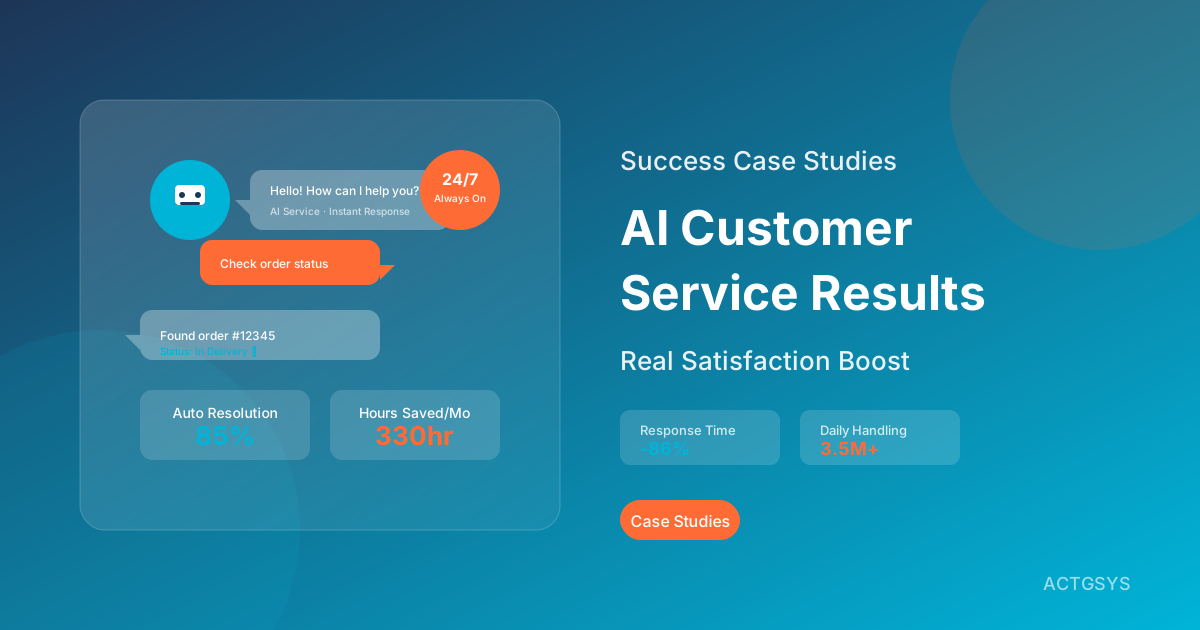
In-depth analysis of real AI customer service chatbot success cases. From a bank's chatbot handling 2.7M inquiries in six months to insurance companies saving 330 hours monthly, learn how to achieve 82% auto-resolution rate and 86% faster response times.
What is ERP? Guide to Inventory Management Systems for SMEs
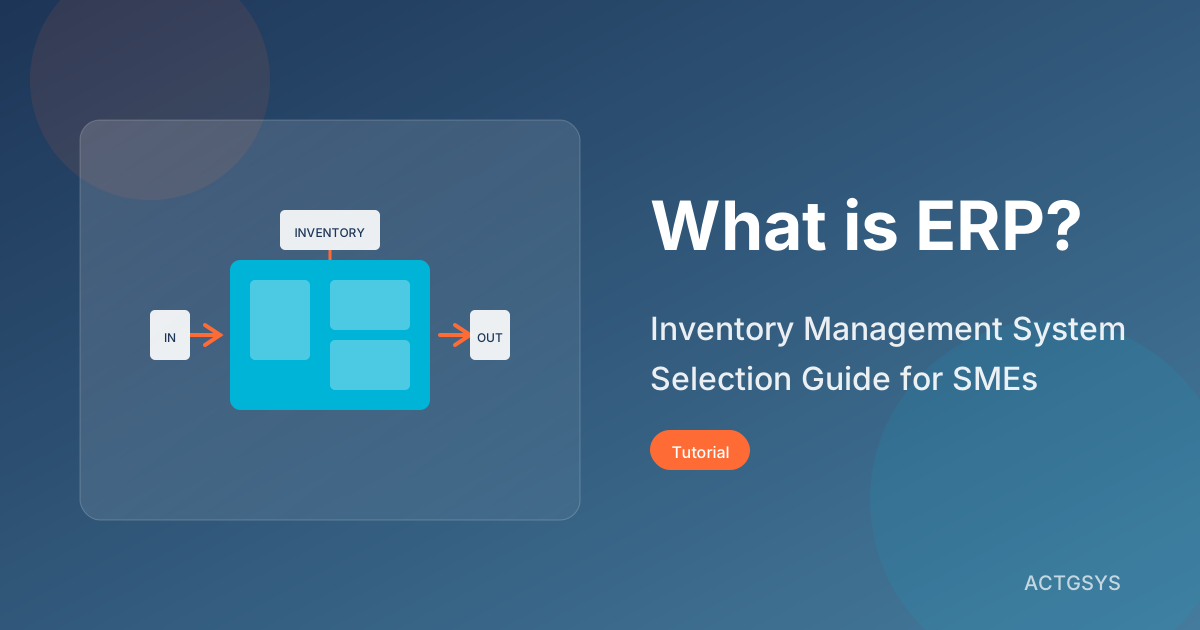
A comprehensive guide to ERP enterprise resource planning systems: from basic inventory management functions to implementation best practices. Learn how to select the right ERP system for your business and optimize inventory and order management.
AI Smart Procurement & Cost Optimization Guide
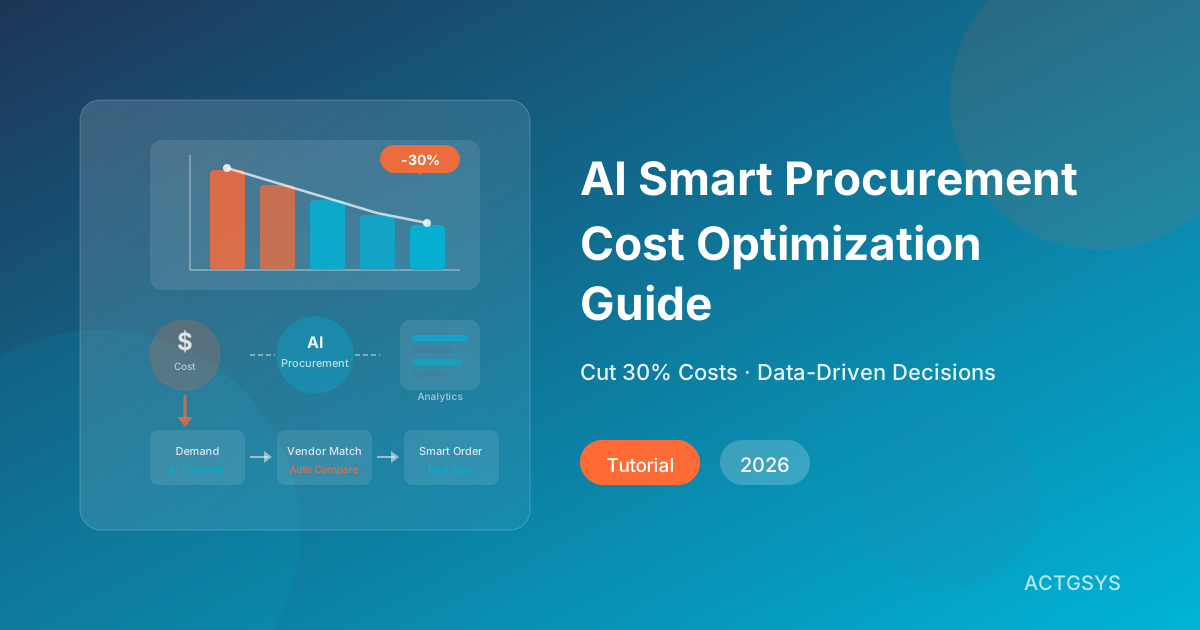
Learn how AI is transforming procurement for small and mid-sized businesses — from supplier evaluation to price prediction, with ROI models, implementation steps, and Dinkoko ERP integration.
What would this cost you?
Answer five questions. Within three working days you get a price range and what it covers. No deck, no follow-up sales calls.
Prefer to talk?LINE·02-2553-8084