Microsoft Agent 365 Goes Live (2026): AI Agent Governance Becomes the New Battleground for SMEs
Microsoft launched Agent 365 on May 1, 2026, a $15-per-user-per-month control plane that brings every AI agent inside a company under identity, permission, and audit management. For Taiwan SMEs, the signal is not "you must buy this product" — it is that AI agent governance has moved from an enterprise topic to a required step in any AI rollout.
What Did Microsoft Announce with Agent 365?
Microsoft moved Agent 365 to general availability (GA) on May 1, 2026, positioning it as "the control plane for enterprise AI agents." According to Microsoft's official Security Blog (2026), Agent 365 is not a tool for building AI agents — it is a security layer for registering, governing, and protecting every AI agent already running inside an organization.
On pricing, Agent 365 sells as a standalone license at $15 per user per month and does not require any other plan to use. It is also bundled into the new Microsoft 365 E7 suite at $99 per user per month, alongside M365 E5, Microsoft 365 Copilot, and the Entra Suite.
Notably, not every capability shipped at GA. According to Microsoft, security posture management for Foundry and Copilot Studio agents, plus runtime threat protection via the "Agent 365 tools gateway," remained in public preview at launch. In short, the governance backbone is ready, but some advanced protections are still on the way.
What Are the Key Features of Agent 365?
Agent 365's core idea is to extend "the way you manage people" to "managing AI agents." It turns scattered, unaccountable agents into objects that IT and security teams can centrally observe and control. Key features include:
- Entra Agent ID — extends Microsoft's Entra ID identity service to AI agents, so each agent has its own identity.
- Agent registry — a central inventory in the Microsoft 365 admin center that lists every agent in the organization.
- Access control — granular settings for which data and systems each agent can reach.
- Audit and compliance — behavior logs through Microsoft Purview to stay audit-ready.
- Lifecycle management — central control from creation and authorization through to retirement.
Microsoft's pitch is blunt: once a company runs dozens or hundreds of AI agents, simply "not knowing which agents exist and what data they can touch" is itself the biggest security risk.
How Does Agent 365 Differ From DIY Agent Management?
The biggest difference is visibility and identity — with DIY management you often do not know how many AI agents are running, while Agent 365 turns each agent into an identifiable, auditable object. The table below compares the two:
| Dimension | DIY Management | Governed with Agent 365 |
|---|---|---|
| Agent inventory | Scattered across teams, no full picture | Central registry, all agents at a glance |
| Identity management | Often shared API keys or human accounts | Each agent has its own Entra Agent ID |
| Permission control | All-or-nothing, hard to scope | Granular control of accessible data and tools |
| Audit trail | Hard to trace which agent caused an issue | Full behavior logs retained in Purview |
| Cost | Zero on paper, high hidden risk | $15 per user per month |
| Best fit | Few agents, simple trials | Agents in production, used across teams |
For a small company running only one or two AI agents, DIY management still works. But once agents touch customer data, financial data, or take outward-facing actions, the lack of identity and audit becomes a real compliance and security gap.
What Do Developers and the Industry Think?
Industry reaction blends anticipation with skepticism — a healthy sign for a brand-new product category. VentureBeat (2026) framed Microsoft's pitch around ungoverned AI agents potentially becoming corporate "double agents" — agents that hold access rights but answer to no one.
Community discussion is more blunt. On Reddit's r/AI_Agents, reaction to Agent 365 split between "finally, someone is addressing this" and "is this just Defender rebranded?" Third-party reviews also flagged a practical gap: if you buy Agent 365 specifically to harden agents against prompt injection or data exfiltration, you will find those protections still in preview at GA.
The timing is no surprise from an analyst lens. Gartner predicts that by 2028, 33% of enterprise software applications will include agentic AI, up from less than 1% in 2024 (Gartner, 2024). When agent counts grow that fast, demand for governance tooling is inevitable rather than hype.
To be honest: Agent 365 is a "governance layer," not a silver bullet. It solves "can you see and control your agents," not "is each agent itself secure" — two questions that must be evaluated separately.
What Does This Mean for Taiwan SMEs?
For Taiwan SMEs, the real signal of Agent 365's launch is not "you should buy this product" — it is that AI agent governance is now unavoidable. According to McKinsey & Company's "State of AI" survey, more than 70% of organizations have already adopted AI in at least one business function (McKinsey, 2025). As those AI systems gain autonomous action, governance shifts from optional to required.
Concretely, SMEs hit this issue in three places:
- In the CRM — when an AI agent can auto-reply to customers and update opportunities, it holds personal data. Who authorized it, and what it did, must leave a trace.
- In the ERP — when an AI agent can issue purchase orders or adjust inventory, a single bad instruction can cause real loss if its permission boundary is loose.
- In cross-system integration — as agents move between CRM, ERP, and LINE, the worst case is "nobody knows what permissions they have."
This is exactly the principle ACTGSYS emphasizes when helping clients adopt DanLee CRM and Dinkoko ERP: AI agents must have "identity, boundaries, and a record" from day one. Agent 365's launch is, in effect, Microsoft endorsing that principle.
Opportunity and risk coexist. The opportunity: mature governance tooling means SMEs can place AI agents into production flows with more confidence. The risk: if you already run agents with no governance at all, technical debt is starting to accumulate right now.
ACTGSYS Recommendation: What Should You Do Now?
Taiwan SMEs do not need to panic about Agent 365 — but they do need to act. Below we separate "do now" from "wait and see":
Do now:
- Inventory your existing AI agents — list every AI automation and agent running, and record what data each can access.
- Check identities and keys — confirm no agent shares a human account or exposes a bare API key, the most common gap.
- Set permission boundaries — for every agent touching customer or financial data, define clearly "what it can and cannot do."
- Build behavior logs — ensure every agent's key actions are logged and reviewable, regardless of which vendor you use.
Wait and see:
- Hold off on buying Agent 365 immediately — if you are not a heavy Microsoft 365 user and agent counts are still low, apply governance principles with existing tools first, then re-evaluate once advanced protections leave preview.
Frequently Asked Questions
Is Microsoft Agent 365 available in Taiwan?
Yes. Agent 365 is part of the Microsoft 365 cloud, so Taiwan businesses can use it through an existing Microsoft 365 subscription or a standalone license. Before adoption, confirm your tenant settings and data residency needs, and assess whether you need Microsoft Entra and Purview alongside it.
How much does Agent 365 cost?
Agent 365's standalone license is $15 per user per month and requires no other plan. It is also included in the new Microsoft 365 E7 suite at $99 per user per month, which bundles M365 E5, Microsoft 365 Copilot, and the Entra Suite.
Do SMEs need an AI agent governance tool right now?
It depends on agent count and permissions. If you run only one or two internal-only agents, process and discipline can carry governance. But if agents already touch personal data, financial data, or can act externally, governance is required — though you can start with a lightweight setup.
Will Agent 365 make my AI agents more secure?
Partly. Agent 365 provides a governance layer — identity, permissions, audit — so you can see and control agents. But protection of the agents themselves against attacks like prompt injection remained partly in preview at the May 2026 launch, so governance and protection must be assessed separately.
Conclusion
Microsoft Agent 365's launch marks AI agents moving from "can we use them" to "how do we manage them." For Taiwan SMEs, the real homework is not rushing to buy a tool — it is building identity, boundaries, and records for the AI agents you already run, so AI moves fast and stays controlled across CRM, ERP, and daily workflows.
Want to assess your company's AI agent governance posture, or get governance right from the start when adopting DanLee CRM or Dinkoko ERP? Contact ACTGSYS — we help SMEs roll out AI that is both fast and safe.
Event date: May 1, 2026 (Microsoft Agent 365 general availability). Last updated: May 20, 2026.
Products & Solutions in This Article
AI-powered CRM for lead management, customer tracking, and sales pipeline optimization designed for SMEs.
AI-driven ERP focusing on procurement, inventory, and supply chain management. Each customer deployed on dedicated cloud infrastructure.
Related Articles
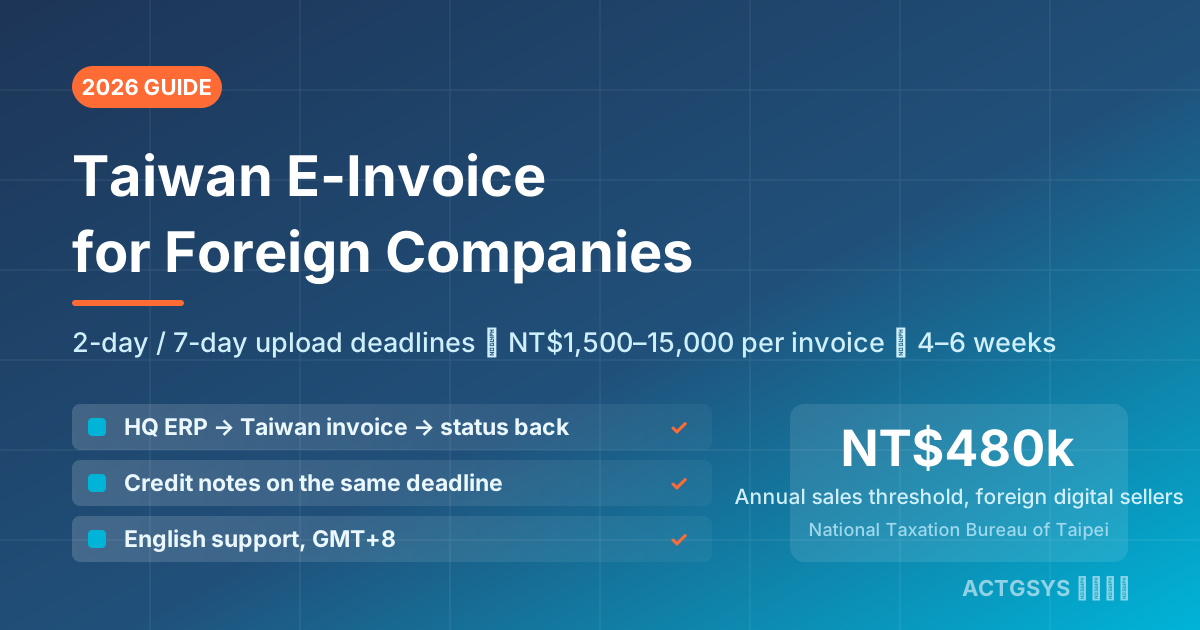
Taiwan E-Invoice for Foreign Companies 2026 - Cost
How a foreign-owned Taiwan subsidiary or branch connects its ERP to Taiwan's e-invoice platform: 2-day B2C / 7-day B2B upload deadlines, NT$1,500–15,000 per-invoice penalties, three integration paths, and a 4–6 week project from NT$50,000.
Coralogix Raises $200M at a $1.6B Valuation (2026)
Monitoring startup Coralogix announced a $200M Series F round on June 3, 2026, reaching a $1.6B post-money valuation, led by Advent and the Canada Pension Plan Investment Board — a bet that as enterprises deploy AI agents en masse, someone needs to watch whether they're doing the right thing. This article explains, from an SME perspective, why AI agent observability is something to figure out before deploying AI automation.
Anthropic Agent Skills as an Open Standard + Enterprise-Managed MCP Auth (2026): Wiring Claude into Stripe, Zapier, and Figma
In June 2026 Anthropic turned Agent Skills into an open standard, launching with 10 partners (including Atlassian, Figma, Canva, Stripe, Zapier), and on June 18 shipped Enterprise-Managed Authorization (EMA) for MCP connectors so IT admins can provision connectors org-wide via Okta. Here's what it means for 'wiring AI into your existing tools' and how Taiwan SMEs should adopt it.
What would this cost you?
Answer five questions. Within three working days you get a price range and what it covers. No deck, no follow-up sales calls.
Prefer to talk?LINE·02-2553-8084