Multi-Agent AI Systems: Enterprise Deployment Guide for 2026
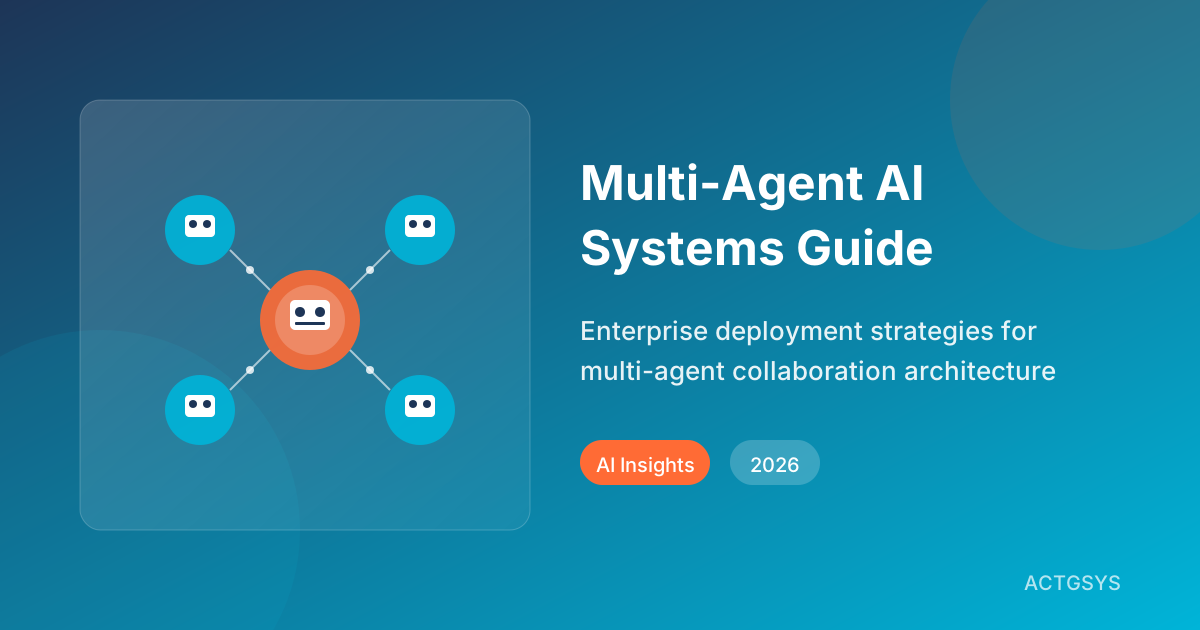
When a single AI assistant can no longer meet the complex business needs of enterprises, Multi-Agent AI systems are becoming the key technology for digital transformation in 2026. Imagine this scenario: a customer service AI receives a customer inquiry, automatically forwards order queries to an ERP AI, while simultaneously notifying a CRM AI to update customer interaction records—this is the power of multi-agent collaboration.
What is a Multi-Agent AI System?
A Multi-Agent AI system is a collaborative network composed of multiple AI agents, each with specific expertise. Each agent is responsible for a particular task domain, communicating through standardized protocols to collaborate and complete complex business processes together.
Compared to traditional single AI assistants, Multi-Agent systems offer several advantages:
| Feature | Single AI Assistant | Multi-Agent System |
|---|---|---|
| Expertise Depth | Generalist with shallow understanding | Each agent specializes in specific domain |
| Scalability | Difficult to scale, requires retraining | Can add specialist agents anytime |
| Fault Tolerance | Single point of failure affects everything | One agent failure doesn't affect the whole |
| Maintenance Cost | Updates require full adjustment | Can optimize individual agents |
| Complexity Handling | Suitable for simple linear tasks | Can handle multi-step parallel tasks |
Core Architecture Components of Multi-Agent Systems
A complete Multi-Agent system typically includes:
- Orchestrator: Responsible for task distribution and process control
- Specialist Agents: Dedicated AI for customer service, sales, finance, etc.
- Communication Layer: Message passing mechanism between agents
- Knowledge Base: Shared enterprise data and business rules
Why 2026 is the Critical Year for Multi-Agent?
According to Google Cloud research, 40% of enterprise applications will embed task-specific AI agents by 2026, a significant increase from less than 5% in 2024. Several key drivers are behind this trend:
Maturity of MCP Protocol
The widespread adoption of Model Context Protocol (MCP) enables standardized communication between different AI systems. Enterprises are no longer limited to a single vendor's AI ecosystem and can mix AI agents from different providers.
Rise of Low-Code Platforms
Platforms like Zapier, Make, and n8n now support Multi-Agent workflow design, allowing non-technical staff to build complex AI collaboration processes.
Improved Cost Efficiency
Rather than investing in one "omnipotent" large AI model, deploying multiple small specialized models is more cost-effective. According to IBM analysis, Multi-Agent architecture can reduce AI computing costs by 30-50%.
Five Enterprise Multi-Agent Deployment Scenarios
Scenario 1: Intelligent Customer Service Ecosystem
Participating Agents:
- Intent Recognition Agent: Analyzes customer query types
- Customer Response Agent: Handles general inquiries
- Order Query Agent: Connects to ERP for order status
- Escalation Agent: Determines if human intervention is needed
Benefits: 60% reduction in handling time, first contact resolution rate increased to 85%
Scenario 2: Sales Process Automation
Participating Agents:
- Lead Scoring Agent: Scores potential customers
- Quote Generation Agent: Automatically generates quotes
- Contract Review Agent: Checks contract terms
- CRM Update Agent: Synchronizes customer data
Benefits: 40% shorter sales cycle, sales staff can focus on high-value customers
Scenario 3: Financial Operations Automation
Participating Agents:
- Invoice Recognition Agent: OCR processing of paper invoices
- Accounting Entry Agent: Automatic journal entry creation
- Anomaly Detection Agent: Identifies suspicious transactions
- Report Generation Agent: Automatic financial report creation
Benefits: Month-end closing reduced from 5 days to 1 day
Scenario 4: Supply Chain Collaborative Management
Participating Agents:
- Demand Forecasting Agent: Analyzes sales trends
- Inventory Management Agent: Monitors stock levels
- Procurement Suggestion Agent: Auto-generates purchase orders
- Supplier Communication Agent: Sends automatic inquiries
Benefits: 25% improvement in inventory turnover, 70% reduction in stockouts
Scenario 5: HR Recruitment Process
Participating Agents:
- Resume Screening Agent: Initial filtering of candidates
- Interview Scheduling Agent: Automatic time coordination
- Background Check Agent: Verifies applicant information
- Offer Notification Agent: Sends offers and tracks responses
Benefits: Recruitment cycle reduced from 45 to 20 days
Technical Architecture Design for Multi-Agent Systems
Architecture Pattern Comparison
| Architecture Pattern | Description | Use Case | Complexity |
|---|---|---|---|
| Master-Slave | Central coordinator assigns tasks | Fixed workflow processes | Low |
| Peer-to-Peer | Agents communicate directly | High flexibility scenarios | High |
| Hierarchical | Multi-level management structure | Cross-department collaboration | Medium |
| Hybrid | Combines advantages of multiple patterns | Complex business processes | High |
Communication Protocols Between Agents
Current mainstream communication protocols include:
- MCP (Model Context Protocol): Open standard promoted by Anthropic
- A2A (Agent-to-Agent): Agent communication specification proposed by Google
- LangGraph: Multi-agent framework in the LangChain ecosystem
State Management and Error Handling
Multi-Agent systems require robust state management mechanisms:
- Checkpoints: Periodically save execution state
- Rollback Mechanism: Return to last stable state when errors occur
- Retry Policy: Automatic retry for failed tasks
- Graceful Degradation: Fallback solutions when partial functions fail
How Can SMEs Start Implementing Multi-Agent?
Step 1: Audit Existing Processes
Identify the most time-consuming and repetitive business processes, such as:
- Answering routine customer service questions
- Daily report compilation
- Order status queries and notifications
Step 2: Choose the Right Platform
For resource-limited SMEs, consider starting with these platforms:
| Platform | Features | Price Range |
|---|---|---|
| Make (Integromat) | Visual workflow design, AI modules | Free tier available |
| n8n | Open source self-hosted, highly customizable | Free (self-hosted) |
| Zapier + AI | Best integration, low learning curve | From $20/month |
Step 3: Start Small
Build a small system with 2-3 agents first, validate the benefits, then gradually expand. For customer service scenarios:
- First build an "Intent Recognition Agent"
- After success, add a "FAQ Response Agent"
- Finally integrate a "Human Handoff Agent"
Step 4: Establish Monitoring
Multi-Agent systems require comprehensive monitoring:
- Response time for each agent
- Task success rate and failure reasons
- Message traffic between agents
- Overall process completion time
Case Study: Multi-Agent in Manufacturing
Background: A mid-sized manufacturer with annual revenue of approximately $10 million USD, facing low order processing efficiency.
Implemented Multi-Agent System:
-
Order Receiving Agent
- Integrates orders from website, email, LINE, and other channels
- Automatically parses order content into standard format
-
Inventory Check Agent
- Real-time ERP inventory queries
- Determines if order can be accepted or needs production scheduling
-
Quote Calculation Agent
- Automatically calculates prices based on customer tier and quantity
- Applies current promotional campaigns
-
Notification Agent
- Sends quote confirmation to customers
- Alerts sales staff of new orders
Results:
- Order processing time reduced from 4 hours to 15 minutes
- Quote error rate dropped from 8% to 0.5%
- Customer satisfaction increased by 35%
FAQ
Q1: Do Multi-Agent systems require a lot of technical staff?
Not necessarily. Many low-code platforms like Make and Zapier allow non-technical staff to build Multi-Agent workflows. However, for high customization or sensitive data handling, working with professional teams is recommended.
Q2: What's the difference between Multi-Agent and RPA?
RPA (Robotic Process Automation) is suitable for rule-based repetitive tasks like data entry and report downloads. Multi-Agent AI can handle complex tasks requiring "judgment," such as understanding natural language and making decisions. Both can be used complementarily.
Q3: How much does Multi-Agent implementation cost?
It depends on scale. Small businesses using SaaS platforms might spend $100-300/month. Medium enterprises requiring custom integration might invest $15,000-50,000 initially. ROI is typically achieved within 6-12 months.
Q4: How is data security ensured?
Choose solutions that support private deployment, or ensure SaaS providers have SOC 2, ISO 27001, or similar security certifications. For sensitive data processing, consider internally deployed open-source models.
Q5: Can existing CRM and ERP systems be integrated?
Yes. Mainstream CRM (like DanLee CRM) and ERP (like Dinkoko ERP) provide API interfaces that can connect with Multi-Agent systems. This is one of our key focus areas when helping clients.
Conclusion: Start Planning Your Multi-Agent Strategy Today
Multi-Agent AI is no longer science fiction—it's an essential capability for enterprise competition in 2026. From customer service and sales to finance and supply chain, multi-agent collaboration is redefining the standards for operational efficiency.
Whether you're an SME just starting to explore AI or a growing company looking to upgrade existing AI applications, now is the perfect time to plan your Multi-Agent strategy.
Want to learn how to apply Multi-Agent architecture to your business processes?
The ACTGSYS team has extensive experience in AI system integration and can help you:
- Assess the AI automation potential of your existing processes
- Design Multi-Agent architecture suitable for your enterprise
- Integrate with existing CRM and ERP systems
👉 Schedule a Free Consultation and let's build your intelligent enterprise blueprint together!
Products & Solutions in This Article
AI-powered CRM for lead management, customer tracking, and sales pipeline optimization designed for SMEs.
AI-driven ERP focusing on procurement, inventory, and supply chain management. Each customer deployed on dedicated cloud infrastructure.
Related Articles
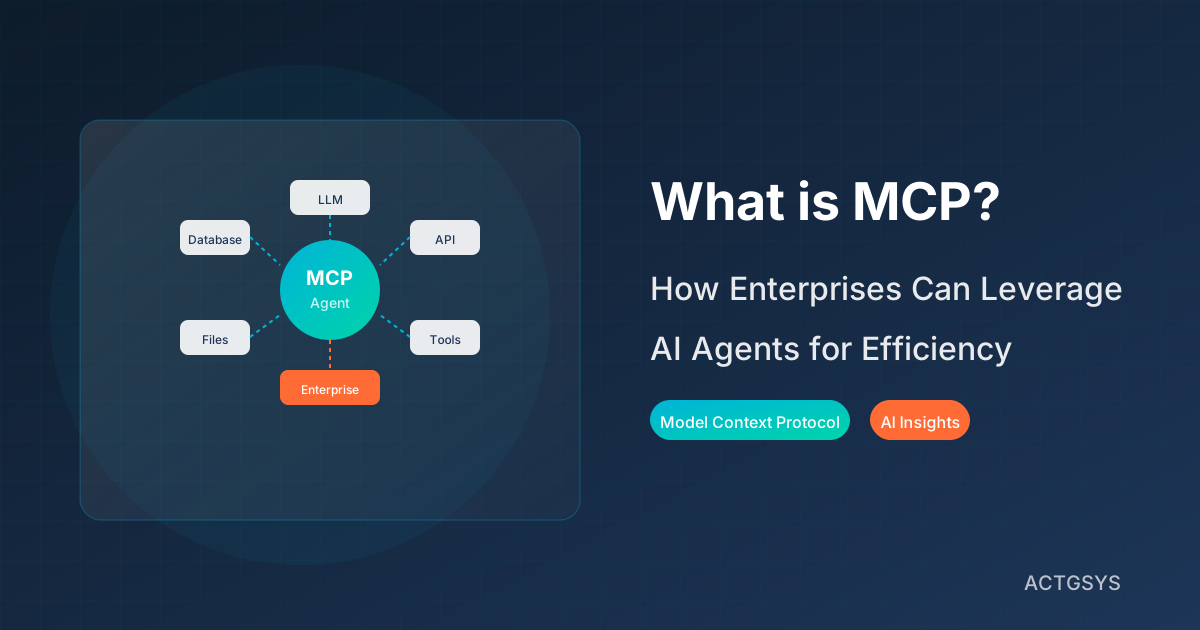
What Is MCP? Enterprise AI Agents Explained
An in-depth explanation of Model Context Protocol (MCP), and how enterprises can implement AI Agent architectures for cross-system integration, automated workflows, and intelligent decision support.
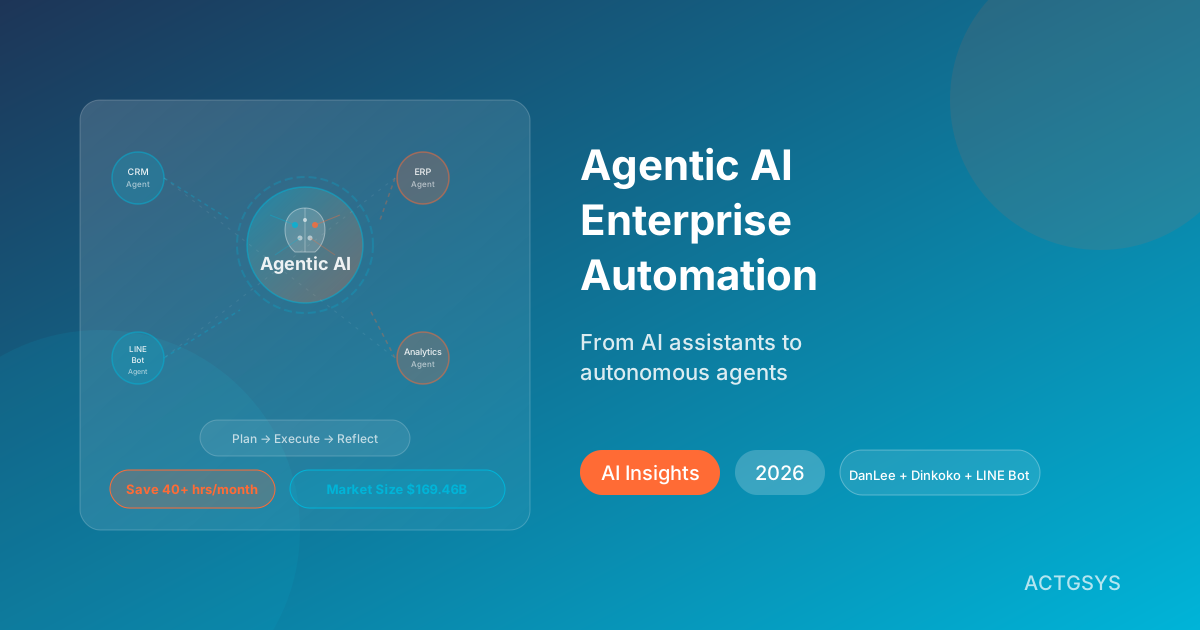
Agentic AI 2026: From Assistants to Autonomy
Deep dive into how Agentic AI surpasses traditional AI assistants with multi-agent orchestration, autonomous decision-making, and end-to-end process automation — helping SMEs save 40+ hours per month and dramatically boost operational efficiency.
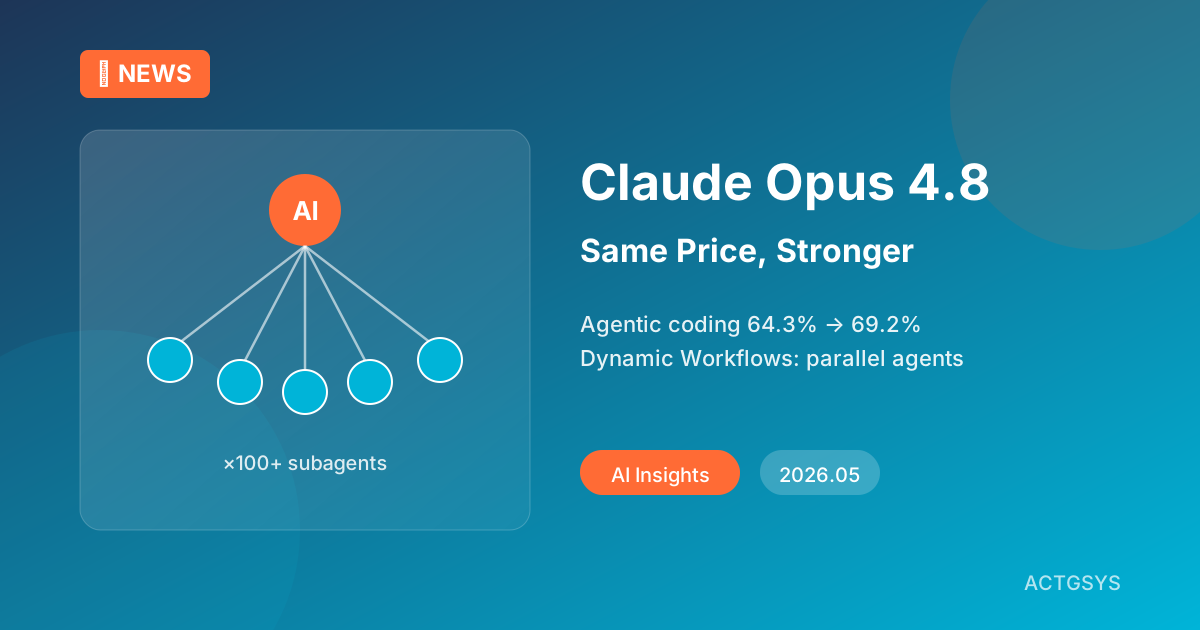
Anthropic Claude Opus 4.8 (2026): Same Price, Stronger
On May 28, 2026, Anthropic launched Claude Opus 4.8, holding the same $5 / $25 per 1M token pricing as its predecessor while lifting agentic coding from 64.3% to 69.2% and adding Dynamic Workflows — a research preview that orchestrates hundreds of parallel subagents. We unpack what this upgrade means for Taiwan SME automation.
What would this cost you?
Answer five questions. Within three working days you get a price range and what it covers. No deck, no follow-up sales calls.
Prefer to talk?LINE·02-2553-8084