OpenAI Brings Codex to 'Every Role' (2026)
On June 2, 2026, OpenAI announced a major Codex update that expands the once engineer-only tool into a productivity platform for "every role" — adding six role-specific plugins, Sites that turn data into shareable internal apps, and Annotations to edit results directly inside documents and spreadsheets. For SMEs, the headline isn't "another coding AI" — it's that salespeople, marketers, and analysts who can't code can now assemble internal tools and dashboards with AI themselves.
What Did OpenAI Change in Codex?
On June 2, 2026, OpenAI announced a role-oriented Codex update that turns Codex from a "code generation tool" into a "general work platform for every role." According to OpenAI's official announcement (2026), the update has three parts: plugins that adapt to your role, annotations that refine results in place, and Sites that turn static data and documents into shareable web-hosted apps.
The shift in user mix is notable: per OpenAI, non-developers (analysts, marketers, operators, designers, researchers, investors) now make up about 20% of Codex users and are growing more than 3x as fast as developers (VentureBeat, 2026). "AI that writes code" is spilling over into "AI that does work for every role."
- Announcement date: June 2, 2026
- Role plugins: first six — Data Analytics, Creative Production, Sales, Product Design, Public Equity Investing, Investment Banking; bundling 62 popular apps and 110 automated skills
- Codex Sites: turns data inputs or documents into interactive internal apps shareable via URL; preview on Business and Enterprise tiers
- Annotations: extended to documents, spreadsheets, and slides; mark corrections directly on results
- Roadmap: five more roles named, including Marketing Strategy and Legal
What Are the Key Breakthroughs in This Codex Update?
The core of this update is "moving AI agents out of the developer's terminal and into everyday employee workflows."
- Role plugins lower the learning curve — plugins pre-wire each role's common apps and skills, so users don't stitch toolchains together and can prompt against their own work context out of the box.
- Sites turn "reports" into "tools" — internal mini-apps that used to require an engineer (a query UI, an interactive dashboard) can now be generated from data or documents and shared via URL.
- Annotations make fixes intuitive — no need to re-prompt entire passages; mark the spots to change directly on documents, spreadsheets, and slides, matching how non-engineers actually work.
- Expanding coverage — from technical roles to sales, investing, and soon marketing and legal, aiming for "a dedicated Codex for every role."
How Does the Role-Oriented Codex Differ From the Original?
The most useful comparison for SMEs is Codex's repositioning "before vs after" roles:
| Dimension | Original Codex | Role-Oriented Codex |
|---|---|---|
| Primary users | Engineers / developers | Every role (sales, analytics, marketing) |
| How it's used | Write and edit code | Prompt against work context via role plugins |
| Outputs | Code, scripts | Internal tools, interactive web apps, edited docs |
| Editing | Change prompt / code | Mark corrections in place with Annotations |
| Sharing | Code repository | Share via URL with Codex Sites |
| Plan fit | Dev subscription | Business / Enterprise (Sites preview) |
(Sources: OpenAI official announcement (2026), VentureBeat (2026).)
The key takeaway: Codex shifts from "help engineers write code" to "help every role turn ideas into usable tools." For SMEs short on IT staff, that shift is often more practical than a few more benchmark points on the model itself.
What Do Developers and the Industry Think?
The community's focus is on the trend of AI tools spilling from developers to general knowledge workers.
Positives center on "non-engineers self-serving" — many note that Sites and role plugins lower the barrier to "build a small internal tool": work that used to queue behind IT can now be assembled by a salesperson or analyst, which is appealing for stretched teams (VentureBeat, 2026).
Reservations center on governance and quality — when everyone can spin up internal tools with AI, companies must watch who can access which data, whether AI-generated tools are reviewed, and whether a pile of unmaintained "shadow tools" emerges. Lower barriers bring productivity — and a governance challenge.
In the bigger picture, this aligns with Gartner's direction of travel: as AI agents enter daily workflows, competitiveness depends more on whether employees can self-serve with AI than on headcount. It's consistent with OpenAI's framing of Codex for knowledge work (2026) — AI is becoming an all-staff productivity tool, not a developer-only one.
What Does This Mean for Taiwan's SMEs?
For Taiwan's SMEs, the most direct meaning is: building internal tools without IT staff just got easier. But "everyone can self-serve" also means "everyone can access data," so governance must keep up.
Opportunities:
- Internal tools no longer queue behind IT — sales, analytics, and marketing can assemble query UIs and interactive reports with role plugins and Sites, speeding up daily work.
- Automate repetitive reports — weekly reports, customer lists, and sales rollups can be generated from data into shareable tools, cutting manual copy-paste.
- Lower the cost of "small custom systems" — many internal mini-apps once outsourced can now be prototyped in Codex Sites to validate need before formal development.
- AI literacy becomes a team advantage — employees who self-serve with AI pull clearly ahead on productivity.
But be pragmatic about three things:
- Set data permissions first — before letting staff self-serve, clarify which data can be connected and which can't, to avoid leaking sensitive data.
- Guard against shadow-tool sprawl — self-generated tools left untracked and unmaintained become a security and data-accuracy hazard; set up a simple registry and review.
- Role plugins skew Western — the first six (including Investment Banking, Public Equity Investing) may not fit Taiwan SMEs; the practical value concentrates in general roles like Data Analytics, Sales, and Creative Production.
In practice: your core operational data should still live in permission-controlled systems like DanLee CRM and Dinkoko ERP, with tools like Codex Sites positioned as a front end for "quick prototypes, query UIs, one-off analyses." Formal, long-lived features touching core data still warrant governed system development.
ACTGSYS Recommendations: What Should You Do Now?
For SMEs, the Codex role update is a "self-serve productivity upgrade" — worth trying, with governance attached.
Do now:
- Pilot one high-frequency, low-risk use case — e.g., turn a weekly report you compile by hand into a shareable Codex Sites tool and measure time saved.
- Define the connectable data scope first — before opening self-service, list which data is allowed and which is off-limits, and set permissions.
- Set up a simple tool registry — log any self-generated tool used by multiple people and assign an owner to prevent unmaintained shadow tools.
Hold off:
- Don't replace core systems with Sites — CRM/ERP features touching core data and long-term ops still warrant governed formal development.
- Don't force-fit irrelevant role plugins — the first roles skew toward Western finance; skip the ones unrelated to your business and focus on general roles.
Frequently Asked Questions
Can OpenAI Codex's role plugins and Sites be used in Taiwan?
Yes. The update has been available to users on the relevant OpenAI plans since June 2, 2026, with Codex Sites rolling out in preview on Business and Enterprise tiers. Taiwanese businesses subscribed to those plans can use it. Available features depend on your subscription tier.
Can employees who can't code really build internal tools with Codex?
They can produce "small tool"–level results. Role plugins pre-wire common apps and skills, and Sites turns data or documents into shareable interactive apps via URL, so non-engineers can generate them by describing needs in natural language. Complex, long-lived systems touching core data still warrant formal development.
Are tools built with Codex Sites secure? Will data leak?
Security depends on your setup and governance. Which data a Sites tool can connect to is determined by your enterprise permissions. Before opening self-service, define the connectable data scope and set up a tool registry and review to avoid sensitive data being connected or leaked unintentionally.
Should SMEs roll out Codex company-wide now?
Not company-wide, but worth piloting. Start with one or two high-frequency, low-risk use cases (e.g., weekly-report automation, an internal query UI), validate time savings and governance feasibility, then expand. Core operational systems should remain in permission-controlled CRM/ERP.
Conclusion
OpenAI bringing Codex to "every role" marks AI agents moving from the developer's terminal into everyday employee workflows. For Taiwan's SMEs, the right response isn't "everyone uses it immediately" — it's: pilot one high-frequency, low-risk use case, define the connectable data first, and set up simple tool governance, turning "self-serve tool building" into controlled productivity rather than runaway shadow systems.
Want to plan which internal needs suit AI self-serve tools versus formal system development, and add a secure self-serve analytics layer on top of your CRM/ERP? Contact ACTGSYS — we help Taiwan's SMEs balance productivity and governance.
Event date: June 2, 2026 (OpenAI announces Codex role plugins and Sites). Last updated: June 19, 2026.
Products & Solutions in This Article
AI-powered CRM for lead management, customer tracking, and sales pipeline optimization designed for SMEs.
AI-driven ERP focusing on procurement, inventory, and supply chain management. Each customer deployed on dedicated cloud infrastructure.
Related Articles
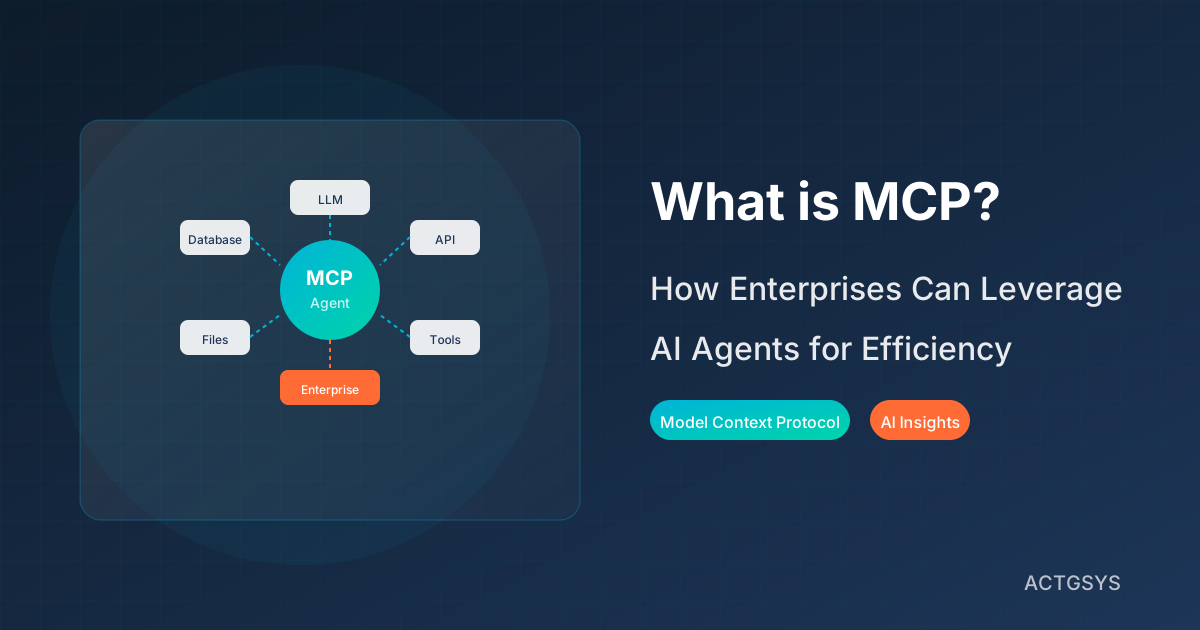
What Is MCP? Enterprise AI Agents Explained
An in-depth explanation of Model Context Protocol (MCP), and how enterprises can implement AI Agent architectures for cross-system integration, automated workflows, and intelligent decision support.
Snowflake CoCo and CoWork (2026): The Data Platform Grows Its Own AI Agents
At its June 2026 Summit, Snowflake made its data platform fully agentic: CoCo (formerly Cortex Code) became an autonomous development platform, CoWork is a personal agent for knowledge workers, and Snowflake claimed CoCo beats Claude Code on its own benchmark. This article unpacks the 'data-native agent' trend and how to read 'vendor self-run benchmarks' — and what it means for SMEs.
Mistral Rebrands Le Chat as Vibe, a Full 'Work Agent' (2026)
Mistral renamed its chatbot Le Chat to Vibe on May 28, 2026, unifying Work Mode and Code Mode so a single account connects to Google Workspace, Outlook, Slack, and GitHub to autonomously handle email, calendar, documents, and recurring processes. Here's what this European work agent means for SME automation.
What would this cost you?
Answer five questions. Within three working days you get a price range and what it covers. No deck, no follow-up sales calls.
Prefer to talk?LINE·02-2553-8084