OpenAI Realtime Voice Models Launch (May 2026): GPT-Realtime-2 Pushes AI Voice Support Past the Usability Line
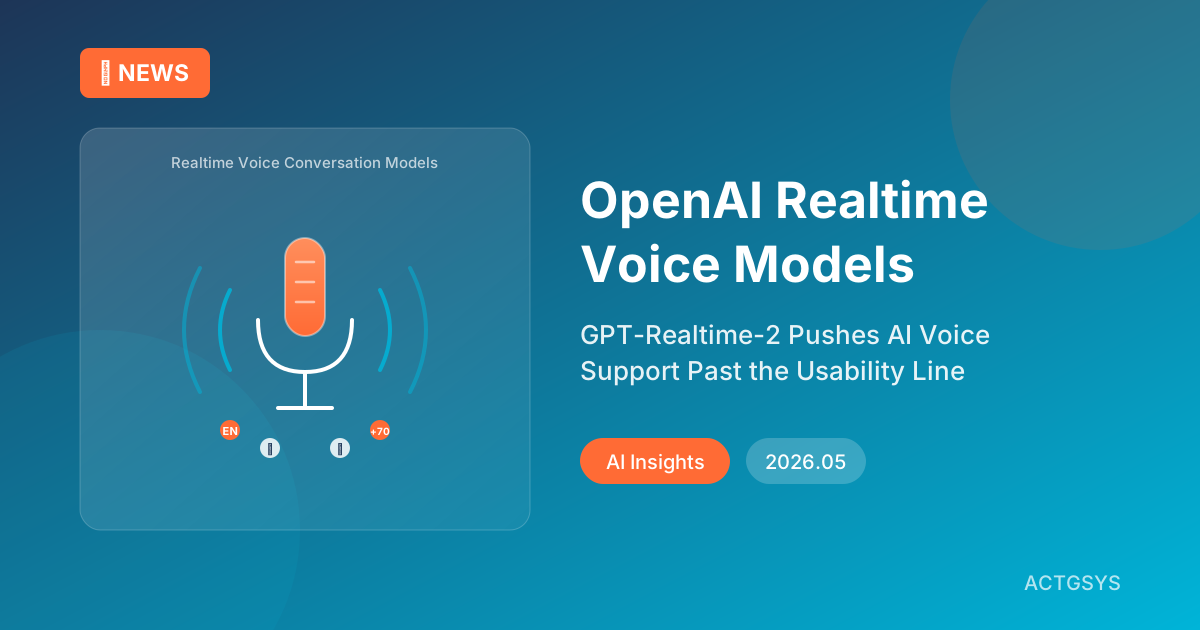
OpenAI launched GPT-Realtime-2, GPT-Realtime-Translate, and GPT-Realtime-Whisper on May 7, 2026, putting GPT-5-class reasoning directly inside the voice conversation loop. For Taiwan SMEs, AI voice support has crossed the usability line for the first time — it can now understand, handle multi-step tasks, and translate live. Whether to adopt it now still depends on your support scenario.
What Did OpenAI Announce With Its Realtime Voice Models?
OpenAI launched three new realtime voice models in the Realtime API on May 7, 2026 — GPT-Realtime-2, GPT-Realtime-Translate, and GPT-Realtime-Whisper. According to OpenAI's developer documentation (2026), all three are available directly in the Realtime API and Playground, so developers can integrate them into existing applications.
The biggest technical leap is GPT-Realtime-2: it places GPT-5-class reasoning directly into the audio pipeline. Older voice AI used a clunky three-stage architecture — transcribe, then think, then synthesize speech. GPT-Realtime-2 reasons inside the audio loop itself, can call multiple tools mid-conversation, and narrates progress in speech while it works — so users no longer hear awkward dead air during multi-step tasks.
On pricing, the three models are billed differently by use case: GPT-Realtime-2 is $32 per million audio input tokens and $64 per million audio output tokens, with cached input at $0.40 per million; GPT-Realtime-Translate is $0.034 per minute; GPT-Realtime-Whisper is $0.017 per minute.
What Can Each of the Three Voice Models Do?
The three models have clear roles — one handles conversation, one handles translation, one handles transcription — so companies can use them alone or in combination by scenario.
- GPT-Realtime-2 (conversation) — a voice model with GPT-5-class reasoning that handles complex requests, calls tools, and recovers after interruptions. It offers adjustable reasoning effort across five levels (minimal, low, medium, high, very high; default low), letting developers trade response speed against depth of thought.
- GPT-Realtime-Translate (translation) — a live multilingual translation model supporting more than 70 input languages and 13 output languages, built for cross-language real-time conversation.
- GPT-Realtime-Whisper (transcription) — a streaming speech-to-text engine focused on zero-latency transcription, suited to live captions and call records.
On performance, according to figures published by OpenAI, GPT-Realtime-2 improved from the prior generation's 81.4% to 96.6% on Big Bench Audio, and from 34.7% to 48.5% on Audio MultiChallenge (OpenAI, 2026). The context a single conversation can hold also quadrupled, from 32,000 to 128,000 tokens — meaning the AI remembers longer conversation history without "forgetting" mid-call.
How Does GPT-Realtime-2 Differ From the Old Voice Architecture?
The key difference is architecture — the old approach was a transcribe-think-synthesize relay, while GPT-Realtime-2 reasons inside the audio itself, with lower latency and a better grip on complex tasks. The table below compares the two:
| Dimension | Old three-stage voice architecture | GPT-Realtime-2 |
|---|---|---|
| Processing | Transcribe → think → synthesize speech | Reasons inside the audio loop |
| Multi-step tasks | Frequent dead air while running | Narrates progress in speech while running |
| Tool calls | Mostly single, passive | Can call multiple tools at once |
| Conversation context | About 32,000 tokens | 128,000 tokens (4x larger) |
| Interruptions | Hard to pick the thread back up | Recovers after interruption |
| Reasoning effort | Fixed | Five adjustable levels by scenario |
For SMEs, the table's takeaway is this: AI voice support can finally, like a human, "handle the unfinished question," "check several systems at once," and "pick the thread back up after being interrupted" — exactly the three pain points voice bots were most criticized for.
What Do Developers and the Industry Think?
Developers praised GPT-Realtime-2's "reasoning-in-voice" architecture but pragmatically flagged two realities. First, cost — at $64 per million audio output tokens, high-interaction voice apps are not cheap, and developers generally recommend using GPT-Realtime-Whisper ($0.017 per minute) for plain transcription and reserving the costly conversation model for scenarios that genuinely need reasoning.
Second, this is "incremental, not revolutionary." It is a continuity upgrade in the GPT-Realtime line, not a new category — it pushes voice AI past the "genuinely usable" line, but still needs sound conversation design and tool integration to deliver. Plugging it in does not make support better on its own.
The direction has clear commercial logic from an analyst lens. Gartner once estimated conversational AI could save contact centers roughly $80 billion in labor costs globally by 2026 (Gartner, 2022), and multiple McKinsey & Company studies consistently identify customer operations as one of the areas where generative AI concentrates the most value (McKinsey, 2025). Voice is the hardest part of customer operations to automate — and GPT-Realtime-2 targets exactly that gap.
What Does This Mean for Taiwan SMEs?
For Taiwan SMEs, the most direct meaning of this launch is that AI voice support and multilingual reception have moved from "looks good in a demo" to "worth modeling seriously." Three SME scenarios benefit most:
- Multilingual customer reception — tourism, food service, and retail often serve foreign visitors and migrant workers. GPT-Realtime-Translate supports 70+ input languages, so one voice line can communicate across languages without dedicated staff per language.
- After-hours and peak-time phone support — AI can handle booking queries, order status, and FAQs, leaving humans for genuinely complex cases.
- Call records and quality management — GPT-Realtime-Whisper turns every call into text at very low cost, so owners can finally "see" the content and quality of phone support.
For these scenarios to deliver real value, the key is that voice AI must connect into your systems. Voice support can look up an order only via ERP integration; it can recognize a VIP customer only via CRM integration. This is the core value ACTGSYS brings when helping clients integrate DanLee CRM with voice and LINE Bot channels — however strong the model, without access to your customer and order data it is just a "chatty bot."
Be honest about the risk too: if voice support quotes a wrong price or makes a wrong promise, the impact is immediate. In early adoption, set clear "can answer / cannot answer" boundaries and keep a human handoff.
ACTGSYS Recommendation: What Should You Do Now?
For OpenAI's new voice models, Taiwan SMEs should "pilot in a small scope, confirm ROI, then scale." Below we separate "do now" from "wait and see":
Do now:
- Inventory your phone support pain points — tally which calls are repetitive (bookings, order lookups, opening hours); these are what AI voice support should take over first.
- Pilot in low-risk scenarios — start with "inquiry-type" calls and avoid high-risk "quoting and promising" conversations.
- Use transcription to cut cost first — if you are not ready for live conversation, deploy GPT-Realtime-Whisper to turn calls into text and gain support-quality data immediately.
- Confirm system integration — before adoption, verify voice AI can read your CRM and order data, or the value drops sharply.
Wait and see:
- Hold off on fully replacing human agents — this is an incremental upgrade, not the end of human support. Let AI and humans split work, scale gradually on real data, and always keep a human handoff.
Frequently Asked Questions
Is GPT-Realtime-2 available in Taiwan?
Yes. The three models are offered through OpenAI's Realtime API, so Taiwan developers and businesses can call them directly. When adopting, assess data transfer and personal-data protection needs, and integrate your CRM and support systems through a familiar integration partner.
How much does AI voice customer service cost to deploy?
Model fees depend on usage: GPT-Realtime-2 is $64 per million audio output tokens, and GPT-Realtime-Whisper transcription is $0.017 per minute. But the real cost usually lies in system integration and conversation design, not model fees — pilot in a small scope first to find your true unit cost.
Should SMEs adopt AI voice customer service right now?
If you have many repetitive calls (bookings, order lookups, opening info), now is a worthwhile time to pilot. Start with low-risk inquiry scenarios, confirm ROI, then scale, and keep a human handoff. Leave quoting and promising conversations to humans first.
Can GPT-Realtime-Translate really replace human translators?
For live spoken communication, GPT-Realtime-Translate supports 70+ input languages and greatly lowers the staffing bar for cross-language reception. But formal documents and legal contracts that demand high precision should still be checked by professional translators; AI translation suits real-time, interactive, fault-tolerant scenarios.
Conclusion
OpenAI's realtime voice model launch pushes AI voice support from "showpiece" to "operable tool." For Taiwan SMEs, the real opportunity lies in multilingual reception and automating repetitive calls — provided the voice AI connects into your CRM and order systems and starts from low-risk scenarios.
Want to assess your AI voice support or multilingual reception scenarios and integrate voice AI with DanLee CRM and LINE channels? Contact ACTGSYS — we help SMEs take AI support from pilot to real savings in staff time and effort.
Event date: May 7, 2026 (OpenAI realtime voice models launch). Last updated: May 20, 2026.
Products & Solutions in This Article
AI-powered CRM for lead management, customer tracking, and sales pipeline optimization designed for SMEs.
Intuitive accounting system designed for Taiwan SMEs, with automated bookkeeping and financial reporting.
Related Articles
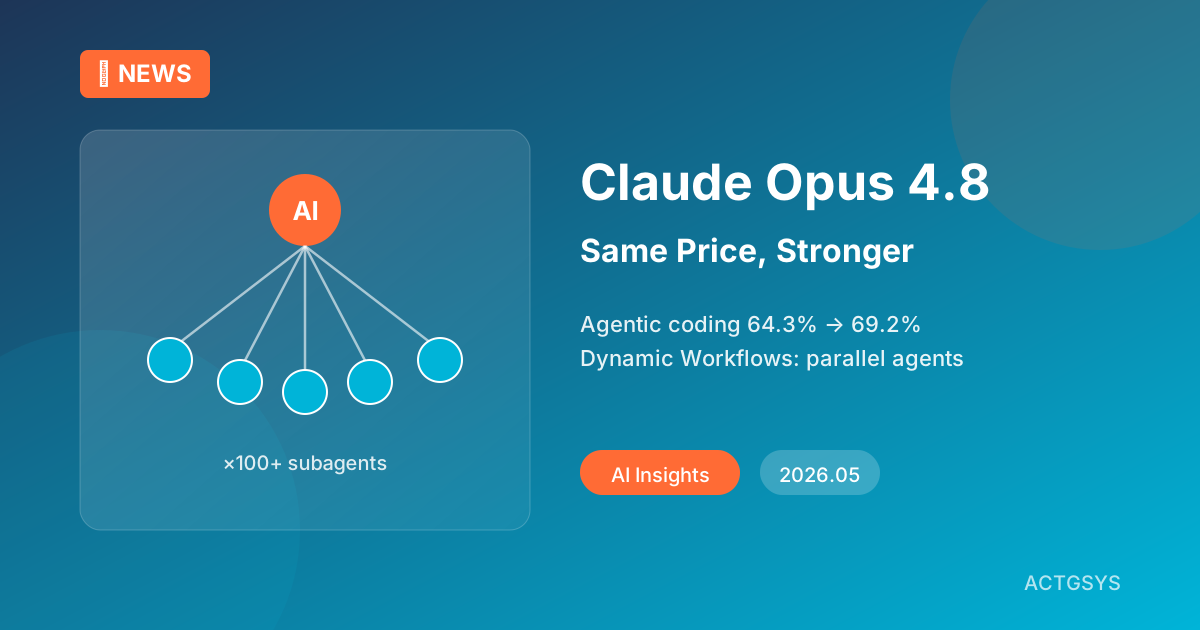
Anthropic Launches Claude Opus 4.8 (May 2026): Same Price, Stronger, and It Can Now Spin Up a Whole Team of Subagents — What Taiwan SMEs Should Know
On May 28, 2026, Anthropic launched Claude Opus 4.8, holding the same $5 / $25 per 1M token pricing as its predecessor while lifting agentic coding from 64.3% to 69.2% and adding Dynamic Workflows — a research preview that orchestrates hundreds of parallel subagents. We unpack what this upgrade means for Taiwan SME automation.
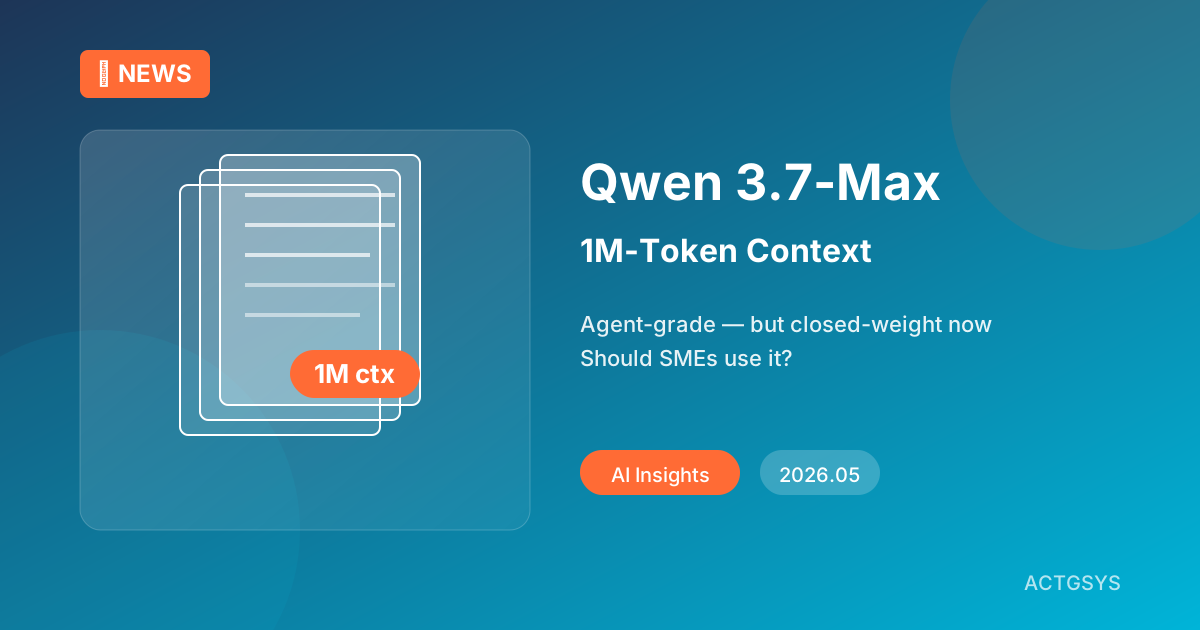
Alibaba Launches Qwen 3.7-Max (May 2026): 1M-Token Context, Agent-Grade Reasoning — but This Time It's Closed-Weight. Should Taiwan SMEs Use It?
On May 20, 2026, Alibaba launched Qwen 3.7-Max with a 1M-token context window and native extended thinking, scoring 69.7 on Terminal-Bench 2.0 and 60.6 on SWE-Bench Pro — but it's closed-weight and API-only for the first time. We unpack what this Chinese flagship means for Taiwan SME long-document processing and cost.
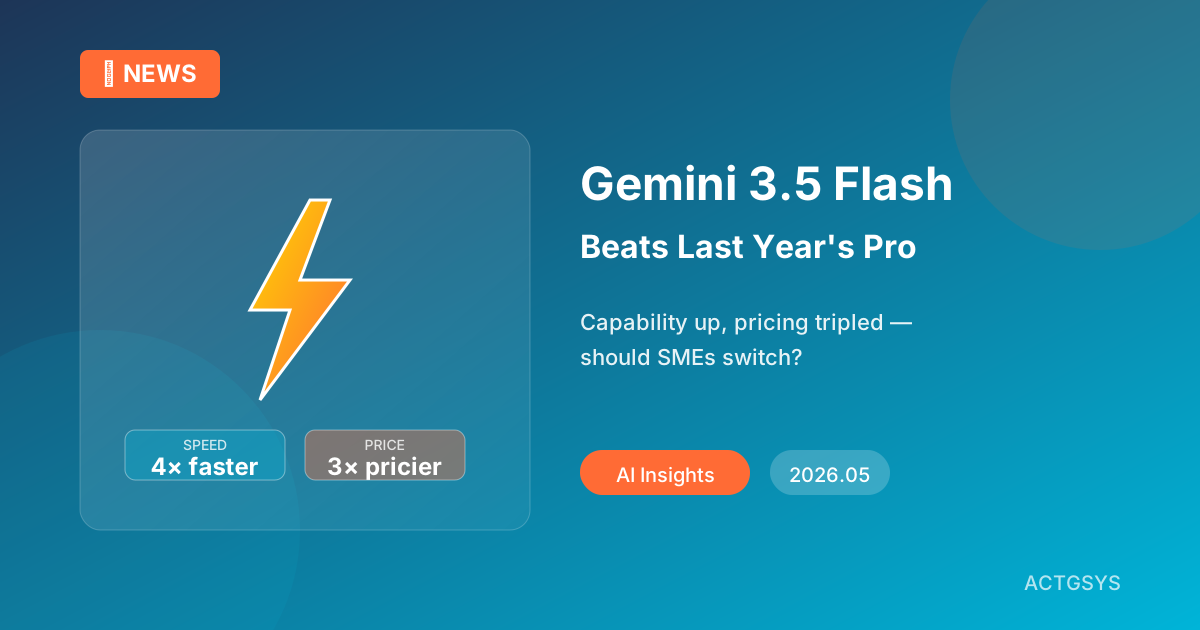
Google Gemini 3.5 Flash Launches (May 2026): Flash Beats Last Year's Pro, but Pricing Tripled — Should Taiwan SMEs Switch?
On May 19, 2026 at I/O 2026, Google launched Gemini 3.5 Flash with coding and agentic benchmarks that beat Gemini 3.1 Pro — but API pricing tripled vs. the previous Flash. We unpack the model's strength, the pricing strategy, and what Taiwan SMEs should do.