RAG Knowledge Base 2026: SME AI That Cites Data
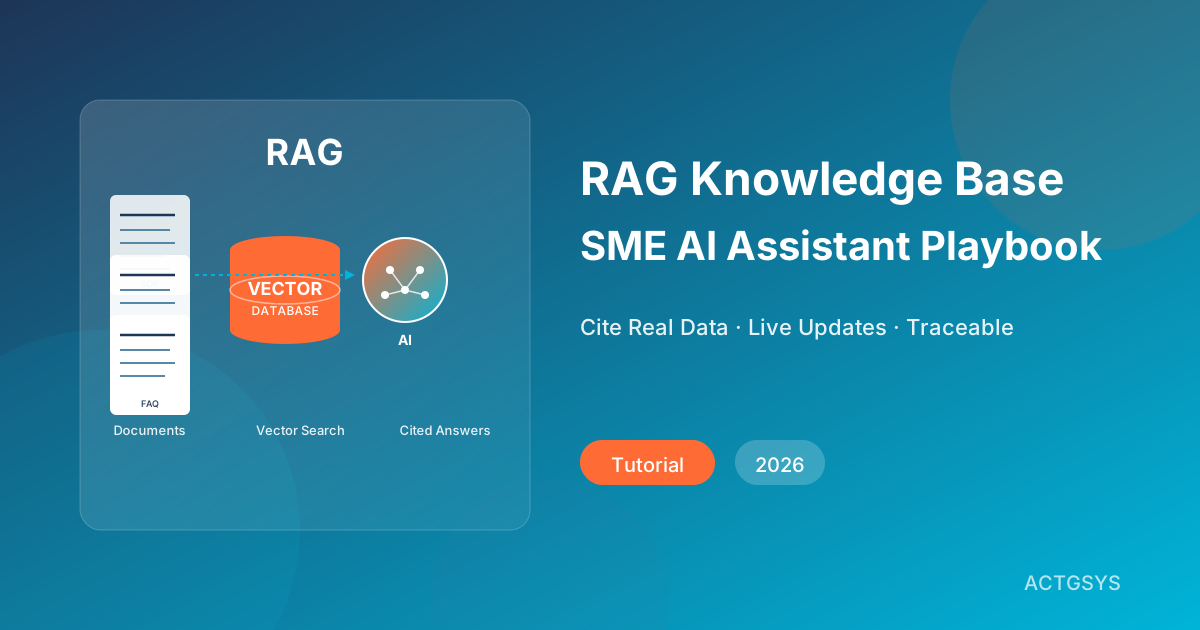
TL;DR: RAG lets an AI consult your internal data before answering — instead of inventing answers from memory, it cites real documents. For SMEs, RAG costs far less than fine-tuning, updates instantly when data changes, and is the cheapest way to build a real custom AI assistant in 2026.
What Is RAG (Retrieval-Augmented Generation)?
RAG (Retrieval-Augmented Generation) is an architecture that combines data retrieval with AI generation. The flow: user asks a question → system searches the knowledge base for relevant snippets → snippets and question go to the AI → the AI answers based on real data.
According to IBM Research (2025), enabling RAG can drop enterprise AI hallucination rates from 15-20% down to 2-3% — a critical reason businesses now trust AI in customer service and internal decision-making.
RAG's Core Three-Step Architecture
- Indexing (offline): chunk documents, convert to vectors, store in vector database
- Retrieval (real-time): convert user question to vector, find most relevant snippets
- Generation (real-time): hand question + retrieved snippets to LLM/SLM, produce answer
RAG vs Fine-tune: Two Ways to Make AI Understand Your Company
| Aspect | RAG | Fine-tune |
|---|---|---|
| Core logic | AI looks up data in real-time | AI learns it into its weights |
| Data updates | Instant (just re-index) | Requires retraining |
| Deployment cost | Low (live in a week) | High (needs GPU and ML engineering) |
| Citation transparency | High, can show source | Low, no traceability |
| Best for data | Frequently changing, large volume | Stable, small volume, special format |
| SME recommendation | ⭐⭐⭐⭐⭐ | ⭐⭐ |
For 90% of SMEs, RAG is the first choice. Fine-tuning matters only when you need to "learn a special style" or when data is "extremely large and stable."
Why SMEs Must Pay Attention to RAG in 2026
Reason 1: Generic AI Doesn't Know Your Company
ChatGPT and Claude are smart, but they know nothing about "your refund policy," "your specific product specs," or "your past interactions with customer X." Asking generic AI gets answers that are either too vague or simply made up.
Reason 2: Fine-tuning Is Too Expensive for SMEs
Custom-training an LLM costs hundreds of thousands of NT dollars and must be redone whenever data changes. SMEs' data shifts weekly or daily (new products, policies, customers) — fine-tuning can't keep up.
Reason 3: Customers Demand "Verifiable" AI Answers
Starting in 2026, customers and regulators want enterprise AI answers that are traceable — which document, which version, who approved it. RAG natively supports source citation, making it compliance-friendly by design.
Five SME Use Cases Where RAG Shines
Use Case 1: Internal Employee Knowledge Assistant
Feed all SOPs, employee handbooks, IT operation guides, salary policies, and leave rules into RAG. New hires can ask the AI: "How do I request annual leave?" and the AI cites the HR manual precisely, with a link to the source.
Use Case 2: Smart Customer Service Replies
Build a RAG knowledge base from three years of customer service FAQs, product manuals, and refund policies. When a customer asks via LINE Bot "When will my order A arrive?", RAG checks both the order system and shipping policy to deliver a precise answer. DanLee CRM ships with a RAG module that imports existing conversation history directly.
Use Case 3: Sales Quoting Assistant
A salesperson asks "What discount history do we have with this customer for this product?" RAG queries the CRM for past orders, signed contracts, and negotiation notes — instant complete context.
Use Case 4: Procurement and Inventory Decisions
"When did we last order this material? What was the unit price? Which supplier?" The procurement manager asks; RAG pulls from Dinkoko ERP, instantly returning a full purchase history and recommendation.
Use Case 5: Tax and Accounting Advisor
Build a RAG knowledge base of Taiwan tax law, case precedents, and how past clients were handled. An accountant asks "Which income category applies here?" and the AI cites specific provisions and prior practice — supporting professional judgment.
Six Core Components of a RAG System
Component 1: Document Pre-processing
Convert PDFs, Word, Excel, web pages, databases into plain text. Common tools:
- PDF: PyMuPDF, Unstructured.io
- Word/Excel: python-docx, openpyxl
- Web scraping: Playwright, BeautifulSoup
- Image OCR: Tesseract, PaddleOCR
Component 2: Chunking
Split long documents into retrieval-friendly pieces. Chunking strategy makes or breaks a RAG system:
- By character count: simple but may break mid-sentence (not recommended)
- By paragraph: preserves semantic integrity (SME recommended)
- By structure: cuts at heading levels (great for structured docs)
- Semantic: AI decides cut points (highest quality, higher cost)
Recommended chunk size: 500-1,000 characters, with 10-20% overlap.
Component 3: Embedding Model
Turns text chunks into vectors. For Chinese scenarios:
- OpenAI text-embedding-3: top English, moderate Chinese, API only
- Cohere Embed v3: balanced multilingual
- BGE-M3 (BAAI): open-source, strong Chinese
- Qwen3-Embedding: Alibaba open-source, one of the best Chinese embedders
Privacy-conscious SMEs choose BGE-M3 or Qwen3-Embedding (locally deployable). Pure quality seekers go OpenAI.
Component 4: Vector Database
The core storage and retrieval engine. Mainstream options:
| Database | Deployment | SME Suitability | Notes |
|---|---|---|---|
| Pinecone | Cloud SaaS | ⭐⭐⭐⭐ | Easy to start, usage-based pricing |
| Weaviate | Cloud / Self-host | ⭐⭐⭐⭐ | Open-source, full-featured |
| Qdrant | Cloud / Self-host | ⭐⭐⭐⭐⭐ | Open-source, fast, Rust-built |
| Milvus | Cloud / Self-host | ⭐⭐⭐ | Strong at scale, steep learning curve |
| pgvector | PostgreSQL extension | ⭐⭐⭐⭐⭐ | Upgrade existing database |
| Chroma | Self-host | ⭐⭐⭐⭐ | Lightweight, ideal for POC |
For companies already on PostgreSQL, pgvector is the lowest-cost starting point — no new system, just extend the existing database.
Component 5: Retrieval Strategy
Not just "find top K most similar chunks." Advanced strategies include:
- Hybrid retrieval: combine keyword search (BM25) with vector search
- Re-ranking: use a more precise model to rerank top 50, then take top 5
- Query rewriting: AI rewrites user questions for better retrieval
- Multi-step retrieval: decide if a second query is needed based on first results
Component 6: Generator Model
Pass retrieved snippets and question to LLM/SLM for the answer. For SMEs:
- OpenAI GPT-4o / GPT-5: top quality, with cost
- Claude Sonnet 4 / Opus 4: strong long-context, fact-conscious
- Qwen 2.5 (local): Chinese SLM, great privacy
- Phi-4 (local): low cost, strong reasoning
Six-Step SME RAG Deployment Framework
Step 1: Define Use Case and Success Metrics
Don't aim for a "company-wide all-knowing AI" on day one. Pick a focused use case with clear pain and complete data:
- "LINE Bot auto-answers 50% of common customer questions"
- "Employee policy lookup gives one-stop answers"
- "Sales quotes auto-populate customer history"
Sample metrics: answer accuracy > 85%, employee satisfaction > 4/5, monthly hours saved > 40.
Step 2: Inventory and Clean Data
This step accounts for 60% of project effort. Lesson: most failed RAG projects fail on data quality.
- Collect all relevant documents (PDF, Word, Excel, web, database)
- Remove outdated, duplicate, conflicting content
- Standardize formats and terminology
- Add metadata to each document (author, date, version, scope)
Step 3: Build a Minimum Viable Architecture
Don't over-engineer. First version, simplest stack:
- Document processing: Unstructured.io
- Chunking: by paragraph, ~800 chars each
- Embedding: BGE-M3
- Vector DB: pgvector (if PostgreSQL already exists) or Qdrant
- Generator: GPT-4o-mini or Qwen 2.5 14B
- Framework: LlamaIndex (simple) or LangChain (flexible)
Step 4: Build an Evaluation Mechanism
Prepare 50-100 test questions with reference answers in advance. Re-run after every architectural change to track improvement quantitatively. RAG projects without evaluation fall into "feels-better" fog.
Step 5: Deploy and Integrate Business Systems
Bring RAG into employees' daily tools:
- LINE Bot: customers ask, RAG answers
- DanLee CRM: sales reps see AI suggestions on customer pages
- Dinkoko ERP: procurement page shows historical purchase suggestions
- Slack/Teams: employees @AI in any channel for instant answers
Step 6: Continuous Optimization and Data Governance
A RAG system needs ongoing operations:
- Weekly: spot-check 20 answers
- Monthly: analyze missed questions, augment data or tune retrieval
- Quarterly: re-evaluate embedding model and vector DB performance
- Always: re-index immediately when SOPs or products change
Five Common RAG Pitfalls
Pitfall 1: Going Live With Dirty Data
The most common death. One SOP from 2020, another from 2024 — when an employee asks about refunds, AI cites randomly and confuses everyone. Spend two to three weeks cleaning data — more important than rushing to launch.
Pitfall 2: Wrong Chunking Strategy
Cutting legal text by character count breaks "Article 3: the following situations are not eligible..." mid-sentence — AI never sees the full context. Cut by structure and embed chapter info in each chunk.
Pitfall 3: Wrong Embedding Model
Using an English embedder on Chinese content yields painful retrieval quality. For Chinese, prioritize BGE-M3, Qwen3-Embedding, or Cohere multilingual.
Pitfall 4: No Citations or Sources
When AI answers without "this came from document X," employees can't verify and customers can't trust it. RAG's core value is traceability — skipping citations throws away half the advantage.
Pitfall 5: Ignoring Permission Controls
If RAG has no permissions, sales reps may access executive-only salary data, customers may see internal cost prices. Plan document-level permissions and result filtering before launch.
Real Case: Logistics Firm Cuts Customer Service Hours by 70% With RAG
Background: A mid-sized logistics company with 60 employees handles 800+ daily customer inquiries (shipping status, refunds, freight quotes). The 8-person customer service team was burning out, and senior staff departures slowed onboarding.
RAG plan:
- Data sources: 30 SOPs, 50,000 historical service conversations, freight tables, partner carrier rules
- Architecture: BGE-M3 embedding + pgvector + Qwen 2.5 14B (self-hosted SLM for customer data privacy)
- Integration: LINE Bot + DanLee CRM service module
- Evaluation: 100-question test set, 85%+ accuracy goal
Results (month 3):
- LINE Bot auto-answer rate: 72% (from 25%)
- Average response time: 3 minutes (from 35 minutes)
- Customer service hours: 70% reduction per week
- Customer satisfaction: 4.6/5 (from 3.8/5)
- New hire ramp-up time: 3 days (from 3 weeks)
ROI: ~NT$250K invested (data cleanup, system build, 3-month rollout); year-one savings on labor and recruiting ~NT$2.8M — payback in 3 months.
FAQ
How is RAG different from ChatGPT Plugins / Custom GPTs?
ChatGPT Custom GPTs, file uploads, and Plugins are "managed" RAG implementations. The upside: no system to build. The downside: data goes to OpenAI; can't integrate internal CRM/ERP; hard to customize retrieval logic; doesn't scale to large data. SMEs with sensitive data or deep integration needs prefer self-hosted RAG.
Our company has only 5 people. Do we need RAG?
Five-person companies often lack the data volume to justify RAG. Start with ChatGPT Team's file upload (built-in mini-RAG) to test the waters. Move to self-hosted RAG when the data reaches "we keep answering the same questions and lookup is slow."
How long does RAG deployment take?
Typical SME timeline: week 1 requirements + data inventory; weeks 2-3 data cleanup; week 4 MVP architecture; weeks 5-6 evaluation and tuning; weeks 7-8 business system integration and launch. Total 8 weeks, with half on data prep.
Can RAG really avoid AI hallucinations?
Largely reduce, not eliminate. In practice, RAG drops hallucination rates from 15-20% to 2-3%. The remaining 2-3% usually happens when retrieval finds nothing (AI tries anyway) or contradictory data (AI picks one). Add a "say I don't know if no relevant data" prompt and surface citations for user verification.
Does a RAG system need a GPU?
Depends on the LLM. Using OpenAI / Claude API: no GPU needed. Using local SLMs (Phi-4, Qwen 2.5) for full privacy: at least one RTX 4090 (16GB) or pro card. The embedding model itself is light enough for CPU.
Conclusion: RAG Is the Lowest Bar for SME AI Adoption
The old "enterprise AI" story required a data science team, six-figure budgets, and half a year before results. RAG rewrites the rules — MVP in a week, no ML engineers required, instant data updates, integrates with existing systems.
For SMEs, 2026 is the perfect time to start building "your own AI knowledge asset." Turn the SOPs, customer service logs, product manuals, and sales experience scattered across the company into instantly searchable intelligent assets — that's true digital transformation.
Last updated: 2026-04-27
Ready to build your custom RAG knowledge base?
ACTGSYS provides end-to-end RAG deployment — data inventory, architecture design, model selection, and CRM/ERP integration:
- Data quality diagnostics and consulting
- RAG integration with DanLee CRM, Dinkoko ERP, TanJee accounting
- Chinese embedding model selection and on-premise deployment
- Evaluation metric design and continuous optimization
👉 Book a free RAG assessment and turn your company knowledge into an AI-ready asset.
Products & Solutions in This Article
AI-powered CRM for lead management, customer tracking, and sales pipeline optimization designed for SMEs.
AI-driven ERP focusing on procurement, inventory, and supply chain management. Each customer deployed on dedicated cloud infrastructure.
Intuitive accounting system designed for Taiwan SMEs, with automated bookkeeping and financial reporting.
Related Articles
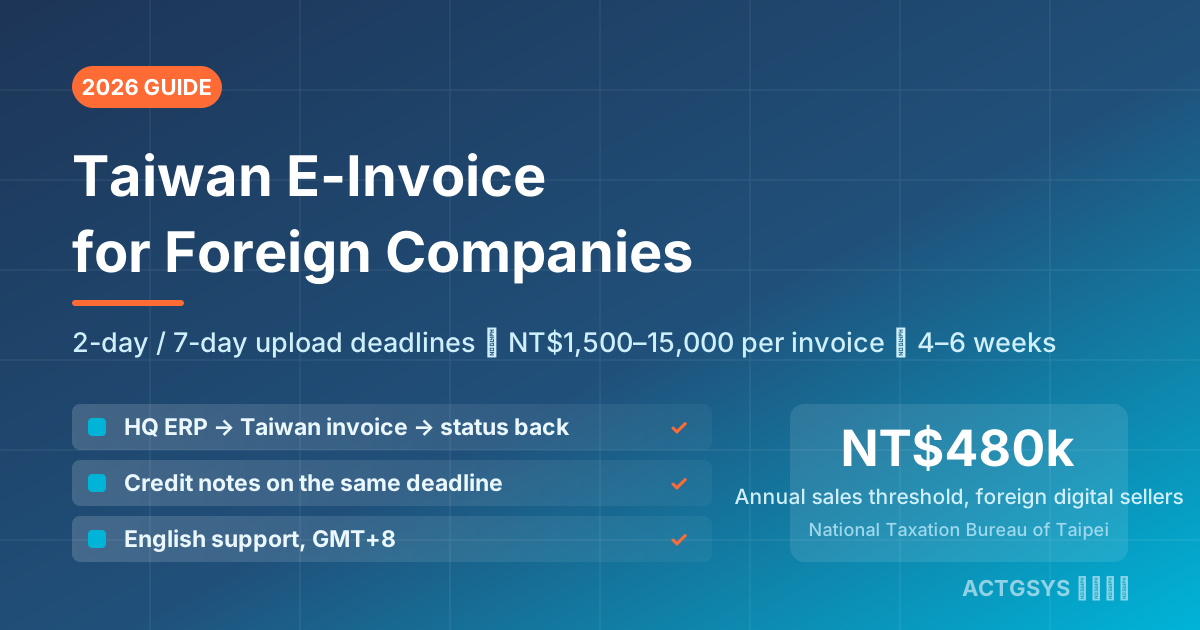
Taiwan E-Invoice for Foreign Companies 2026 - Cost
How a foreign-owned Taiwan subsidiary or branch connects its ERP to Taiwan's e-invoice platform: 2-day B2C / 7-day B2B upload deadlines, NT$1,500–15,000 per-invoice penalties, three integration paths, and a 4–6 week project from NT$50,000.
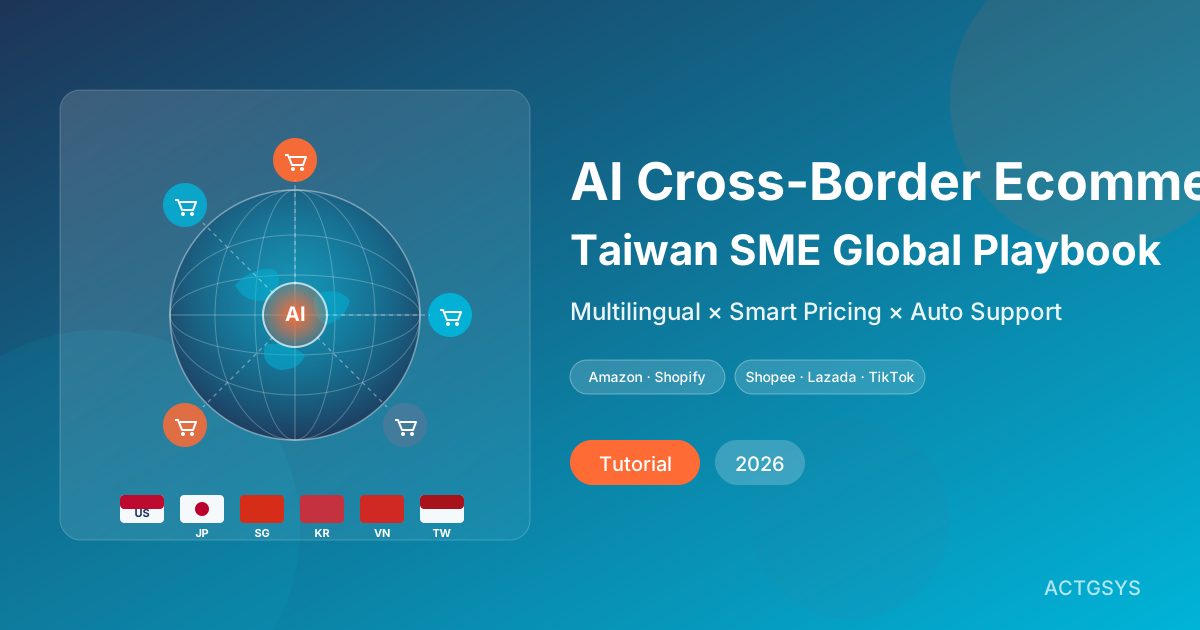
AI Cross-Border Ecommerce Playbook for SMEs (2026)
How Taiwan SMEs use AI to automate cross-border e-commerce — multilingual listings, smart customer service, dynamic pricing, ad ops, and logistics forecasting across Amazon, Shopify, Shopee, Lazada, and TikTok Shop.
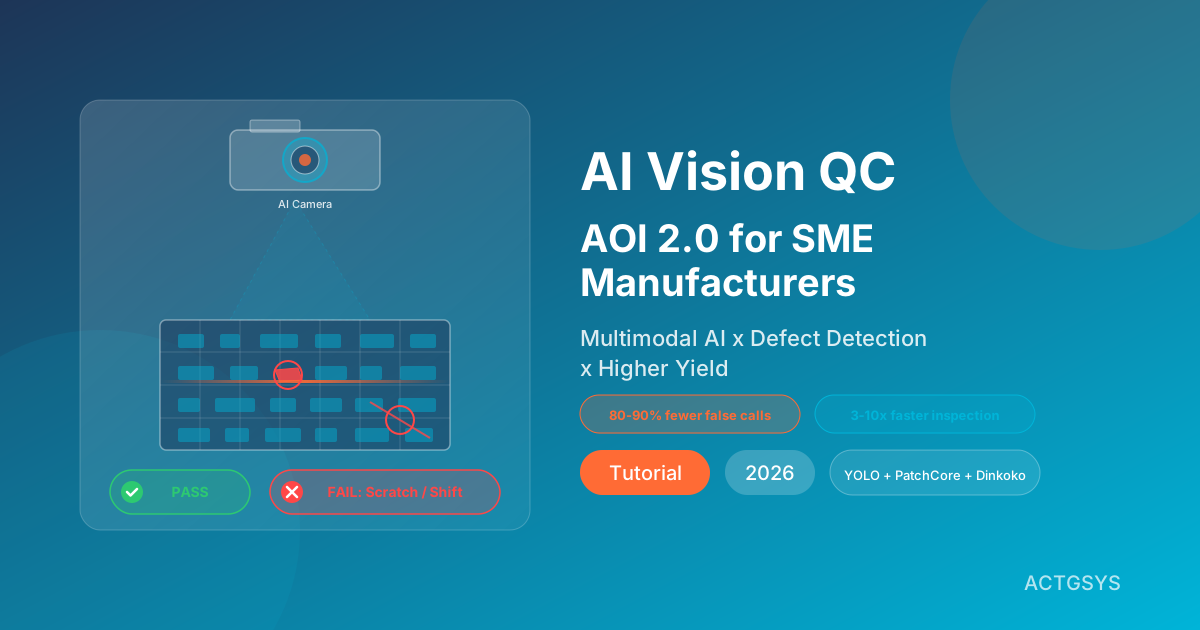
AI Vision Quality Control 2026: AOI 2.0 for SMEs
A deep dive into how AI vision QC (AOI 2.0) combines computer vision with multimodal LLMs to automate defect detection, raise yield and shrink inspection time. Includes a five-step rollout, platform comparison and FAQ.
What would this cost you?
Answer five questions. Within three working days you get a price range and what it covers. No deck, no follow-up sales calls.
Prefer to talk?LINE·02-2553-8084