Small Language Models (SLM) for SMEs (2026)
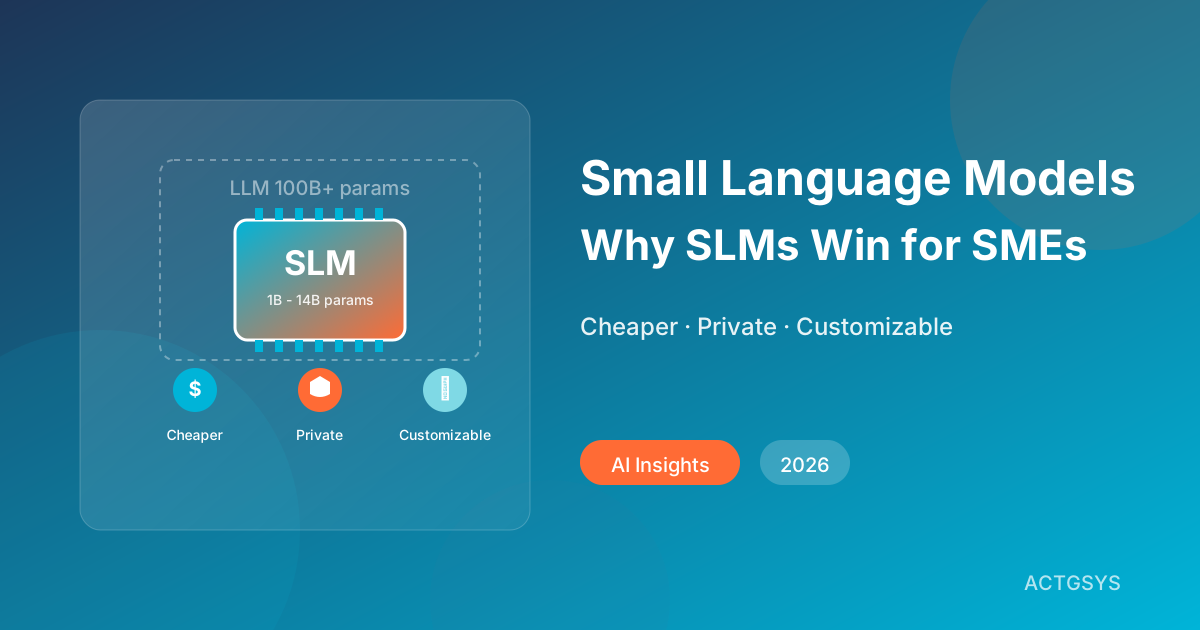
TL;DR: Small Language Models (SLMs) sit between 1B and 14B parameters and run locally on laptops, phones, or edge devices. They solve the three biggest pain points for SMEs — runaway API bills, data leakage to cloud AI, and the inability to customize on internal knowledge. SLMs are how AI finally goes mainstream for small businesses in 2026.
What Is a Small Language Model (SLM)?
A Small Language Model (SLM) is an AI model with far fewer parameters than GPT-4 or Claude Opus, yet still capable of natural language understanding and generation. Typical SLM sizes range from 1B to 14B parameters — one to two orders of magnitude smaller than the 100B+ giants.
According to Microsoft Research (2025), Phi-4 (14B parameters) outperforms GPT-3.5 (175B parameters) on math reasoning, coding, and business document understanding, with some tasks approaching GPT-4 level. This marks AI's shift into a "small but smart" era.
SLM vs LLM: Core Differences
| Aspect | LLM (Large Language Model) | SLM (Small Language Model) |
|---|---|---|
| Parameters | 100B – 2T+ | 1B – 14B |
| Deployment | Cloud GPU clusters | Laptops, phones, edge devices |
| Inference cost | Several to tens of dollars per million tokens | Near zero (own hardware) |
| Latency | 1-3 seconds | 50-300 milliseconds |
| Data privacy | Data must go to the cloud | Fully offline possible |
| Customization | Hard (massive GPUs to fine-tune) | Easy (single consumer GPU) |
| General capability | Extremely broad | Moderate, needs task tuning |
| Best fit | Creative work, complex reasoning | Repetitive tasks, privacy-sensitive scenarios |
Why 2026 Is the Year SLMs Break Through
Three forces converge:
Force 1: Architectural Breakthroughs
Microsoft Phi-4, Meta Llama 3.2 (1B/3B), Google Gemma 2, Alibaba Qwen 2.5, and others have launched in quick succession. These models combine curated training data, knowledge distillation, and inference optimization to make "small" feel "smart."
For example, Phi-4 deliberately excludes web noise during training and uses only textbook-grade content — proof that "less is more."
Force 2: Hardware Sinks Down
Apple M4, Intel Lunar Lake, AMD Ryzen AI, and Qualcomm Snapdragon X Elite all pack neural processing units (NPUs). Running SLMs on laptops and phones is now standard. Apple Intelligence integrates a 3B-parameter on-device model system-wide — a flagship example of mainstream SLM adoption.
Force 3: API Costs Push Back
ChatGPT and Claude API prices fell rapidly in 2024-2025 but rebounded in 2026. Flagship API prices for GPT-5 and Claude 4 actually rose, and enterprise customers feel the long-term cost pressure of heavy LLM usage.
According to Gartner (2026), 40% of enterprise AI workloads will move from cloud LLMs to SLMs by 2027, driven primarily by cost and privacy.
Three Big Wins SMEs Get From SLMs
Win 1: Predictable Costs, No More Token Bill Shock
SMEs using ChatGPT API often hit "bill shock" — one over-eager sales rep can blow the monthly budget. SLMs deployed on your own server or laptop have near-zero variable cost after the hardware investment.
A practical example:
- A 30-person company using GPT-4o for customer service: $800-$1,200/month
- Switching to Phi-4 self-hosted (one-time NT$60K workstation): ~NT$300/month electricity
- Payback in 2-3 months, with NT$30K+/month savings thereafter
Win 2: Sensitive Data Never Leaves the Building
SLMs run completely offline, ideal for handling:
- Customer PII (IDs, contact info, health records)
- Trade secrets (contracts, quotes, formulations)
- Employee data (salaries, reviews, interview notes)
- Legal documents (attorney letters, contract drafts)
For manufacturing, healthcare, and accounting firms, SLMs are the way to avoid cloud-AI privacy risks.
Win 3: Deep Customization on Internal Knowledge
SMEs almost always want "AI that understands our company's rules" — product manuals, SOPs, historical Q&A. SLM fine-tuning costs far less than LLM fine-tuning:
- LLM fine-tune: 8x H100 GPUs, tens of thousands of dollars
- SLM fine-tune: a single RTX 4090 (~NT$50K), 4-8 hours
- Can be retrained weekly to keep up with business changes
Five Real SLM Use Cases for SMEs
Use Case 1: Smart Customer Service FAQ
Feed three years of customer service logs to an SLM for fine-tuning. Integrated with LINE Bot, 80% of common questions can be auto-answered by the SLM, with higher accuracy than generic LLMs (because it learned your product terminology).
DanLee CRM ships with an SLM-powered customer service module that imports historical conversations directly, eliminating the technical barrier.
Use Case 2: Auto-Generated Quotes and Contracts
Train an SLM on your standard quote and contract templates. Sales reps input "Customer X, Product Y, Quantity Z" and get a compliant document. Compared to ChatGPT's generic generation, SLMs are less likely to "improvise" clauses you don't want.
Use Case 3: Inventory Alerts and Restocking Recommendations
Dinkoko ERP integrates SLMs to analyze sales and inventory history, generating daily restocking suggestions. The SLM advantage: works offline, so even network outages don't disrupt core business decisions.
Use Case 4: Multilingual Email Handling
Export sales reps handle inquiries in English, Japanese, and Southeast Asian languages. SLMs translate, classify, and draft replies locally — without uploading customer lists or pricing to cloud AI.
Use Case 5: Employee Knowledge Assistant
Feed SOPs, employee handbooks, and IT operation guides to an SLM. New hires can ask the AI assistant directly. Faster than digging through PDFs or asking colleagues, and no internal data leaks to cloud vendors.
Four-Step SLM Deployment Framework
Step 1: Inventory Needs and Data
Before picking a model, answer three questions:
- Task type: What should the AI do? (classification, summarization, translation, generation, Q&A)
- Data scale: How much training data? (under 1,000 records, use RAG instead of fine-tune)
- Hardware budget: How much hardware investment? (under NT$50K, consumer GPU; over NT$100K, workstation)
Step 2: Pick the Right SLM
| Model | Parameters | Chinese Capability | Commercial License | Recommended Scenario |
|---|---|---|---|---|
| Phi-4 | 14B | Moderate | MIT | General business tasks, reasoning |
| Llama 3.2 | 1B / 3B | Moderate | Llama 3.2 License | Edge devices, lightweight tasks |
| Qwen 2.5 | 1.5B – 14B | Excellent | Apache 2.0 / Tongyi Qianwen | First choice for Chinese scenarios |
| Gemma 2 | 2B / 9B | Moderate | Gemma License | Google ecosystem integration |
| Mistral Small | 7B / 22B | Moderate | Apache 2.0 | European compliance scenarios |
For Chinese-heavy business, Qwen 2.5 wins. For English/general tasks, Phi-4 strikes the balance.
Step 3: Choose an Execution Environment
- Fully local (max privacy): Ollama, LM Studio, llama.cpp on your own server
- Private cloud (balanced flexibility): Your VPC + GPU host, multi-user shared
- Hybrid: SLM for sensitive tasks, LLM API for creative ones
Step 4: Build a Data Pipeline and Evaluation Metrics
The most common failure post-deployment is "no ongoing operations." Recommended:
- Weekly answer-quality sampling (5-10 questions)
- Employee feedback collection (thumbs up/down)
- Model version control (numbered fine-tune snapshots)
- Cost and performance dashboards
SLM vs LLM: Decision Matrix
When should you use LLM? When SLM? Practical decision matrix:
| Scenario | Recommendation | Reason |
|---|---|---|
| Internal employee Q&A assistant | SLM | Sensitive data, high-frequency queries |
| Marketing copy ideation | LLM | Broad knowledge, occasional use |
| Customer service auto-replies | SLM | High-frequency, jargon, privacy |
| Contract first drafts | SLM | Confidential, fixed format |
| Industry trend analysis reports | LLM | Latest info, low-frequency |
| Blog article writing | LLM | Creative, publishable |
| Report summarization and insights | SLM | High-frequency, contains operational secrets |
| Cross-language customer communication | SLM | Customer data, frequent |
Core principle: high-frequency + sensitive → SLM; low-frequency + creative → LLM; mixed → use both.
Real Case: Accounting Firm Replaces ChatGPT With SLM
Background: A mid-sized accounting firm with 25 employees subscribed to ChatGPT Team ($750/month, 10 seats) for organizing client financial reports, drafting working papers, and answering tax-law questions. But fearing client data leakage, employees avoided entering real numbers.
Transformation plan:
- Bought an RTX 4090 workstation (NT$80K)
- Deployed Qwen 2.5 14B (better Chinese)
- Fine-tuned on five years of working papers, building a "specialized accounting assistant"
- Integrated with TanJee accounting system; staff invokes AI directly within the app
Comparison:
| Item | Before (ChatGPT Team) | After (Self-Hosted Qwen) |
|---|---|---|
| Monthly fee | $750 (~NT$24,000) | ~NT$1,500 electricity |
| Data privacy | Staff hesitant to input real data | Fully local, full confidence |
| Client data leak risk | Moderate | Zero |
| Chinese accounting term accuracy | 75% | 92% |
| Total annual cost | NT$288K | NT$98K (incl. hardware amortization) |
ROI: NT$80K hardware investment, NT$190K saved year one — payback in 8 months.
FAQ
Can SLMs really replace ChatGPT?
For SMEs' "repetitive business tasks" — customer service, quotes, document organization, internal Q&A — yes, almost completely. But for "open questions requiring fresh world knowledge" (e.g., 2026 market trends), SLMs still trail LLMs. Best practice: mix and match — high-frequency repetitive tasks on SLMs, low-frequency creative ones on LLMs.
Our company has no IT engineers — can we deploy SLMs ourselves?
Yes. LM Studio and Ollama have lowered the bar to "if you can use Office, you can install it." Pick a PC with a discrete GPU, download Ollama, choose Phi-4 or Qwen 2.5, and you're up in 10 minutes. For deeper customization (fine-tuning, CRM/ERP integration), system vendors like ACTGSYS provide turnkey solutions.
Are SLMs dumber than LLMs?
For "specific tasks," SLMs are often smarter. Studies show that industry-fine-tuned SLMs frequently outperform general-purpose LLMs in their domain. A customer service SLM trained on five years of conversations can hit 92% accuracy versus 75% for generic ChatGPT.
How does SLM differ from RAG (Retrieval-Augmented Generation)?
The two often combine. SLM is "the model itself"; RAG is "plugging real-time data into the model." The best combo is "SLM + RAG": SLM provides base understanding, RAG plugs in your CRM, ERP, document store for live data. Result: a model that understands your jargon and sees the latest numbers.
How much money does it take to start?
Minimum: Use an existing laptop + Ollama. Zero dollars to run 1B-3B models. Mid-tier: NT$50-80K for a desktop with consumer GPU, smooth 7B-14B models, sufficient for daily use in a 30-person company. High-end: NT$150-300K workstation for multi-user serving and fine-tuning, suitable for 50+ employee enterprises.
Conclusion: In 2026's AI Game, Small Beats Big
For three years the question was "whose LLM has more parameters." In 2026, enterprises ask another: "In my scenario, whose AI is cheapest, fastest, and understands me best?" Increasingly, the answer is SLM. For SMEs, this is historic good news — the AI adoption barrier is dropping at breathtaking speed, no longer the exclusive game of cloud giants.
Last updated: 2026-04-24
Ready to build your company's own SLM assistant?
ACTGSYS provides end-to-end SLM deployment — hardware planning, model selection, fine-tuning, and CRM/ERP integration:
- Assess your business scenario, recommend the right SLM
- Integrate SLMs with DanLee CRM, Dinkoko ERP, TanJee accounting
- Fine-tune a custom model with your historical data
- Deployment, operations, and ongoing optimization support
👉 Book a free SLM assessment and make AI truly yours.
Products & Solutions in This Article
AI-powered CRM for lead management, customer tracking, and sales pipeline optimization designed for SMEs.
AI-driven ERP focusing on procurement, inventory, and supply chain management. Each customer deployed on dedicated cloud infrastructure.
Intuitive accounting system designed for Taiwan SMEs, with automated bookkeeping and financial reporting.
Related Articles
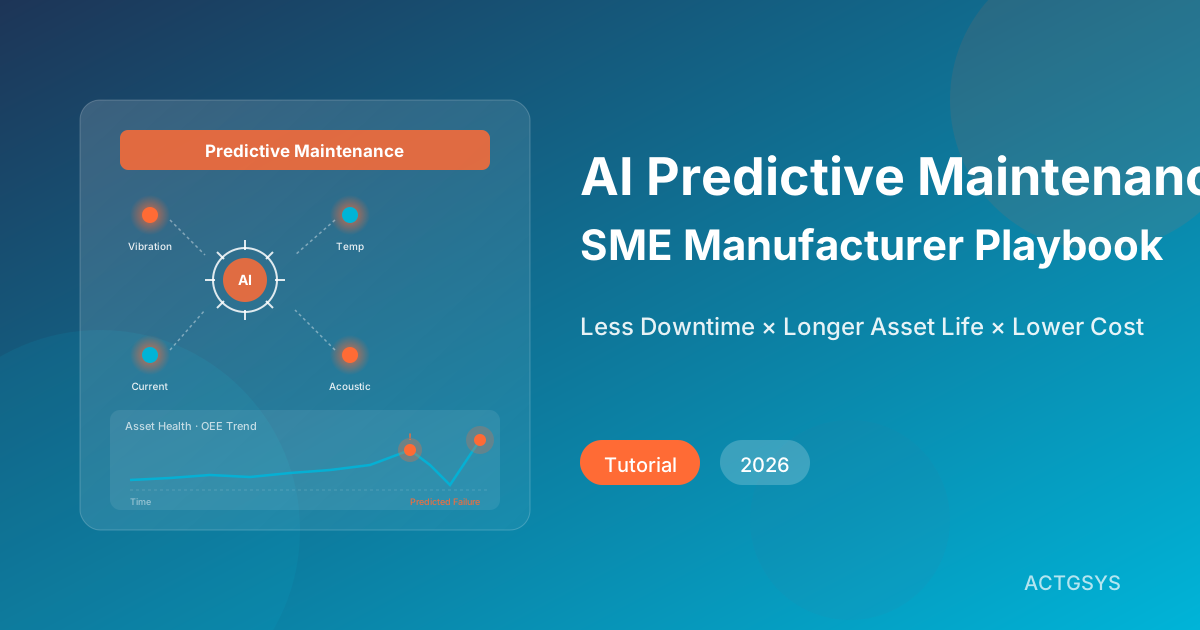
AI Predictive Maintenance for SME Manufacturers
What is AI predictive maintenance? This 2026 guide for SME manufacturers explains the IoT + edge AI architecture, a six-step rollout, and a side-by-side platform comparison, with citations from McKinsey, Deloitte, NVIDIA, AWS, and Taiwan's ITRI.
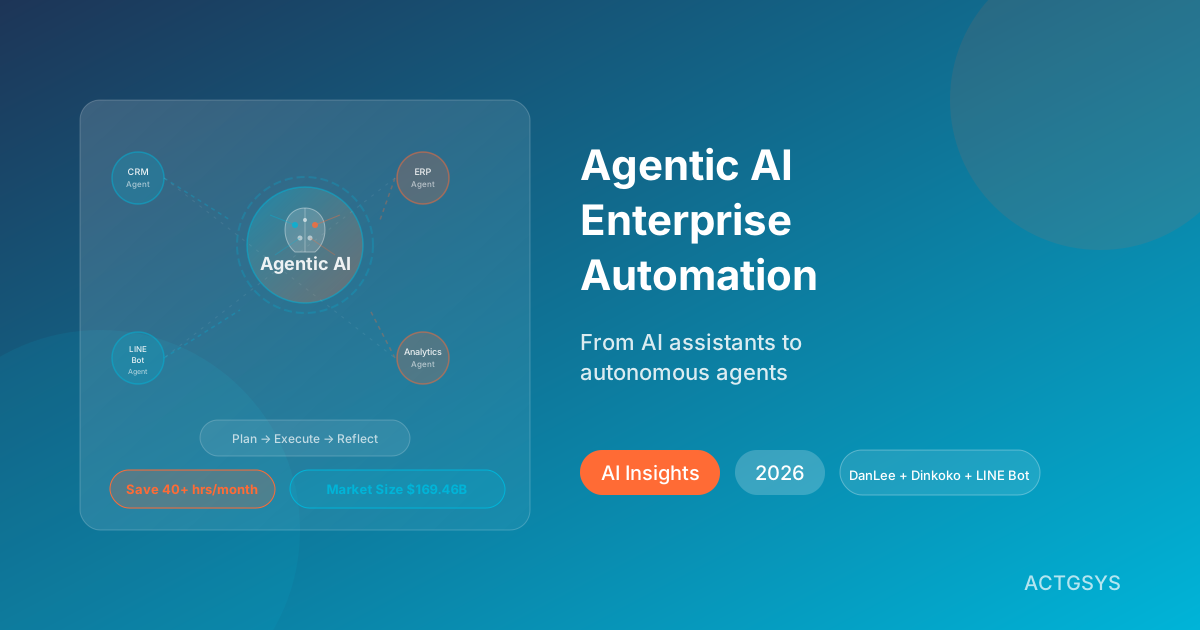
Agentic AI 2026: From Assistants to Autonomy
Deep dive into how Agentic AI surpasses traditional AI assistants with multi-agent orchestration, autonomous decision-making, and end-to-end process automation — helping SMEs save 40+ hours per month and dramatically boost operational efficiency.
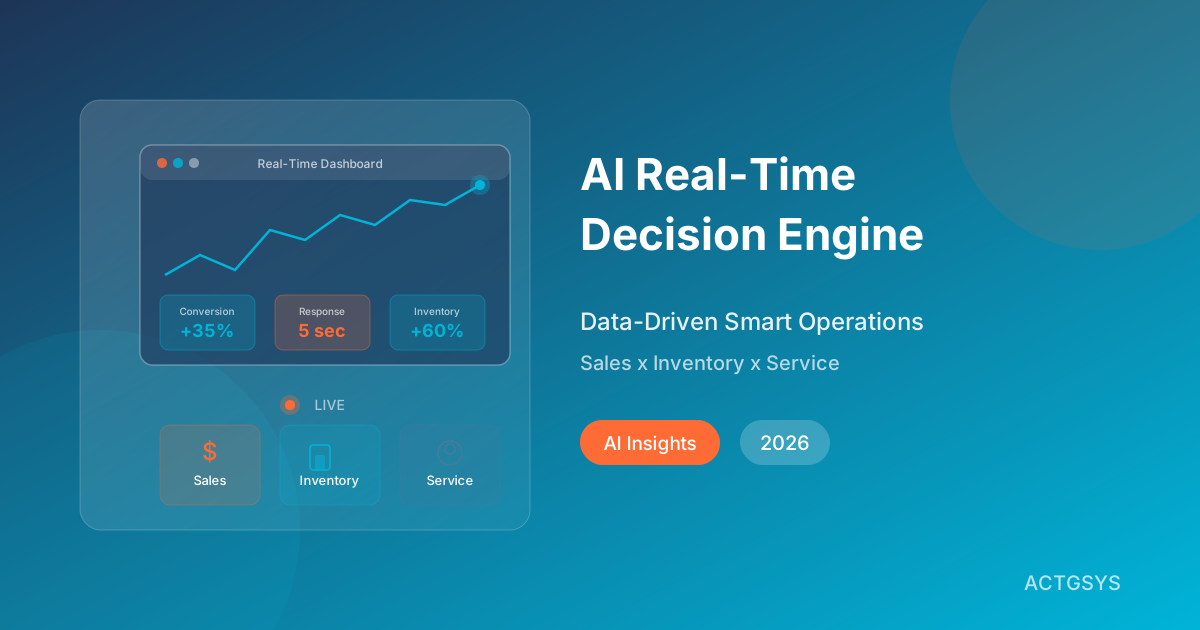
AI Real-Time Decision Engines for SMEs (2026)
85% of executives expect employees to make real-time, data-driven decisions using AI Agents by 2026. This article explains how real-time decision engines work and provides actionable strategies for SMEs across sales, inventory, and customer service.
What would this cost you?
Answer five questions. Within three working days you get a price range and what it covers. No deck, no follow-up sales calls.
Prefer to talk?LINE·02-2553-8084