SME AI Automation ROI Guide (2026)
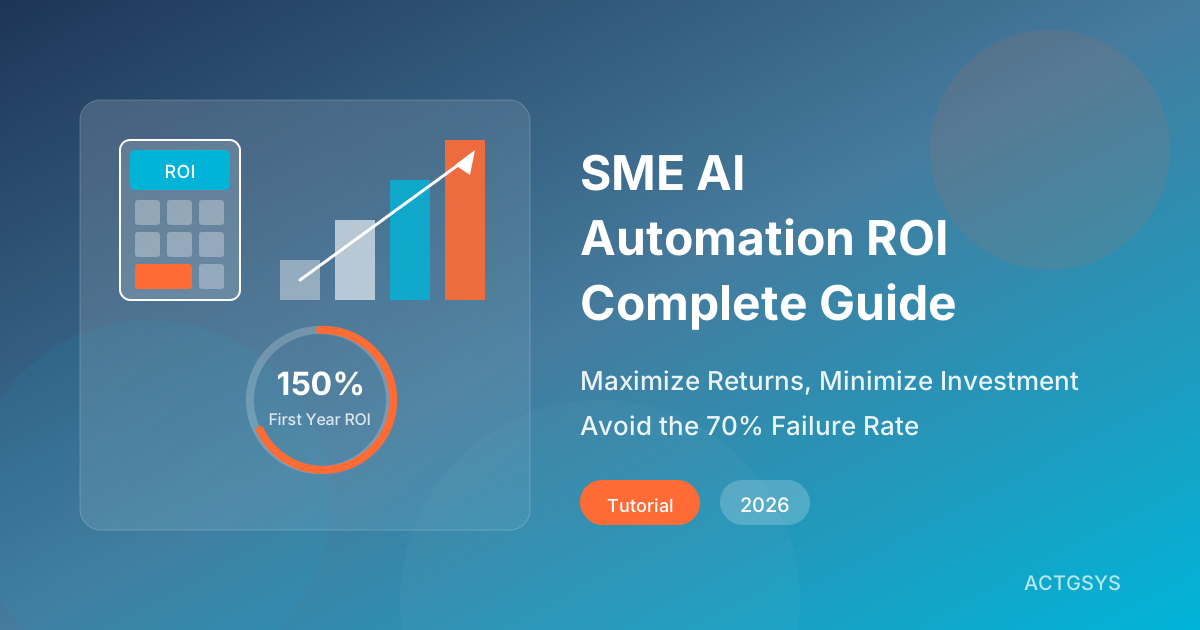
"How much does AI cost? Will it pay for itself?" This is every SME owner's most pressing question. The 2026 data provides an encouraging answer: according to a University of St Andrews study, SMEs adopting AI achieved productivity gains of up to 133%, and successful AI projects can deliver 150% ROI in the first year.
However, reality can be harsh—up to 70% of SME AI projects are abandoned before going live, and cost overruns of 20-70% are the norm. This article will help you avoid these pitfalls and create maximum returns with minimal investment.
The True Cost Structure of AI Automation
Before calculating ROI, we need to understand the complete cost structure of AI implementation. Many businesses underestimate project costs because they only see the tip of the iceberg.
Direct Costs
| Cost Item | Description | Estimated Range (USD) |
|---|---|---|
| Software Subscription | SaaS platform monthly/annual fees | $100-1,500/month |
| Custom Development | Development for special requirements | $3,000-60,000 |
| Data Preparation | Cleaning, transforming existing data | $1,500-15,000 |
| System Integration | Integration with existing systems | $3,000-30,000 |
| Training | Employee education and training | $600-6,000 |
Hidden Costs (Often Overlooked)
- Staff time investment: Hours from internal teams for planning, testing, and acceptance
- Temporary productivity decline: Efficiency loss during the learning curve
- Opportunity cost: Other projects delayed due to focus on AI initiatives
- Operations cost: Ongoing monitoring, adjustment, and updates after go-live
Common Cost Estimation Mistakes
Research shows businesses routinely underestimate costs by 500% to 1000% when scaling from pilot to production. Main reasons include:
- Only calculating development costs, ignoring operations costs
- Not budgeting for data quality issue resolution
- Underestimating change management and organizational adaptation difficulty
- Not considering additional requirements when scaling
ROI Timeline for Different AI Applications
Different types of AI applications have vastly different payback periods. Here's a reference based on actual case statistics:
Quick Wins (4-8 months)
Customer Service Automation
- Investment: $200/month AI customer service tool
- Output: $2,000/month savings in labor costs
- ROI: 900%
Invoice Processing Automation
- AI system processes invoices 10x faster than manual
- Reduces days of work to hours
- Reduces human errors and late payment losses
Medium-term Returns (6-12 months)
Productivity Tool Integration
- Sales team saves 20+ hours/month on administrative work
- 40% reduction in operating costs
- More time for high-value customer interactions
Inventory Management Optimization
- 60-70% reduction in stockouts
- 40-50% reduction in overstock
- Improved cash flow, reduced warehousing costs
Long-term Returns (9-18 months)
Custom AI Solutions
- Require longer development and tuning time
- But can create unique competitive advantages
- Most businesses reach break-even between months 18-30
- Accelerating returns in years 3-5
Seven Quick-Win AI Automation Scenarios
If you're just starting to explore AI automation, here are seven scenarios most likely to deliver quick results:
1. Automated Customer Query Responses
Pain point: Customer service team spends significant time answering repetitive questions Solution: AI chatbot handles 70-80% of common questions Benefit: Customer service staff focus on complex cases, response time reduced by 80%
2. Email Classification and Prioritization
Pain point: 1-2 hours daily spent sorting and replying to emails Solution: AI automatically classifies, tags important emails, suggests reply content Benefit: Each employee saves 30-60 minutes daily
3. Automated Quote Generation
Pain point: Sales staff manually creating quotes is time-consuming and error-prone Solution: AI automatically generates quotes based on customer requirements Benefit: Quote generation time reduced from 2 days to 2 hours
4. Meeting Scheduling and Summaries
Pain point: Back-and-forth scheduling is time-consuming, meeting notes incomplete Solution: AI automatically coordinates times, generates meeting summaries and action items Benefit: Saves 2-3 hours of administrative time weekly
5. Data Entry and Validation
Pain point: Manual data entry into multiple systems, prone to errors Solution: AI OCR recognizes document content, auto-fills systems Benefit: Data entry speed increased 10x, error rate reduced 90%
6. Social Media Monitoring
Pain point: Unable to track customer discussions on social media in real-time Solution: AI monitors brand mentions, analyzes sentiment, alerts on negative comments Benefit: Faster response to customer issues, protect brand reputation
7. Sales Forecasting and Lead Scoring
Pain point: Sales team doesn't know which prospects to prioritize Solution: AI analyzes historical data, predicts closing probability, ranks leads Benefit: Sales focus on high-potential customers, 20-30% increase in close rate
How to Calculate Your AI ROI
The formula for calculating AI ROI is:
ROI = (Benefits - Costs) / Costs × 100%
Quantifying Benefits
Time Savings
- Record time to complete the same task before and after automation
- Time saved × employee hourly rate = direct cost savings
Error Reduction
- Track error rates before and after automation
- Cost to handle each error × errors reduced = cost savings
Revenue Increase
- Compare sales data before and after implementation
- Attribute revenue growth to AI after excluding other factors
Employee Satisfaction
- Survey employee satisfaction changes
- Indirectly impacts turnover rate and recruitment costs
Real Case: An E-commerce Company's AI Implementation Results
Background: 20-person e-commerce company processing 500 orders daily
Implementation:
- AI customer service bot ($150/month)
- Order processing automation ($10,000 one-time development)
First Year Results:
- Customer service staff reduced from 3 to 1, annual savings of $30,000
- Order processing time reduced by 60%, 200 more orders processed monthly
- Customer satisfaction increased from 4.1 to 4.6 (out of 5)
ROI Calculation:
- Total investment: $10,000 + $1,800 (annual subscription) = $11,800
- Total benefits: $30,000 (labor) + $16,000 (additional orders) = $46,000
- ROI = (46,000 - 11,800) / 11,800 × 100% = 290%
Avoiding Common AI Implementation Pitfalls
Pitfall 1: Pursuing a Perfect First Version
Problem: Wanting everything at once, project keeps growing, never launches Solution: Start with a minimum viable product (MVP), iterate quickly
Pitfall 2: Ignoring Data Quality
Problem: Garbage in, garbage out. AI effectiveness depends on data quality Solution: Invest in data cleaning and standardization first, then implement AI
Pitfall 3: Lacking Clear Success Metrics
Problem: Not knowing what success looks like leads to project drift Solution: Define clear KPIs and target values before starting
Pitfall 4: Underestimating Change Management
Problem: Technology goes live but employees won't use it Solution: Involve users from the start, provide thorough training and support
Pitfall 5: Choosing Overly Complex Solutions
Problem: Attracted by fancy features, chose a high-end solution you don't need Solution: Choose based on actual needs, use first then expand
2026 AI Automation Trends
The Rise of Agentic AI
The most important trend for 2026 is the maturation of Agentic AI. These AI don't just analyze data and provide suggestions—they can autonomously execute complex workflows. For example:
- Automatically processing complete procurement workflows (from requirement confirmation to ordering and payment)
- Autonomously managing social media accounts (posting, replying, data analysis)
- Proactively identifying business opportunities and taking action
Cloud AI Platform Adoption
Cloud AI services enable SMEs to access enterprise-grade AI capabilities at low cost:
- Pay-per-use pricing, no large upfront investment required
- Flexible scaling that adjusts with business growth
- Continuous updates, automatically receive latest features
Industry-Specific AI Solutions
More AI solutions targeting specific industries (manufacturing, retail, services) are emerging, significantly reducing customization needs and costs.
FAQ
Q1: Limited budget—where should we start?
Start with "high frequency × low complexity" tasks, such as customer service automation or data entry. These tasks happen daily, automation benefits are obvious, and the technology is mature with low failure risk.
Q2: No technical team—can we still implement AI?
Yes. Choose No-Code/Low-Code AI platforms, or seek external consultants. The key is choosing good partners rather than starting from scratch yourself.
Q3: How do we convince the boss to invest in AI?
Speak with numbers. Run a small-scale pilot project first, document actual benefits, then use data to secure more resources. Most bosses respond best to "how much cost was saved" and "how much revenue increased."
Q4: What's the most common reason for AI implementation failure?
According to statistics, the most common reasons in order are: poor data quality, lack of clear objectives, organizational resistance to change, choosing wrong solutions, insufficient budget. Note these are all "people" problems, not technical problems.
Q5: How do we continuously track AI benefits?
Build a dashboard, regularly (weekly or monthly) review key metrics. Also collect qualitative feedback from users to understand actual usage experience. Continuously adjust and optimize based on data.
Conclusion: Smart Investment, Steady Growth
AI automation is not exclusive to large enterprises. In 2026, cloud services and mature solutions enable SMEs to enjoy AI benefits at reasonable costs. The keys are:
- Start small: Choose a clear pain point, quickly validate benefits
- Prioritize data foundations: AI effectiveness depends on data quality
- Calculate real ROI: Include all costs and benefits, don't deceive yourself
- Continuously learn and adjust: AI is not a one-time project but an ongoing journey
ACTGSYS specializes in helping SMEs with AI transformation. Our Dinkoko ERP and DanLee CRM have built-in AI features, allowing you to enjoy automation benefits without complex integration.
Want to know which AI automation solution fits your business? Book a free consultation and let us plan the AI transformation path that's right for you.
Products & Solutions in This Article
AI-driven ERP focusing on procurement, inventory, and supply chain management. Each customer deployed on dedicated cloud infrastructure.
AI-powered CRM for lead management, customer tracking, and sales pipeline optimization designed for SMEs.
Related Articles
No-Code and Low-Code SME Automation (2026)
Comprehensive analysis of 2026 No-Code/Low-Code market trends, covering Citizen Developers, AI-assisted development, and platform selection to help SMEs achieve rapid business automation.
AI Smart Procurement & Cost Optimization Guide
Learn how AI is transforming procurement for small and mid-sized businesses — from supplier evaluation to price prediction, with ROI models, implementation steps, and Dinkoko ERP integration.
WhatsApp AI Chatbot Guide for SMEs (2026)
WhatsApp has 3.3 billion users and 98% open rates. Meta's 2026 AI policy changes the rules. Learn how SMEs can use WhatsApp AI chatbots to boost customer communication and achieve 28% lead conversion.
What would this cost you?
Answer five questions. Within three working days you get a price range and what it covers. No deck, no follow-up sales calls.
Prefer to talk?LINE·02-2553-8084