SME Cybersecurity in the AI Era: A 2026 Framework
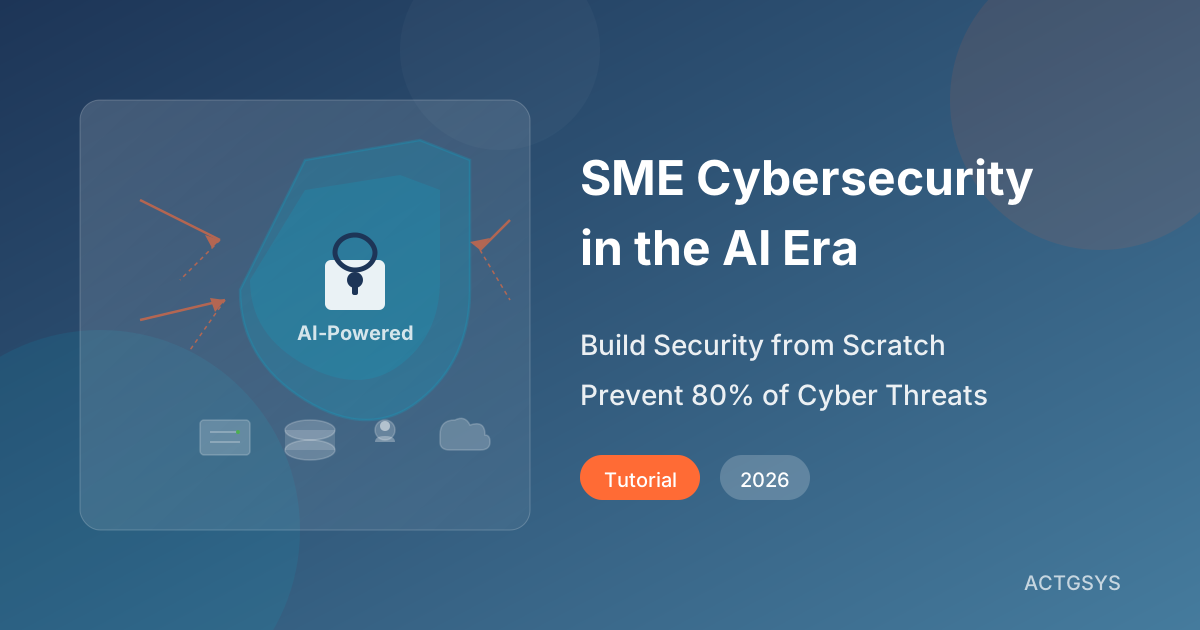
"Our company is too small for hackers to bother with." This is the most common — and most dangerous — statement SME owners make. The reality: 43% of cyberattacks in 2025 targeted small businesses, and with AI-powered attack methods becoming widespread, this figure is expected to exceed 50% in 2026. Even more alarming: 60% of attacked SMEs go out of business within 6 months.
Five Critical Cyber Threats SMEs Face in 2026
1. AI-Powered Phishing Attacks
Generative AI has dramatically elevated phishing email quality. Previously easy-to-spot red flags (grammar errors, unnatural phrasing) have vanished. AI can even mimic specific executives' writing styles to send convincing "directive" emails.
Typical scenario: An employee receives an email that appears to be from their CEO, requesting an urgent wire transfer. The tone, vocabulary, and email signature are indistinguishable from the real person.
2. Ransomware-as-a-Service (RaaS)
Ransomware has been commoditized, with criminal organizations offering subscription-based attack tools. SMEs are prime targets because they have weak defenses but still have the ability to pay.
3. Supply Chain Attacks
Hackers no longer attack target companies directly. Instead, they infiltrate through weaker supply chain partners as a stepping stone. SMEs using third-party software or services face indirect attack risks.
4. Cloud Misconfiguration
As more SMEs migrate to the cloud, lack of expertise in properly configuring security settings becomes a major vulnerability. Public storage buckets, unencrypted databases, and overly broad access permissions are common issues.
5. Insider Threats (Including Non-Malicious)
Unintentional employee mistakes (clicking malicious links, using weak passwords, handling business on public WiFi) account for 82% of security incidents.
SME Security Framework Roadmap
Phase 1: Foundation (Budget: $0-1,000/year)
Must-Do Checklist:
-
Enable Multi-Factor Authentication (MFA)
- Enable MFA on all company accounts (email, cloud services, CRM, etc.)
- Prefer authenticator apps (e.g., Google Authenticator) over SMS verification
- Cost: Free
-
Establish Password Management
- Deploy a password manager (e.g., Bitwarden free tier)
- Require all passwords 12+ characters
- Prohibit password reuse
- Cost: Free to $60/year
-
Regular Software Updates
- Enable automatic OS updates
- Establish monthly software update verification process
- Cost: Free
-
Basic Backup Strategy (3-2-1 Rule)
- 3 copies of data
- Stored on 2 different media types
- 1 off-site backup
- Cost: $150-500/year (cloud backup)
-
Employee Security Awareness Training
- Basic phishing email identification techniques
- Safe public WiFi usage rules
- Suspicious activity reporting procedures
- Cost: Free (using online resources)
Phase 2: Advanced Protection (Budget: $1,000-5,000/year)
| Protection | Description | Recommended Tools | Annual Cost Est. |
|---|---|---|---|
| Endpoint Detection (EDR) | AI-powered malware detection | CrowdStrike Falcon Go / SentinelOne | $600-1,600 |
| Email Security Gateway | Filter phishing emails and malicious attachments | Proofpoint Essentials / Mimecast | $500-1,300 |
| Network Monitoring | Detect anomalous network activity | Darktrace / Cisco Umbrella | $1,000-2,000 |
| Vulnerability Scanning | Regular system vulnerability scans | Qualys / Nessus | $300-1,000 |
Phase 3: Mature Security (Budget: $5,000+/year)
- SOC Services (Security Operations Center): Outsourced 24/7 security monitoring
- Zero Trust Architecture: Implement identity verification and micro-segmentation
- Incident Response Plan (IRP): Establish complete incident handling procedures
- Compliance Management: Meet ISO 27001 or local data protection requirements
How AI Improves SME Cybersecurity
Three Key AI Security Applications
1. Intelligent Threat Detection
AI models learn your organization's "normal behavior patterns" and alert when anomalies are detected:
- Employee downloading large amounts of files at unusual hours
- Login from unusual geographic locations
- Accessing previously unused systems or data
2. Automated Incident Response
AI can take action within seconds of detecting a threat:
- Isolate infected devices
- Block suspicious account access
- Initiate backup restoration procedures
3. Predictive Risk Assessment
AI analyzes external threat intelligence and internal vulnerability data to predict the most likely attack vectors and proactively strengthen defenses.
AI Security Tools Are Not Silver Bullets
Important limitations to note:
- Requires data training: May generate more false positives initially
- Cannot replace basic hygiene: MFA, updates, and backups remain the most important fundamentals
- Attackers use AI too: Both sides leverage AI, so technology alone isn't enough
Incident Response Guide
Steps When a Security Incident Is Discovered
-
Don't panic, don't shut down
- Shutting down may destroy memory data needed for forensics
- Disconnect from the network but keep devices powered on
-
Document all observed anomalies
- Time, affected systems, description of abnormal behavior
- Take screenshots to preserve evidence
-
Notify security lead or external consultant
- If you don't have internal security staff, contact an external security provider
- Report to your local CERT (Computer Emergency Response Team)
-
Assess impact scope
- Which systems are affected?
- What data may have been compromised?
- Does it involve customer personal data?
-
Report according to regulations
- Data protection laws typically require notifying affected parties under certain conditions
- Timely reporting reduces subsequent legal risks
Frequently Asked Questions
Q1: What percentage of budget should SMEs allocate to cybersecurity?
We recommend allocating 10-15% of your total IT budget to security. If annual revenue is $1 million, invest at least $1,500-3,000 per year in security measures.
Q2: Without an IT department, who handles security?
Designate a "security liaison" (doesn't need to be an IT professional) responsible for coordinating with external providers, executing basic checks, and managing incident reporting. Outsource complex technical work.
Q3: Employees use personal phones for work — what should we do?
Implement a BYOD (Bring Your Own Device) policy: require MDM tool installation, enable device locking, separate work and personal accounts, and prohibit handling confidential data in unsecured environments.
Q4: Is cloud more secure than on-premises?
Major cloud providers (GCP, AWS) typically offer better infrastructure security than SME-managed on-premises setups. However, cloud security is a "shared responsibility model" — the provider secures the infrastructure while you secure your data and access configurations.
Q5: Is antivirus software enough?
Traditional antivirus only protects against known threats. In 2026, we recommend upgrading to EDR (Endpoint Detection and Response) solutions that can detect unknown threats and anomalous behavior patterns.
Conclusion: Security Is Not a Cost — It's Business Insurance
In 2026's accelerating digital transformation landscape, cybersecurity is not optional — it's a fundamental business survival requirement. The good news: 80% of security incidents can be prevented through basic measures (MFA, regular updates, employee education, backups). Start building your security framework today, one step at a time.
ACTGSYS provides enterprise cloud security deployment and IT infrastructure planning services, helping SMEs build budget-appropriate security frameworks.
Worried about whether your business security is adequate? Schedule a free security assessment now and let us diagnose your risks and plan improvements.
Products & Solutions in This Article
Related Articles
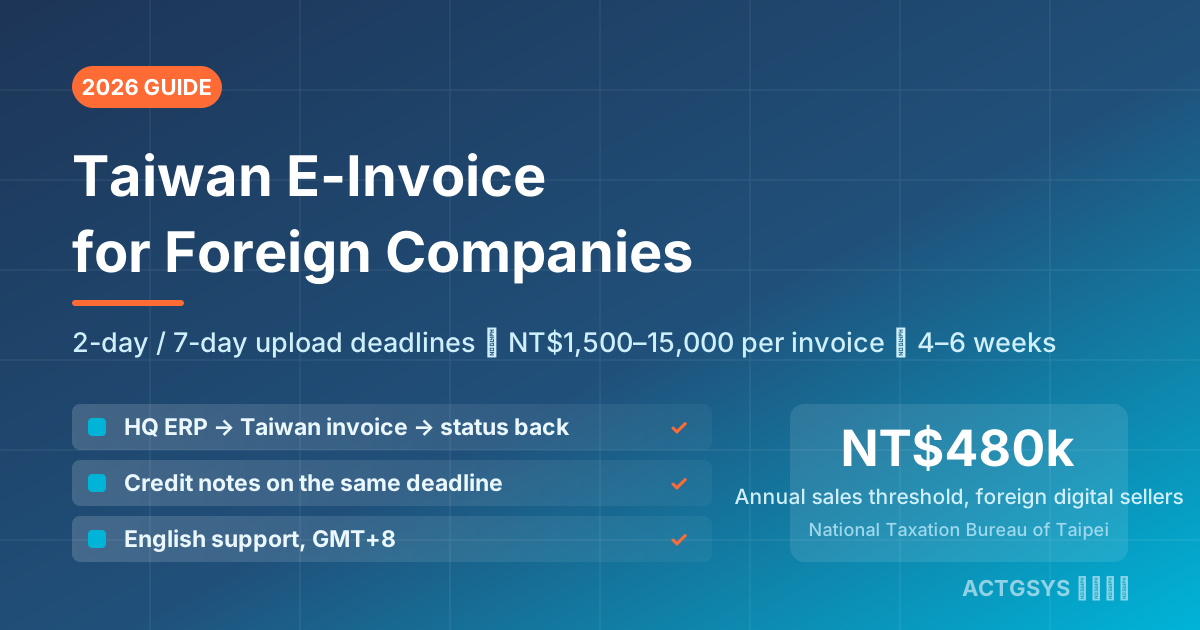
Taiwan E-Invoice for Foreign Companies 2026 - Cost
How a foreign-owned Taiwan subsidiary or branch connects its ERP to Taiwan's e-invoice platform: 2-day B2C / 7-day B2B upload deadlines, NT$1,500–15,000 per-invoice penalties, three integration paths, and a 4–6 week project from NT$50,000.
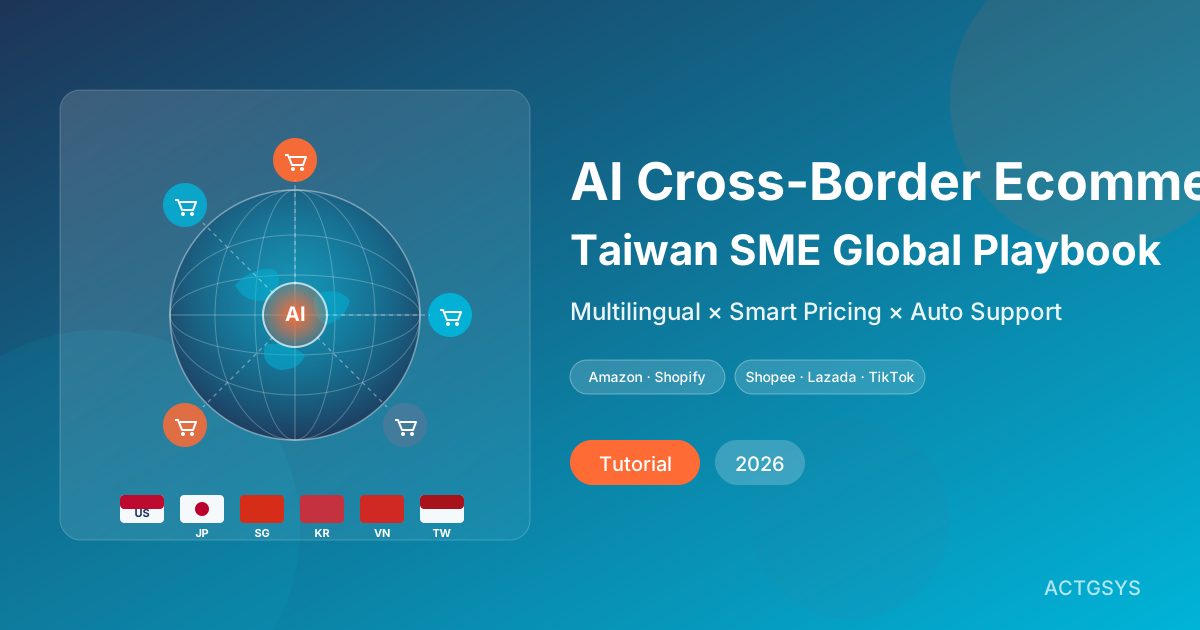
AI Cross-Border Ecommerce Playbook for SMEs (2026)
How Taiwan SMEs use AI to automate cross-border e-commerce — multilingual listings, smart customer service, dynamic pricing, ad ops, and logistics forecasting across Amazon, Shopify, Shopee, Lazada, and TikTok Shop.
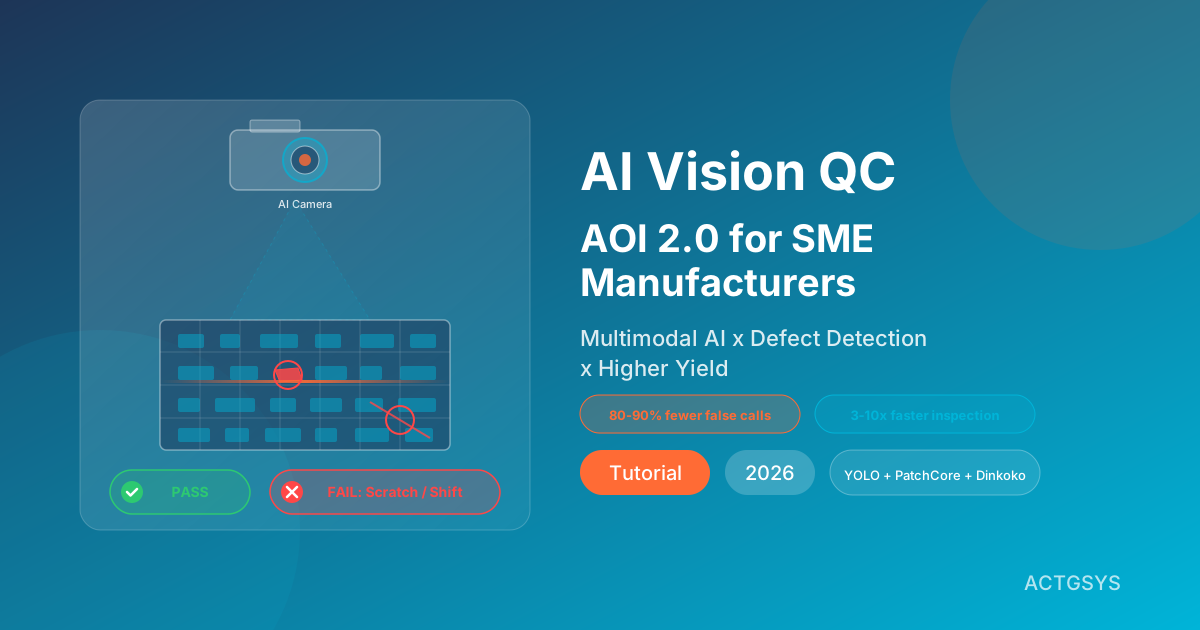
AI Vision Quality Control 2026: AOI 2.0 for SMEs
A deep dive into how AI vision QC (AOI 2.0) combines computer vision with multimodal LLMs to automate defect detection, raise yield and shrink inspection time. Includes a five-step rollout, platform comparison and FAQ.
What would this cost you?
Answer five questions. Within three working days you get a price range and what it covers. No deck, no follow-up sales calls.
Prefer to talk?LINE·02-2553-8084