SME Process Reengineering for AI Automation (2026)
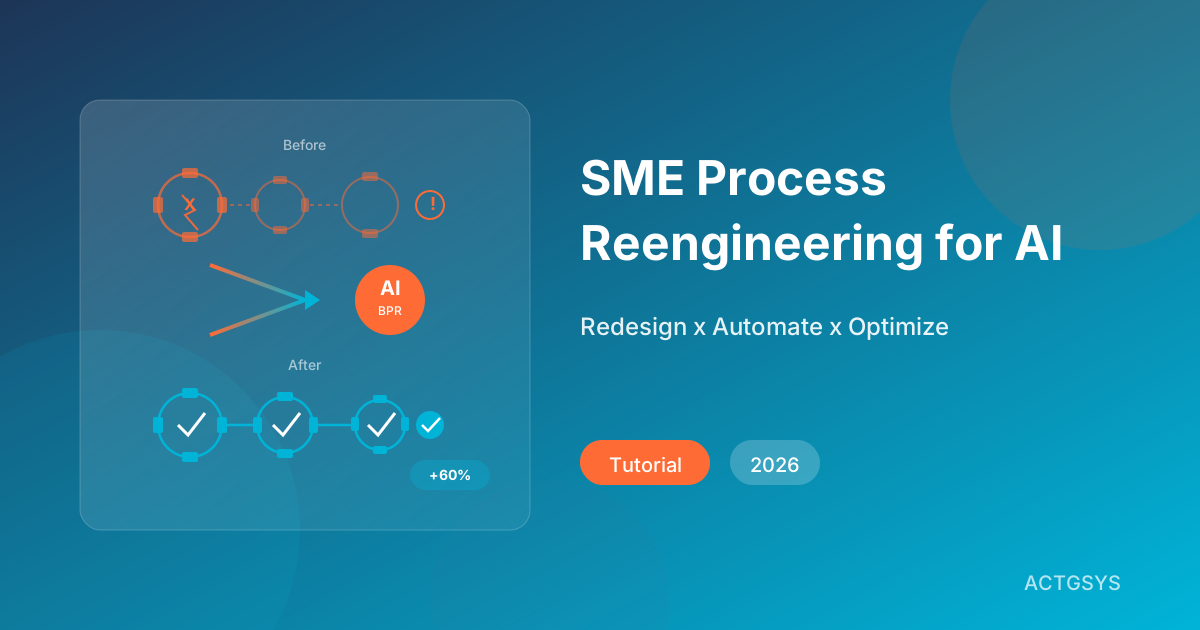
"We spent six months implementing AI automation, and efficiency only improved by 5%." This is the real experience of many SME owners. Where did things go wrong? It's not that AI isn't powerful enough—it's that they automated a broken process, simply running it faster. In 2026, the real key to successful AI automation is redesigning your workflows first.
Why Do 70% of AI Automation Projects Fall Short of Expectations?
According to McKinsey research, over 70% of enterprise automation projects fail to deliver expected results. Many businesses make one critical mistake: they directly transplant existing processes onto AI.
Here's an example: A trading company's order processing workflow originally required five people to sign off, each reviewing only a small piece of information. After implementing AI, the system automatically generated review reports for all five approvers—speed improved, but the five-stage approval structure remained unchanged, and the overall process was still lengthy.
The root cause is clear: these processes were designed for humans, not for "AI + humans." Multi-stage approvals existed because humans make mistakes and need cross-checking. But AI's error patterns are fundamentally different—it can validate all rules simultaneously, making five-stage reviews entirely unnecessary.
Common failure patterns include:
- Automating redundant steps: Some steps in the process are long outdated but were never removed
- Ignoring information flow redesign: Data bounces between departments, and AI just accelerates the bouncing
- Failing to redefine human-AI roles: Staff continue doing work that AI could handle independently
- Lacking end-to-end thinking: Only optimizing individual segments without considering the overall process
What is Business Process Reengineering (BPR)? Why It's a Prerequisite for AI Success
Business Process Reengineering (BPR), introduced by Michael Hammer in the 1990s, centers on fundamentally rethinking and radically redesigning business processes—not making incremental improvements to existing workflows.
In the AI era, BPR is more significant than ever. AI's capabilities differ dramatically from human abilities—it excels at processing massive data volumes, pattern recognition, and 24/7 operation, but struggles with tasks requiring emotional judgment and creativity. Process reengineering redistributes responsibilities between humans and AI based on these characteristics.
Here's how "direct automation" compares with "automation after process reengineering":
| Aspect | Direct Automation | BPR + AI |
|---|---|---|
| Core Approach | Replace manual operations with AI | Redesign processes then introduce AI |
| Process Changes | Same steps, faster speed | Streamlined steps, restructured logic |
| Efficiency Gain | 10-30% | 50-80% |
| Error Rate Improvement | Minor decrease | Significant decrease |
| Staff Roles | Unchanged, reduced workload | Transformed to oversight and decision-making |
| Customer Experience | Slight improvement | Dramatic improvement |
| ROI Timeline | 12-18 months | 6-10 months |
| Long-term Scalability | Limited by original process | Highly scalable |
Five-Step Framework for SME Process Reengineering
Step 1: Current Process Inventory
Before making any changes, you must thoroughly understand existing processes. Many SME workflows have never been fully documented—employees follow "the old way," but nobody knows the complete picture.
How to do it:
- Identify 3-5 core business processes that consume the most time and generate the most complaints
- Observe and document every step in each process, including wait times
- Mark the responsible person, time required, and system tools used for each step
- Calculate the ratio of end-to-end completion time to actual working time for each process
A common discovery: Order processing takes 8 hours end-to-end, but the actual working time is only 45 minutes—the rest is waiting and handoff time.
Step 2: Pain Point and Bottleneck Analysis
After completing the inventory, conduct in-depth analysis for each process:
- Waiting bottlenecks: Where do things get stuck? Is it because someone is unavailable, or because information is missing?
- Duplicate work: What data gets entered multiple times? Which reports are produced redundantly?
- Decision delays: Which approvals are actually unnecessary? Which judgments can be rule-based?
- Information gaps: Which steps require manually looking up data from other systems?
Using backend analytics from systems like DanLee CRM or Dinkoko ERP, you can quantitatively analyze processing times and backlogs at each stage, making bottlenecks impossible to hide.
Step 3: Redesign with AI at the Core
This is the most critical step. Don't ask "Which steps can AI speed up?" Instead, ask:
"If this process were designed from scratch today, with AI available, what would the ideal approach look like?"
Redesign principles:
- Eliminate unnecessary steps: If AI can validate all conditions at once, multi-stage reviews are unnecessary
- Consolidate similar tasks: Combine related tasks scattered across different people
- Front-load information gathering: Have AI collect all required information at the start of the process
- Route exceptions only: Let AI automatically handle standard cases; only escalate exceptions to humans
- Enable real-time feedback: Shift from batch processing to instant response
Step 4: Select Appropriate Technology Tools
Only after process redesign is complete should you select tools. Common technology combinations:
| Process Need | Recommended Tools | Application |
|---|---|---|
| Customer Interaction Automation | DanLee CRM + LINE Bot | Automated follow-ups, smart replies |
| Inventory Process Automation | Dinkoko ERP | Auto order processing, inventory alerts |
| Financial Process Automation | TanJee Accounting System | Auto reconciliation, report generation |
| Cross-system Data Integration | API Integration + AI Agent | Multi-system information sync queries |
| Document Processing Automation | AI OCR + Workflow Engine | Invoice recognition, contract management |
The point is not to choose the most advanced technology, but to choose the tools that best fit your redesigned process.
Step 5: Gradual Implementation and Continuous Optimization
Attempting a complete overhaul at once carries too much risk. A phased approach is recommended:
Phase 1 (Months 1-2):
- Select one high-impact, low-risk process to reengineer first
- Run old and new processes in parallel to confirm stability
Phase 2 (Months 3-4):
- Expand to 2-3 related processes
- Collect user feedback and fine-tune process design
Phase 3 (Months 5-6):
- Roll out across all core processes
- Establish a process monitoring dashboard to continuously track efficiency metrics
After each implementation, measure key indicators: processing time, error rates, customer satisfaction, and employee hours. Validate reengineering results with data, not gut feeling.
Three Common Business Process Reengineering Examples
Sales Process Reengineering
Before:
- Sales reps manually search for prospect lists
- Contact each one individually by phone or email
- Manually create CRM records after customer responds
- Manager reviews quotation (1-2 day wait)
- Revise quotation and resubmit for approval
- After order confirmation, manually notify warehouse
After (DanLee CRM + AI):
- AI automatically analyzes market data and recommends high-potential prospects
- System sends personalized messages automatically; AI tracks interactions
- Customer responses auto-create records with lead scoring
- AI auto-approves standard quotations based on rules; only exceptions go to managers
- Upon order confirmation, automatically syncs to Dinkoko ERP to trigger fulfillment
Result: Sales cycle shortened from 14 days to 5 days, allowing sales reps to focus on high-value customer relationships.
Procurement and Inventory Process Reengineering
Before:
- Warehouse staff manually count inventory weekly
- Fill out purchase requisition when stock falls below safety level
- Procurement manager reviews (1-2 day wait)
- Manually compare prices from 3+ suppliers
- After confirming order, manually notify warehouse of expected delivery
- Upon delivery, manually verify quantities and process receipt
After (Dinkoko ERP + AI):
- System monitors inventory in real-time; AI predicts demand trends
- Auto-generates purchase recommendations when below safety stock, including optimal supplier suggestions
- Standard items auto-ordered; non-standard items routed for human review
- Supplier confirmation automatically updates expected delivery dates
- Barcode scanning at delivery auto-verifies and processes receipt; anomalies auto-flagged
Result: Inventory turnover improved by 40%, stockout rate dropped from 12% to 2%.
Customer Service Process Reengineering
Before:
- Customer calls; service rep manually searches multiple systems
- Records complaint details in Excel
- Forwards to relevant department (1-3 day wait for response)
- Service rep tracks progress, manually follows up with customer
- After resolution, manually categorizes complaint type for statistics
After (DanLee CRM + LINE Bot + AI):
- AI customer service auto-responds to common questions 24/7, simultaneously querying CRM and ERP data
- Complex issues auto-classified and assigned to appropriate departments with complete customer history
- Resolution progress pushed to customer in real-time
- AI auto-analyzes complaint trends and proactively warns about emerging issues
Result: Customer service response time reduced from 24 hours to 5 minutes, with 70% of issues resolved automatically by AI.
Success Story: Trading Company Achieves 60% Efficiency Gain After Process Reengineering
Background: A mid-sized import/export trading company with 35 employees and approximately $10 million USD in annual revenue. The company previously managed operations using scattered Excel files and a legacy ERP system. Before implementing AI automation, they conducted comprehensive process reengineering.
Problems Before Reengineering:
- Orders took an average of 5 business days from receipt to shipment
- Month-end reports required 4 days to produce
- When customers asked about order status, service reps needed an average of 30 minutes to look it up
- Inventory discrepancy rate was as high as 8%
Reengineering Strategy:
-
Eliminated three unnecessary approval layers: Orders originally required sign-off from sales, sales manager, and finance. Analysis revealed that 85% of orders were standard items from existing customers that didn't need layered review. Redesigned so AI auto-approves standard orders; only orders exceeding threshold amounts or from new customers require manual approval.
-
Consolidated information entry points: Sales reps previously operated CRM, ERP, and LINE simultaneously. After reengineering, DanLee CRM became the single entry point, auto-syncing to Dinkoko ERP, with customer notifications automatically sent via LINE Bot.
-
Shifted from batch to real-time processing: Orders were previously processed in a single batch each afternoon. After reengineering, orders enter the system in real-time, with AI automatically completing validation and routing.
Results After Reengineering:
- Order processing time reduced from 5 days to 2 days (-60%)
- Month-end reports reduced from 4 days to half a day (-87.5%)
- Customer inquiry response reduced from 30 minutes to 3 minutes (-90%)
- Inventory discrepancy rate reduced from 8% to 1.5% (-81%)
- Employee overtime hours reduced by 45%
FAQ
Q1: Does process reengineering mean large-scale layoffs?
No. The purpose of process reengineering is to enable people to do more valuable work, not replace them. In practice, most SMEs reassign staff after reengineering—customer service reps transition into customer success managers, data entry staff become data analysts. The focus is on role transformation, not workforce reduction.
Q2: We only have 10 employees. Do we still need process reengineering?
Smaller companies often see the most immediate results from process reengineering. Small businesses typically have more chaotic processes (many tasks are assigned verbally), and everyone wears multiple hats—optimizing one process can free up significant capacity. Start with the most painful process; you don't need to overhaul everything at once.
Q3: How much does process reengineering cost?
Process reengineering itself primarily requires time, not money. Most SMEs can complete core process inventory and redesign in 2-4 weeks. Subsequent AI tool implementation costs depend on requirements—cloud-based systems like DanLee CRM or Dinkoko ERP start at a few hundred dollars per month, with no large upfront investment required.
Q4: How do I convince leadership and colleagues to accept process changes?
The most effective approach is to let data speak. First quantify existing process pain points (e.g., how many hours per month are spent on repetitive work), then demonstrate improvements with a small-scale pilot. When people see firsthand that "what used to take 3 hours now takes 20 minutes," resistance naturally dissolves.
Conclusion: Redesign First, Then Automate
AI technology in 2026 is remarkably mature, but no amount of technical power can fix a fundamentally flawed process design. If you're considering AI automation, invest two weeks upfront in mapping and redesigning your core processes. This "slow" step will make everything that follows exponentially more effective.
Remember this principle: Automating a bad process only produces bad results faster.
Ready to start your process reengineering journey?
The ACTGSYS team brings extensive experience in SME process diagnostics and AI implementation. We can help you:
- Conduct a comprehensive health check of existing processes
- Identify high-value opportunities for automation
- Design new processes with AI at the core
- Implement the right tools including DanLee CRM, Dinkoko ERP, and more
👉 Schedule a Free Consultation and make process reengineering the first step toward AI automation success!
Products & Solutions in This Article
AI-powered CRM for lead management, customer tracking, and sales pipeline optimization designed for SMEs.
AI-driven ERP focusing on procurement, inventory, and supply chain management. Each customer deployed on dedicated cloud infrastructure.
Intuitive accounting system designed for Taiwan SMEs, with automated bookkeeping and financial reporting.
Related Articles
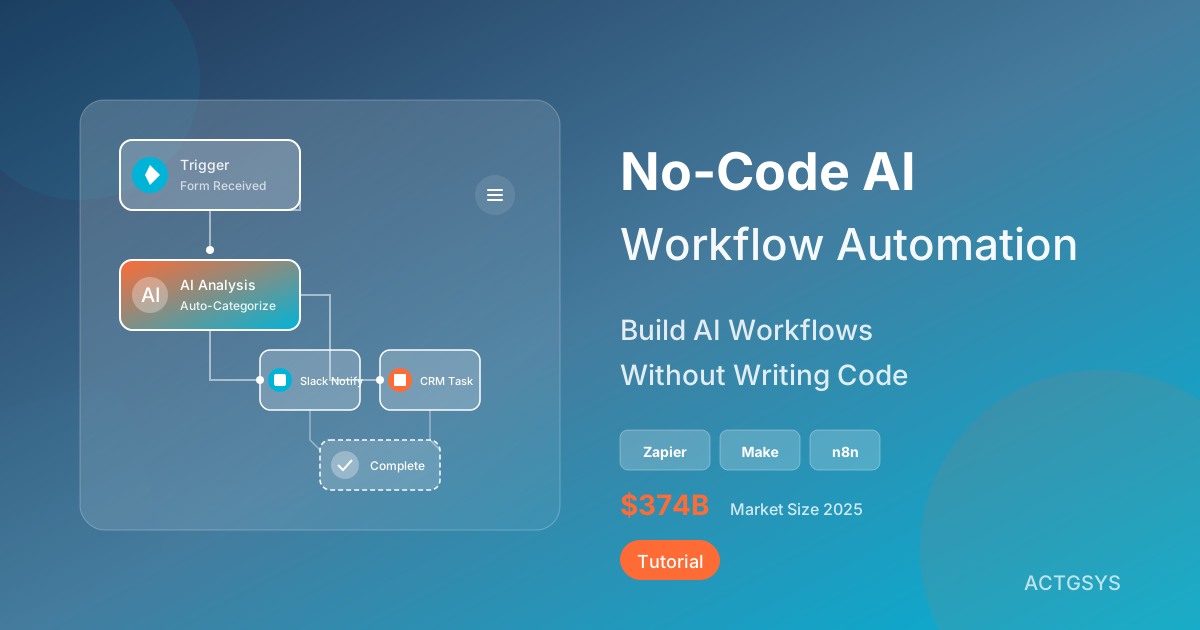
No-Code AI Workflow Automation for SMEs
Explore the hottest No-Code AI automation tools of 2025, including Zapier AI, Make, and n8n. Learn how to build AI workflows using natural language, enabling non-technical staff to achieve enterprise automation with 80% efficiency gains.
What is ERP? Guide to Inventory Management Systems for SMEs
A comprehensive guide to ERP enterprise resource planning systems: from basic inventory management functions to implementation best practices. Learn how to select the right ERP system for your business and optimize inventory and order management.
What Is CRM? The 2025 SME Guide
A comprehensive guide to CRM systems: from basic concepts to implementation best practices. Learn how to select and implement the right CRM system to improve sales and customer management for your business.
What would this cost you?
Answer five questions. Within three working days you get a price range and what it covers. No deck, no follow-up sales calls.
Prefer to talk?LINE·02-2553-8084