Snowflake CoCo and CoWork (2026): The Data Platform Grows Its Own AI Agents
At its June 2026 Summit, Snowflake made its data platform fully "agentic" — upgrading the coding assistant CoCo (formerly Cortex Code) into an autonomous development platform, launching CoWork as a personal agent for knowledge workers, and claiming on its own benchmark that CoCo beats Claude Code. For Taiwan's SMEs, this news has two takeaways: the trend of "AI agents moving to where the data lives" is worth understanding, and "vendor self-run benchmarks" deserve a skeptical eye.
What Did Snowflake Announce at Summit 2026?
At Snowflake Summit 2026 in June 2026, the theme was "agentic intelligence," centered on letting AI agents live directly on top of the enterprise data platform. According to Snowflake's official press release (2026), the headline is CoCo — formerly Cortex Code — now upgraded from an AI coding assistant into an "autonomous development platform" that lets users automate data engineering, build apps, and operationalize AI on enterprise data through simple conversation.
Several agent capabilities launched alongside it: CoWork is a secure personal agent for knowledge workers (Snowflake press release (2026)); Cortex Sense is a runtime context-enrichment layer that assembles shared semantics from query history, object metadata, BI dashboard definitions, and semantic views, injecting business definitions into every agent response; and Cortex Training lets enterprises train domain-specific models in their own environments.
- Venue: Snowflake Summit 2026 (June 2026)
- CoCo: formerly Cortex Code, upgraded to a data-native autonomous development platform
- CoWork: a secure personal agent for knowledge workers
- Cortex Sense: runtime context-enrichment layer injecting business semantics into agent responses
- Cortex Training: train domain-specific models in your own environment
- Talking point: on June 18, 2026, Snowflake claimed on its own benchmark that CoCo beats Claude Code on coding-agent tasks
What Are the Highlights of CoCo and CoWork?
The core of this launch is "putting agents next to the data so they're born carrying enterprise context."
- Data-native agents — CoCo and CoWork run inside the data platform, so agents are "attached" to enterprise data from birth, reducing data movement and lost context.
- Conversational automation — drive data engineering, app development, and analysis in natural language, lowering the technical bar.
- Automatic context injection — Cortex Sense brings field definitions and dashboard semantics into every response, cutting "agent doesn't understand business jargon" errors.
- Trainable custom models — Cortex Training lets enterprises tune models on their own data for a better fit.
But treat that benchmark with care: CoCo "beats Claude Code" is a conclusion drawn on Snowflake's own benchmark (TechTimes, 2026). Vendors claiming a lead under custom, self-favorable test conditions is industry-standard — such numbers are a reference, not an independent, objective verdict.
How Does a "Data-Native Agent" Differ From a "General Coding Agent"? (Comparison Table)
The most useful thing for SMEs isn't CoCo's benchmark — it's understanding the difference between "an agent living inside the data platform" and "a general agent connecting to data externally":
| Dimension | Data-native agent (e.g., Snowflake CoCo) | General coding/AI agent (external data) |
|---|---|---|
| Data context | Born attached to platform data and definitions | Must connect data and supply context |
| Best fit | Enterprises already heavy on that platform | Any environment, high flexibility |
| Lock-in risk | Higher (tied to platform) | Lower (swappable) |
| Adoption bar | Requires being on the platform | Depends on integration |
| Benchmark source | Often vendor self-run; treat with care | Depends on third-party evals |
| For SMEs | Mostly enterprise-grade | Easier to adopt in existing setups |
(Sources: Snowflake press release (2026), TechTimes (2026).)
The key takeaway: "agents attached to data" is a real trend, but "attached to which platform's data" determines your lock-in risk. For SMEs, the point isn't whether to buy Snowflake — it's absorbing the principle "let agents connect to contextual data" while staying alert to two traps: single-platform lock-in and vendor self-run benchmarks.
What Do Developers and the Industry Think?
The community's focus is on "data platforms entering the agent war" and "the credibility of self-run benchmarks."
Positives center on the value of agents attached to data — many agree that running agents inside the data platform, automatically carrying field definitions and business semantics, genuinely reduces the common "the agent doesn't understand your data" problem — consistent with the broader direction that "data readiness is a precondition for agents."
Reservations center on benchmarks and lock-in — independent commentary cautions that "beats a rival on our own benchmark" claims should be discounted, since the test conditions are vendor-set (TechTimes, 2026); and deeply wiring core workflows into a single data platform amplifies vendor lock-in over time.
In the bigger picture, this aligns with Gartner's consistent view: in 2026, AI agents are rapidly becoming part of enterprise infrastructure, with every platform (cloud, data, CRM, dev tools) embedding agents into its own turf. The real question for enterprises isn't "whether to use agents," but "how to gain context without being locked into a single platform."
What Does This Mean for Taiwan's SMEs?
For Taiwan's SMEs, the thing to absorb is the principle, not the product: AI agents are reliable only when connected to data that's contextual, defined, and governed — but don't tie your lifeline to a single platform for that benefit. Most SMEs won't use a Snowflake-grade data cloud, but both the trend and the warning apply.
Opportunities:
- Validates the "agents attached to data" direction — your AI agents should connect to core operational data (customers, orders, inventory), not scattered spreadsheets, to err less.
- Use the "context injection" idea — tidy up field definitions and business terminology so agent responses carry business context — low-cost, high-return prep.
- See the model/platform division of labor — notably, even Snowflake brings external flagships like Claude Fable 5 into its security perimeter, showing "data platform + best external model" is a common pattern.
But be pragmatic about three things:
- Discount vendor self-run benchmarks — for any "we beat X" claim, first ask "who set the test? Is there an independent third-party eval?" before deciding how much to believe.
- Guard against vendor lock-in — before deeply wiring core processes into one platform, weigh future migration cost and flexibility.
- Don't chase enterprise-grade tools — CoCo/CoWork skew enterprise; for SMEs, absorb the principle and build your data foundation with your existing CRM/ERP.
In practice: if your core data is concentrated in DanLee CRM and Dinkoko ERP, let AI agents connect to that structured, permissioned data and tidy up field definitions — that achieves the core benefit of "data-native agents" in a way small businesses can afford, while keeping models and platforms swappable in your architecture so no single vendor locks you in.
ACTGSYS Recommendations: What Should You Do Now?
For SMEs, Snowflake's launch is "trend validation + two warnings" — the action is applying the principles, not procurement.
Do now:
- Connect agents to core operational data — wire AI applications to governed data in your CRM/ERP, not scattered files, to cut hallucinations and errors.
- Tidy up business definitions for high-frequency fields — write out definitions like "customer status" and "deal amount" so agent responses carry context.
- Build a benchmark-skepticism checklist — when evaluating any AI tool, always ask about the test source, whether there's a third-party eval, and how close it is to your real tasks.
Hold off:
- Don't rush an enterprise data cloud — unless you already have high-volume, multi-system integration needs, build the foundation with existing systems first.
- Don't deeply wire core processes into one platform yet — keep models and platforms swappable to avoid long-term lock-in.
Frequently Asked Questions
Are Snowflake CoCo and Cortex Code the same thing?
Yes. CoCo was formerly Cortex Code, upgraded and renamed at Summit 2026 in June 2026, expanding from an AI coding assistant into an "autonomous development platform" that automates data engineering, app development, and AI operationalization through conversation.
Does CoCo really beat Claude Code at coding?
Treat it with care. Snowflake claimed on June 18, 2026, that CoCo beats Claude Code on coding-agent tasks, but that conclusion comes from Snowflake's own benchmark. Vendor self-run tests under self-favorable conditions are common; take them as a reference and ask whether an independent third-party eval exists.
Do SMEs need Snowflake CoCo / CoWork?
Most don't. CoCo/CoWork mainly target enterprises already heavy on Snowflake. SMEs should absorb the principle: connect AI agents to contextual, governed core data. Concentrating data in your existing CRM/ERP and tidying definitions achieves similar benefits at lower cost.
What's the lesson of "data-native agents" for SMEs?
That AI agents are reliable only when connected to contextual, defined, permissioned data — not scattered spreadsheets. SMEs needn't buy a large data cloud, but should connect agents to clean data in core operational systems while staying alert to two traps: vendor lock-in and vendor self-run benchmarks.
Conclusion
By making its data platform fully agentic, Snowflake validates the trend that "AI agents are moving to where the data lives," but "beats Claude Code on its own benchmark" also reminds us to view vendor claims skeptically. For Taiwan's SMEs, the right response isn't chasing a large data cloud — it's grasping the principles: connect agents to contextual, governed core data, tidy business definitions, stay skeptical of any benchmark, and keep models and platforms swappable.
Want AI agents to safely connect to core data in your CRM/ERP, with tidy business definitions, without being locked into a single platform? Contact ACTGSYS — we help Taiwan's SMEs find the most practical path between "agents attached to data" and "keeping flexibility."
Event date: June 2026 (Snowflake Summit 2026 launches CoCo/CoWork; benchmark announced June 18). Last updated: June 19, 2026.
Products & Solutions in This Article
AI-powered CRM for lead management, customer tracking, and sales pipeline optimization designed for SMEs.
AI-driven ERP focusing on procurement, inventory, and supply chain management. Each customer deployed on dedicated cloud infrastructure.
Related Articles
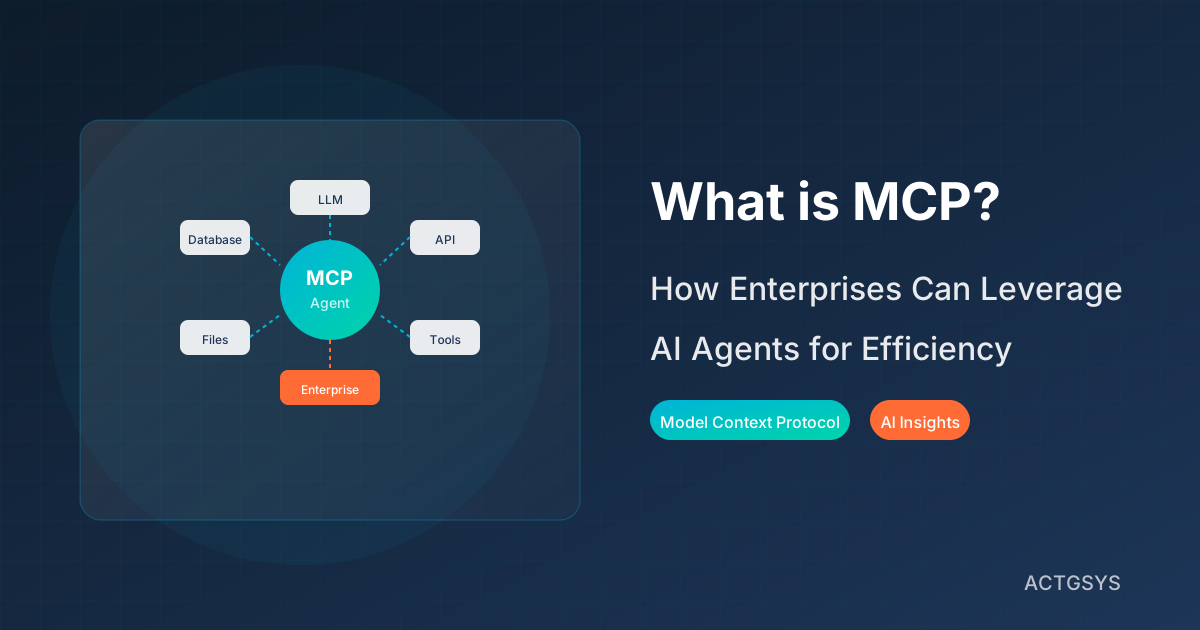
What Is MCP? Enterprise AI Agents Explained
An in-depth explanation of Model Context Protocol (MCP), and how enterprises can implement AI Agent architectures for cross-system integration, automated workflows, and intelligent decision support.
OpenAI Brings Codex to 'Every Role' (2026)
On June 2, 2026, OpenAI announced a major Codex update: role-specific plugins for six jobs (data analytics, sales, product design and more — bundling 62 apps and 110 automated skills) plus Codex Sites, which turns data and documents into shareable internal apps. This article breaks down what 'non-engineers building tools with AI' means for SMEs.
Mistral Rebrands Le Chat as Vibe, a Full 'Work Agent' (2026)
Mistral renamed its chatbot Le Chat to Vibe on May 28, 2026, unifying Work Mode and Code Mode so a single account connects to Google Workspace, Outlook, Slack, and GitHub to autonomously handle email, calendar, documents, and recurring processes. Here's what this European work agent means for SME automation.
What would this cost you?
Answer five questions. Within three working days you get a price range and what it covers. No deck, no follow-up sales calls.
Prefer to talk?LINE·02-2553-8084