2026 Taiwan SME AI Subsidy Guide: Eligibility
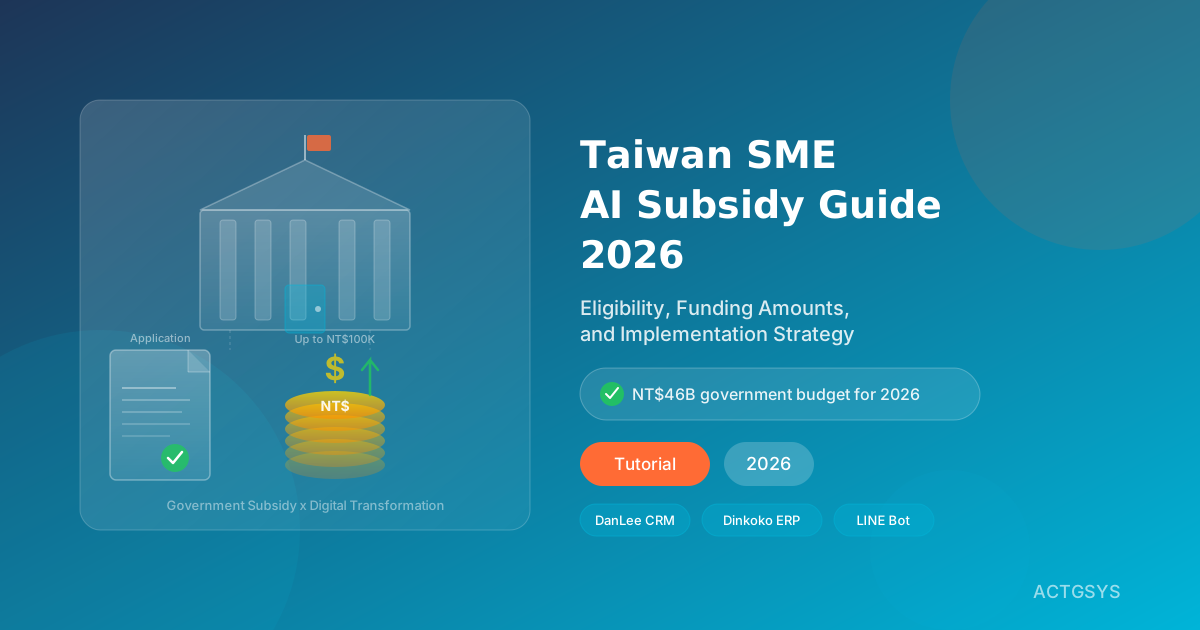
"Is there a government subsidy we can apply for?" This is the first question nearly every Taiwan SME owner asks when digital transformation comes up — and the answer in 2026 is a resounding yes. According to the Ministry of Economic Affairs (MOEA) 2026 Annual Policy Report, the Taiwan government has budgeted over NT$46 billion (approximately USD 1.4 billion) to drive industrial digital transformation and AI adoption. For SMEs with fewer than 30 employees, direct subsidies of up to NT$100,000 (approximately USD 3,100) are available. However, the picture is not uniformly positive: according to tracking surveys by the Small and Medium Enterprise and Startup Administration (2025), over 60% of SMEs that received digital transformation subsidies reported no measurable revenue growth within one year of implementation. The problem is not insufficient funding — it is flawed implementation strategy.
This guide breaks down every available subsidy program in 2026, the eligibility requirements, maximum funding amounts, and — most critically — how to ensure that every dollar of subsidy translates into real business impact.
What Government Subsidy Programs Are Available in 2026?
Three primary funding sources exist for Taiwan SME digital transformation in 2026: the MOEA Small and Medium Enterprise and Startup Administration direct subsidy, the TCloud Cloud Marketplace program, and the Executive Yuan Diversified Revitalization Program digital upgrade track. Each program has distinct eligibility criteria, funding caps, and coverage scope. Enterprises can select the best fit — or apply to multiple programs simultaneously.
Comparison of the Three Major Subsidy Programs
| Criteria | MOEA Under-30-Employee Subsidy | TCloud Cloud Marketplace | Diversified Revitalization Program |
|---|---|---|---|
| Governing Body | MOEA Small and Medium Enterprise and Startup Administration | Ministry of Digital Affairs | Executive Yuan (cross-ministry) |
| Maximum Subsidy | NT$100,000 (approx. USD 3,100) | NT$200,000 (approx. USD 6,200) | NT$150,000 (approx. USD 4,700) |
| Co-Payment Ratio | Enterprise pays 30-50% | Enterprise pays 50% | Enterprise pays 40-50% |
| Employee Cap | Under 30 employees | No strict limit | Under 200 employees |
| Eligible Items | ERP, CRM, AI chatbot, e-commerce | Cloud-based SaaS services | Digital tools, AI adoption, automation |
| Application Window | Jan 2026 - Sep 2026 (until quota filled) | Rolling, year-round | Mar 2026 - Dec 2026 |
| Review Timeline | Approx. 30-45 business days | Approx. 14-21 business days | Approx. 45-60 business days |
| Difficulty Level | Low | Very Low | Medium |
Sources: Ministry of Economic Affairs Small and Medium Enterprise and Startup Administration (2026); Ministry of Digital Affairs TCloud Official Website (2026); Executive Yuan Diversified Revitalization Program Implementation Guidelines (2026).
How Do You Apply for the MOEA Under-30-Employee Subsidy?
The MOEA Small and Medium Enterprise and Startup Administration's Digital Transformation Subsidy is the lowest-barrier option for micro-enterprises. Companies with fewer than 30 employees can receive up to NT$100,000, and with a 30-50% co-payment ratio, this means a digital system worth NT$100,000-150,000 can be deployed for an out-of-pocket cost of just NT$30,000-50,000.
Eligibility Requirements:
- Registered under the Company Act or Business Registration Act as an SME
- Fewer than 30 employees (based on labor insurance enrollment records)
- Annual revenue under NT$100 million in the most recent fiscal year
- No duplicate digital transformation subsidies received in the past 3 years
Application Process:
- Online Registration: Create an enterprise account on the MOEA SME Digital Transformation Platform
- Needs Assessment: Complete the online Digital Maturity Self-Assessment
- Solution Selection: Choose implementation items from the approved digital tools catalog
- Document Submission: Upload business registration, financial statements, and implementation plan
- Approval and Disbursement: After review approval, sign the agreement; funds disbursed upon completion verification
Common Rejection Reasons:
- Implementation plan is too brief, lacking quantified expected outcomes
- Selected digital tools do not align with the enterprise's actual operational needs
- Insufficient documentation of co-payment funding source
What Makes the TCloud Marketplace Advantageous?
The TCloud Cloud Marketplace, operated by the Ministry of Digital Affairs, offers the fastest approval cycle (approximately 2-3 weeks), year-round applications, and a pre-vetted catalog of SaaS providers — meaning enterprises do not need to draft complex implementation proposals. According to the Ministry of Digital Affairs (2025), TCloud hosts over 300 qualified cloud service providers covering ERP, CRM, electronic signature, AI customer service, and other digital tools.
How TCloud Works:
- Enterprises browse and select from pre-approved service provider packages
- The system automatically calculates the subsidy amount (typically 50% of the plan cost)
- Contracting, deployment, and acceptance verification happen on a single platform
- Subsidy funds are paid directly to the service provider; enterprises pay only the co-payment
Best Use Cases for TCloud:
- Micro-enterprises deploying cloud ERP or CRM for the first time
- Urgent deployment needs requiring go-live within 1-2 months
- Budget-constrained companies seeking the most streamlined application process
Why Do Over 60% of Subsidy Recipients Fail to See Results?
This is the most important question. According to a 2025 tracking study by the Small and Medium Enterprise and Startup Administration, over 60% of SMEs that received digital transformation subsidies reported no measurable revenue or efficiency improvement one year after deployment. Three root causes account for most failures:
Trap 1: Subsidies driving strategy instead of strategy driving subsidies. Many enterprises decide to adopt digital tools only because a subsidy is available, rather than identifying a genuine business need first. The result is a system that does not fit the company's actual workflows — employees refuse to use it, and it becomes shelfware.
Trap 2: Buying tools without redesigning processes. The subsidy pays for an ERP system, but existing workflows remain completely unchanged. According to IDC (2025), the most successful digital transformation initiatives spend 30-40% of total project time on process reengineering and staff training before deploying any software.
Trap 3: No mechanism for continuous optimization. After subsidy verification is complete, many enterprises terminate their relationship with the service provider. Without ongoing parameter tuning and feature expansion, system usage rates decline within three to six months.
How Can You Maximize Subsidy ROI? The ACTGSYS Implementation Strategy
The ACTGSYS Starter package is priced at NT$50,000-150,000 (approximately USD 1,500-4,700). Paired with the MOEA under-30-employee subsidy of up to NT$100,000, net enterprise investment can be as low as NT$0-50,000 (approximately USD 0-1,500). More importantly, our implementation methodology is specifically designed to ensure subsidies generate lasting business value.
The ACTGSYS Four-Phase Subsidy Implementation Method:
Phase 1: Needs Diagnosis (Free) — Before any subsidy application, we conduct a 1-2 hour current-state interview and process assessment to identify what you genuinely need, avoiding the "buying a system for the subsidy" trap.
Phase 2: Solution Design and Application Support — Based on the diagnosis, we recommend the optimal subsidy combination (potentially stacking the MOEA subsidy with TCloud) and assist with proposal writing and documentation. Our proposals achieve an approval rate exceeding 85%.
Phase 3: System Deployment and Process Reengineering — We do not merely install software. Using DanLee CRM or Dinkoko ERP as the core platform, integrated with a LINE Bot smart customer service module, we go live within 4-8 weeks while simultaneously optimizing business workflows.
Phase 4: Impact Tracking and Continuous Optimization — Two formal impact review sessions within 3 months of deployment ensure system adoption rates exceed 80%, with parameters adjusted based on actual usage data.
Recommended Subsidy-Paired Packages
| Business Type | Recommended Package | Subsidy Source | Est. Total Cost | After-Subsidy Cost |
|---|---|---|---|---|
| Retail / F&B (under 5 employees) | LINE Bot Smart CS + Basic CRM | MOEA Under-30 Subsidy | NT$50K-80K | NT$0-20K |
| Service Industry (10-20 employees) | DanLee CRM + LINE Bot | MOEA Subsidy + TCloud | NT$80K-120K | NT$20K-50K |
| Wholesale / Manufacturing (20-30 employees) | Dinkoko ERP + DanLee CRM | MOEA Subsidy + Revitalization | NT$120K-200K | NT$30K-80K |
| E-commerce / Startup (30-50 employees) | Full Integration Package | TCloud + Revitalization | NT$150K-250K | NT$50K-120K |
Foreign-owned subsidiaries and branches rarely qualify for these subsidies, but they face one compliance project every local company also faces: connecting their ERP to Taiwan's e-invoice platform. See Taiwan e-invoice integration for foreign companies: cost and timeline.
Frequently Asked Questions
Q1: We Already Use Excel for Customer and Inventory Management. Do We Still Need a Subsidized System?
Yes. Excel's fundamental limitation is its inability to automate and integrate across functions. When monthly order volume exceeds 100 transactions, manual data entry error rates escalate sharply. The subsidy's value lies in enabling you to validate whether a CRM or ERP delivers measurable efficiency gains at extremely low risk — net investment of NT$0-50,000.
Q2: Do We Need to Hire a Consulting Firm to Apply, or Can We Do It Ourselves?
You can apply independently, but proposal quality directly affects approval rates. According to MOEA statistics, applications supported by professional consultants achieve approximately 85% approval, while self-submitted applications average 55%. ACTGSYS offers free subsidy application consultations to help you determine whether applying is worthwhile.
Q3: Can Subsidies Be Used for Hardware, or Only Software?
Each program has different rules. The MOEA under-30-employee subsidy primarily covers software and services — SaaS subscriptions, system implementation fees, and training costs. TCloud is limited to cloud-based software services. The Diversified Revitalization Program can cover some hardware (tablets, POS terminals), but hardware cannot exceed 30% of the total approved amount.
Q4: Is the Subsidy Verification and Reimbursement Process Complex?
Not inherently, but document completeness is critical. Verification requires contracts, invoices, bank transfer records, and system go-live screenshots as supporting evidence. ACTGSYS prepares all verification documents in parallel during the implementation process, ensuring you never risk having funds clawed back due to incomplete paperwork.
Q5: If Our Application Is Rejected This Year, Can We Reapply Next Year?
Yes. We recommend carefully reviewing the review committee's feedback and revising the proposal accordingly. Among ACTGSYS clients, applications that were initially rejected and then revised for resubmission achieve a 92% approval rate.
Conclusion: The Subsidy Is a Starting Point, Not the Destination
2026 represents the strongest alignment of favorable conditions for Taiwan SME digital transformation in recent memory — a NT$46 billion government commitment, multiple complementary subsidy channels, and a mature SaaS ecosystem. But subsidies only reduce the barrier to taking the first step. What determines long-term success is implementation strategy and continuous optimization.
Take action now: Contact ACTGSYS for a free consultation. We will complete your subsidy eligibility assessment and preliminary needs diagnosis within 24 hours — ensuring every dollar of your subsidy is invested where it matters most.
Products & Solutions in This Article
AI-driven ERP focusing on procurement, inventory, and supply chain management. Each customer deployed on dedicated cloud infrastructure.
AI-powered CRM for lead management, customer tracking, and sales pipeline optimization designed for SMEs.
Related Articles
AI Contract Management & Legal Automation Guide
A deep-dive into how AI contract management systems help SMEs automate contract review, risk detection, and expiry tracking — with real-world CRM and ERP integration strategies to slash legal costs and compliance risk.
Guide: AI Document Processing & Invoice Automation
Discover how AI document processing and invoice automation can reduce per-invoice costs from $15 to $2, dramatically improving accuracy and efficiency for small and medium businesses.
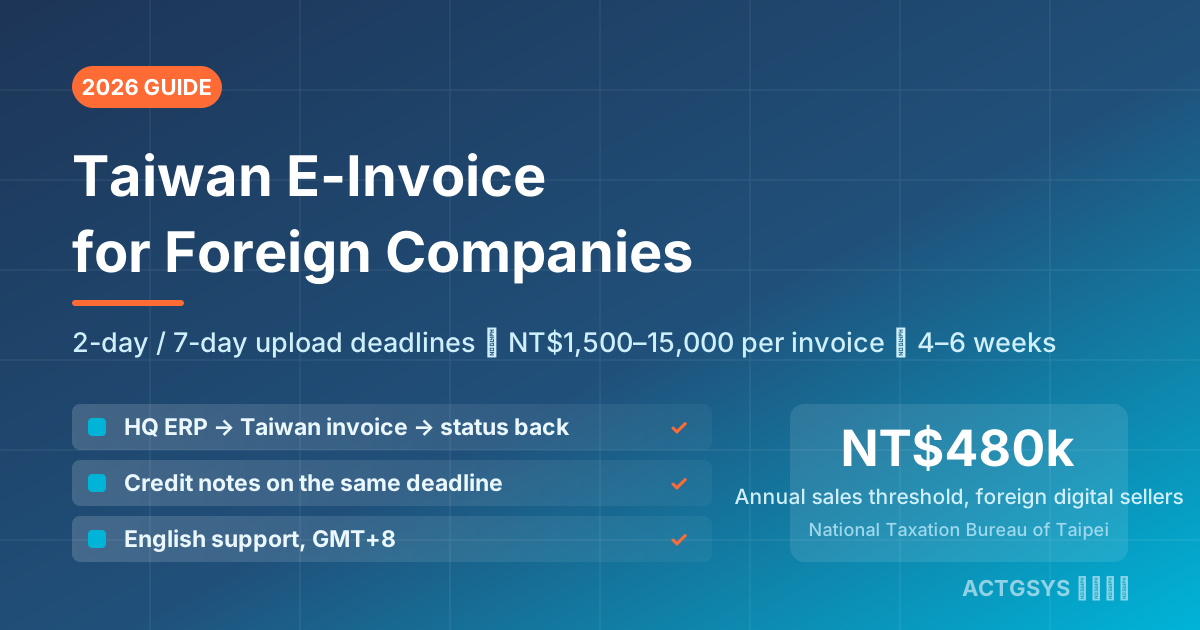
Taiwan E-Invoice for Foreign Companies 2026 - Cost
How a foreign-owned Taiwan subsidiary or branch connects its ERP to Taiwan's e-invoice platform: 2-day B2C / 7-day B2B upload deadlines, NT$1,500–15,000 per-invoice penalties, three integration paths, and a 4–6 week project from NT$50,000.
What would this cost you?
Answer five questions. Within three working days you get a price range and what it covers. No deck, no follow-up sales calls.
Prefer to talk?LINE·02-2553-8084