Vertical AI Agents 2026: Why Industry-Specific Agents Are Eating SaaS and How SMEs Choose or Build Their Own
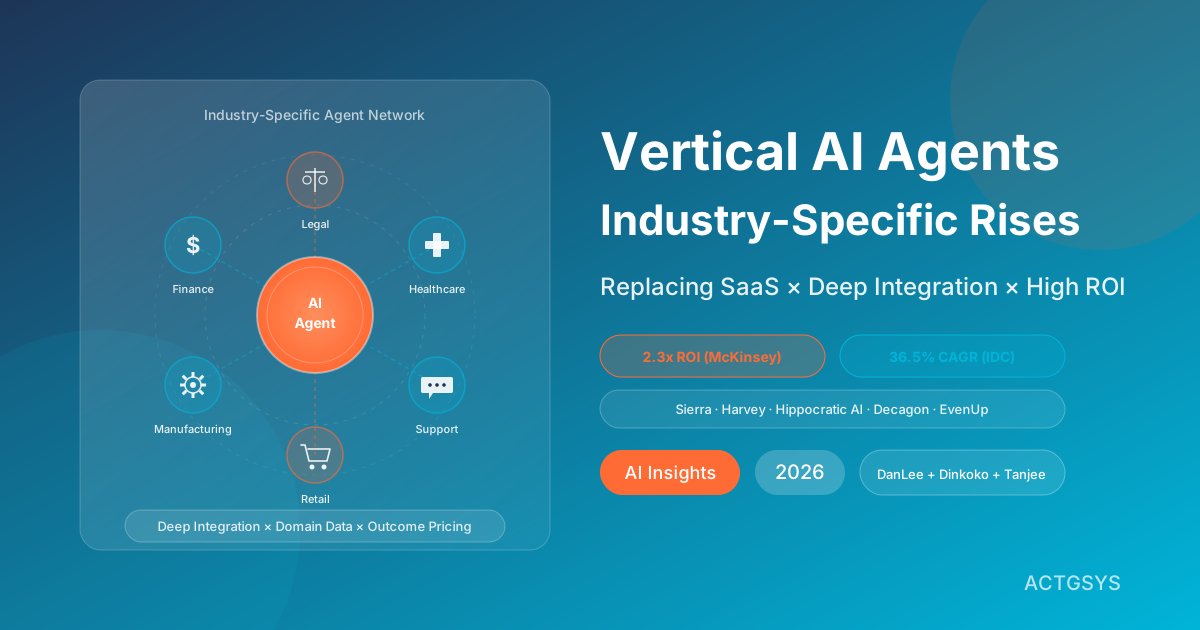
Vertical AI Agents 2026: Why Industry-Specific Agents Are Eating SaaS and How SMEs Choose or Build Their Own
TL;DR
2026 is the year vertical AI agents — purpose-built for one industry or workflow — overtake horizontal SaaS. Sierra (customer service), Harvey (legal), Hippocratic AI (healthcare) and EvenUp (personal injury law) are reshaping a $450B+ vertical SaaS market through deep integrations, domain knowledge, and outcome-based pricing. Gartner and McKinsey forecast that over 40% of enterprise AI deployments in 2026 will be vertical-first. This article unpacks vertical vs horizontal agents, surveys leading 2026 case studies, and gives Taiwanese SMEs a 7-step playbook to pick or build their own industry-specific agent.
What Is a Vertical AI Agent? How It Differs from Horizontal Agents
A vertical AI agent is an AI system purpose-built for a single industry or workflow, pre-loaded with domain knowledge, compliance rules, proprietary data models and deep integrations. Horizontal agents (ChatGPT, Claude, Microsoft Copilot) are designed for cross-domain generality and rely on user prompting to add expertise. The difference is not "can it answer legal questions" — it is "can it draft a brief, pull precedents, log billable time and meet firm-wide compliance inside a lawyer's actual workflow."
Anthropic's "Building Effective Agents" (2024) explicitly states that agent effectiveness "depends primarily on tool design and task decomposition," not raw model capability. This is exactly where vertical agents win — they ship with pre-engineered tools, SOPs, and decision trees for one industry, so users don't have to rewrite prompts or rebuild context every session.
Horizontal agents behave like a generalist intern: they can write emails, summarise meetings, and search the web, but they don't know your customer codes, contract templates, industry regulations, or ERP schema. Vertical agents behave like a senior employee with 10 years of industry experience — on day one they already understand your payment terms, jargon and exception handling.
McKinsey's "State of AI 2025" reports that companies deploying vertical AI solutions see 2.3x higher average ROI than those using only general-purpose LLMs, and 71% of vertical deployments continue generating value 6 months in (vs 32% for horizontal-only deployments).
Four Building Blocks of a Vertical Agent
- Domain data layer: industry datasets, vocabulary, compliance rules (HIPAA, PCI-DSS, GDPR)
- Tool layer: deep connectors to core industry systems (iManage for law firms, EHRs for hospitals, POS/ERP for retail)
- Workflow layer: programmatic decomposition of industry SOPs and task orchestration
- Evaluation layer: industry-specific KPIs (CSAT for support, win rate for legal, diagnostic accuracy for healthcare)
Why Vertical AI Agents Are Replacing Traditional SaaS
Vertical AI agents are replacing SaaS because SaaS sells software seats, but vertical agents sell completed work. When buyers shift from "we need 50 CRM licences" to "we need 5,000 tickets handled monthly," the subscription model, competitive moat and market structure all reshuffle. a16z's 2025 report "AI Eats Vertical SaaS" estimates the global vertical SaaS market at roughly $450B, with 30-40% likely to be reshaped by AI agents between 2026 and 2028.
IDC's "Worldwide AI Spending Guide 2025" forecasts global enterprise AI spending will reach $307B in 2026, with industry solutions growing at a 36.5% CAGR — far above 18.9% for general-purpose AI tools. BCG's "AI at Work 2025" found that 70% of the highest-ROI enterprise AI deployments come from "embedding agents into existing business processes," not from "buying a new AI tool."
Traditional SaaS sells "interfaces + forms + dashboards" — humans enter data, generate insights, and decide. Vertical agents internalize the entire "fill → analyse → decide → act" loop; users only define goals and review exceptions. This is why Klarna stated publicly in 2024 that its AI customer service assistant did the work of "700 full-time agents" and progressively reduced its Salesforce Service Cloud footprint.
Three Value Shifts from SaaS to Vertical Agents
- From per-seat licensing to outcome-based pricing: Sierra, EvenUp and Crescendo charge per resolved ticket or per completed claim
- From dashboards to autonomous action: traditional BI shows data; vertical agents take optimisation actions
- From "integrating many SaaS tools" to "an agent orchestrating systems": open protocols like Anthropic's MCP (Model Context Protocol, launched 2024) turn agents into the new integration hub
Stanford HAI's "AI Index Report 2025" tracked that 47% of the top 500 U.S. enterprises had migrated at least one business process from SaaS to a vertical AI agent in 2024-2025, up from just 11% in 2023.
Notable Vertical AI Agents in 2026
The leading vertical agents of 2026 are no longer demos — they handle millions of transactions and generate billions in value. The companies below are all backed by top-tier VCs (a16z, Sequoia, Benchmark) and run real production workloads. The common thread: deep domain know-how, deep system integration, and outcome-aligned pricing.
1. Sierra (customer service)
Founded in 2023 by former Salesforce co-CEO Bret Taylor and ex-Google executive Clay Bavor, Sierra builds custom branded agents that handle support across voice and chat. It integrates brand voice, product catalogues, refund policies and CRM. Customers include SiriusXM, WeightWatchers and Sonos. Sierra charges per resolved ticket and was valued at $4.5B in 2024.
2. Decagon (enterprise customer support)
Decagon targets mid-to-large enterprises (ClassPass, Eventbrite, Bilt Rewards) with agents that handle 70-90% of support interactions, paired with a performance console for human oversight. The company hit a $1.5B Series B valuation in 2025 (source: The Information, 2025).
3. Harvey AI (legal)
Harvey is a vertical agent built for law firms — contract review, case law research, due diligence, brief drafting. Customers include A&O Shearman, PwC Legal and Macfarlanes. Its moat is deep integration with legal language, citation systems and document management (iManage, NetDocuments). Harvey was valued at $3B in 2025.
4. Hippocratic AI (healthcare)
Hippocratic AI focuses on non-diagnostic healthcare interactions — pre-op education, chronic care, medication reminders — and partners with NVIDIA on real-time conversational healthcare agents. It has a physician-led safety board and was valued at $1.6B in 2025, with 25+ U.S. health system partners (source: CNBC Health Tech, 2025).
5. Crescendo (CX with outcome guarantees)
Crescendo blends AI agents with a global human CX team to offer hybrid agent + outcome-based service, raising a $50M Series A in 2024.
6. EvenUp (personal injury law)
EvenUp auto-generates demand letters and calculates fair settlement amounts for personal injury law firms. Valued at $1B in 2024, it has processed over 30,000 cases.
7. Cresta (contact centre agent assist)
Cresta delivers real-time conversational intelligence for large contact centres, running humans and AI agents on dual tracks and learning industry best practices from every call. Customers include Verizon, Vodafone and CarMax.
8. Klarity (contract review)
Klarity specialises in contract review for SaaS companies and accounting firms (especially ASC 606 revenue recognition), raising a $70M Series C in 2024.
9. Mendel AI (healthcare data structuring)
Mendel AI converts unstructured clinical records into analysable data, accelerating clinical research and real-world evidence (RWE) for pharma companies and hospitals.
What unites all nine: they don't replace humans — they replace the most time-consuming, repetitive, knowledge-dense SaaS workflows in their industry.
How SMEs Choose or Build a Vertical AI Agent
The SME playbook is: pick the pain before the agent; look at your data before the model. Don't get dazzled by demos — what matters is whether the agent can actually connect to your systems, use your data, and run your workflow. Here is a 7-step method ACTGSYS distilled from 50+ SME deployments.
Step 1: Inventory high-frequency, high-knowledge workflows
Start with tasks repeated >20 times per week that require domain knowledge — support reps looking up order status, sales manually filling quotes, accountants reconciling invoices. Taiwan's MIC (2025 SME AI Adoption Survey) found that 73% of SMEs' biggest pain point is "repetitive administrative work."
Step 2: Apply the vertical vs horizontal decision matrix
If the workflow has at least two of (a) industry compliance requirements, (b) proprietary data models, or (c) multi-system integration needs, prefer vertical. If it only requires document generation, meeting summaries, or simple translation, horizontal is fine.
Step 3: Audit data readiness
Vertical agents depend on clean, structured, historically-rich data. Run a data health check on your CRM / ERP before deployment. Dinkoko ERP ships with a data quality scanner that helps SMEs complete cleanup within two weeks.
Step 4: Choose Buy, Compose, or Build
- Buy: subscribe to off-the-shelf vertical agents (Sierra, Harvey) for non-differentiating workflows
- Compose: use agent platforms (DanLee CRM's Agent Builder, Microsoft Copilot Studio) to assemble industry-specific agents
- Build: co-develop with integrators like ACTGSYS for workflows where data or process is a competitive moat
Step 5: Design tools and authority boundaries
Anthropic emphasises that "tool design is the deciding factor for agent success." List every tool the agent needs (APIs, databases, third-party services) and set authority boundaries — e.g., the agent can auto-refund up to NT$ 5,000, anything higher requires manager approval.
Step 6: Validate ROI with a 30-day PoC
Pilot in a single department (usually support) for 30 days with clear KPIs (first response time, first-call resolution, CSAT). MIT Sloan's "Generative AI Adoption Benchmark 2025" found 79% of agent pilots with clear KPIs survived past 6 months, vs only 23% without.
Step 7: Scale to multi-department agent orchestration
After a successful PoC, connect the vertical agent to agents in other departments via MCP or API (support agent → sales agent → ERP agent), forming a cross-functional agent network.
Vertical vs Horizontal AI Agent — Complete Comparison Table
The table below compares the nine dimensions SMEs care about most when picking an investment direction.
| Dimension | Vertical AI Agent | Horizontal AI Agent |
|---|---|---|
| Domain depth | Pre-trained + fine-tuned + industry data | Generic corpus, depends on user prompts |
| System integration | Deep connectors (CRM, ERP, EHR, iManage) | Generic APIs, DIY wiring |
| Customisation cost | Low (pre-customised) | High (heavy prompt engineering) |
| Time-to-value | 1-4 weeks | 3-9 months |
| Monthly cost | Mid-to-high (USD 1,000-50,000+) | Low (USD 20-200 / user) |
| Pricing model | Outcome-based (per completed task) | Seat-based (per user) |
| ROI (McKinsey 2025) | 2.3x average | 1.0x average |
| Switching cost | High (data + workflow lock-in) | Low (swap chatbots easily) |
| Best fit | Support, legal, healthcare, accounting, insurance, retail | Drafting, translation, summarisation, brainstorming |
| Compliance & safety | Built-in industry compliance (HIPAA, PCI, GDPR) | DIY governance |
Bottom line: if a workflow is core to your competitive advantage or consumes >20% of team time, go vertical. If it's auxiliary, low-frequency or cross-domain, horizontal is enough.
Pragmatic Starting Points for SMEs: ACTGSYS Solutions
For Taiwanese SMEs, ACTGSYS offers three proven vertical AI agent starting points:
- DanLee CRM — a vertical sales and customer relationship agent with built-in flows for quoting, follow-up, lead scoring and contract sign-off, tuned for Taiwan SME sales motions
- Dinkoko ERP — a vertical operations agent covering procurement, inventory, AR/AP, and monthly close, with native support for Taiwan accounting standards
- Tanjee scheduling / LINE Bot solutions — a vertical customer service agent integrating LINE OA, order systems, and Taiwan-specific payment and logistics
ITRI IEK's "2025 Taiwan AI Industry Outlook" projects that Taiwanese SMEs deploying at least one vertical AI agent in 2026 can expect 22-35% productivity gains.
FAQs
Q1: Are vertical AI agents just rebranded ChatGPT?
No. The value of a vertical agent comes from the three layers of data, tools and workflow — not the model alone. Sierra and Harvey may run Claude or GPT underneath, but their industry datasets, deep integrations and codified SOPs took tens of thousands of hours to build. That is the real moat.
Q2: SMEs have tight budgets — should we start with vertical or horizontal?
Use a dual-track strategy: a horizontal agent for the whole company plus one vertical agent. Horizontal tools (ChatGPT Team, Claude for Work) handle daily writing at USD 20-30 per user per month. One vertical agent on a high-ROI pain point (typically support or sales follow-up) costs NT$ 10,000-50,000 / month and usually pays back in 2-4 months.
Q3: We already use Salesforce, SAP, etc. — do we still need a vertical agent?
Yes. Legacy SaaS is a "database plus forms"; a vertical agent is "the worker." Most 2025-2026 leaders layer vertical agents on top of existing SaaS rather than ripping it out. The "agent-over-SaaS" architecture has been one of the hottest topics on r/MachineLearning and r/singularity over the last 6 months.
Q4: How will MCP (Model Context Protocol) affect vertical agents?
Anthropic's MCP, launched in 2024, is becoming the standardised integration layer for agents. It dramatically lowers the integration cost of vertical agents, making customisation affordable for SMEs. By 2026, MCP has been adopted by OpenAI, Google DeepMind and Microsoft as well.
Q5: How do we avoid vendor lock-in with a single vertical agent provider?
Three rules: (1) prefer vendors that support MCP or open APIs; (2) negotiate data portability clauses with exportable formats; (3) keep a backup vendor for mission-critical workflows. HBR's "Avoiding AI Vendor Lock-in" (2025) recommends signing contracts that guarantee full data and training-set export within 6 months.
Conclusion: Vertical Agents Are the Best Catch-Up Lane for SMEs
Horizontal AI is the "tool everyone has." Vertical AI agents are the "weapon that opens a gap." While your competitors are still writing emails with generic ChatGPT, you can already have a dedicated "industry-trained AI colleague" handling customers, chasing receivables and tracking contracts 24/7 — and that is the bet SMEs should make in 2026.
ACTGSYS has helped 50+ Taiwanese SMEs deploy vertical AI agents from evaluation, selection, PoC to full rollout, reaching first ROI within 90 days on average. Ready to build your own industry-specific AI agent? Contact us for a free 30-minute vertical agent assessment.
Products & Solutions in This Article
AI-powered CRM for lead management, customer tracking, and sales pipeline optimization designed for SMEs.
AI-driven ERP focusing on procurement, inventory, and supply chain management. Each customer deployed on dedicated cloud infrastructure.
Intuitive accounting system designed for Taiwan SMEs, with automated bookkeeping and financial reporting.
Related Articles
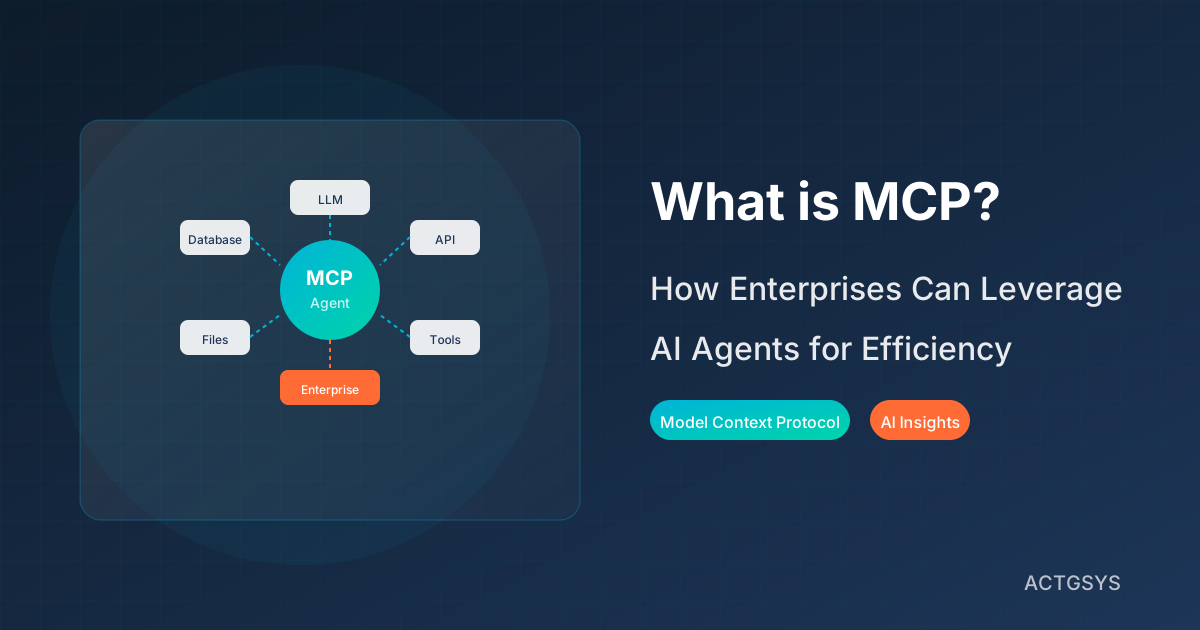
What Is MCP? Enterprise AI Agents Explained
An in-depth explanation of Model Context Protocol (MCP), and how enterprises can implement AI Agent architectures for cross-system integration, automated workflows, and intelligent decision support.
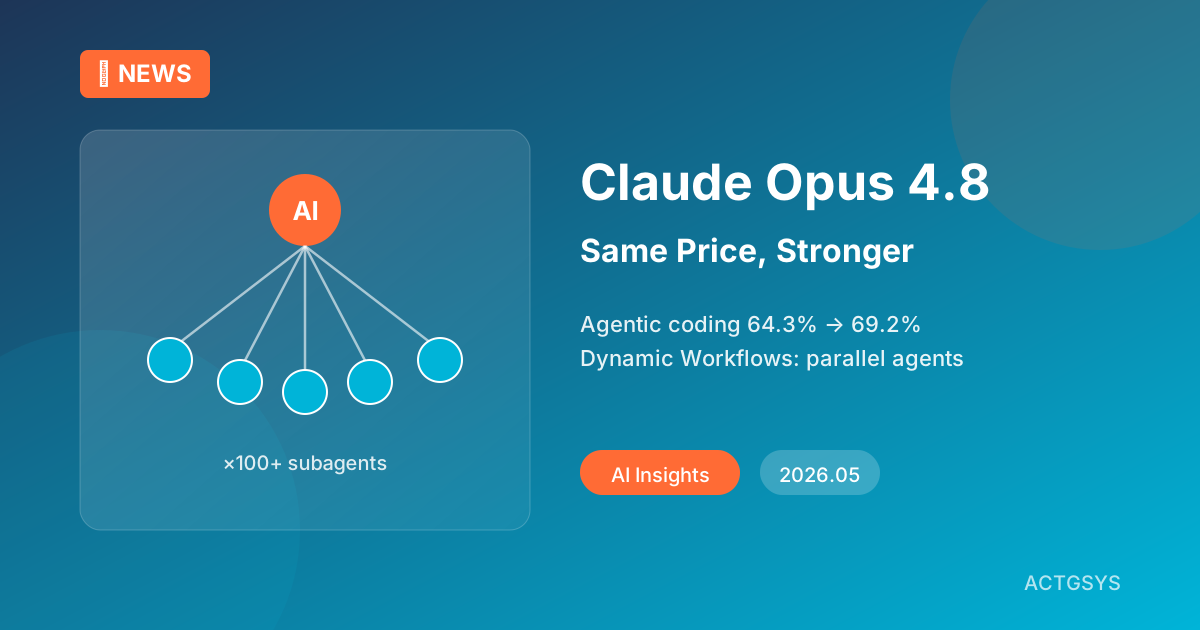
Anthropic Claude Opus 4.8 (2026): Same Price, Stronger
On May 28, 2026, Anthropic launched Claude Opus 4.8, holding the same $5 / $25 per 1M token pricing as its predecessor while lifting agentic coding from 64.3% to 69.2% and adding Dynamic Workflows — a research preview that orchestrates hundreds of parallel subagents. We unpack what this upgrade means for Taiwan SME automation.
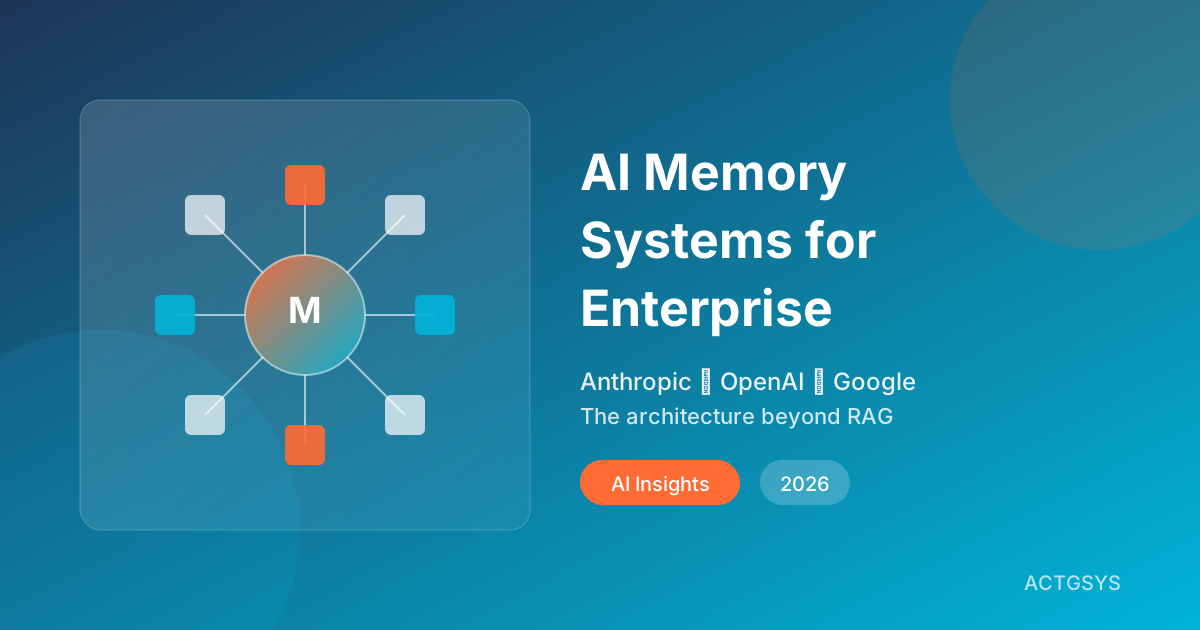
AI Memory Systems: Enterprise Beyond RAG (2026)
AI memory systems are persistent architectures that let AI Agents retain user preferences, business context, and decision history across sessions — in 2026, Anthropic, OpenAI, and Google released enterprise-grade memory features simultaneously, making this the new baseline for production AI.
What would this cost you?
Answer five questions. Within three working days you get a price range and what it covers. No deck, no follow-up sales calls.
Prefer to talk?LINE·02-2553-8084