WhatsApp AI Chatbot Guide for SMEs (2026)
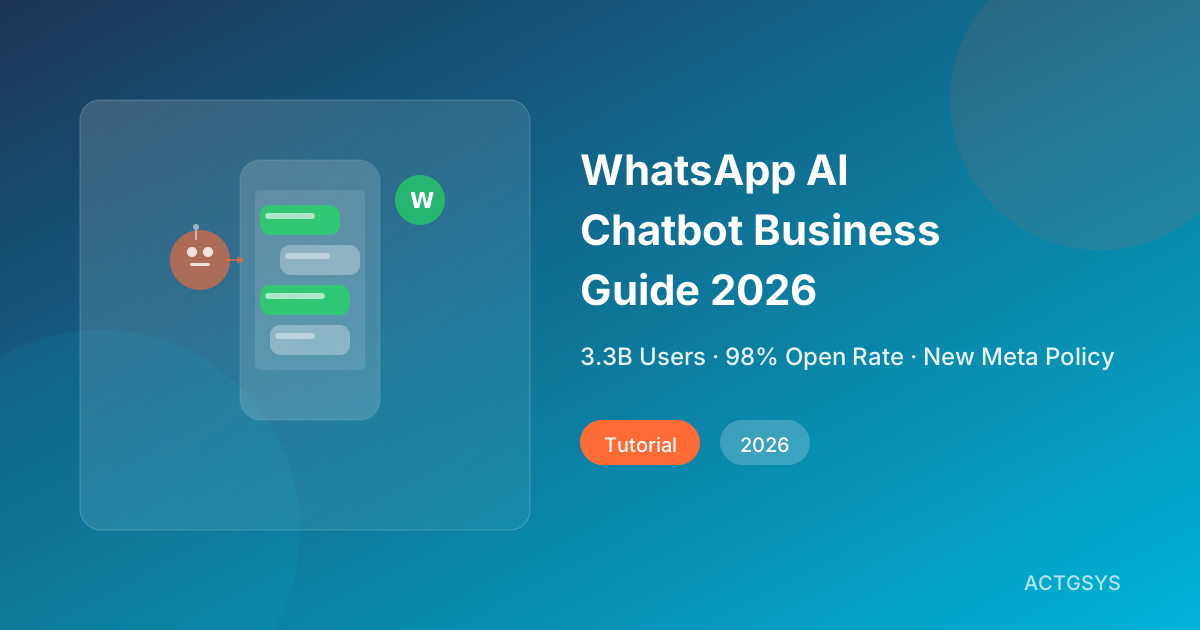
WhatsApp AI Chatbot Business Guide: The New Standard for SME Customer Communication in 2026
If your business still relies only on email and phone calls to communicate with customers, you're missing a massive opportunity. WhatsApp has 3.3 billion monthly active users worldwide, with message open rates reaching 98% (compared to email's roughly 20%). Businesses using WhatsApp have achieved 28% lead conversion rates and 225% faster response times.
But Meta's 2026 AI policy changes the game — businesses can no longer deploy general-purpose AI chatbots and must use business-specific AI instead. This is actually an opportunity for SMEs.
The State of WhatsApp Business Communication
Why WhatsApp?
| Channel Comparison | LINE | Phone | ||
|---|---|---|---|---|
| Open/Answer Rate | 20% | 60% | 98% | 35% |
| Avg. Response Time | 24-48 hours | 2-6 hours | 1-3 minutes | Instant |
| Automation Level | High | Medium-High | High | Low |
| Global Users | 4B+ | 200M | 3.3B | N/A |
| Rich Media Support | Limited | Rich | Rich | None |
| API Integration | Easy | Medium | Medium | Hard |
While LINE dominates in Taiwan and Japan, if your customer base spans Southeast Asia, Europe, or Latin America, WhatsApp is an essential channel. Even in the Taiwan market, an increasing number of international companies and foreign consumers prefer WhatsApp.
Key Changes in Meta's 2026 AI Policy
Meta's 2026 policy introduces significant changes to WhatsApp Business API:
- General-purpose AI chatbots banned: No open-ended conversational bots like ChatGPT on WhatsApp
- Business-specific AI required: AI must be designed for specific business scenarios (order tracking, customer service, booking, etc.)
- Enhanced consent mechanisms: Explicit user consent required before sending AI-generated messages
- Upgraded data protection: Stricter data handling and storage requirements
Why is this good news for SMEs? Because purpose-built AI performs far better than generic chatbots — customers don't need an AI that "can chat about anything." They need a smart assistant that can solve their problem quickly.
Five Key Business Applications of WhatsApp AI Chatbots
1. Intelligent Customer Service Automation
Scenario: Customer sends a product inquiry outside business hours
Traditional approach: Reply the next business day — customer may have already gone to a competitor AI approach: Instant response + accurate answers + auto-escalation to human when needed
Customer: Does your CRM support LINE integration?
AI: DanLee CRM fully supports LINE Official Account integration, including:
    ✅ Auto-sync LINE friends as CRM contacts
    ✅ Reply to LINE messages directly within CRM
    ✅ LINE interaction history auto-filed to customer profiles
    Want to learn more? I can arrange an online demo for you 🎯
Customer: Sure, please arrange that
AI: Great! What times work for you?
    📅 This Thursday 2:00 PM
    📅 This Friday 10:00 AM
    📅 Next Monday 3:00 PM
2. Order Tracking and Notifications
Automatically send order status updates, reducing "Where's my order?" inquiries:
- Order confirmation → Auto-notification
- Shipping notification + tracking link
- Expected delivery reminders
- Delivery confirmation + satisfaction survey
- Proactive delay notifications + resolution options
3. Appointment and Scheduling Management
Ideal for service businesses, healthcare, beauty, repairs, and any appointment-based industry:
- Customers view available time slots via WhatsApp
- AI auto-matches calendars to schedule appointments
- Pre-appointment reminders reduce no-shows by 40%
- Cancellations and rescheduling handled automatically
- CRM integration records customer preferences (favorite services, preferred staff, etc.)
4. Marketing Campaigns and Promotional Messages
Leverage 98% open rates for precision marketing:
- Birthday offers: CRM auto-triggers + WhatsApp delivers personalized discounts
- Stock alerts: "Your saved item only has 3 left"
- Repurchase reminders: Auto-push based on purchase cycles (e.g., consumables 30-day reminder)
- Exclusive event invitations: VIP-only events pushed based on CRM segments
5. Lead Nurturing
Transform first-contact strangers into paying customers:
- Website visitor clicks WhatsApp button → Auto-logs source and browsed pages
- AI assesses interest based on browsing behavior → Sends relevant content
- Continuous interaction tracking → Calculates purchase intent score
- Score reaches threshold → Auto-notifies sales to follow up
- Sales views complete interaction history in WhatsApp → Precise engagement
Technical Architecture
Basic Architecture
Customer WhatsApp → WhatsApp Business API → AI Processing Engine → CRM/ERP
                                                    ↓
                                           Knowledge Base + Business Logic
                                                    ↓
                                           Reply to Customer or Route to Human
Key Technical Components
| Component | Function | Recommended Solution |
|---|---|---|
| WhatsApp Business API | Official API access | Meta Cloud API / BSP provider |
| AI Processing Engine | Intent recognition + response generation | Claude API / GPT API |
| Knowledge Base | Product data + FAQ | Vector database (RAG architecture) |
| CRM Integration | Customer data sync | DanLee CRM API |
| Workflow Engine | Automation flows | TanJee workflow platform |
SME Implementation Roadmap
Phase 1: Foundation (1-2 Weeks)
- Apply for WhatsApp Business API (via BSP provider or Meta Cloud API)
- Set up business profile (company name, logo, hours, description)
- Create basic auto-replies (welcome message, after-hours message)
- Set up quick reply templates (Top 10 FAQs)
Phase 2: AI Intelligence (2-4 Weeks)
- Build product and service knowledge base
- Deploy AI chat engine (intent recognition + natural language responses)
- Configure human handoff rules (when should AI escalate to a person?)
- Test and optimize response quality
Phase 3: CRM Integration and Automation (2-3 Weeks)
- Connect DanLee CRM for automatic customer data sync
- Set up marketing automation workflows (segment-based messaging, lifecycle communications)
- Build customer interaction scoring system
- Configure reporting and analytics dashboards
Phase 4: Optimize and Expand (Ongoing)
- Improve AI response accuracy based on conversation data
- Expand automation to new scenarios
- Add multilingual support as needed
- Integrate payment features (when WhatsApp Pay launches in your market)
WhatsApp vs LINE: Which Should Your Business Choose?
| Consideration | Choose LINE | Choose WhatsApp | Use Both |
|---|---|---|---|
| Target Market | Taiwan/Japan only | International customers | Taiwan + global expansion |
| Customer Type | B2C consumers | B2B or international | Mixed |
| Marketing Needs | Rich menus, LINE Points | High open-rate broadcasts | Omnichannel marketing |
| Budget | LINE monthly subscription | API pay-per-conversation | Split by channel |
ACTGSYS recommendation: For Taiwan-focused businesses, LINE remains the primary channel. But if you have international clients or want to maximize message delivery rates, WhatsApp is an excellent complement. DanLee CRM supports both LINE and WhatsApp integration, letting you manage all customer communications from a single dashboard.
Results After Implementation
| Metric | Before | After | Improvement |
|---|---|---|---|
| Customer response time | Average 6 hours | Average 2 minutes | 180x faster |
| After-hours service coverage | 0% | 100% | 24/7 |
| Customer satisfaction | 72% | 91% | +26% |
| Lead conversion rate | 8% | 28% | +250% |
| Customer service labor cost | Baseline | -45% | Significant reduction |
Frequently Asked Questions
Q1: How is WhatsApp Business API priced?
Meta uses "conversation-based pricing": each 24-hour conversation window counts as one billing unit. Costs vary by conversation type and country — business-initiated marketing messages are most expensive, customer-initiated service conversations are cheapest. For the Taiwan market, typical costs range from NT$1-5 per conversation.
Q2: We already use LINE. Do we need WhatsApp too?
If 100% of your customers are in Taiwan and use LINE, you may not need it short-term. But if you have customers in Southeast Asia, Europe, or the Americas, or work with international employees/clients, WhatsApp's coverage far exceeds LINE's. We recommend at least setting up a basic WhatsApp Business account as a backup channel.
Q3: How complex can AI chatbots handle?
2026 AI can handle quite sophisticated multi-turn conversations, including: querying order status, comparing product differences, calculating quotes, and scheduling appointments. However, set clear escalation rules — sensitive topics like complaints, refunds, and contract negotiations should auto-route to human agents.
Q4: How do I prevent AI from giving wrong answers?
Use RAG (Retrieval-Augmented Generation) architecture: AI only answers based on your provided knowledge base content and won't "improvise." Set confidence thresholds — when AI isn't certain about an answer, it automatically responds with "Let me connect you with a specialist" and routes to a human agent.
Q5: What privacy considerations should we be aware of?
Meta strengthened user privacy protections in 2026: businesses must obtain explicit user consent before sending marketing messages, and all AI interactions must be clearly labeled as automated. Violations may result in account suspension. Use double opt-in mechanisms and disclose the AI nature at the start of each conversation.
Conclusion: Meet Your Customers Where They Already Are
The secret to business success has never been "where you want to communicate" — it's "where your customers are." 3.3 billion people use WhatsApp daily, and 98% of messages get opened. Combined with AI chatbots, your business can provide service 24/7, on your customers' most comfortable platform, in the most natural way possible.
Meta's 2026 policy requiring business-specific AI is actually a blessing — it helps SMEs focus on truly effective customer service and marketing automation rather than wasting resources on flashy but ineffective generic chatbots.
Ready to deploy your AI business assistant on WhatsApp? Contact ACTGSYS — we'll help you from API setup to AI deployment, building a complete WhatsApp business communication solution.
Products & Solutions in This Article
AI-powered CRM for lead management, customer tracking, and sales pipeline optimization designed for SMEs.
Intuitive accounting system designed for Taiwan SMEs, with automated bookkeeping and financial reporting.
Related Articles
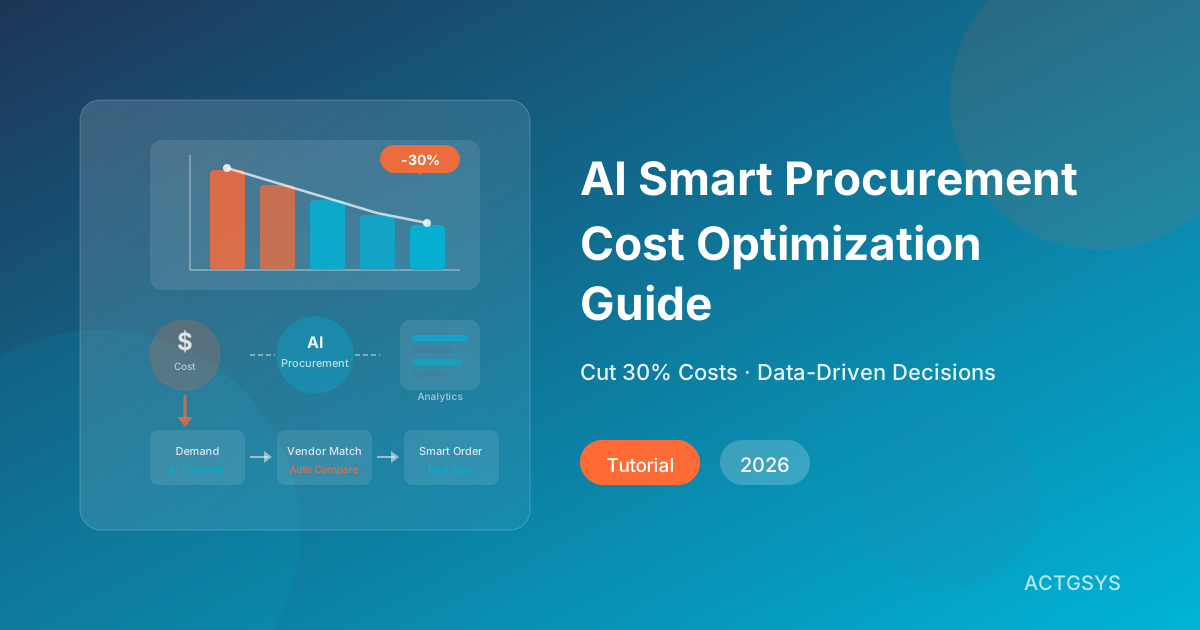
AI Smart Procurement & Cost Optimization Guide
Learn how AI is transforming procurement for small and mid-sized businesses — from supplier evaluation to price prediction, with ROI models, implementation steps, and Dinkoko ERP integration.
AI HR Automation: SME Onboarding and Talent 2026
68% of organizations now use AI in hiring and onboarding. Learn how SMEs can automate interview screening, onboarding workflows, and employee experience to reduce HR admin workload by 75%.
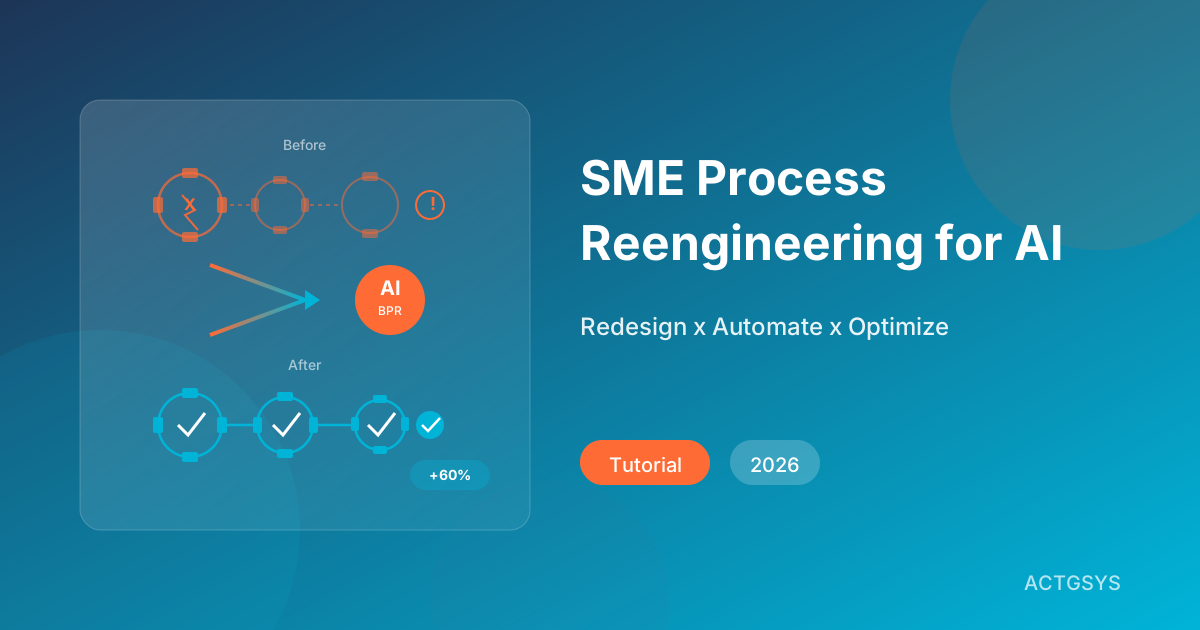
SME Process Reengineering for AI Automation (2026)
Why do most AI automation projects fail? This guide reveals that Business Process Reengineering (BPR) is the key to success, with a complete framework for SMEs.
What would this cost you?
Answer five questions. Within three working days you get a price range and what it covers. No deck, no follow-up sales calls.
Prefer to talk?LINE·02-2553-8084