E-commerce CRM Case Study: 46% Revenue Growth
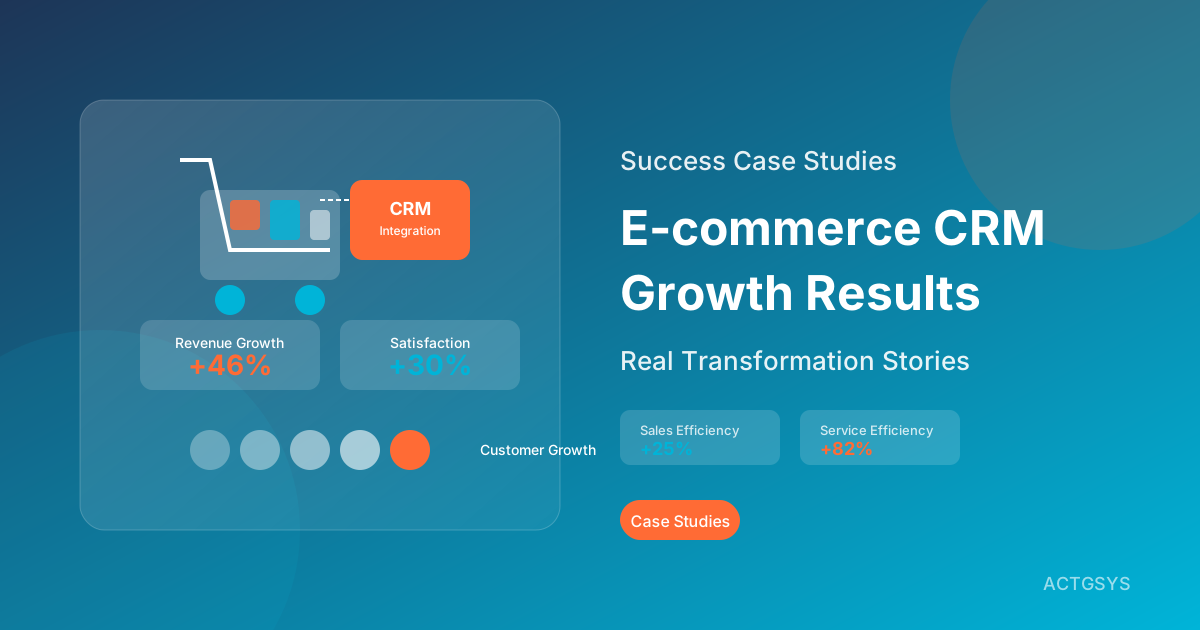
"Does implementing CRM really work?" This is the question many e-commerce owners ask. This article compiles real e-commerce CRM implementation cases from 2024-2025, from data to actual practices, showing you how CRM helps e-commerce businesses achieve revenue doubling growth.
Case 1: UK Retail Chain — 30% Customer Satisfaction Boost
Company Background
A major UK retail chain (unnamed due to confidentiality), operating for years, faced these challenges:
- Customer data scattered across different systems
- Store and online channel information not synced
- Inconsistent customer service quality
- Unable to track complete customer purchase journey
Solution Deployed
The company chose to integrate Adobe Commerce (Magento) with CRM system, creating unified customer view.
Integration Scope:
- E-commerce platform transaction data
- Store POS systems
- Customer service ticketing system
- Marketing automation tools
Actual Results
| Metric | Before | After | Improvement |
|---|---|---|---|
| Customer satisfaction | 62% | 80.6% | +30% |
| Service response consistency | Poor | Excellent | Greatly improved |
| Cross-channel data sync | None | Real-time | Complete integration |
| 360-degree customer view | None | Complete | New feature |
Key Success Factors
- Unified customer identification: Recognize same person regardless of contact channel
- Real-time data sync: Store purchases immediately reflected in online account
- Service knowledge base integration: Service staff can instantly view complete customer history
- Marketing automation: Auto-send relevant recommendations based on purchase behavior
Case 2: B2B Wholesaler — 25% Sales Efficiency Improvement
Company Background
A B2B wholesale company with thousands of enterprise customers, facing problems:
- Massive customer data difficult to manage
- Low sales follow-up efficiency
- Serious opportunity loss
- Lack of systematic sales process
Solution Deployed
Implemented CRM system with key features:
- Sales pipeline automation: Complete tracking from lead to deal
- Customer tier management: Auto-classification by contribution
- Follow-up reminder system: Auto-notify sales of customers to contact
- Quote management: Standardized quotation process
Actual Results
| Metric | Before | After | Improvement |
|---|---|---|---|
| Sales efficiency | Baseline | - | +25% |
| Opportunity conversion rate | 12% | 18% | +50% |
| Average deal cycle | 45 days | 32 days | -29% |
| Customer data completeness | 60% | 95% | +58% |
Key Success Factors
- Sales process standardization: Defined clear stages and actions
- Automated follow-ups: System auto-reminds, no missed opportunities
- Data-driven decisions: Management can see sales funnel status in real-time
- Team collaboration: Shared customer information, avoid duplicate contact
Case 3: Eye-oo Italian Eyewear E-commerce — $175K Additional Revenue
Company Background
Eye-oo is an Italian online eyewear retailer facing challenges at end of 2023:
- Long customer service response times (2-5 minutes)
- Repetitive questions consuming manpower
- High lead loss rate
- Website conversion rate needs improvement
Solution Deployed
Implemented Tidio Live Chat + Lyro AI Chatbot:
- AI auto-reply to common questions
- Smart lead capture
- Live human service transfer
- Conversation data analysis
Actual Results
Impressive Data:
| Metric | Data |
|---|---|
| Additional revenue contribution | $175,000 (€177,000) |
| Overall sales growth | +25% |
| First response time | From 2-5 minutes → 30 seconds (-86%) |
| AI auto-handled inquiries | 82% (1,831 out of 2,233) |
| Auto-captured leads | 1,305 |
Key Success Factors
- AI handles repetitive questions: 82% of inquiries auto-resolved by AI
- Instant response: Response time from minutes to seconds
- Proactive lead capture: Browsers converted to trackable potential customers
- Human-AI collaboration: Complex issues seamlessly transferred to human service
Case 4: EcoHome Furniture — 46% Revenue Growth
Company Background
EcoHome Furniture is a Manchester, UK furniture e-commerce that decided on digital transformation in late 2024.
Pre-implementation Challenges:
- Slow order processing
- Inventory and e-commerce platform not synced
- Procurement decisions lack data support
- Tedious accounting work
Solution Deployed
Adopted Cloud ERP Integration Solution, connecting:
- Shopify e-commerce platform
- Inventory management module
- Procurement management
- Accounting system
Actual Results
| Metric | Improvement |
|---|---|
| Revenue growth | +46% |
| Order processing speed | Significantly improved |
| Inventory accuracy | Nearly 100% |
| Manual work reduction | Noticeably decreased |
Key Success Factors
- Omnichannel integration: E-commerce, inventory, accounting end-to-end
- Real-time inventory sync: Avoid overselling and stockouts
- Automated order process: From order to shipment fully automated
- Data-driven procurement: Smart restocking based on sales trends
Case 5: CarMax US Used Car E-commerce — 50M Daily Recommendations
Company Background
CarMax is America's largest used car retailer, achieving online-offline integration through digital transformation.
Innovation
Built Customized CRM + AI Recommendation System:
- Integrated online browsing and in-store visit data
- AI/ML-driven personalized recommendations
- Omnichannel customer experience
Actual Results
| Metric | 2024 Data |
|---|---|
| Daily car recommendations | 50 million |
| Retail used car sales | +5.4% |
| Wholesale sales | +6.3% |
| Customer experience | Seamless online-offline |
Implications for E-commerce
While CarMax is large-scale, its strategies can be applied smaller to SME e-commerce:
- Unify online-offline customer data
- Use AI for personalized recommendations
- Create seamless omnichannel experience
Common Success Patterns in E-commerce CRM
Pattern 1: Unified Customer View
Problem: Customer data scattered across different systems
Solution:
E-commerce platform ─┐
                     ├──→ CRM unified customer database ──→ 360° customer view
Service system ──────┤
                     │
Store POS ───────────┘
Benefit: 20-30% customer satisfaction improvement
Pattern 2: Sales Process Automation
Problem: Untimely opportunity follow-up, low conversion rate
Solution:
Lead entry → Auto-scoring → Auto-assignment → Follow-up reminder → Deal tracking
Benefit: 25%+ sales efficiency improvement
Pattern 3: AI Customer Service Integration
Problem: High customer service costs, slow response
Solution:
Customer inquiry → AI judges type → Simple questions AI answers (80%)
                       → Complex questions transfer to human (20%)
Benefit: 50-60% customer service cost reduction, satisfaction improvement
Pattern 4: Omnichannel Integration
Problem: Different channel data not synced
Solution:
Website orders ─┐
                ├──→ Central ERP/CRM ──→ Unified inventory
LINE orders ────┤                     ──→ Unified customer data
                │                     ──→ Unified reports
Store orders ───┘
Benefit: 30-46% revenue growth
E-commerce CRM Recommendations for SMEs
Solution Selection by Revenue Scale
| Annual Revenue | Recommended Solution | Budget Range |
|---|---|---|
| Under $150K | LINE OA + Simple CRM | $300-1,500/year |
| $150K-600K | Cloud CRM (DanLee/Zoho) | $1,500-6,000/year |
| $600K-3M | CRM + ERP Integration | $6,000-24,000/year |
| Over $3M | Custom Integration Solution | $24,000+/year |
Implementation Priority Recommendations
Phase 1 (1-2 months):
- Customer data centralization
- Basic sales pipeline setup
- Service ticket management
Phase 2 (2-4 months):
- AI customer service chatbot
- Marketing automation
- Data reports
Phase 3 (4-6 months):
- ERP integration
- Omnichannel sync
- Advanced analytics
Frequently Asked Questions
Q1: Do small e-commerce businesses need CRM too?
Yes. Even with just 100 customers, CRM helps you:
- Remember each customer's purchase preferences
- Auto-remind of repurchase timing
- Track customer service conversation history
Start with free or low-cost plans (like HubSpot free version, DanLee).
Q2: What's the difference between CRM and e-commerce platform membership systems?
E-commerce platform membership systems:
- Only record transactions on that platform
- More basic features
- Difficult to integrate other channels
CRM systems:
- Integrate all channel customer interactions
- Complete sales/marketing automation
- Customizable process design
Q3: How much manpower needed to implement CRM?
Depends on scale:
- Small e-commerce (1-5 people): Owner or one employee can manage
- Medium e-commerce (5-20 people): Recommend 1 dedicated person
- Large e-commerce (20+ people): Need dedicated team
Key is choosing user-friendly system to reduce learning cost.
Q4: How to evaluate if CRM implementation succeeds?
Recommend tracking these metrics:
- Customer repurchase rate change
- Sales conversion rate change
- Customer service response time
- Customer satisfaction score
- Revenue/profit change
3-6 months after implementation, should see noticeable improvement.
Q5: Are there CRMs suitable for e-commerce?
Yes. Besides international solutions, local options include:
- DanLee CRM: Local language interface, messaging app integration, local currency pricing
- Various e-commerce platform CRM plugins
- Local consultant custom solutions
Recommend choosing vendors with e-commerce integration experience.
Conclusion: CRM is E-commerce Growth Accelerator
From these cases, e-commerce businesses successfully implementing CRM commonly achieve:
- 20-30% customer satisfaction improvement
- 25%+ sales efficiency improvement
- 25-46% revenue growth
The key isn't choosing the most expensive or feature-rich CRM, but:
- Choose solution suitable for your scale
- Actually execute customer data integration
- Utilize automation features well
- Continuously optimize and expand
As one industry observer said:
"If 2024 was the year of digital awakening, 2025 is the year of digital acceleration."
Want to learn about the best CRM solution for your e-commerce business?
ACTGSYS offers DanLee CRM, designed for local e-commerce, supporting messaging app integration and e-commerce platform connections, helping you achieve customer relationship management digitalization.
Products & Solutions in This Article
Related Articles
Manufacturing ERP Digital Transformation
In-depth analysis of real manufacturing ERP success cases. From German STIHL power tools to global brand P&G, learn how ERP integration achieved 85% equipment efficiency improvement and 20-30% shorter process cycles.
AI Customer Service Chatbot Success Cases
In-depth analysis of real AI customer service chatbot success cases. From banks handling 3.5M daily inquiries to insurance companies saving 330 hours monthly, learn how to achieve 82% auto-resolution rate and 86% faster response times.
What Is CRM? The 2025 SME Guide
A comprehensive guide to CRM systems: from basic concepts to implementation best practices. Learn how to select and implement the right CRM system to improve sales and customer management for your business.
What would this cost you?
Answer five questions. Within three working days you get a price range and what it covers. No deck, no follow-up sales calls.
Prefer to talk?LINE·02-2553-8084