AI Smart Procurement & Cost Optimization Guide
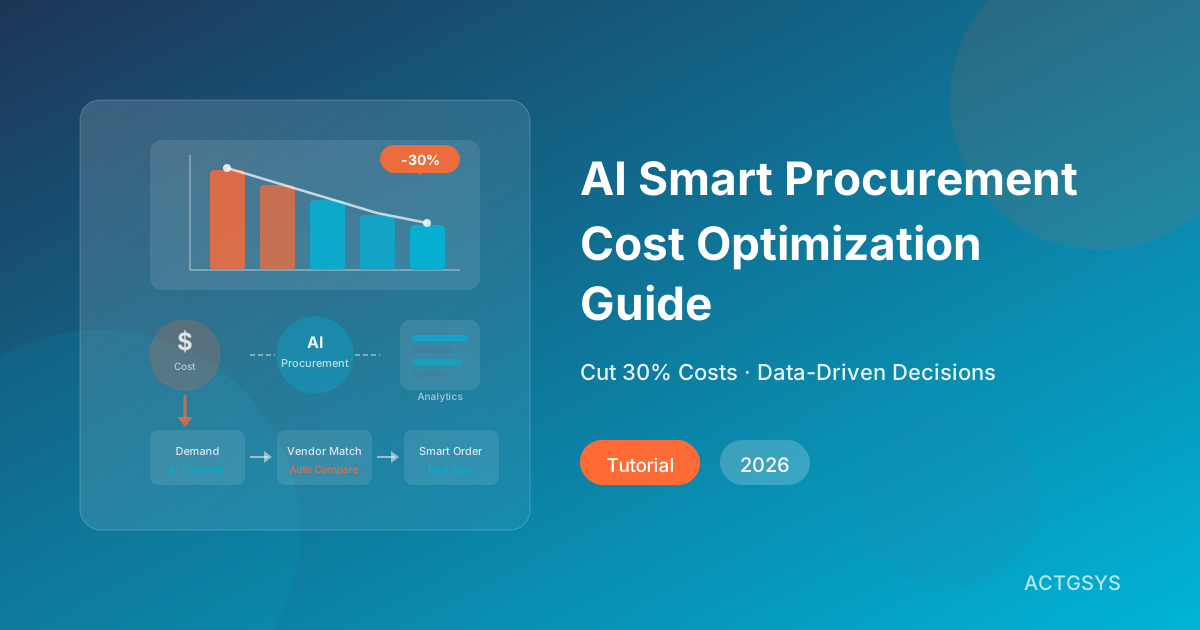
Procurement accounts for 40% to 70% of operating costs for small and mid-sized enterprises (SMEs), yet most companies still rely on spreadsheet comparisons, phone negotiations, and manual purchase orders. According to a 2025 Deloitte survey, SMEs using manual procurement processes overspend by 15% to 30% — due to missed buying windows, lack of supplier performance data, duplicate orders, and excess inventory. In 2026, AI-powered procurement is no longer reserved for large corporations. When combined with an ERP system, even small businesses can leverage AI for demand forecasting, automated price benchmarking, and intelligent supplier selection — making every procurement dollar count.
Why Traditional Procurement Is Costing You Money
The procurement pain points for SMEs often hide in everyday operations, barely noticeable individually but devastating in aggregate:
- Information asymmetry: Buyers select suppliers based on gut feeling and personal relationships, with no systematic tracking of pricing or quality trends. You never truly know if you are getting the best market price.
- Intuition-based demand planning: The "order the same as last time" approach leads to either excess inventory tying up cash or stockouts halting production — both of which burn money.
- Slow, manual processes: From requisition to price comparison, approval, and PO creation, traditional workflows take 3 to 7 business days. Rush orders create chaos.
- Weak supplier management: Without quantitative supplier scorecards, quality issues and delivery delays recur without consequence.
- Compliance gaps: Manual processes are prone to unauthorized purchases, split orders to bypass approval thresholds, and audit trail blind spots.
- Scattered data: Procurement records live across emails, messaging apps, and spreadsheets, making meaningful spend analysis nearly impossible.
The root cause is the absence of an integrated intelligent system that connects procurement data, supplier information, and market intelligence — and that is exactly what AI + ERP delivers.
Five Core Capabilities of AI Smart Procurement
1. AI Demand Forecasting: Stop Guessing
AI models analyze historical sales data, seasonal patterns, market indicators, and even weather data to predict material demand 30 to 90 days ahead. Compared to manual forecasting, AI demand prediction improves accuracy by an average of 35% or more, effectively preventing over-purchasing and stockout-induced downtime.
2. Intelligent Supplier Scoring: Choose Partners with Data
The system automatically tracks each supplier's on-time delivery rate, quality acceptance rate, price competitiveness, and response speed to build a dynamic scoring model. When a new order is needed, AI recommends the optimal supplier mix in real time — rather than leaving the decision to memory and habit.
3. Price Prediction & Optimal Buying Windows
AI monitors raw material market trends, currency fluctuations, and supply chain shifts to forecast price movements. When the system identifies a low-price window, it proactively alerts the procurement team to order early. Conversely, if prices are predicted to decline, it recommends postponing. This capability alone can save 5% to 15% on key material costs.
4. Automated Purchase Orders & Approval Workflows
When inventory drops below safety levels or AI predicts upcoming demand, the system auto-generates draft purchase orders — complete with recommended suppliers, quantities, and prices. Approval workflows route automatically via preset rules: small orders are auto-approved, large orders are pushed to managers for sign-off. The entire cycle shrinks from days to hours.
5. Spend Analytics & Cost Transparency
AI automatically classifies, aggregates, and benchmarks all procurement spending, generating multi-dimensional cost analysis reports. You gain clear visibility into which categories are seeing cost increases, which suppliers are pricing above market rates, and which departments show irregular purchasing patterns. These insights form the foundation for continuous cost reduction.
AI Procurement vs. Traditional Procurement: A Comparison
| Evaluation Dimension | Traditional Procurement | AI Smart Procurement | Improvement |
|---|---|---|---|
| PO processing time | 3-7 business days | 2-4 hours | 85% faster |
| Procurement cost | Baseline | 15-30% reduction | Significant savings |
| Human error rate | 5-8% | <1% | 90% reduction |
| Supplier evaluation | Subjective experience | Multi-dimensional data scoring | Objective & quantifiable |
| Price negotiation | Limited market intel | AI-powered benchmarks & negotiation guidance | Stronger leverage |
| Compliance | Relies on manual review | Automated rule engine + anomaly detection | Dramatically lower risk |
| Inventory accuracy | 60-75% | 90-95% | 25% improvement |
| Decision speed | Days | Real-time | Paradigm shift |
4 Steps for SMEs to Implement AI Smart Procurement
Step 1: Procurement Process Audit & Data Inventory (Weeks 1-2)
Before implementing any system, conduct a thorough assessment of your current procurement operations:
- Map the complete procure-to-pay workflow end to end
- Measure the average time and cost for each stage
- Assess the quality and completeness of existing procurement data
- Identify the top three pain points and improvement opportunities
The deliverable is a "Procurement Digitization Readiness Report" that serves as the blueprint for what comes next.
Step 2: ERP System Setup & Data Integration (Weeks 3-6)
Select an ERP system designed for SMEs and centralize all procurement-related data:
- Build a unified supplier database (company details, transaction history, performance records)
- Standardize item master data (coding, classification, specifications)
- Configure procurement approval workflows and authorization rules
- Import historical procurement data covering at least the past 12 months
Step 3: AI Module Activation & Training (Weeks 7-10)
With the ERP foundation in place, activate AI capabilities:
- Enable the demand forecasting module and configure prediction horizons and item scope
- Launch the supplier scoring engine and set weighting for each criterion
- Set up price monitoring and buying-window alerts
- Configure automated PO generation rules
- Fine-tune AI model parameters based on the first two weeks of results
Step 4: Continuous Optimization & Expansion (Week 11 Onward)
The value of an AI system compounds over time and data volume:
- Review AI prediction accuracy and recommendation adoption rates monthly
- Continuously adjust model parameters based on actual outcomes
- Gradually expand coverage to more item categories and suppliers
- Integrate AI procurement insights into broader business decision-making
ROI Calculation: How Much Can AI Procurement Actually Save?
Consider an SME with annual procurement spend of USD 1 million as an example:
| Benefit Category | Conservative Estimate | Optimistic Estimate |
|---|---|---|
| Purchase price reduction (negotiation + timing) | 5% ($50,000) | 12% ($120,000) |
| Inventory cost reduction (less over-purchasing) | 3% ($30,000) | 8% ($80,000) |
| Process efficiency gains (labor savings) | 1 FTE ($45,000) | 2 FTEs ($90,000) |
| Quality loss reduction (supplier optimization) | 1% ($10,000) | 3% ($30,000) |
| Annual total savings | $135,000 | $320,000 |
If the annual cost of the AI + ERP system (including subscription and maintenance) is $20,000 to $40,000, the return on investment (ROI) ranges from 238% to 700%, with a payback period of approximately 2 to 4 months.
This excludes hard-to-quantify benefits such as improved supply chain resilience, faster market responsiveness, and freeing your procurement team from transactional work to focus on strategic, high-value initiatives.
How Dinkoko ERP's AI Procurement Module Works
Dinkoko ERP is a cloud-based ERP system built by ACTGSYS specifically for SMEs. Its built-in AI procurement module lets businesses access AI-driven purchasing management without third-party integrations:
- One-click smart replenishment: Based on sales trends and inventory levels, AI calculates the optimal order quantity and timing, generating purchase orders with a single click.
- 360-degree supplier profiles: Automatically aggregates each supplier's transaction history, quality records, and pricing trends into a real-time scorecard and ranking.
- Procurement dashboard: Displays spend distribution, price trends, supplier performance, and other key metrics in real time, with support for natural language queries.
- Intelligent approval routing: Automatically assigns approval paths by amount and category, with mobile sign-off support — no more delays when managers are out of office.
- Budget control & alerts: Tracks procurement budget utilization by department and project in real time, sending proactive alerts before overspending occurs.
Dinkoko ERP's modular design allows businesses to start with procurement management — the most pressing need — and progressively expand into inventory, finance, sales, and other modules, reducing the risk and cost of a big-bang implementation.
Frequently Asked Questions
Q1: Does my small business really need AI procurement? Isn't Excel enough?
Excel works fine when procurement volume is low, the number of items is small, and suppliers are few and stable. But once annual procurement exceeds $150,000, items surpass 100 SKUs, or you manage more than 20 suppliers, spreadsheet efficiency drops dramatically. The value of AI procurement lies in its ability to simultaneously process data across hundreds of items and suppliers, detecting patterns and opportunities that the human brain simply cannot — something Excel was never designed to do.
Q2: How much does it cost to implement AI smart procurement?
For SMEs, the budget for an AI + ERP procurement system typically ranges from $150 to $1,000 per month, depending on company size and feature requirements. The cloud SaaS model eliminates server and maintenance costs, significantly lowering the barrier to entry. With Dinkoko ERP, for example, businesses can start with a basic plan and scale up as they grow.
Q3: Our procurement data is messy. Can AI still work?
Data quality does affect AI performance, but you do not need perfect data to get started. Implementing an ERP system is itself a data governance process — the system enforces standardized item codes, supplier records, and procurement documentation. Typically, after 2 to 3 months of operation, the accumulated structured data is sufficient for AI models to generate meaningful predictions and recommendations.
Q4: Will AI replace our procurement staff?
No. AI serves as an intelligent assistant to procurement professionals, not a replacement. AI handles the heavy lifting of data analysis, price monitoring, and process automation — the repetitive, transactional work. This frees your procurement team to focus on what matters most: building supplier relationships, negotiating strategic contracts, and evaluating new sourcing opportunities. After AI adoption, the procurement team's role evolves from "order placers" to "procurement strategists."
Conclusion: From Cost Center to Value Engine
Procurement should not be just a department that spends money. With AI smart procurement, SMEs can transform purchasing from a reactive cost center into a proactive value engine — buying better goods for less, making more decisions in less time, and replacing gut feeling with data to reduce risk.
In 2026, AI procurement technology is mature, costs are affordable, and the implementation barrier has dropped significantly. The question is no longer "should we do it?" but "when will your competitors do it?"
Want to learn how AI smart procurement can reduce costs and boost efficiency for your business? Contact the ACTGSYS consulting team today — we offer a free procurement process assessment and Dinkoko ERP trial.
Products & Solutions in This Article
Related Articles
What is ERP? Guide to Inventory Management Systems for SMEs
A comprehensive guide to ERP enterprise resource planning systems: from basic inventory management functions to implementation best practices. Learn how to select the right ERP system for your business and optimize inventory and order management.
WhatsApp AI Chatbot Guide for SMEs (2026)
WhatsApp has 3.3 billion users and 98% open rates. Meta's 2026 AI policy changes the rules. Learn how SMEs can use WhatsApp AI chatbots to boost customer communication and achieve 28% lead conversion.
AI HR Automation: SME Onboarding and Talent 2026
68% of organizations now use AI in hiring and onboarding. Learn how SMEs can automate interview screening, onboarding workflows, and employee experience to reduce HR admin workload by 75%.
What would this cost you?
Answer five questions. Within three working days you get a price range and what it covers. No deck, no follow-up sales calls.
Prefer to talk?LINE·02-2553-8084