US AI Export Controls Tighten and Anthropic Briefly Pulls Fable 5 (2026): Taiwan SMEs Suddenly Lose Top-Tier Models
In June 2026, the US escalated export controls on advanced AI models: on June 2 it signed an executive order titled "Promoting Advanced Artificial Intelligence Innovation and Security," and mid-month, citing national security, ordered Anthropic to block its most powerful Mythos 5 and the newly released Fable 5 for non-US nationals — briefly disabling both top-tier models for all customers. For Taiwan SMEs, the takeaway is blunt: you are the "non-US nationals" here, so this isn't someone else's problem — it's "the top model you used yesterday might be unreachable today."
What Happened?
There are two layers. First, policy: the US President signed an executive order on June 2, 2026, titled "Promoting Advanced Artificial Intelligence Innovation and Security" (White House official announcement, 2026). It directs federal agencies to establish a secure-deployment framework for frontier AI models, with the NSA and CISA developing a classified benchmarking process to identify models with advanced cyber capabilities — designating them "covered frontier models." Developers may voluntarily give the government up to 30 days of pre-release access before broader release.
Second, the operational fallout: according to multiple reports, in mid-June 2026 the US government, citing national security, ordered Anthropic to block its most powerful Mythos 5 and the newly released Fable 5 for non-US nationals. Anthropic said the practical effect was that it had to abruptly disable both models for all customers to ensure compliance, while its other models were unaffected. Fable 5 remained offline on June 22 (about 10 days after the Department of Commerce issued an emergency export-control directive), and Anthropic's Chris Ciauri said at a Seoul press conference that access would return "in the coming days."
What Are the Key Points of These Controls?
Three points Taiwan SMEs must understand:
- Controls expanded from "chips" to "models" — export controls previously targeted mainly NVIDIA and AMD AI chips; this extends them to "the most powerful AI models themselves." Media and experts broadly note that controlling models is far harder than controlling chips, and the policy tools are still being worked out.
- "Non-US nationals" are the affected group — the block targets non-US nationals. Taiwanese businesses and individuals fall in this category, meaning the availability of US top-tier models can change with geopolitics in an instant.
- The "brief full shutdown" highlights supply risk — to comply, providers may take the conservative "shut everything off, then restore" path. For companies that tie critical processes to a single model, that's a concrete operational-continuity risk.
For Taiwan SMEs, This Matters More Than "Which Model Is Strongest"
Past model news focused on benchmarks, pricing, and capability. This event exposes a deeper issue: whether you can keep using a model depends not only on tech and price but on geopolitics. The table contrasts two risk lenses:
| Risk lens | Previous focus | What this event reminds us |
|---|---|---|
| Tech / price | Capability, API price, speed | Still matters, but isn't everything |
| Supply stability | Service uptime | Policy-driven cutoff (geopolitics) |
| Who's affected | All users | Specific nationality / region (e.g., non-US nationals) |
| Response | Pick strongest and cheapest | Multi-model fallback, switchable architecture |
Bottom line: for Taiwan SMEs, "putting all eggs in a single US top-tier model" now carries a risk that wasn't seriously priced in before — policy-driven cutoff.
What Are Developers and the Industry Saying?
Reactions split between "shock" and "pragmatic adjustment."
On Reddit and Hacker News, many developers voiced unease about "losing a model overnight," especially teams that built their product core on Claude; others began seriously discussing switchable-model architectures and local/open-source fallback. Notably, this also re-evaluated the value of open and non-US models — recently released models like MiniMax M3 and NVIDIA's open Nemotron are now seen as fallback options precisely because they're less exposed to US policy cutoffs.
From a framework view, this echoes the long-standing principle of supply-chain resilience: critical capabilities shouldn't be locked to a single vendor or jurisdiction. For enterprise AI, that means designing in "the ability to swap models" rather than hard-wiring prompts, tools, and workflows to one vendor's API.
What Does This Mean for Taiwan's SMEs?
The core lesson: treat AI models as replaceable parts to be planned for, not as an indispensable single supplier.
- Companies that tie critical processes to a single US model: high-risk. If AI customer service, automated reporting, or AI agents all bet on Claude or a single GPT, a policy-driven cutoff halts the business. Build a "primary + fallback" multi-model architecture.
- Companies currently adopting AI: design "switchable models" into requirements from the start — abstract the AI call layer so the underlying model can switch among Claude, Gemini, GPT, and open models (e.g., MiniMax M3, Nemotron) without rewriting the whole workflow.
- Companies that value data residency: geopolitical risk is another reason to evaluate local deployment / open-source models. For sensitive data and critical processes, self-hosted or residency-capable open models reduce dependence on external policy — exactly the options ACTGSYS evaluates when helping clients with custom AI and cloud deployment.
ACTGSYS Recommendations: What Should You Do Now?
- Inventory which processes are locked to a single model — list which model each of your AI service, reporting, and agents uses, and flag the high-risk links that "stop if cut off." (Do now)
- Build a switchable AI-call architecture — abstract model calls into a unified interface so primary and fallback models can switch quickly. (Do now)
- Set a fallback model for critical processes — if you primarily use Claude / GPT, test at least one non-US or open-source fallback (e.g., MiniMax M3, Nemotron, Gemini) and confirm acceptable quality after switching. (Do now)
- Evaluate local / residency-capable deployment for sensitive data — for critical and confidential processes, assess self-hosted or residency-capable open models to reduce cutoff and leakage risk. (Plan first)
- Keep tracking policy — export controls are still evolving; make "model availability" a standing item in vendor risk assessment. (Ongoing)
Frequently Asked Questions
Can Taiwan still use Claude / Fable 5 now?
When the event occurred, Anthropic briefly disabled Mythos 5 and Fable 5 for all customers to comply, with other models unaffected, and said access would return "in the coming days." Check Anthropic's official announcements for current status. The point isn't whether it works on a given day — it's that policy-driven cutoffs are now a real risk.
Why is Taiwan affected?
Because the block targets "non-US nationals," and Taiwanese businesses and individuals fall in that category. So the availability of US top-tier models for Taiwan can shift with US export-control policy, not just with whether you can afford them.
How should SMEs reduce model-supply risk?
The core is "multi-model fallback + switchable architecture": abstract AI calls into a unified interface, prepare at least one fallback model (including non-US / open-source) for critical processes, and assess local or residency-capable deployment for sensitive workflows. Make models replaceable parts.
Can open models (e.g., MiniMax M3, Nemotron) serve as fallback?
Yes, and this event makes their fallback value clearer — they're less exposed to US policy cutoffs. But fallback isn't "plug and forget": test quality and cost on your real tasks, confirm acceptability after switching, then formally add them to your architecture.
Conclusion
June 2026's tighter US AI export controls and Anthropic's brief Fable 5 shutdown taught Taiwan SMEs a lesson: a model's availability is not just a tech-and-price question but a geopolitical one. The pragmatic response isn't panic — it's treating models as replaceable parts: build multi-model fallback and switchable architecture, and assess local deployment for sensitive processes. ACTGSYS can help design an AI architecture that isn't locked to a single model and integrate it with DanLee CRM, Dinkoko ERP, and a multi-model strategy. Contact us to discuss further.
Event date: June 2, 2026 (executive order) / mid-June 2026 (model block) | Last updated: June 26, 2026
Products & Solutions in This Article
AI-powered CRM for lead management, customer tracking, and sales pipeline optimization designed for SMEs.
AI-driven ERP focusing on procurement, inventory, and supply chain management. Each customer deployed on dedicated cloud infrastructure.
Related Articles
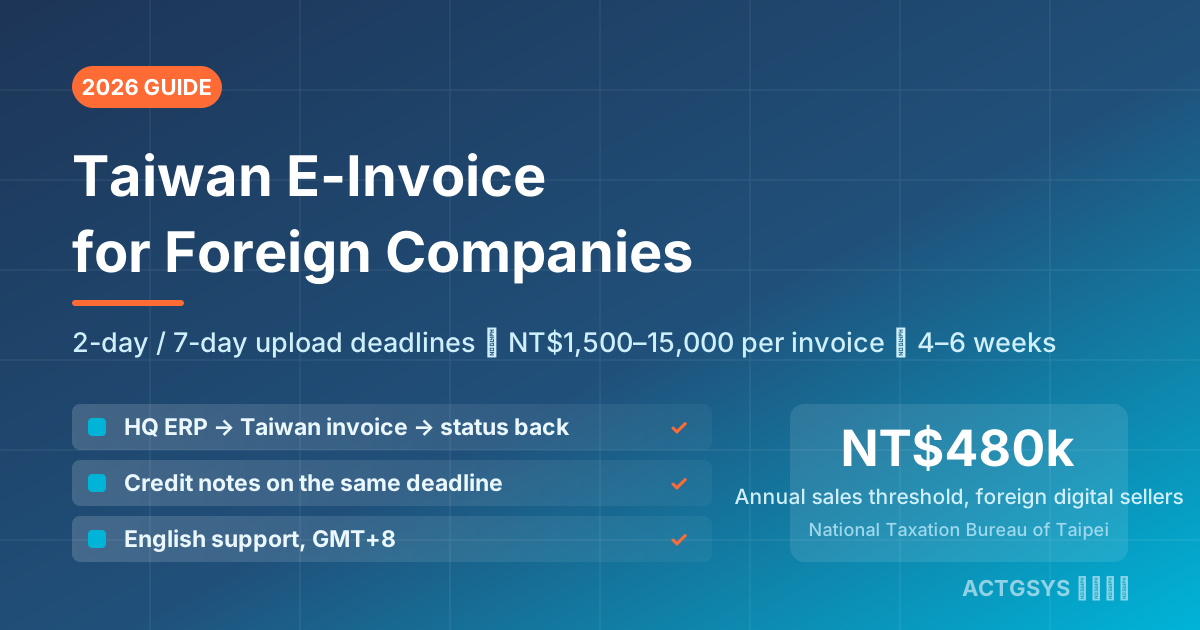
Taiwan E-Invoice for Foreign Companies 2026 - Cost
How a foreign-owned Taiwan subsidiary or branch connects its ERP to Taiwan's e-invoice platform: 2-day B2C / 7-day B2B upload deadlines, NT$1,500–15,000 per-invoice penalties, three integration paths, and a 4–6 week project from NT$50,000.
Anthropic Claude Fable 5 (2026): Its Most Powerful Public Model Yet
On June 9, 2026, Anthropic launched Claude Fable 5 — its first Mythos-class model available to the general public, claimed to be state-of-the-art on nearly all tested benchmarks, alongside the restricted Claude Mythos 5. From June 23, pricing is $10 per 1M input tokens and $50 per 1M output. This article explains where this flagship belongs — and where it doesn't.
Anthropic Doubles Claude Cowork Limits Free for a Month (2026): More Connectors, a June 15 Billing Change
From June 5, 2026, Anthropic doubled Claude Cowork's 5-hour usage limit for free through July 5 (for Pro / Max / Team), released 20+ legal MCP connectors and 12 practice-area plugins, and previewed a June 15 billing change for Claude Code and the Agent SDK. This article explains, from an SME perspective, how to use this low-cost window to test an AI work agent.
What would this cost you?
Answer five questions. Within three working days you get a price range and what it covers. No deck, no follow-up sales calls.
Prefer to talk?LINE·02-2553-8084