Anthropic Agent Skills as an Open Standard + Enterprise-Managed MCP Auth (2026): Wiring Claude into Stripe, Zapier, and Figma
In June 2026, Anthropic turned Agent Skills into an open standard, launching with 10 partners (including Atlassian, Figma, Canva, Stripe, Zapier), and on June 18 shipped Enterprise-Managed Authorization (EMA) for MCP connectors so IT admins can provision connectors org-wide via Okta. For Taiwan SMEs, the point isn't "another spec." It's that "wiring AI into the tools your company already uses" is rapidly shifting from an engineering project to standardized, configuration-driven work.
What Happened?
In June 2026, Anthropic shipped two complementary capabilities (Anthropic official announcement, 2026):
First, Agent Skills as an open standard. Anthropic turned Agent Skills into an open standard, much as it earlier made MCP (Model Context Protocol) the de facto standard for how AI agents use tools. It launched with Skills from 10 partners — a who's who of modern enterprise software: Atlassian (Jira, Confluence), design tools Figma and Canva, payments infrastructure Stripe, and automation platform Zapier — signaling that Anthropic wants Skills to be the connective tissue between Claude and the apps businesses already use.
Second, Enterprise-Managed Authorization (EMA). On June 18, 2026, Anthropic shipped enterprise-managed authorization, letting IT admins provision MCP connectors for the entire organization through Okta; employees inherit that access automatically when they first open Claude — no OAuth queues or per-user consent screens. Seven MCP providers support EMA at launch: Asana, Atlassian (Jira, Confluence, Rovo), Canva, Figma, Granola, Linear, and Supabase.
In addition, new enterprise management lets admins on Team and Enterprise plans provision Skills centrally, controlling which workflows are available across the organization while letting individuals customize.
What Are the Key Points?
Viewed together, Anthropic's strategy is clear: use "open standards + enterprise governance" to lower the barrier to "wiring AI into tools."
- Agent Skills goes the open-standard route — like MCP, an open standard aims for ecosystem-wide adoption so you don't rewrite integration for each new tool, which lowers integration cost over time.
- Launch partners span payments, design, and automation — Stripe (payments), Zapier (automation), Figma / Canva (design), and Atlassian (project management) cover key tools SMEs use daily.
- Enterprise auth solves adoption friction — the old pain was "every employee runs authorization themselves"; EMA lets IT set it once and have everyone inherit it, exactly the part enterprises care about for scaling adoption.
How Do Agent Skills Differ from MCP and Traditional API Integration?
The three sit at different layers: MCP governs "how Claude connects to a tool," Agent Skills govern "what Claude does once connected," and traditional API integration is "write the glue yourself." The table compares them:
| Comparison | Agent Skills | MCP (connection protocol) | Traditional self-built API integration |
|---|---|---|---|
| What it solves | What work the agent does | How the agent connects to tools | Stitch from scratch |
| Standardization | Open standard | Open standard | Each implements its own |
| Adoption | Provision a Skill | Enable a connector | Engineering development |
| Enterprise governance | Centrally provisionable | EMA centralizes auth (Okta) | Self-managed |
| Maintenance cost | Shared across ecosystem | Shared across ecosystem | High, self-maintained |
Bottom line: Agent Skills and MCP standardize "AI-to-tools," meaning many integrations no longer need to be written from scratch — just "select + configure." That's especially meaningful for SMEs with limited dev resources.
What Are Developers and the Industry Saying?
The developer community broadly welcomes standardizing integration, while cautioning that the standards race and governance execution remain key.
On the upside: across VentureBeat, The New Stack, and developer forums, many see Agent Skills as Anthropic's next bid to "define an AI standard" after MCP became the de facto one; pulling in heavyweights like Stripe, Zapier, and Figma at launch is read as a strong ecosystem signal. EMA's one-time authorization via Okta is also seen by enterprise IT as a practical fix for adoption friction.
On caution: some note that multiple vendors are pushing their own agent-integration approaches, so whether the standard truly converges remains to be seen; also, "centrally provisioning Skills and authorizing connectors once" is convenient but means a misconfigured permission has a larger blast radius — governance design must keep pace.
From a framework view, this echoes the long-term "platformization" of enterprise AI — AI's value lies not just in the model but in how smoothly it connects to existing systems. Standardizing the integration layer moves squarely in that direction.
What Does This Mean for Taiwan's SMEs?
The meaning: the barrier to wiring Claude into the tools you already use (payments, automation, project, design) is dropping fast.
- Companies already using Stripe, Zapier, Atlassian, Figma, etc.: you can more quickly get Claude to "do work" in these tools, not just chat. Pick a high-repetition, cross-tool process (e.g., "customer orders → issue invoice → notify team") for a first pilot.
- Companies wanting custom AI workflows: standardized Agent Skills and MCP mean ACTGSYS can connect Claude to your DanLee CRM, Dinkoko ERP, and external tools in a more standard, lower-maintenance way — less one-off glue code, faster adoption, better long-term maintainability.
- Governance is the precondition: central authorization and provisioning are convenient, but design "which Skill / connector goes to whom and what data it can touch" first. Under central management, a misconfigured permission's impact is amplified.
ACTGSYS Recommendations: What Should You Do Now?
- Inventory the tools you use and want to connect to AI — list payments, automation, CRM, project, design tools, and flag which are already in the Agent Skills / MCP ecosystem. (Do now)
- Pilot one cross-tool repetitive process — e.g., "order → invoice → notify," stitched via Skills / connectors, and quantify the manual effort saved. (Do now)
- Design authorization and data-permission rules first — before central provisioning, define which Skill / connector goes to whom and what data it can access, so one misconfiguration doesn't affect everyone. (Do now)
- Replace one-off glue code with standardized integration — for new integrations, prefer the MCP / Agent Skills standard approach to lower long-term maintenance. (Do now)
- Keep multi-model flexibility — while the integration layer is shown via Claude's ecosystem, keep the underlying model switchable to avoid single-vendor lock-in. (Plan first)
Frequently Asked Questions
What are Anthropic Agent Skills, and how do they relate to MCP?
Agent Skills, made an open standard by Anthropic in June 2026, define "what work an AI agent does"; MCP defines "how the agent connects to tools." They're complementary: MCP handles the connection, Agent Skills execute concrete workflows once connected, and together they let Claude connect to existing enterprise apps more smoothly.
Can Taiwan SMEs use it?
Yes. Both are platform-layer capabilities available in the relevant Claude plans for Taiwan businesses, and the launch integrations (Stripe, Zapier, Atlassian, Figma, Canva, etc.) are mostly international tools commonly used by Taiwan SMEs. Start your pilot with the tools you already use.
What does Enterprise-Managed Authorization (EMA) solve?
EMA solves the friction of "every employee runs authorization themselves." Shipped June 18, 2026, it lets IT admins provision connectors for the whole organization via Okta, and employees inherit access automatically on first opening Claude — no OAuth queues or per-user consent — smoothing enterprise-scale adoption.
With Agent Skills, do we still need custom development?
Yes, but less. Standard Skills / connectors cover common tools and generic workflows; your company-specific processes and deep integration with your own CRM / ERP still need custom design. The ideal is "use the standard where you can, customize only the differentiated parts" — ACTGSYS can help plan that boundary.
Conclusion
Anthropic making Agent Skills an open standard, plus enterprise-managed MCP authorization, moves "wiring AI into existing enterprise tools" from an engineering project toward standardized work. For Taiwan SMEs, that's good news for lowering AI-integration barriers — provided you design authorization and data-permission governance first. ACTGSYS can help connect Claude to DanLee CRM, Dinkoko ERP, and external tools the standardized way — less glue code, faster adoption. Contact us to discuss further.
Event date: June 2026 (Agent Skills) / June 18, 2026 (enterprise MCP auth) | Last updated: June 26, 2026
Products & Solutions in This Article
AI-powered CRM for lead management, customer tracking, and sales pipeline optimization designed for SMEs.
Intuitive accounting system designed for Taiwan SMEs, with automated bookkeeping and financial reporting.
Related Articles
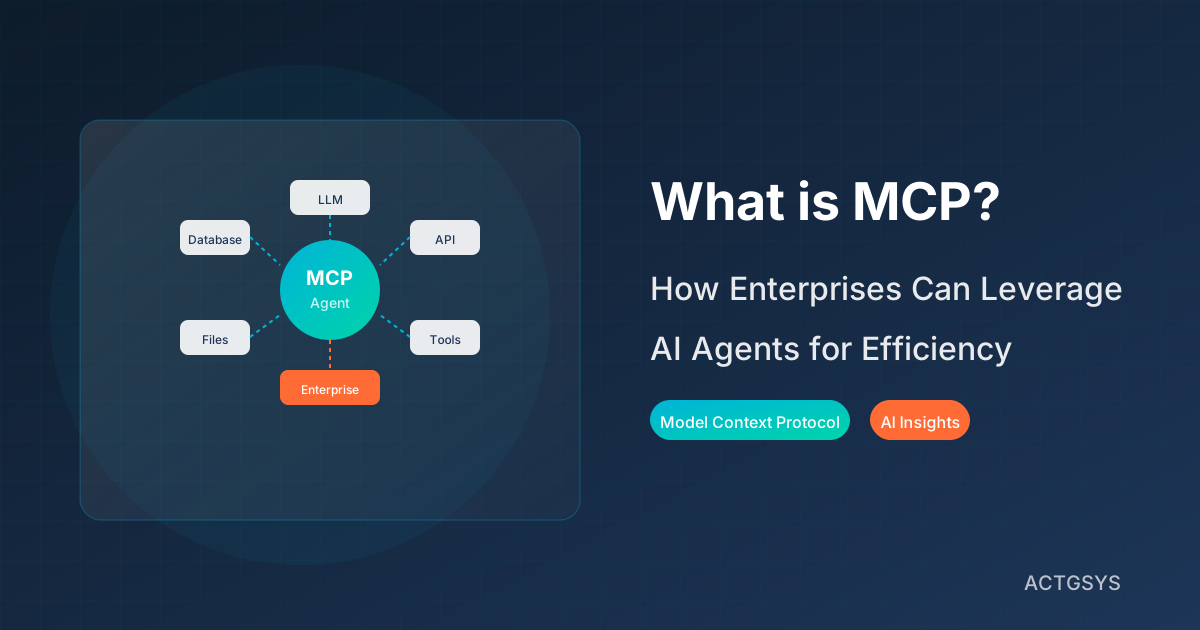
What Is MCP? Enterprise AI Agents Explained
An in-depth explanation of Model Context Protocol (MCP), and how enterprises can implement AI Agent architectures for cross-system integration, automated workflows, and intelligent decision support.
US AI Export Controls Tighten and Anthropic Briefly Pulls Fable 5 (2026): Taiwan SMEs Suddenly Lose Top-Tier Models
In June 2026 the US escalated AI model export controls: a June 2 executive order, 'Promoting Advanced Artificial Intelligence Innovation and Security,' was followed mid-month by an order requiring Anthropic to block Mythos 5 and Fable 5 for non-US nationals — briefly disabling both for all customers. Taiwan SMEs are 'non-US nationals' and were directly affected. Here's the event, the risk, and a multi-model fallback strategy.
OpenAI ChatGPT 'Lockdown Mode' Against Prompt Injection (2026): As AI Connects to the Web and Tools, How Do SMEs Protect Their Data?
Starting June 4, 2026, OpenAI rolled out Lockdown Mode and Elevated Risk labels in ChatGPT for personal and self-serve Business accounts, disabling web access, Agent Mode, connectors, and file downloads to reduce data exfiltration via prompt injection. OpenAI explicitly notes it cannot stop injected content itself. Here's the real AI-security lesson and action plan for Taiwan SMEs.
What would this cost you?
Answer five questions. Within three working days you get a price range and what it covers. No deck, no follow-up sales calls.
Prefer to talk?LINE·02-2553-8084