OpenAI ChatGPT 'Lockdown Mode' Against Prompt Injection (2026): As AI Connects to the Web and Tools, How Do SMEs Protect Their Data?
Starting June 4, 2026, OpenAI rolled out Lockdown Mode and Elevated Risk labels in ChatGPT for personal and self-serve Business accounts, disabling web access, Agent Mode, connectors, and file downloads to reduce the risk of data exfiltration via prompt injection attacks. For Taiwan SMEs, the real headline isn't "a new toggle." It's that even OpenAI now officially acknowledges prompt injection as a real security threat once AI starts connecting to the web and tools.
What Did OpenAI Announce?
Starting June 4, 2026, OpenAI began rolling out Lockdown Mode to personal ChatGPT accounts and self-serve ChatGPT Business accounts (OpenAI official announcement, 2026). It's an optional setting for people and teams who want a more conservative ChatGPT experience when working with sensitive information or connected features.
When enabled, it limits or turns off features that connect ChatGPT to the web or external services — including live web access, image support in responses, Deep Research, Agent Mode, Canvas networking, live connectors, and file downloads. These are exactly the channels a prompt-injection attack could use to "send information outside the conversation." Lockdown Mode disables these tools deterministically to shrink the attack surface.
OpenAI also introduced Elevated Risk labels to warn users in higher-risk situations. The positioning is clear: Lockdown Mode is an advanced option for a small set of highly security-conscious users, such as executives or security teams.
There's a Crucial Limitation — Make Sure You Get It
Lockdown Mode does not prevent prompt injections from appearing in the content ChatGPT processes. This is a limitation OpenAI states plainly: an injection could appear in cached web content or an uploaded file and could still affect a response's behavior or accuracy. In other words, Lockdown Mode shrinks the "exit" where data leaves — not the "entrance" where malicious instructions come in.
This honest disclosure matters — it tells SMEs there's no single switch that solves AI security. Lockdown Mode is one risk-reducing layer, not a cure-all.
What Is Prompt Injection, and Why Should SMEs Care?
Prompt injection is when an attacker hides malicious instructions in content the AI will read (web pages, emails, documents, customer messages) to make the AI behave unexpectedly — leaking confidential details from the conversation, sending data outside, or executing actions it shouldn't.
When AI is just chat Q&A, the risk is limited. But once you connect AI to company data (CRM, ERP, email, documents) and give it the ability to act autonomously (Agent Mode, connectors), prompt injection moves from theory to real threat — which is the backdrop for OpenAI launching Lockdown Mode now. For SMEs adopting AI customer service, AI reporting, or AI agents, this is not "only a big-company problem."
What Does Lockdown Mode Turn Off? Where It Protects and Where It Doesn't
The table summarizes Lockdown Mode's scope so you can judge what it can and can't do:
| Aspect | With Lockdown Mode on | Notes |
|---|---|---|
| Live web / browsing | Off | Cuts the channel sending data to external sites |
| Agent Mode / autonomous actions | Off | Lowers risk of AI being lured into auto-executing actions |
| Live connectors / file downloads | Off | Shrinks data-exfiltration exits |
| Deep Research / response images | Off | Reduces exploitable outbound channels |
| Stop injected instructions appearing | ❌ Can't | Injection may still hide in cached pages or uploads |
| Intended audience | Highly security-conscious niche | Not on by default, not for everyone |
Bottom line: Lockdown Mode is "shrink the exit" protection at the cost of web access and automation; it can't replace full data governance and access control.
What Are Developers and the Industry Saying?
The security community broadly credits OpenAI for treating prompt injection as a production threat, while cautioning against treating it as the solution.
On the upside: on Hacker News and in security circles, many see Lockdown Mode as at least making the "most dangerous outbound features" a one-click deterministic off-switch — a pragmatic layer for high-risk users. OpenAI's willingness to honestly list "what it can't do" is also seen as responsible disclosure.
On caution: security experts (e.g., an analysis from Kiteworks) note Lockdown Mode doesn't close the fundamental governance gap — it protects the "data exit," but what enterprises really need to manage is "which data can reach the AI, who can use it, and for what." Treating Lockdown Mode as the finish line for AI security is itself risky.
From a framework view, the basics of security haven't changed because of AI: least privilege, data classification, and access auditing remain core. Firms like Gartner have long argued enterprise AI should "govern data first, then open access"; Lockdown Mode is just one control within that governance, aimed at a single tool.
What Does This Mean for Taiwan's SMEs?
For Taiwan SMEs, the real signal of Lockdown Mode is: once you connect AI to company data and automation, security shifts from "nice to have" to "must have."
- Companies only using ChatGPT for Q&A: relatively low risk, but still teach employees not to paste customer PII, contracts, or financials into public AI. Enable Lockdown Mode as extra insurance when handling sensitive content.
- Companies adopting AI service / agents / connectors: this is the high-risk group. Once AI can read CRM, ERP, and email and act autonomously, prompt injection is a real threat. Design for: data classification (what may reach the AI), least privilege (AI touches only necessary data), human approval (sensitive actions need confirmation), and operation auditing (traceable records).
- Shared principle: don't treat one vendor's switch as full protection. AI security must be designed holistically — how data enters, how permissions are split, how behavior is audited — which is exactly the governance framework ACTGSYS bakes in when helping clients deploy DanLee CRM, Dinkoko ERP, and custom AI.
ACTGSYS Recommendations: What Should You Do Now?
- Define the red line for "what data must never reach public AI" — list customer PII, contracts, financials, and trade secrets as off-limits and educate everyone. (Do now)
- Enable Lockdown Mode when handling sensitive content — use it as extra insurance for high-risk situations, not a daily default. (Do now)
- Design least privilege and human approval for AI agents / connectors — give AI access only to necessary data; sensitive actions (transfers, sending, edits/deletes) always require human confirmation. (Do now)
- Establish AI operation audit logs — record what AI read and did so it's traceable afterward, meeting security and compliance needs. (Do now)
- Don't rely solely on one vendor's safety switch — make data governance, access control, and auditing a cross-platform institution. (Plan first)
Frequently Asked Questions
How do I enable ChatGPT Lockdown Mode, and is it available in Taiwan?
Yes. Lockdown Mode began rolling out on June 4, 2026, to personal ChatGPT and self-serve ChatGPT Business accounts and can be enabled in settings; it's available to Taiwan users too. It's an optional advanced security setting, not on by default.
Can Lockdown Mode fully prevent prompt injection?
No. Per OpenAI, Lockdown Mode shrinks the "exit" where data leaves (disabling web, connectors, downloads, etc.) but cannot prevent injected instructions from appearing in the content it processes — injections may hide in cached pages or uploaded files. It's one layer, not a complete solution.
What's the top security risk for SMEs adopting AI?
The top risk is data exfiltration and unauthorized actions after you connect AI to company data and automation. Core practices: data classification (what may reach the AI), least privilege, human approval for sensitive actions, and operation audit logs. A single tool's switch isn't enough — govern holistically.
Our company only uses ChatGPT to ask questions — should we worry?
Relatively low risk, but still: don't paste customer PII, contracts, or financials into public AI. Setting an internal red line for "what not to paste" and educating staff is the lowest-cost, highest-impact first step.
Conclusion
OpenAI's Lockdown Mode is an official stamp that prompt injection is a real security threat once AI connects to the web and tools. For Taiwan SMEs, it's a reminder: as you adopt AI, data governance and access control must keep pace. Lockdown Mode is a good tool, but not the finish line. When ACTGSYS helps companies deploy DanLee CRM, Dinkoko ERP, and custom AI, we build in data classification, least privilege, and operation auditing so AI can be used with confidence. Contact us to discuss further.
Event date: June 4, 2026 | Last updated: June 26, 2026
Products & Solutions in This Article
AI-powered CRM for lead management, customer tracking, and sales pipeline optimization designed for SMEs.
AI-driven ERP focusing on procurement, inventory, and supply chain management. Each customer deployed on dedicated cloud infrastructure.
Related Articles
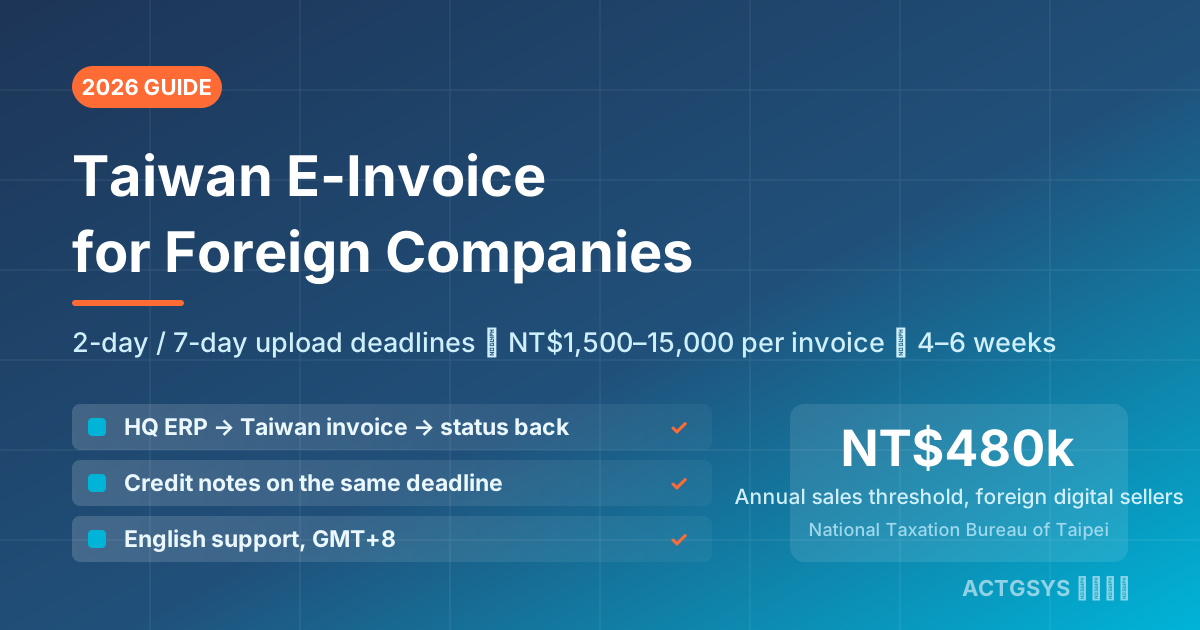
Taiwan E-Invoice for Foreign Companies 2026 - Cost
How a foreign-owned Taiwan subsidiary or branch connects its ERP to Taiwan's e-invoice platform: 2-day B2C / 7-day B2B upload deadlines, NT$1,500–15,000 per-invoice penalties, three integration paths, and a 4–6 week project from NT$50,000.
Anthropic Agent Skills as an Open Standard + Enterprise-Managed MCP Auth (2026): Wiring Claude into Stripe, Zapier, and Figma
In June 2026 Anthropic turned Agent Skills into an open standard, launching with 10 partners (including Atlassian, Figma, Canva, Stripe, Zapier), and on June 18 shipped Enterprise-Managed Authorization (EMA) for MCP connectors so IT admins can provision connectors org-wide via Okta. Here's what it means for 'wiring AI into your existing tools' and how Taiwan SMEs should adopt it.
US AI Export Controls Tighten and Anthropic Briefly Pulls Fable 5 (2026): Taiwan SMEs Suddenly Lose Top-Tier Models
In June 2026 the US escalated AI model export controls: a June 2 executive order, 'Promoting Advanced Artificial Intelligence Innovation and Security,' was followed mid-month by an order requiring Anthropic to block Mythos 5 and Fable 5 for non-US nationals — briefly disabling both for all customers. Taiwan SMEs are 'non-US nationals' and were directly affected. Here's the event, the risk, and a multi-model fallback strategy.
What would this cost you?
Answer five questions. Within three working days you get a price range and what it covers. No deck, no follow-up sales calls.
Prefer to talk?LINE·02-2553-8084