AI Agent Marketplaces: No-Code AI for SMEs (2026)
"I know AI matters, but we don't have engineers on staff and we certainly can't afford to build a custom AI system from scratch." In 2026, this remains the most common refrain from small and medium enterprise (SME) owners across Asia-Pacific. Surveys show that over 78% of SMEs consider AI critical to future competitiveness, yet fewer than 15% have actually deployed it. The problem was never about willingness — it was about accessibility.
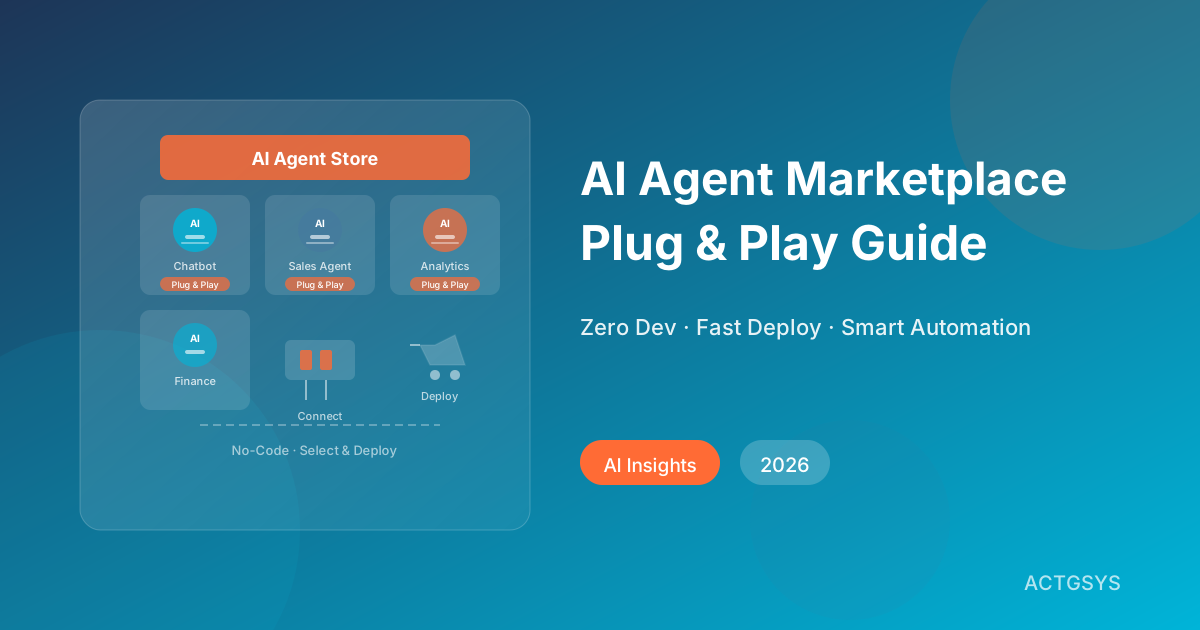
AI Agent marketplaces are the breakthrough that closes this gap. Think of them as an App Store for business AI: instead of hiring a development team and waiting months for a bespoke solution, companies can browse, subscribe, and activate purpose-built AI agents that handle specific business functions right out of the box. No coding required.
What Is an AI Agent Marketplace? Redefining How Businesses Adopt AI
An AI Agent marketplace is an online platform that aggregates pre-built AI agents, each designed for a specific business function — customer service automation, sales lead scoring, financial report analysis, supply chain forecasting, document processing, and more.
What distinguishes this model from traditional AI adoption:
- Zero development barrier: No data scientists or AI engineers needed. Setup and deployment happen through visual interfaces and guided workflows.
- Subscription-based pricing: From free trials to monthly plans of a few hundred dollars, businesses can scale on demand instead of committing six-figure budgets upfront.
- Rapid time-to-value: While custom AI development typically takes 3-6 months, marketplace agents can be live in hours or days.
- Continuous automatic updates: The platform vendor handles model iterations, security patches, and performance improvements — eliminating technical debt for the customer.
In essence, AI Agent marketplaces reduce the cost of AI adoption from a "million-dollar project" to a "monthly subscription" and compress timelines from "half a year of development" to "same-day deployment."
Four Forces Driving the AI Agent Marketplace Explosion in 2026
Why is 2026 the tipping point? Four converging trends are accelerating this market:
1. Exponential Growth in Enterprise AI Agent Demand
Gartner reported a staggering 1,445% surge in enterprise inquiries about multi-agent systems between 2024 and 2025. This is not just conceptual curiosity — organizations are actively evaluating deployment plans. Deloitte projects that by 2027, 25% of enterprises using generative AI will have launched Agentic AI pilot projects.
2. Tech Giants Going All-In
Salesforce launched Agentforce, enabling businesses to deploy AI agents directly within the CRM ecosystem. Google released Vertex AI Agent Builder and Agentspace, integrating AI agents into search and enterprise toolchains. Microsoft Copilot Studio lets organizations build custom agents within the Office 365 environment. When infrastructure players of this magnitude commit, the foundation is set for mass adoption.
3. Custom Development Remains Prohibitively Expensive
A moderately complex custom AI agent still costs between USD $25,000 and $100,000 to develop, takes 3-8 months to build, and requires 20-30% of the initial cost in annual maintenance. For an SME generating under $2 million in annual revenue, this risk-to-reward ratio simply does not work. Marketplace platforms reduce the initial cost by 90% or more.
4. SME Digital Transformation Is No Longer Optional
Post-pandemic competitive pressure, persistent labor shortages, and rising customer expectations have turned digital transformation from a "nice-to-have" into a survival imperative. AI Agent marketplaces offer the lowest technical barrier and the shortest adoption timeline — making AI accessible to businesses with limited resources.
Comparing the Leading AI Agent Marketplace Platforms
Here are the five platforms that SMEs most commonly evaluate in 2026:
| Criteria | Salesforce Agentforce | Microsoft Copilot Studio | Google Vertex AI Agent Builder | Open Source (LangChain / CrewAI) | TanJee (ACTGSYS) |
|---|---|---|---|---|---|
| Monthly Cost | From USD $50/user | From USD $30/user | Usage-based pricing | Free (self-hosted) | Flexible plans, contact for quote |
| Ease of Use | Moderate (requires Salesforce familiarity) | Low (Office 365 users adapt quickly) | Moderate-High (cloud knowledge needed) | High (engineering skills required) | Low (Chinese UI, guided onboarding) |
| Customization | High (Apex + Flow) | Medium (Power Automate integration) | High (code + no-code) | Very High (full code control) | High (supports secondary development) |
| Chinese Language Support | Partial | Good | Good | Model-dependent | Native Traditional Chinese, deep localization |
| Local Integration | Limited | Limited | Limited | Requires custom development | LINE, e-invoicing, local payment gateways |
| Best For | Mid-to-large enterprises already on Salesforce | Businesses in the Microsoft ecosystem | Companies with mature technical teams | Startups with engineering talent | SMEs in Taiwan and the Asia-Pacific region |
Key insight: International platforms excel in feature depth and ecosystem breadth. However, for Chinese-language comprehension, local system integration (LINE Official Accounts, e-invoicing, regional payment and logistics providers), and hands-on customer support, localized solutions like TanJee deliver a significantly better fit for SMEs in the region.
5 Evaluation Criteria for SMEs Selecting an AI Agent
With so many options available, how should an SME make the right choice? Here are five criteria distilled from our experience working with over a hundred businesses:
Criterion 1: Define the Problem Before Choosing the Tool
The most common failure pattern is buying an AI tool first and then figuring out what to do with it. The correct approach: audit your most time-consuming, most repetitive, and most error-prone workflows (such as customer inquiries, order processing, or report compilation) — then look for an agent that addresses that specific pain point.
Criterion 2: Evaluate Integration Capabilities
An AI Agent does not operate in isolation. It needs to connect with your existing systems. Key questions: Does it support API integration with your ERP or CRM? Can it connect to LINE Official Accounts or e-commerce platforms? Is data synchronization bidirectional, or only one-way import?
Criterion 3: Calculate True Total Cost of Ownership (TCO)
The monthly subscription fee is just the tip of the iceberg. Factor in: initial setup and data migration costs, employee training time, ongoing customization adjustments, and price increases when you scale. A plan that appears cheap at first glance may cost more over three years than a seemingly expensive alternative.
Criterion 4: Verify Data Security and Compliance
AI agents will access your core business data. Confirm: Where is data stored, and does it comply with local data protection regulations? Is data encrypted both in transit and at rest? Does the vendor offer a formal Data Processing Agreement (DPA)? Are access controls granular enough for your needs?
Criterion 5: Always Trial Before You Commit
Quality platforms offer 14-30 day free trials. Use this window for a small-scale proof of concept (PoC): test with real business data, involve frontline users in the evaluation, and measure concrete metrics — time saved, error rates reduced, customer satisfaction changes. User feedback from the trial is worth more than any spec sheet.
Three Success Stories: Zero-Development AI Agent Deployments
Case 1: E-commerce Brand — Customer Service Agent Cuts Staffing by 60%
A local e-commerce brand generating roughly USD $2.5 million in annual revenue had a five-person customer service team handling LINE and website inquiries around the clock. After deploying an AI customer service agent, 80% of common questions were resolved automatically, average response time dropped from 45 minutes to near-instant, and the team was streamlined from five to two people handling only complex cases. Monthly labor savings: approximately USD $5,800. Deployment time: 3 days.
Case 2: Manufacturer — Quality Inspection Agent Reduces Defect Rate by 40%
A precision parts manufacturer struggling with elevated defect rates subscribed to a visual inspection AI agent through a marketplace platform. The agent connected to existing production-line cameras and provided real-time defect detection. Within two weeks, the defect rate fell from 3.2% to 1.9%, saving roughly USD $8,000 per month in scrap and rework costs. The entire deployment required zero custom code.
Case 3: Accounting Firm — Document Processing Agent Triples Throughput
A mid-sized accounting firm faced a crushing workload every tax season — mountains of invoices and receipts to sort, classify, and enter. After adopting a document processing AI agent, the system automatically recognized invoice contents, categorized records, and generated draft reports. What previously required three assistants working for two weeks now takes one assistant with the AI agent just four days.
How TanJee Helps SMEs Rapidly Deploy AI Agents
TanJee is ACTGSYS's AI Agent platform purpose-built for SMEs in Taiwan and the broader Asia-Pacific market. Its core philosophy: "Give businesses without engineers the same AI capabilities as enterprises with large technical teams."
Key advantages of TanJee include:
- Native Traditional Chinese design: From the user interface to the underlying AI models, everything is optimized for Traditional Chinese business contexts, terminology, and communication styles.
- Deep local integration: Out-of-the-box support for LINE Official Accounts, popular regional e-commerce platforms, electronic invoicing systems, and local payment gateways.
- Consultative onboarding: ACTGSYS does not just sell software. The team provides end-to-end guidance — from process diagnosis and agent selection through go-live support and optimization.
- Flexible pricing: Tiered plans based on company size and usage volume, with entry-level options accessible even to micro-businesses.
Whether you are evaluating your very first AI project or you have tried international platforms but hit a wall with Chinese-language performance and local integrations, TanJee belongs on your shortlist.
Frequently Asked Questions
Q1: How is an AI Agent marketplace different from ChatGPT?
ChatGPT is a general-purpose conversational AI. Agents on a marketplace are specialized tools designed for specific business workflows. They do not just chat — they connect to your systems, read your data, and autonomously execute tasks such as sending notifications, updating inventory, or generating reports. Think of ChatGPT as a brilliant generalist; an AI agent is a trained specialist with hands-on access to your business tools.
Q2: How long does it take to deploy an AI Agent from a marketplace?
It depends on complexity. Simple scenarios (like FAQ auto-response) can go live in 1-3 days. Moderate complexity (such as full customer service workflow automation) typically takes 1-2 weeks. Complex multi-system integrations may require 4-8 weeks. All of these timelines are dramatically shorter than the 3-8 months typical of traditional custom development.
Q3: Will the AI platform use my business data to train its models?
This is one of the top concerns for businesses. Reputable platforms — including TanJee — explicitly commit to not using customer data to train general-purpose models. When evaluating platforms, always review their data processing policies and request a formal Data Processing Agreement (DPA) before signing.
Q4: What happens if the AI Agent makes a mistake or a wrong decision?
Mature AI Agent platforms are designed with human-in-the-loop mechanisms: agents automatically escalate to a human when confidence is below a set threshold; all actions are logged for full auditability; and critical operations (such as financial transactions or order cancellations) can be configured to require human approval before execution. We recommend starting in "AI assists, human decides" mode and gradually increasing agent autonomy as trust and performance data accumulate.
Conclusion: Now Is the Best Time for SMEs to Embrace AI Agents
The AI Agent marketplace has matured to the point where it genuinely serves small and medium businesses. Technical barriers are lower than ever, adoption costs have dropped by an order of magnitude, and proven success stories continue to accumulate. The reasons to wait are disappearing one by one — while your competitors may already be moving.
You do not need to be an AI expert. You do not need a million-dollar budget. What you need is the right platform, the right partner, and the willingness to start small — validate with one use case, see measurable results, and then scale from there.
Ready to deploy your first AI Agent? Contact the ACTGSYS team today and let us guide you from needs assessment through go-live — taking the first step on your AI transformation journey.
Products & Solutions in This Article
Related Articles
WhatsApp AI Chatbot Guide for SMEs (2026)
WhatsApp has 3.3 billion users and 98% open rates. Meta's 2026 AI policy changes the rules. Learn how SMEs can use WhatsApp AI chatbots to boost customer communication and achieve 28% lead conversion.
AI Agents Enterprise Transformation 2026
Deep dive into how AI Agents are reshaping enterprise operations in 2026, covering multi-agent systems, CRM/ERP integration, and customer service automation for SMEs.
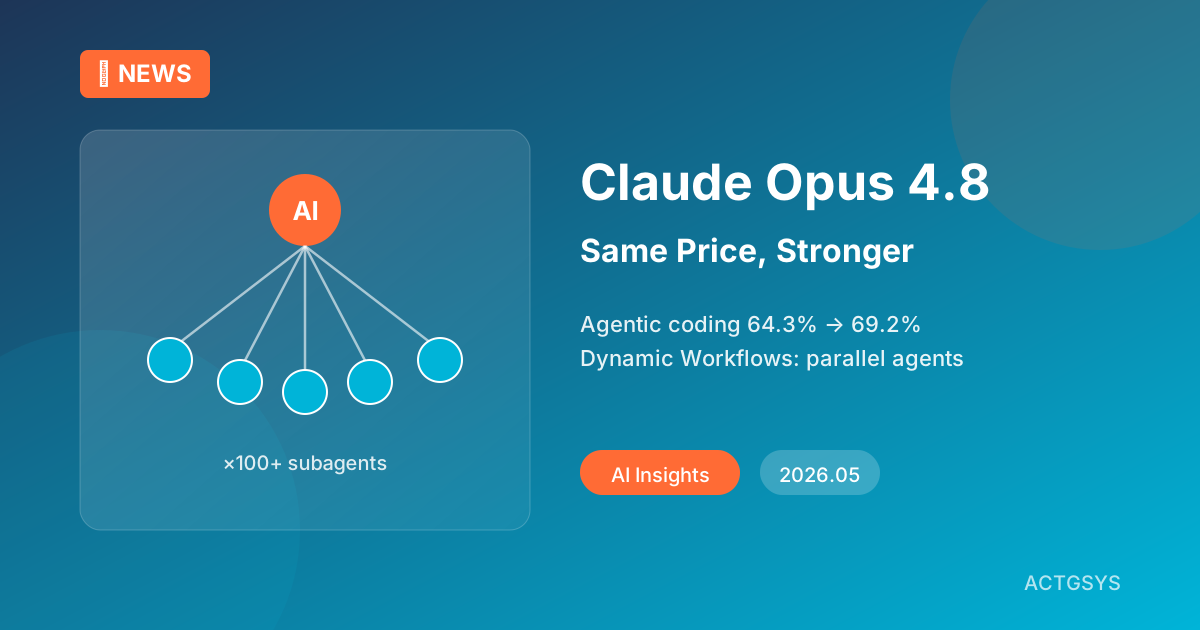
Anthropic Claude Opus 4.8 (2026): Same Price, Stronger
On May 28, 2026, Anthropic launched Claude Opus 4.8, holding the same $5 / $25 per 1M token pricing as its predecessor while lifting agentic coding from 64.3% to 69.2% and adding Dynamic Workflows — a research preview that orchestrates hundreds of parallel subagents. We unpack what this upgrade means for Taiwan SME automation.
What would this cost you?
Answer five questions. Within three working days you get a price range and what it covers. No deck, no follow-up sales calls.
Prefer to talk?LINE·02-2553-8084